The First October Cold Snap: A Critical Test for Denver Heating Systems
You turn on your thermostat during the first October cold snap, and instead of a steady flow of warm air, you are met with a lukewarm breeze and a strange rattling sound from the basement. When your heating system struggles early in the season, getting those common homeowner questions answered quickly becomes a top priority. Is the unit actually broken? And more importantly, if it needs a major repair, will your manufacturer warranty step in to cover the costs?
Many homeowners assume that once they register their new furnace or heat pump, they are fully protected for the next decade. However, that sense of security often shatters when a mid-winter breakdown occurs and the manufacturer asks for proof of maintenance. You are suddenly faced with a frustrating decision point: risk a denied warranty claim that could cost thousands out of pocket, or ensure your system has a compliant, documented annual check before the heavy winter weather arrives.
Modern heating systems are incredibly efficient, but they are also highly complex machines that require professional oversight to maintain valid warranty status. The days of simply swapping out a filter and calling it a tune-up are long gone. Manufacturers have strict guidelines for what constitutes proper care, and they heavily scrutinize claims for major components like heat exchangers and compressor motors. Understanding exactly what is required to keep your warranty active is the single best way to protect your home and your wallet this season.
The Fine Print: Does Skipping Maintenance Actually Void Your Warranty?
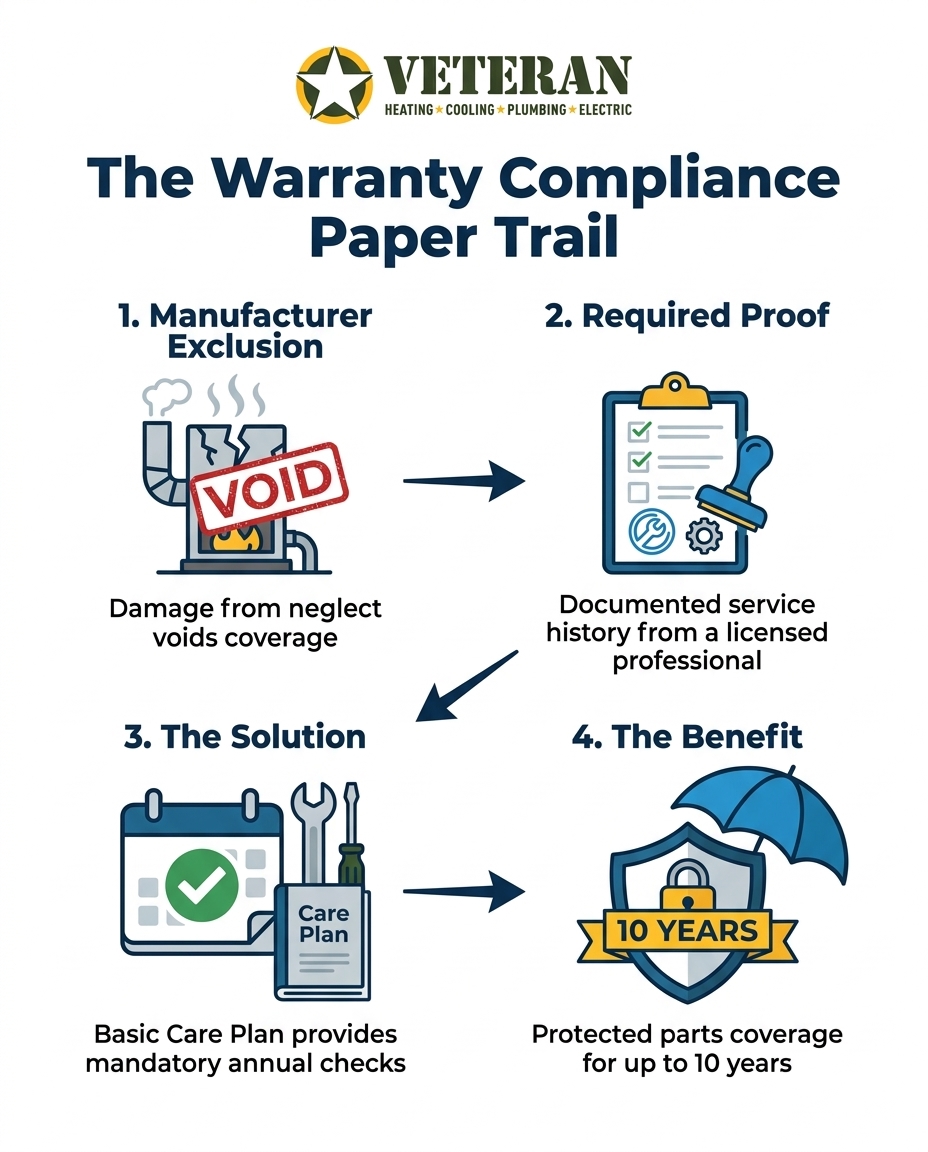
The short answer is yes. Failing to perform and document annual maintenance can absolutely void your manufacturer warranty. While every brand has its own specific terms and conditions, the underlying rule across the HVAC industry remains the same: damage resulting from neglect is strictly excluded from coverage.
As a Midea Elite dealer, we know firsthand exactly how strict manufacturers can be when it comes to parts replacement. When a critical component fails and we submit a warranty claim on your behalf, the manufacturer does not simply ship a new part no questions asked. They require diagnostics, and in many cases, they require a documented service history proving that the system was properly cared for leading up to the failure. If a blower motor burns out prematurely because a system was running with extreme static pressure from years of neglect, the manufacturer will likely classify that as a preventable failure and deny the claim.
Most homeowners do not realize there is a massive difference between having a registered warranty and maintaining an active warranty. Registering your equipment typically extends your parts coverage from five years to ten years. However, keeping that ten-year coverage valid requires you to uphold your end of the agreement through regular, professional maintenance.
• Parts Coverage — Common Homeowner Assumption: All broken parts are replaced for free for 10 years. — The Reality in the Fine Print: Only parts that fail due to factory defects are covered. Failures from neglect are excluded.
• Labor Costs — Common Homeowner Assumption: The manufacturer pays the technician to install the warranty part. — The Reality in the Fine Print: Standard warranties almost never cover labor. You are responsible for the labor costs unless you have a separate labor guarantee.
• Maintenance Proof — Common Homeowner Assumption: Changing the air filter every few months is enough. — The Reality in the Fine Print: Manufacturers require a documented history of professional, comprehensive tune-ups.
When you skip your fall heating maintenance, you are essentially gambling with your coverage. A minor issue that could have been caught and corrected during a routine inspection can quickly snowball into a catastrophic failure, leaving you completely unprotected when you need your warranty the most.
Why the 'Paper Trail' is Mandatory for Warranty Claims
When a manufacturer reviews a warranty claim, they operate entirely on documentation. They cannot see your furnace, and they do not know how well you take care of your home. The only thing that proves your system was maintained is a formal paper trail. A documented service history from a licensed professional is typically required to process any significant part failure claim.
Many homeowners take great pride in maintaining their homes, diligently changing their own air filters and keeping the area around their outdoor units clear of debris. While these DIY efforts are incredibly helpful for system airflow and efficiency, they do not satisfy a manufacturer's requirement for professional maintenance. A manufacturer needs to see that a qualified technician measured electrical amp draws, tested safety limits, and verified gas combustion ratios. Without an official invoice detailing these technical checks, the manufacturer will view the system as unmaintained.
As a veteran-owned and operated team, we apply strict military discipline to our maintenance documentation. In the military, accountability is everything—if a procedure isn't thoroughly documented, it didn't happen. We bring that exact same standard of rigorous record-keeping to your home. When our technicians perform a heating tune-up, they meticulously log every diagnostic reading, safety check, and adjustment made to your system.
This disciplined approach ensures that absolutely no details are missed. More importantly, it guarantees that you have a flawless, airtight paper trail ready to go if a breakdown ever occurs. If a manufacturer asks for proof of maintenance, we can immediately provide them with a comprehensive, professional history that proves you are fully compliant with their warranty terms, protecting your investment without any back-and-forth hassle.
How Denver's Unique Climate Accelerates System Wear
The rules surrounding manufacturer warranties aren't just arbitrary corporate policies; they exist because environmental factors take a massive mechanical toll on HVAC equipment. Here in the Denver metro area, our unique climate places extreme stress on heating systems, making routine maintenance far more critical than it might be in milder, more humid parts of the country.
Denver's high altitude and notoriously dry air create a challenging environment for mechanical components. The lack of humidity can cause the specialized lubricants inside blower motors and inducer fans to dry out much faster than normal. When these motors lose their lubrication, they experience higher friction, which causes them to draw more electricity and run hotter. Over time, this excessive heat leads to premature motor failure. Furthermore, the thinner air at our altitude means that gas furnaces must be precisely tuned to ensure proper combustion. If the gas-to-air ratio drifts out of alignment, the system will produce excessive soot, which insulates the heat exchanger and forces the furnace to work significantly harder to warm your home.
Beyond altitude and aridity, our rapid temperature swings are brutal on heating equipment. It is not uncommon for a Denver fall day to reach a comfortable 70 degrees in the afternoon, only to plummet well below freezing overnight. This constant, extreme cycling forces metal components—particularly the heat exchanger—to expand and contract violently. Over multiple seasons, this thermal stress can expose vulnerabilities in neglected units, leading to microscopic cracks that leak dangerous carbon monoxide into the home.
Sudden home system failures are always stressful, regardless of the equipment involved. For example, one Denver metro homeowner recently reached out to us in the spring with multiple issues with their kitchen sink requiring immediate repair. Our technician arrived promptly, provided a reasonable quote, picked up the necessary replacement parts, and completely resolved the kitchen plumbing issues with no surprise pricing. While that was a plumbing repair, the exact same principle of sudden, unexpected failure applies to a stressed furnace. A system pushed to its limits by extreme climate factors will eventually break down. Manufacturers are well aware of how hard systems work in extreme climate zones, and they are significantly less likely to forgive a lack of maintenance when they know the environment itself is accelerating the wear and tear.
Securing Your Coverage with the Basic Care Plan
Knowing that you need a flawless paper trail is one thing, but actually remembering to schedule your maintenance every single year before the cold weather hits is another challenge entirely. Life gets busy, and HVAC maintenance easily slips down the to-do list until a problem forces it to the top. This is exactly why we created the Basic Care maintenance plan—to provide a structured, stress-free way to guarantee the required documentation for your warranty claims.
The Basic Care plan includes the mandatory annual heating check necessary to keep your coverage intact before winter arrives. By enrolling, you take the guesswork out of warranty compliance. Our team tracks your service history, ensures your tune-ups happen on schedule, and maintains the exact records that manufacturers demand. Because the written warranty explicitly excludes damage related to a lack of maintenance, this plan serves as a direct protective measure for your investment.
Beyond just satisfying the fine print, the plan offers tangible, immediate benefits when the weather turns harsh. Members receive priority scheduling, which means you are scheduled ahead of non-members during busy cold snaps. When the first major freeze of the year hits and our phones are ringing off the hook with emergency no-heat calls, Basic Care members jump to the front of the line. It is the ultimate peace of mind, ensuring that your system is not only protected on paper but also prioritized in practice.
What a Warranty-Compliant Heating Inspection Looks Like
A true, warranty-compliant heating inspection goes far beyond wiping down the cabinet and swapping out a one-inch filter. To build the authority and documentation that manufacturers require, a licensed technician must perform a deep, technical evaluation of the system's electrical, mechanical, and safety components. These precise technical checks are exactly what manufacturers look for in service records when deciding whether to approve or deny a major claim.
During an annual visit, our technicians methodically test the components that are most likely to fail under stress. We measure the electrical amp draws of all motors to ensure they are operating within the manufacturer's specified range. If a motor is pulling too many amps, it is a clear sign that it is struggling and on the verge of burning out. We also test capacitors, inspect wiring harnesses for signs of thermal damage, and verify that all safety limits are functioning properly.
Furnace Safety and Performance Checks
For homes relying on natural gas furnaces, safety is the absolute top priority during a maintenance visit. Our technicians perform rigorous checks that directly impact both the lifespan of the unit and the safety of your family:
• Burner alignment and ignition testing: We ensure that the burners are firing cleanly and evenly. Delayed ignition can cause small, repeated gas explosions inside the combustion chamber, which severely damages the equipment over time.
• Heat exchanger inspection: We visually inspect the heat exchanger for any signs of metal fatigue, rust, or cracking. A compromised heat exchanger is a massive safety hazard.
• Carbon monoxide risk mitigation: We test the drafting system and the flue pipe to guarantee that all dangerous combustion gases are being safely vented out of the home, rather than leaking into your living space.
Heat Pump System Verification
Heat pumps require a different set of technical checks, as they operate continuously year-round for both heating and cooling. Preparing a heat pump for a Denver winter involves specific performance verifications:
• Defrost cycle testing for winter readiness: We force the heat pump into its defrost mode to ensure the control board and sensors are working correctly. If the defrost cycle fails during a snowstorm, the outdoor unit will become encased in solid ice, completely halting the heating process.
• Refrigerant level verification: Even a slight drop in refrigerant charge can drastically reduce a heat pump's ability to extract heat from cold outdoor air.
• Communication checks: We also verify how indoor and outdoor units are connected to ensure seamless communication between the thermostat, the indoor air handler, and the outdoor compressor. If these components cannot communicate effectively, the system will short-cycle or fail to stage properly.
Frequently Asked Questions About HVAC Warranties and Maintenance
Navigating the rules of home warranties can be confusing. To help clarify the process, we have compiled the most common questions we receive from Denver homeowners regarding their HVAC coverage and maintenance obligations.
Does lack of maintenance void my furnace warranty?
Yes, failing to perform and document annual maintenance can void your manufacturer warranty. Most major HVAC brands explicitly state in their terms and conditions that damage resulting from neglect is excluded from coverage. If a part fails and the manufacturer determines that routine cleaning and professional inspections would have prevented the failure, they reserve the right to deny the claim entirely.
What documentation is needed for an HVAC warranty claim?
Manufacturers typically require a detailed service invoice from a licensed HVAC professional. This documentation must show the date of service, the specific diagnostic checks performed, and proof that the system was operating within safe parameters prior to the breakdown. DIY filter receipts or handwritten notes are not accepted as valid proof of maintenance by manufacturer warranty departments.
How often do I need to schedule heating maintenance in Denver?
You should schedule professional heating maintenance once a year, ideally in the fall before the first major cold snap hits. Because Denver experiences extreme temperature fluctuations, high altitude, and very dry air, your heating system works incredibly hard and requires annual calibration. Annual checks ensure your system remains warranty-compliant and is prepared for the heavy winter workload.
What does a manufacturer warranty actually cover versus exclude?
A standard manufacturer warranty covers the cost of replacement parts that fail due to factory defects or premature mechanical breakdown. It explicitly excludes failures caused by a lack of maintenance, improper installation, physical damage (like hail or falling branches), and normal wear-and-tear items like air filters. It is designed to protect you from bad parts, not from the consequences of neglecting the system.
Will my warranty cover labor costs for a broken heating part?
In almost all cases, a standard manufacturer warranty does not cover labor costs. The manufacturer will provide the replacement part (such as a new blower motor or control board) for free, but you are responsible for paying the HVAC contractor for the time and expertise required to diagnose the issue and install the new component. Some dealers offer separate labor warranties, but these are distinct from the manufacturer's parts warranty.
How do I prove my system was maintained if I just bought the house?
If you recently purchased a home, you should ask the previous owner for all HVAC service records during the closing process. If those records are unavailable, you should immediately schedule a comprehensive inspection with a licensed professional to establish a new baseline of care. While you cannot prove past maintenance, having a current, documented inspection shows the manufacturer that you are actively maintaining the system going forward.
Protect Your Investment Before Winter Hits
Having a clear, authoritative understanding of how manufacturer warranties actually work saves you money, frustration, and stress when the unexpected happens. Your heating system is one of the most expensive investments in your home, and protecting that investment requires more than just hoping for the best. It requires consistent, documented professional care.
Do not wait until your furnace starts making strange noises in the middle of a blizzard to find out if your warranty is still valid. Reiterate the importance of acting before the deep winter cold sets in and pushes your equipment to its absolute limits. Reach out to our veteran-led team today to schedule your annual heating check. We will ensure your system is operating safely, secure your required paper trail, and provide the meticulous specific checks required to keep your coverage intact all season long.
ABOUT Veteran Heating, Cooling, Plumbing & Electric
Veteran Heating, Cooling, Plumbing & Electric was founded on the belief that service should be personal, honest, and community-focused. Our team is built around integrity, professionalism, and a true commitment to your home’s comfort and safety.
Led by a U.S. Army veteran with over 30 years of industry experience, we’re proud to remain locally owned and operated. Every technician, plumber, and electrician is EPA-certified, background checked, and driven to exceed expectations.
- 24/7 ServiceWe offer weekend & 24/7 emergency service. We’re here whenever you need us—day, night, or weekend, no exceptions.
- $0 Trip FeesNo dispatch or trip fees. You’ll never pay just for us to show up—service starts when the work does.
OUR SERVICES
AIR CONDITIONING
.jpg)
We offer specialty and seasonal services like indoor air quality upgrades, pre-winter furnace checks, and summer AC tune-ups to keep your home prepared year-round.
Our Primary Air Conditioning Services Include:
Don't see the service you need? Call our Team today!
PLUMBING
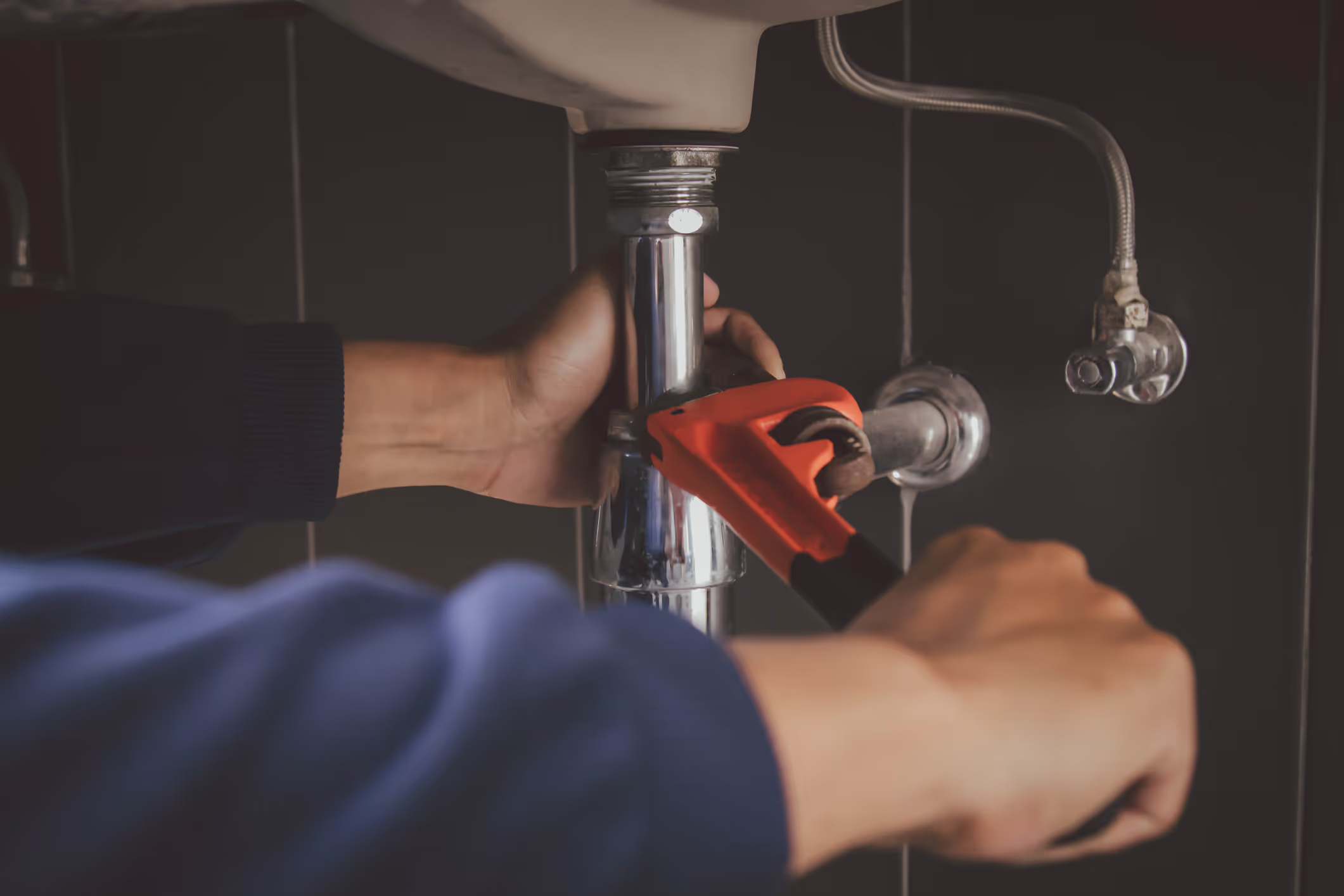
From leaks to full system installs, our plumbing services cover everything you need for a safe, reliable home water system, 24/7.
Our Primary Plumbing Include:
- Water Heater Replacement
- Water Heater Repair
- Trenchless Sewer Line
- Water Filtration
- Slab Leak
- Sewer Line Repair
Don't see the service you need? Call our Team today!
ELECTRICAL

Our electrical services ensure your home stays safe and powered, from routine fixes to complete system upgrades.
Our Primary Electrical Services Include:
- House Rewiring
- Electrician
- Electric Panel Upgrade
- Electric Panel Replacement
- EV Chargers
- Whole House Generator
Don't see the service you need? Call our Team today!
HEATING
.jpg)
We install, repair, and maintain heating & furnace systems with expert care to keep your Colorado home comfortable and energy-efficient year-round.
Our Primary Heating Services Include:
- Heating Installation
- Heating Replacement
- Heating Maintenance
- Heating Repair
- Heating Service
- Heating Tune-Up
Don't see the service you need? Call our Team today!