How the Indoor and Outdoor Units Are Connected: A Complete Guide
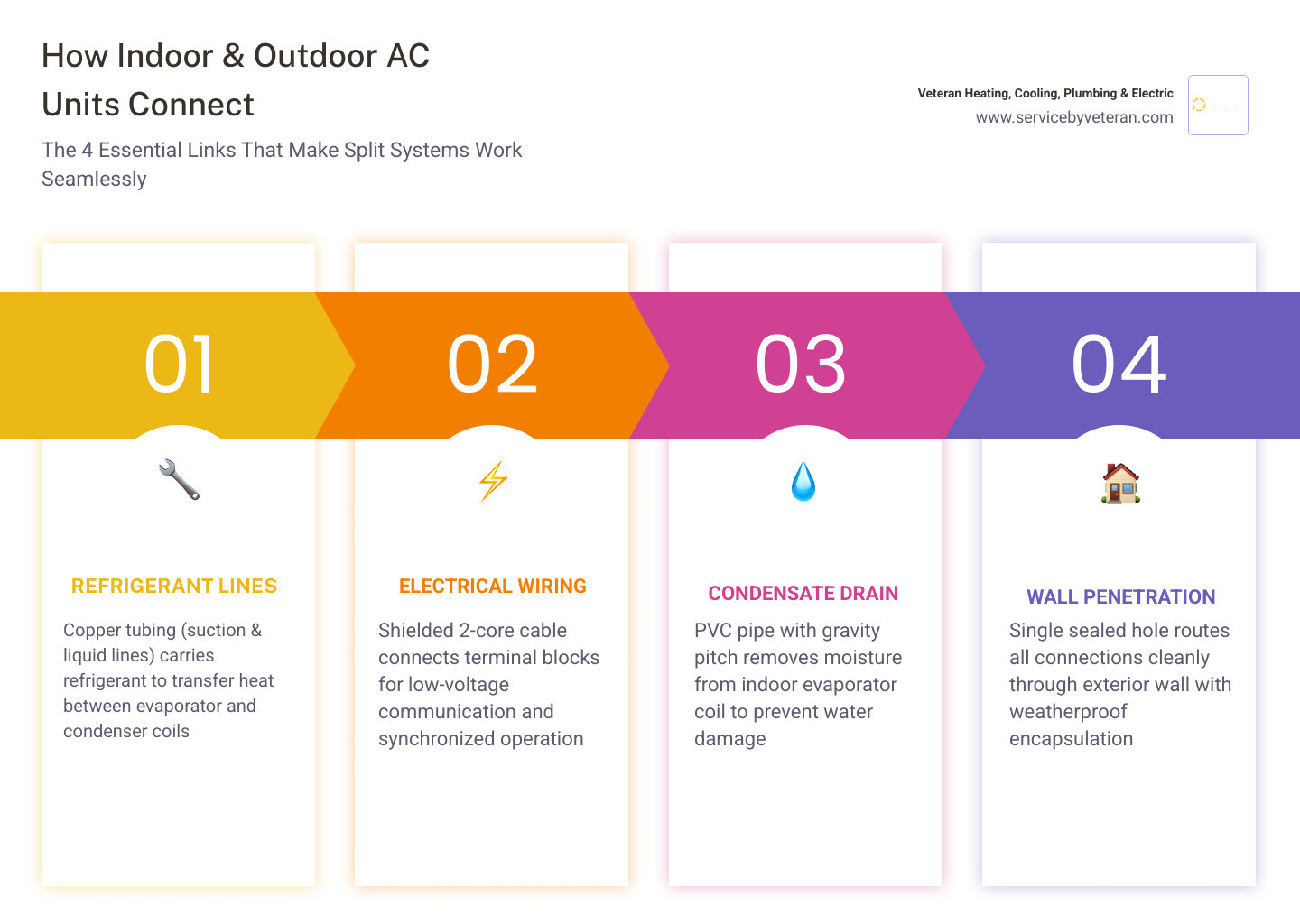
How the indoor and outdoor units are connected is simpler than most homeowners think. Here is a quick breakdown:
• Refrigerant lines - Copper tubing (a line set) carries refrigerant between the two units to move heat in or out of your home
• Electrical wiring - A shielded 2-core communication cable links the indoor and outdoor terminal blocks so the units can talk to each other
• Condensate drain line - A PVC pipe removes moisture collected by the indoor evaporator coil
• Wall penetration - All three connections pass through a single drilled hole in the wall, usually sealed and encapsulated for a clean finish
These three connections are what make a split system work as one unified system, even though the components sit in two completely different locations.
Most homeowners in Golden, CO and across the Denver Metro area never think about these connections until something goes wrong. A refrigerant leak, a loose terminal wire, or a poorly pitched drain line can bring the whole system down, often at the worst possible time. Understanding what connects your indoor and outdoor units helps you ask the right questions and catch problems before they become expensive ones.
I am Mike Townsend, a U.S. Army veteran whose military career included managing precision cooling systems for heat-seeking missile heads, giving me technical insight into exactly how the indoor and outdoor units are connected and why every detail matters. That same level of precision is what I bring to every installation and service call we run across the Denver Metro area.
When we arrive at a home for a Mini Split AC Arvada CO installation, the first thing we do is map out the "umbilical cord" of the system. In a split system, the indoor unit (the evaporator) and the outdoor unit (the condenser) are physically separated, but they must function as a single heart.
The connection process involves three primary systems: refrigerant piping, electrical wiring, and condensate drainage. These components are bundled together and routed through a small hole—usually about three inches in diameter—drilled through the exterior wall. To keep things looking sharp and to protect the lines from Colorado’s intense sun and snow, we use "trunking." This is a durable, weather-resistant cover (often color-matched to your home’s siding) that encapsulates the services, ensuring they don't just hang loosely off the side of your house.
The connection types include:
• Suction and Liquid Lines: The "arteries" of the system.
• Communication Cable: The "nervous system."
• Power Supply: The "energy source."
• Drainage Pipe: The "waste system."
How the indoor and outdoor units are connected via refrigerant line sets
The most critical physical link is the refrigerant line set. This consists of two copper tubes: a smaller "liquid line" and a larger "suction line." These tubes are responsible for transporting the refrigerant that absorbs heat from your living room and dumps it outside.
In a Mini Split AC Denver CO setup, these lines are often pre-charged and available in lengths ranging from 15 to 100 feet. We use specialized flaring tools to create precision connections at the service valves. Because refrigerant is under high pressure, these joints must be perfect. We also ensure the lines are wrapped in high-quality, closed-cell insulation. This prevents the pipes from sweating (which causes water damage) and ensures the refrigerant stays at the right temperature, maximizing efficiency.
One "pro tip" we follow is ensuring proper oil return. The compressor in your outdoor unit needs oil for lubrication. If the piping is routed incorrectly—say, with too many sharp rises without proper traps—the oil can get stuck in the indoor unit, eventually "starving" the compressor and causing a total system failure.
How the indoor and outdoor units are connected for electrical communication
If the refrigerant lines are the arteries, the electrical wiring is the brain. In modern systems, particularly for a Mini Split AC Broomfield CO project, we use a shielded 2-core or 4-core communication cable.
This cable connects the terminal block of the indoor unit directly to the outdoor unit. It allows the thermostat to tell the outdoor compressor exactly how hard to work. Many systems also require a specific low-voltage wire for the automatic defrost function. This is vital for Colorado winters; it prevents the outdoor unit from turning into a giant block of ice when it's in heating mode.
Safety is our top priority, so we always install a dedicated isolator switch near the outdoor unit. This allows a technician to safely cut power to the system during maintenance without having to run back and forth to the main breaker panel.
Managing Condensate Drainage and Wall Penetrations
As your AC cools the air, it also removes humidity. That moisture turns into liquid water on the evaporator coil. If that water isn't managed, it will end up on your floor or inside your walls. This is where the condensate drain line comes in.
For a Mini Split AC Centennial CO installation, we typically use PVC piping or specialized flexible drain hose. The most important rule of drainage is the "gravity pitch." The pipe must slope downward at a steady angle toward the exit point. If the layout of your home doesn't allow for a natural downward slope, we install a small condensate pump to "push" the water up and out.
Once the pipes and wires are through the wall, we don't just leave a gaping hole. We use high-grade silicone sealant and weatherproofing sleeves to plug the gap. This keeps out drafts, moisture, and uninvited guests like spiders or mice. It’s a small detail, but it’s the difference between a "DIY job" and a professional installation that lasts for decades.
Testing and Commissioning the Connection
Once everything is physically attached, we don't just flip the switch. We perform a rigorous commissioning process. For every Mini Split AC Castle Rock CO job, we start with a dry nitrogen pressure test. We pump the lines full of nitrogen to a high PSI and watch the gauges. If the needle moves even a hair, we know there’s a leak in a flare connection.
Next comes the vacuum pump. We evacuate the system to 500 microns or less. This removes all air and moisture from the copper lines. Moisture is the enemy of an AC system; if it mixes with refrigerant and oil, it creates acid that eats the system from the inside out. Only after the vacuum holds do we release the refrigerant into the lines.
• Connection Method — Ducted Split System: Large Air Ducts + Small Line Set — Ductless Mini-Split: Small Line Set Only
• Max Piping Length — Ducted Split System: Varies (often shorter) — Ductless Mini-Split: Up to 165 feet
• Max Height Gap — Ducted Split System: Approx. 30-50 feet — Ductless Mini-Split: Up to 50 feet
• Installation Impact — Ducted Split System: Major (cutting ceilings/walls) — Ductless Mini-Split: Minor (3-inch hole)
Frequently Asked Questions about AC Connections
We get a lot of questions from our neighbors about Mini Split AC Columbine CO systems. Maintaining Indoor Air Quality Golden starts with understanding how your equipment is linked.
How far apart can the indoor and outdoor units be?
While we like to keep the units as close as possible for maximum efficiency, modern technology is impressive. Most high-quality systems allow for a maximum piping length of up to 165 feet (50 meters). There is also a "height difference" limit, usually around 50 feet (15 meters). If you go beyond these limits, the compressor has to work significantly harder, and you may need to add extra refrigerant or install oil traps to keep the system healthy.
What is the role of the expansion valve in the connection?
The expansion valve (or metering device) is the gatekeeper. It is usually located in the outdoor unit or just before the indoor coil. Its job is to create a pressure drop. When the high-pressure liquid refrigerant passes through this valve, it turns into a cold, low-pressure mist. This is the exact moment the "cooling" happens. Without this precise connection, the refrigerant would just circulate without ever changing temperature.
Why is matching terminal numbers critical for my warranty?
This is the most common mistake we see in amateur installations. If the indoor unit terminal "1" is connected to the outdoor unit terminal "2," the system might not just fail to start—it could fry the expensive circuit boards (PCBs) in both units. Manufacturers are very strict about this; if they see evidence of cross-wiring, they will void your warranty immediately. We double-check every terminal connection to ensure "1 to 1" and "2 to 2" matching for total system safety.
Conclusion
At Veteran Heating, Cooling, Plumbing & Electric, we believe that how the indoor and outdoor units are connected is the foundation of your home’s comfort. Whether you are in Denver, Arvada, or Highlands Ranch, you deserve a system that is installed with military-grade precision and a commitment to honesty.
We are proud to be a veteran-led, locally owned company. We don't just offer a service; we offer a lifetime warranty on parts and labor, a money-back guarantee, and the peace of mind that comes from 30 years of industry experience. If you are ready for a Mini Split AC Golden CO or need a professional Mini Split Installation anywhere in the Denver Metro area, give us a call. We are available 24/7, including weekends, with no dispatch fees. It’s our way of serving the community that has given us so much.
ABOUT Veteran Heating, Cooling, Plumbing & Electric
Veteran Heating, Cooling, Plumbing & Electric was founded on the belief that service should be personal, honest, and community-focused. Our team is built around integrity, professionalism, and a true commitment to your home’s comfort and safety.
Led by a U.S. Army veteran with over 30 years of industry experience, we’re proud to remain locally owned and operated. Every technician, plumber, and electrician is EPA-certified, background checked, and driven to exceed expectations.
- 24/7 ServiceWe offer weekend & 24/7 emergency service. We’re here whenever you need us—day, night, or weekend, no exceptions.
- $0 Trip FeesNo dispatch or trip fees. You’ll never pay just for us to show up—service starts when the work does.
OUR SERVICES
AIR CONDITIONING
.jpg)
We offer specialty and seasonal services like indoor air quality upgrades, pre-winter furnace checks, and summer AC tune-ups to keep your home prepared year-round.
Our Primary Air Conditioning Services Include:
Don't see the service you need? Call our Team today!
PLUMBING
From leaks to full system installs, our plumbing services cover everything you need for a safe, reliable home water system, 24/7.
Our Primary Plumbing Include:
- Water Heater Replacement
- Water Heater Repair
- Trenchless Sewer Line
- Water Filtration
- Slab Leak
- Sewer Line Repair
Don't see the service you need? Call our Team today!
ELECTRICAL

Our electrical services ensure your home stays safe and powered, from routine fixes to complete system upgrades.
Our Primary Electrical Services Include:
- House Rewiring
- Electrician
- Electric Panel Upgrade
- Electric Panel Replacement
- EV Chargers
- Whole House Generator
Don't see the service you need? Call our Team today!
HEATING
.jpg)
We install, repair, and maintain heating & furnace systems with expert care to keep your Colorado home comfortable and energy-efficient year-round.
Our Primary Heating Services Include:
- Heating Installation
- Heating Replacement
- Heating Maintenance
- Heating Repair
- Heating Service
- Heating Tune-Up
Don't see the service you need? Call our Team today!