Navigating Pre-Winter Heating Upgrades on the Front Range
When your aging heating system starts making strange noises just as the fall air turns crisp, looking at options comparisons for homeowners becomes an urgent priority. Here at Veteran Heating, Cooling, Plumbing & Electric, the anxiety of a failing system is a pattern we see often across the Denver metro area, especially when early fall temperatures suddenly plummet. You are faced with a critical decision: do you replace your failing furnace with a like-for-like traditional system, or do you upgrade to a modern cold-climate heat pump before the deep winter sets in?
To ensure your home is fully prepared for the upcoming cold season, it helps to work with a team that understands the full scope of your home's infrastructure. Exploring multi-trade HVAC, plumbing, and electrical services ensures that whatever heating upgrade you choose, your home is safely equipped to handle it.
Making this choice in pre-winter October means you have a brief window to evaluate your options without the pressure of an emergency breakdown. As a veteran-owned home services company, our goal is to provide unbiased, pressure-free advice grounded in technical discipline. We do not believe in pushing one technology over another; instead, our team evaluates your specific home footprint, existing ductwork, and long-term efficiency goals based on years of local field experience. The transition from mild autumn afternoons to freezing nights on the Front Range happens rapidly, making proactive system decisions the best way to protect your home.
The Denver Climate Challenge: Why Generic Heating Advice Fails
The unique environment of the Front Range: In our years of servicing homes from Aurora to Arvada, we have learned that national HVAC advice often treats all winter climates the same. However, the Denver metro area presents a highly specific set of environmental stressors. Our high altitude and drastic temperature swings—often shifting from hot late-summer days to freezing winter nights within a 24-hour period—demand specialized equipment sizing and selection.
Thinner air means different airflow requirements: At a mile above sea level, the air is thinner. This means there is less air mass available to carry heat through your ductwork. Generic national data often fails to account for this altitude factor, leading to undersized blower motors or inefficient system installations that our technicians frequently have to correct when a system struggles to distribute warm air evenly across a multi-story home.
Designing for the deep freeze: With average winter lows consistently hovering around 17 degrees Fahrenheit, your heating system cannot simply be "good enough." It must be engineered to perform under sustained cold. Through our first-hand experience diagnosing and installing systems across the Denver metro area, our crews have seen exactly what happens when generic national sizing charts are used instead of localized load calculations. Systems run constantly, parts wear out prematurely, and homes never quite reach a comfortable temperature.
The impact of rapid temperature drops: When a cold front rolls over the mountains, the temperature can drop drastically in a matter of hours. Your heating system must have the capacity to recover quickly and maintain indoor comfort without relying heavily on expensive backup heat sources. This localized reality is exactly why our team approaches every installation with a deep understanding of Colorado's specific climate challenges.
Debunking the Freezing Weather Myth: Modern Cold-Climate Heat Pumps
The Problem: For decades, the prevailing wisdom was that heat pumps were only suitable for mild, southern climates. The outdated myth suggests that once the temperature drops below 30 degrees, a heat pump will struggle, run constantly, and ultimately fail to keep your home warm, forcing a reliance on inefficient backup electric resistance heating.
The Cause: Older generation heat pumps utilized single-stage compressors that simply lacked the mechanical ability to extract heat energy from freezing air. When the ambient temperature dropped, their heating capacity plummeted alongside it. This historical limitation created a persistent belief that heat pumps could not survive a true Colorado winter.
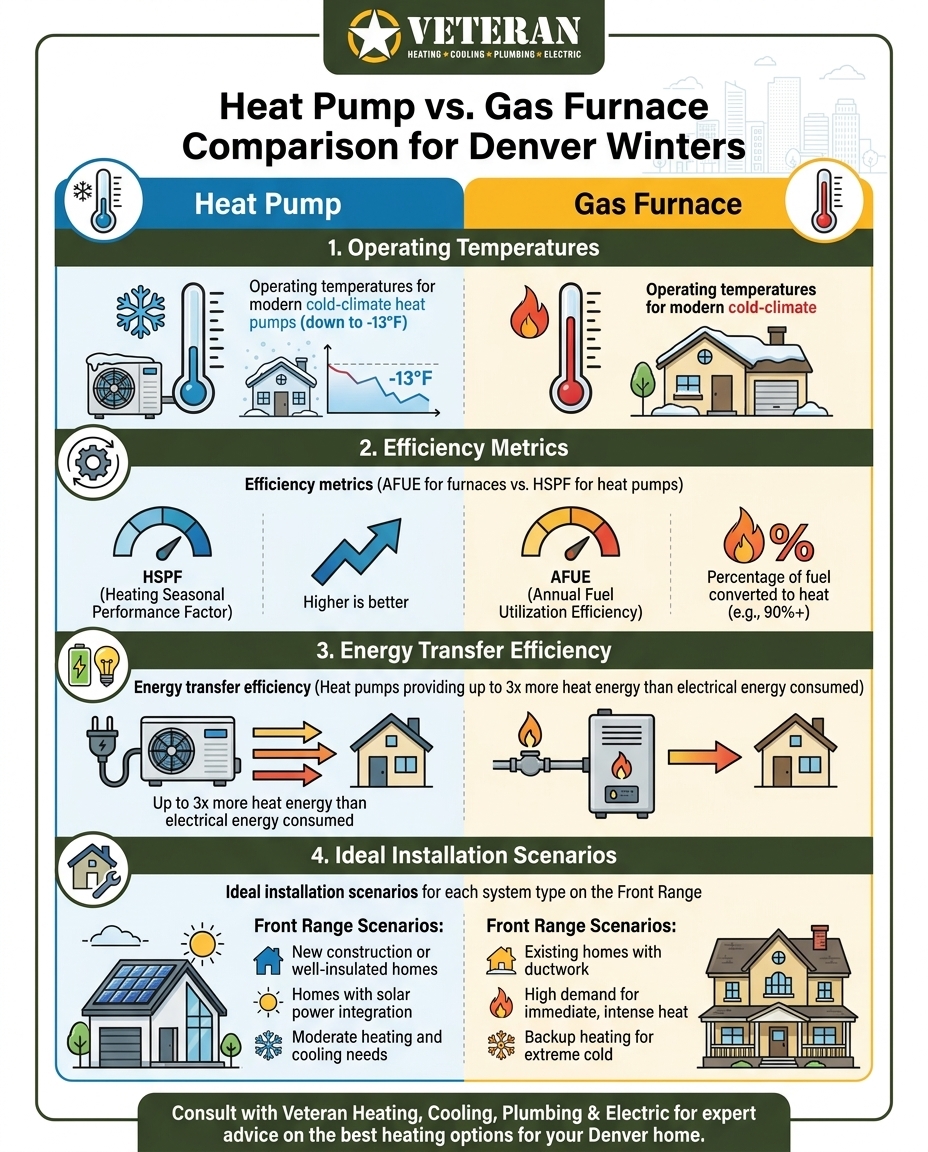
The Solution: Modern cold-climate heat pump technology has completely rewritten the rules of winter heating. To understand how a heat pump works in a four-season climate, you have to look at the advancements in variable-speed compressor technology. These systems do not generate heat; they move it. Even in freezing temperatures, there is still ambient heat energy in the outside air. In our experience as a Midea Elite dealer, we routinely install cold-climate systems that operate efficiently at temperatures down to -13 degrees Fahrenheit—well below Denver's average winter lows.
How Cold-Climate Technology Prevents Winter Heat Loss
• Inverter-driven compressors: Unlike traditional systems that blast on at 100% capacity and then shut off, modern variable-speed compressors adjust their output in tiny increments. This allows them to extract heat from frigid air continuously and maintain a perfectly consistent indoor temperature.
• Advanced defrost cycles: In our high-altitude environment, proper local installation is critical. We utilize specific snow stands and brackets to ensure that when the unit enters its defrost cycle, the melting ice can drain away freely rather than refreezing in the base pan.
• Energy transfer efficiency: Modern heat pumps are incredibly efficient, often providing up to three times more heat energy to your home than the electrical energy they consume to run the compressor.
Traditional Gas Furnaces: Evaluating the Like-for-Like Replacement
While heat pumps represent the cutting edge of modern efficiency, a high-efficiency gas furnace remains an exceptionally reliable and powerful option for many homes in the Denver metro area. When our HVAC technicians inspect older Denver properties, we often find that sticking with traditional combustion heating makes the most sense depending on the home's existing infrastructure and layout.
When a gas furnace is the optimal choice: If your home already has fully intact, properly sized gas lines and a venting system designed for combustion exhaust, a like-for-like furnace replacement is often a straightforward process. Older homes with poor insulation or leaky ductwork may also benefit from the intense, high-temperature heat output that a gas furnace provides, as it can overcome rapid heat loss more aggressively than the steady, lower-temperature output of a heat pump.
Reliability during the deepest freezes: Traditional gas furnaces are the undisputed heavyweights of rapid heating. When the Colorado winter delivers its absolute worst, a properly sized high-efficiency furnace will quickly elevate the indoor temperature. This reliability is why prompt service is so critical when these systems fail. For example, one local homeowner reached out to our dispatch last fall when their aging furnace suddenly failed to run properly right as the weather turned. Our veteran-led team responded promptly, diagnosed the malfunctioning components efficiently, and quickly repaired the furnace to restore reliable heating to the home before the cold became a hazard.
The installation process: Comparing the upfront installation process is a major factor in this decision. Swapping out an old gas furnace for a new, high-efficiency model is typically a direct replacement process. Conversely, retrofitting a home for a new heat pump system may require modifications to your ductwork, the addition of a new outdoor unit pad, and significant updates to your electrical panel to handle the new voltage requirements.
Expert Diagnostics: System Sizing with Military Precision
Choosing between a heat pump and a gas furnace is only half the battle. The brand of equipment you select matters far less than the precision of the sizing and installation. As a veteran-owned company, we bring military discipline to our diagnostic process, ensuring no corners are cut and every variable is accounted for.
Here is the exact methodology our technicians use when evaluating a home in the Denver metro area:
1. Manual J Load Calculations: We never guess based on square footage. We measure windows, insulation levels, ceiling heights, and directional orientation to determine the exact heating load your home requires.
2. Ductwork Evaluation: We inspect your existing ductwork to ensure it can handle the airflow requirements of a modern variable-speed system. Leaky or undersized ducts will strangle a high-efficiency system.
3. Altitude Adjustments: We apply specific derating calculations to account for Denver's thinner air, ensuring the blower motor and burner capacities are correctly calibrated for our elevation.
4. Electrical Capacity Checks: We thoroughly assess your home's electrical infrastructure to ensure it can safely power a new system without overloading your main panel.
The Importance of Electrical Infrastructure
Upgrading to a heat pump often requires a significant shift in how your home consumes energy. Because heat pumps run entirely on electricity, many older homes require whole-home electrical assessments to determine if a panel upgrade is necessary. This is where integrated multi-trade expertise becomes invaluable. If an issue is found, our veteran-led emergency electrical response teams can ensure safe, compliant upgrades without causing frustrating installation delays. Having HVAC and electrical experts under one roof means your project moves forward seamlessly.
Efficiency and Long-Term Value: Navigating Incentives and Performance Ratings
When comparing long-term operational costs, it is important to understand that furnaces and heat pumps are measured using different metrics. Understanding these ratings allows you to compare apples to apples when evaluating systems for your home in the Denver metro area.
• Gas Furnace — Efficiency Metric: AFUE (Annual Fuel Utilization Efficiency) — What It Measures: The percentage of fuel converted directly into usable heat (e.g., 96% means 4% is lost as exhaust). — Long-Term Value Impact: Modern condensing furnaces drastically reduce wasted gas, lowering monthly fuel consumption compared to older 80% models.
• Heat Pump — Efficiency Metric: HSPF (Heating Seasonal Performance Factor) — What It Measures: The ratio of heat output over the heating season to electricity used. — Long-Term Value Impact: Because they move heat rather than create it, heat pumps offer exceptional efficiency, transferring more energy than they consume.
Modern high-efficiency systems, whether gas or electric, are designed to lower your monthly energy consumption over their lifespan. Variable-speed blowers and modulating gas valves ensure that the system only uses the exact amount of energy needed to maintain the temperature, rather than constantly cycling on and off at full blast.
Furthermore, upgrading your heating infrastructure can often unlock significant generic incentive programs. Federal tax credits may apply to qualifying high-efficiency heat pump installations, and local utility rebates are frequently available for both advanced heat pumps and top-tier gas furnaces. Because these programs change frequently, we advise all readers to consult with their utility provider or a tax professional to verify current eligibility and maximize their long-term investment.
The October Window: Securing Your Home's Comfort Before the First Hard Freeze
Timing is everything when it comes to heating upgrades. Early to mid-October is the historical window for Denver's first hard freeze. Waiting until late November or December to address an aging system often leads to catastrophic failures on the coldest night of the year, turning a planned upgrade into a stressful emergency.
Taking action during the pre-winter October window gives you the time to make a measured, educated decision. It also ensures that the installation team has the time to go above and beyond, securing your home's comfort before the snow flies. At Veteran Heating, Cooling, Plumbing & Electric, we pride ourselves on efficiency and respect for your time. For instance, during a major multi-day installation project last winter, our crew worked efficiently across neighboring properties to accelerate the process, successfully completing the extensive job in just one day without sacrificing an ounce of quality.
To establish a clear baseline of your current system's health, scheduling a Service to Heroes HVAC inspection in Denver is the perfect first step. This program reflects our commitment to the local community, providing a thorough, pressure-free evaluation of your existing equipment. We will check the heat exchanger for cracks, test the blower motor amp draw, and evaluate the overall safety of the unit. If your system is ready for winter, we will tell you. If it is on borrowed time, we will provide you with the data you need to choose between a furnace or a heat pump on your own terms.
Frequently Asked Questions About Denver Heating Upgrades
Is a heat pump better than a gas furnace in Colorado?
There is no single "better" option; it depends entirely on your home's infrastructure and efficiency goals. Heat pumps offer incredible year-round efficiency and reduce reliance on fossil fuels, making them excellent for homes looking to electrify. However, gas furnaces provide rapid, high-temperature heat that some older, less insulated homes require. As a Midea Elite dealer, our team evaluates your specific ductwork, electrical capacity, and insulation to determine which system will perform best in your unique space.
At what temperature does a heat pump become inefficient in Denver?
Older heat pumps typically began losing efficiency around 30 degrees Fahrenheit, but modern technology has changed this dramatically. Today's cold-climate heat pumps utilize advanced variable-speed compressors that can extract heat energy effectively down to -13 degrees Fahrenheit. While they do work harder as the temperature drops, they remain highly efficient well into the deepest freezes of a typical Colorado winter.
Can a modern heat pump heat a house in freezing weather without backup?
Yes, a properly sized cold-climate heat pump can heat a home in freezing weather without relying on backup electric resistance strips. The key is accurate sizing through a Manual J load calculation and ensuring the home is adequately insulated. If the system is engineered correctly for the Denver metro area, the inverter-driven compressor will maintain a steady, comfortable indoor temperature even when the outdoor air is frigid.
Should I replace my aging furnace with a heat pump this fall?
If your furnace is over 15 years old, requires frequent repairs, or struggles to heat your home evenly, this fall is the ideal time to consider a replacement. Upgrading to a heat pump before the heavy winter weather hits allows you to avoid emergency breakdowns. It also gives you time to properly evaluate if your home needs any electrical or ductwork modifications to support the new system.
Do I need an electrical panel upgrade to install a cold-climate heat pump?
Because heat pumps rely entirely on electricity for both heating and cooling, they require dedicated circuits with sufficient amperage. Many older homes with 100-amp service panels may require an upgrade to safely support the increased electrical load. During our initial assessment, our integrated electrical team evaluates your current panel to determine if an upgrade is necessary, ensuring a safe and compliant installation.
How does high altitude affect my HVAC system's sizing requirements?
High altitude significantly impacts HVAC performance because the air is thinner and less dense. This means there is less air mass available to absorb and transfer heat throughout your home. To compensate, systems installed in Denver must be properly derated, and blower motors must be calibrated to move a higher volume of air to achieve the same heating output as a system installed at sea level.
Schedule Your Expert Heating Assessment Today
The best choice between a modern cold-climate heat pump and a high-efficiency gas furnace ultimately comes down to your home's unique footprint, your existing infrastructure, and your long-term comfort goals. Whether you want the rapid heating power of traditional combustion or the advanced, year-round efficiency of a heat pump, making the decision during the pre-winter October window ensures you are prepared for whatever the Colorado climate delivers.
Our team at Veteran Heating, Cooling, Plumbing & Electric is dedicated to providing clear, climate-specific comparisons without the high-pressure sales tactics. We rely on technical data, precise load calculations, and our extensive local experience to guide you. If you are ready to evaluate your aging system before the deep winter freezes arrive, discover the benefits of choosing a veteran-owned home services company. Reach out today to schedule your comprehensive heating assessment, and let us help you confidently choose the right system for your home.
ABOUT Veteran Heating, Cooling, Plumbing & Electric
Veteran Heating, Cooling, Plumbing & Electric was founded on the belief that service should be personal, honest, and community-focused. Our team is built around integrity, professionalism, and a true commitment to your home’s comfort and safety.
Led by a U.S. Army veteran with over 30 years of industry experience, we’re proud to remain locally owned and operated. Every technician, plumber, and electrician is EPA-certified, background checked, and driven to exceed expectations.
- 24/7 ServiceWe offer weekend & 24/7 emergency service. We’re here whenever you need us—day, night, or weekend, no exceptions.
- $0 Trip FeesNo dispatch or trip fees. You’ll never pay just for us to show up—service starts when the work does.
OUR SERVICES
AIR CONDITIONING
.jpg)
We offer specialty and seasonal services like indoor air quality upgrades, pre-winter furnace checks, and summer AC tune-ups to keep your home prepared year-round.
Our Primary Air Conditioning Services Include:
Don't see the service you need? Call our Team today!
PLUMBING
From leaks to full system installs, our plumbing services cover everything you need for a safe, reliable home water system, 24/7.
Our Primary Plumbing Include:
- Water Heater Replacement
- Water Heater Repair
- Trenchless Sewer Line
- Water Filtration
- Slab Leak
- Sewer Line Repair
Don't see the service you need? Call our Team today!
ELECTRICAL

Our electrical services ensure your home stays safe and powered, from routine fixes to complete system upgrades.
Our Primary Electrical Services Include:
- House Rewiring
- Electrician
- Electric Panel Upgrade
- Electric Panel Replacement
- EV Chargers
- Whole House Generator
Don't see the service you need? Call our Team today!
HEATING
.jpg)
We install, repair, and maintain heating & furnace systems with expert care to keep your Colorado home comfortable and energy-efficient year-round.
Our Primary Heating Services Include:
- Heating Installation
- Heating Replacement
- Heating Maintenance
- Heating Repair
- Heating Service
- Heating Tune-Up
Don't see the service you need? Call our Team today!