The Honest Truth About Ductless vs Ducted Cooling Pros and Cons for Denver Homeowners
Understanding the ductless vs ducted cooling pros and cons is the fastest way to figure out which system actually fits your home, your budget, and Colorado's demanding climate. Here is a quick breakdown before we go deeper:
Ductless (Mini-Split) Pros:
• No ductwork needed — ideal for older homes, additions, and garages
• Higher efficiency (SEER2 ratings up to 38+)
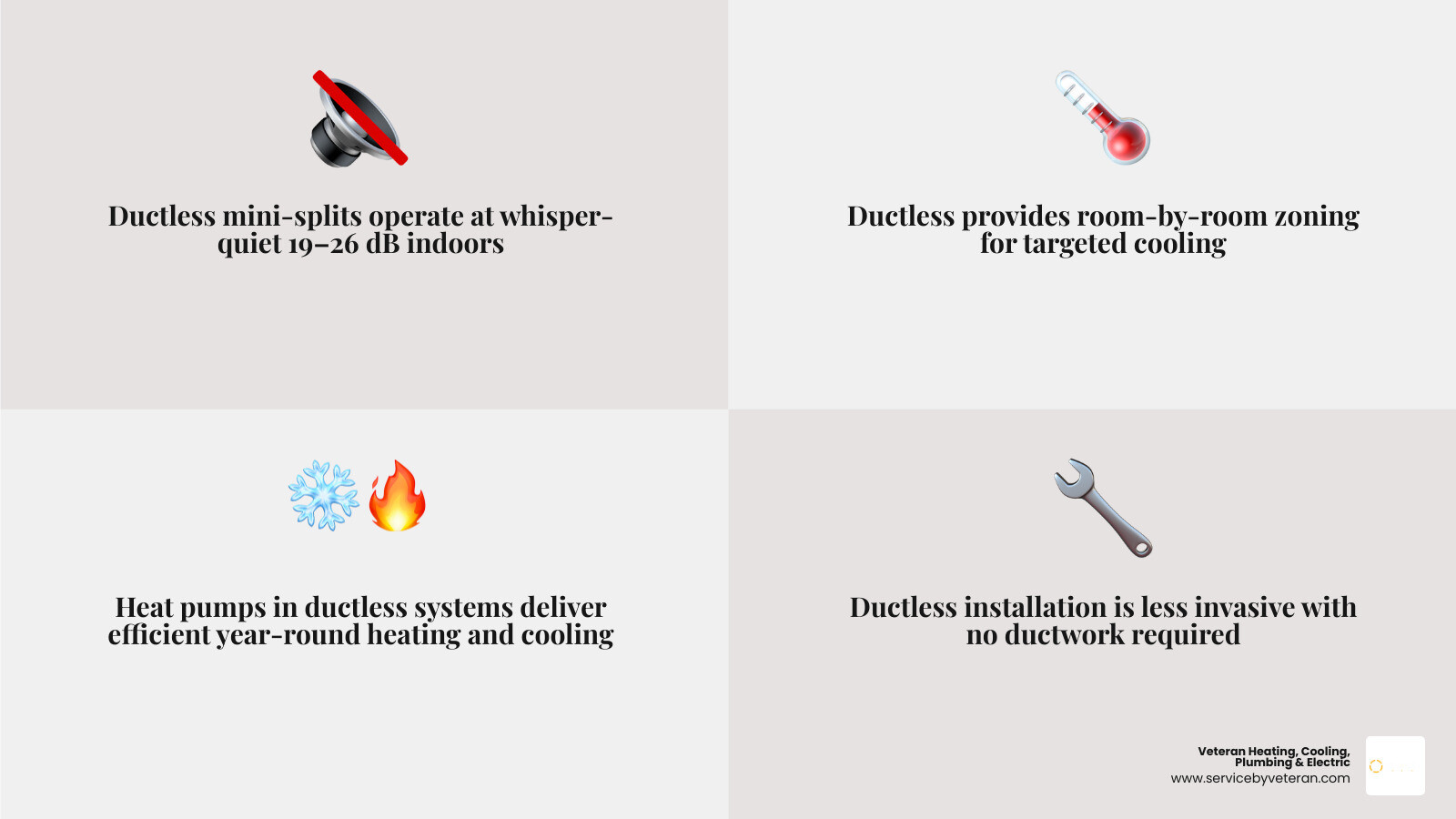
• Room-by-room temperature control (zoning)
• Whisper-quiet operation (19–26 dB indoors)
• Also heats efficiently — one system, year-round comfort
• Less invasive installation
Ductless (Mini-Split) Cons:
• Visible wall-mounted indoor units
• Higher upfront cost for whole-home coverage
• Filters need cleaning every 2–4 weeks per unit
Ducted (Central AC) Pros:
• Consistent, whole-home temperature from one thermostat
• Invisible system — no visible indoor units
• Better whole-home air filtration (HEPA/MERV-rated filters)
• More cost-effective when good ductwork already exists
Ducted (Central AC) Cons:
• Loses 20–30% of cooled air through duct leaks and poor insulation
• Expensive and invasive to install without existing ductwork
• Limited room-by-room control
• Older ducts may have sizing issues or hidden leaks
Most Denver homeowners searching for answers on this topic are not just browsing — they are staring at rising utility bills, dealing with a room that never cools down, or trying to figure out whether that home addition needs a whole new system. The Denver Metro area adds another layer to this decision. Colorado's wide temperature swings, dry air, and high altitude mean your cooling system has to perform under conditions that expose the weaknesses of a poorly chosen or poorly installed setup fast.
Whether your home is a 1960s ranch in Lakewood without a single duct, a newer build in Highlands Ranch with central air already running, or a finished basement in Centennial that the main system simply cannot reach — the choice between ductless and ducted cooling has real consequences for your comfort and your energy bills.
I'm Mike Townsend, a U.S. Army veteran and owner of Veteran Heating, Cooling, Plumbing & Electric, and my background — which includes managing precision cooling systems for heat-seeking missile technology during my military service — gives me a sharp, technical perspective on the ductless vs ducted cooling pros and cons that goes well beyond a standard sales pitch. Let's walk through exactly what you need to know to make the right call for your home.
Understanding the Fundamental Differences: Ductless vs Ducted Cooling Pros and Cons
When we talk about the ductless vs ducted cooling pros and cons, we are really looking at two different philosophies of home comfort.
A ducted system—what most people call "Central Air"—is a forced-air system. It uses one large central air handler to cool the air and then pushes it through a network of ducts hidden behind your walls and ceilings. It’s controlled by a single thermostat, meaning the whole house is treated as one giant zone. If you want the bedroom at 68 degrees, the guest room you haven't used in months is getting cooled to 68 degrees, too.
On the other hand, a Mini Split (ductless) system skips the middleman. Instead of big metal pipes, it uses small refrigerant lines to connect an outdoor compressor to individual indoor air handlers. What is a Ductless Mini-Split System? It is a system that allows you to control the temperature of each room independently.
The "secret weapon" inside most modern ductless systems is inverter technology. Traditional central AC units are often "all or nothing"—they kick on at 100% power, blast cold air until the thermostat is satisfied, and then shut off. Inverter technology works more like a dimmer switch, allowing the compressor to ramp up or down to maintain a steady temperature without the constant on-and-off cycling.
Energy Efficiency and Performance in the Denver Climate
As of April 2026, the HVAC industry has fully transitioned to SEER2 (Seasonal Energy Efficiency Ratio 2) standards. These ratings measure how much cooling a system provides for every watt of electricity it uses. In the high-altitude, dry environment of Arvada or Broomfield, efficiency isn't just about "saving the planet"—it’s about surviving July without a mortgage-sized electric bill.
• Standard Central AC — Typical SEER2 Range: 14.3 – 18 — Energy Loss Potential: 20-30% (Duct Leaks)
• High-End Central AC — Typical SEER2 Range: 21 – 26 — Energy Loss Potential: 20-30% (Duct Leaks)
• Ductless Mini-Split — Typical SEER2 Range: 20 – 38+ — Energy Loss Potential: Near 0% (No Ducts)
Ductless systems are inherently more efficient because they eliminate "thermal bypass." When cold air travels through an attic in Castle Rock that’s hitting 130 degrees in the summer, it loses its "chill" before it ever reaches your vents. By delivering cooling directly to the room, mini-splits ensure 100% of the conditioned air stays where you want it.
Furthermore, Mini Split Service ensures that these high-efficiency ratings are maintained over the life of the unit. Without the 25% to 30% energy loss typical of leaky ducts, ductless systems often provide a much faster return on investment through monthly savings.
Why Ductless vs Ducted Cooling Pros and Cons Matter for Your Utility Bills
If you have a 2,500-square-foot home in Centennial but spend 90% of your day in a home office, a central AC system is essentially "cooling the furniture" in the rest of the house just to keep you comfortable. This is a massive waste of energy.
Ductless systems allow for "zoned cooling." You can set your office to a crisp 70 degrees while letting the rest of the house drift to 78. This targeted comfort can drop your cooling costs by 30% to 40% compared to an aging central system. However, if your central system fails, Mini Split AC Repair is localized—if one indoor head has an issue, the rest of the house stays cool. With central AC, if the main unit goes down, the whole house swelters.
Comparing the Visual Impact and Noise: Ductless vs Ducted Cooling Pros and Cons
Aesthetics are often the biggest hurdle for homeowners considering ductless. Central AC is "invisible"—all you see are small grates on the floor or ceiling. Ductless systems require an indoor unit in every room. While modern wall-mounted heads are sleek and white, some people find them distracting.
The good news? You have options. Beyond the standard wall mount, there are:
• Ceiling Cassettes: These sit flush with the ceiling, showing only a decorative grille.
• Floor-Mounted Units: These look similar to a modern radiator and sit low on the wall.
• Slim Duct Units: These can be hidden in a small soffit or closet, giving you the "invisible" look of central air for a single zone.
When it comes to noise, there is no contest. Central AC compressors can be loud enough to disturb a backyard BBQ, and the "thump" of the air handler kicking on can wake light sleepers. Mini-split indoor units operate at 19-26 decibels—that is literally quieter than a whisper or a library.
Installation and Home Integration for Colorado Homeowners
The "ductwork question" is the most important factor in your decision. If you live in an older home in Golden or Littleton that was built with a boiler and radiant heat, you likely have zero ductwork. Installing ducts in a finished home is a nightmare—it involves tearing out drywall, losing closet space, and weeks of construction mess.
In these cases, the Mini Split Installation Littleton Guide highlights how non-invasive ductless can be. We only need to drill a small three-inch hole in the exterior wall to run the refrigerant and power lines. Most single-zone installations can be completed in a single day.
For those curious about the Mini Split Installation Cost, it’s important to remember that while the equipment is high-tech, you are saving thousands by not paying for duct construction. Conversely, if you have existing ducts in good condition in a Highlands Ranch home, simply replacing the central unit is often the most straightforward path.
Maintenance, Air Quality, and Long-Term Durability
Denver is a dusty place. Between the wildland fire smoke we occasionally see and the high pollen counts in the spring, air quality is a major concern.
Central AC systems win on "whole-home" filtration. Because they move a massive volume of air through a central point, you can install high-MERV or HEPA filters that "scrub" the air for the entire house. However, ducts themselves can become breeding grounds for dust mites and mold if not cleaned every few years.
Ductless systems provide excellent localized filtration. Each indoor unit has its own filter. While this means you have to rinse the mesh filters every 2–4 weeks, it also means you aren't blowing dust from the basement into the master bedroom. Mini Split Service is vital here; we recommend a professional deep clean once a year to prevent mold buildup on the indoor coils.
Both systems typically last 15–20 years, though some premium mini-splits can reach 25 years with proper care. In Colorado’s dry climate, we don’t deal with the same humidity-related corrosion that coastal states face, which helps extend the life of all HVAC equipment.
Frequently Asked Questions about Cooling Systems in Colorado
Can a mini-split handle Colorado’s extreme temperature swings?
Absolutely. Modern "cold-climate" heat pumps are designed specifically for regions like Arvada and Aurora. While older models struggled when the mercury dropped, today’s units can provide effective heating even when it is -15°F outside. This makes them a viable year-round solution, often replacing both an old AC and an inefficient electric furnace or baseboard heaters.
Is it possible to combine ducted and ductless systems in one home?
We do this all the time! This is called a "hybrid" approach. Perhaps your central AC works fine for the main floor of your Centennial home, but the finished basement is always a "brick oven" in the summer. Instead of trying to force more air through existing ducts, we can install a single-zone mini-split just for that space. It’s the best of both worlds.
Which system is better for indoor air quality in Lakewood or Golden?
If you have severe allergies, a ducted system with a high-end air purifier integrated into the ductwork is usually the gold standard. However, for most homeowners, the advanced multi-stage filtration found in modern mini-splits is more than enough to handle pet dander and local pollen. The key is regular maintenance—if you don't clean the filters, neither system can protect your air.
Conclusion
Choosing between ductless vs ducted cooling doesn't have to be a headache. If you have great existing ducts and want an invisible system, Central AC is likely your winner. If you want the lowest possible utility bills, precise room control, or have a home without ductwork, a mini-split is hard to beat.
At Veteran Heating, Cooling, Plumbing & Electric, we don't believe in high-pressure sales. We believe in the military values of integrity and service. Whether you are in Lakewood, Littleton, or anywhere in the Denver Metro area, our veteran-led team is here to give you an honest assessment. We offer a lifetime warranty on parts and labor and a money-back guarantee because we stand behind our work 100%.
Ready to find your perfect cooling match? Mini Split Installation is just one of the ways we help our neighbors stay comfortable. Give us a call today, and let’s get your home ready for a Colorado summer.
ABOUT Veteran Heating, Cooling, Plumbing & Electric
Veteran Heating, Cooling, Plumbing & Electric was founded on the belief that service should be personal, honest, and community-focused. Our team is built around integrity, professionalism, and a true commitment to your home’s comfort and safety.
Led by a U.S. Army veteran with over 30 years of industry experience, we’re proud to remain locally owned and operated. Every technician, plumber, and electrician is EPA-certified, background checked, and driven to exceed expectations.
- 24/7 ServiceWe offer weekend & 24/7 emergency service. We’re here whenever you need us—day, night, or weekend, no exceptions.
- $0 Trip FeesNo dispatch or trip fees. You’ll never pay just for us to show up—service starts when the work does.
OUR SERVICES
AIR CONDITIONING
.jpg)
We offer specialty and seasonal services like indoor air quality upgrades, pre-winter furnace checks, and summer AC tune-ups to keep your home prepared year-round.
Our Primary Air Conditioning Services Include:
Don't see the service you need? Call our Team today!
PLUMBING
From leaks to full system installs, our plumbing services cover everything you need for a safe, reliable home water system, 24/7.
Our Primary Plumbing Include:
- Water Heater Replacement
- Water Heater Repair
- Trenchless Sewer Line
- Water Filtration
- Slab Leak
- Sewer Line Repair
Don't see the service you need? Call our Team today!
ELECTRICAL

Our electrical services ensure your home stays safe and powered, from routine fixes to complete system upgrades.
Our Primary Electrical Services Include:
- House Rewiring
- Electrician
- Electric Panel Upgrade
- Electric Panel Replacement
- EV Chargers
- Whole House Generator
Don't see the service you need? Call our Team today!
HEATING
.jpg)
We install, repair, and maintain heating & furnace systems with expert care to keep your Colorado home comfortable and energy-efficient year-round.
Our Primary Heating Services Include:
- Heating Installation
- Heating Replacement
- Heating Maintenance
- Heating Repair
- Heating Service
- Heating Tune-Up
Don't see the service you need? Call our Team today!