I'm thinking about installing an EV charger at my Colorado home. What do I need to know?
This EV charger installation guide for Colorado homeowners covers what to know before installing a charger at home — from choosing the right charger level to understanding permits, panel requirements, and safe placement.
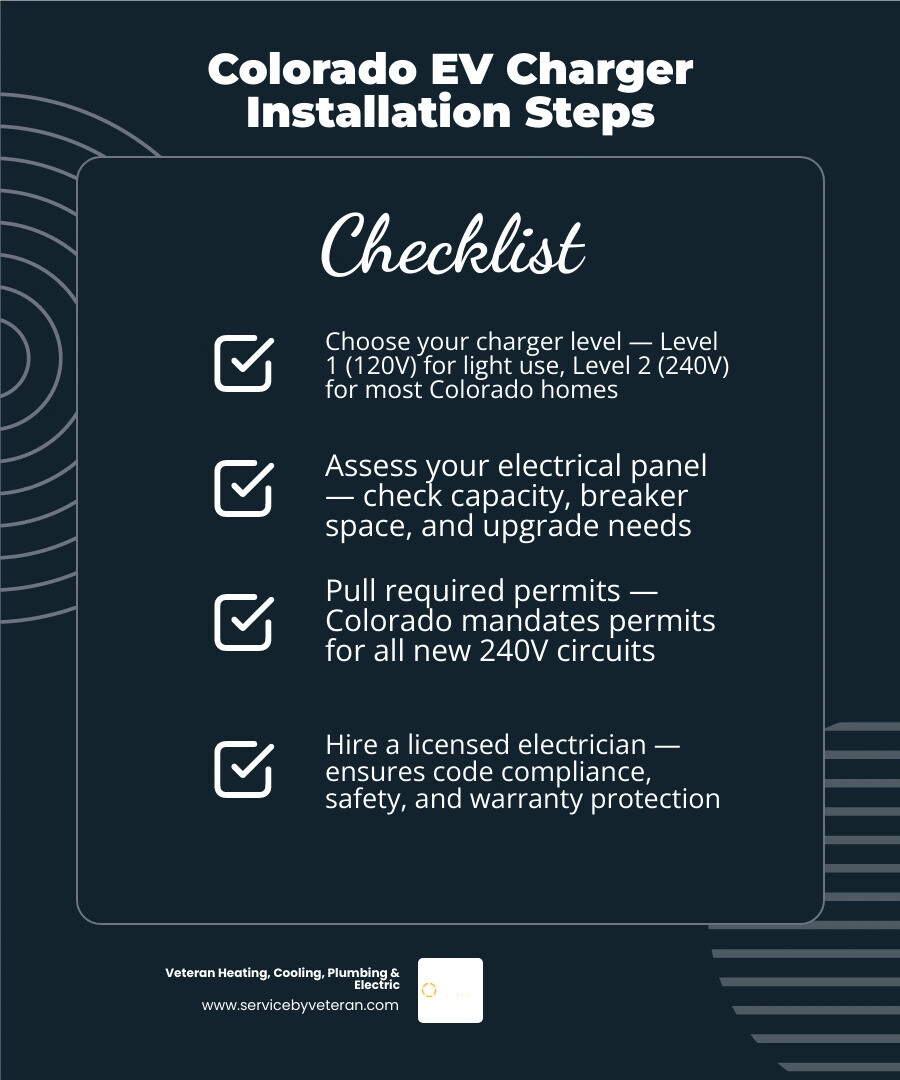
Here's a quick overview of the Colorado home EV charger installation process:
1. Choose your charger level — Level 1 (120V) for light use, Level 2 (240V) for most Colorado homes
2. Assess your electrical panel — check capacity, breaker space, and whether an upgrade is needed
3. Pull the required permits — Colorado requires permits for most new 240V circuits
4. Hire a licensed electrician — important for code compliance, safety, and warranty protection
5. Select your installation location — garage is ideal; outdoor mounts need weatherproof-rated enclosures
6. Complete the installation and inspection — final approval helps confirm the work meets code
7. Review available incentives — federal and utility programs may apply depending on current rules
Electric vehicles are becoming more common across the Denver Metro area, and home charging is often the most convenient way to keep your vehicle ready to go. But getting there requires more than just buying a charger and plugging it in. Colorado's climate, altitude, local permit rules, and your home's existing electrical setup all play a role in getting the job done safely and correctly. Whether you're already driving an EV or planning to make the switch soon, knowing what to expect before you start can help you avoid delays and unnecessary headaches.
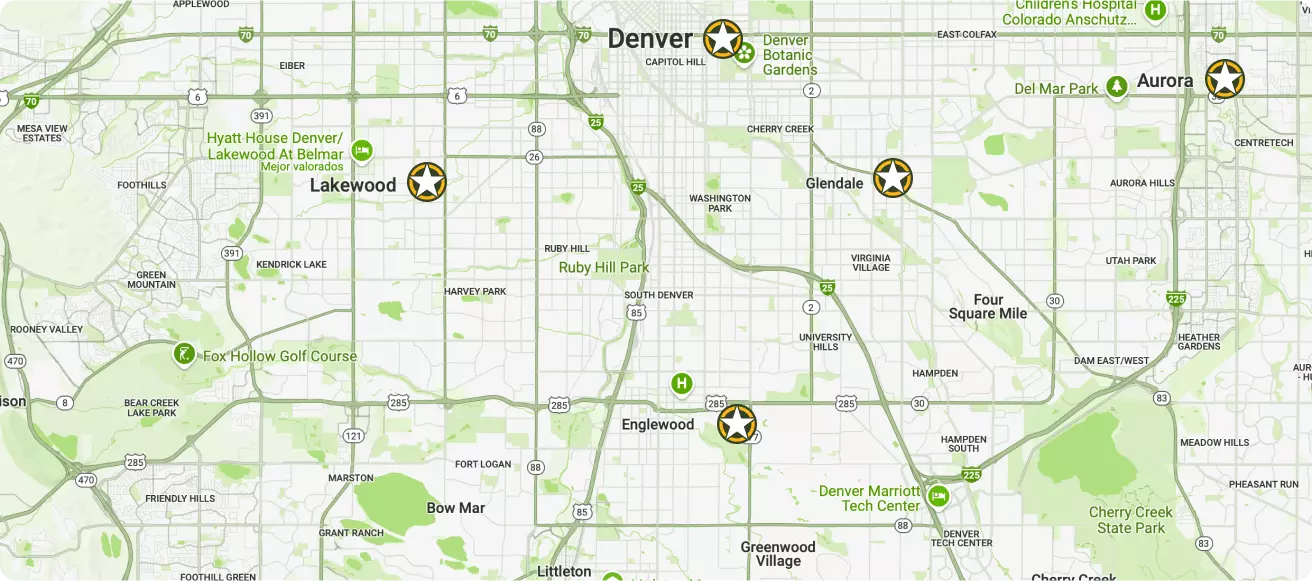
At Veteran Heating, Cooling, Plumbing & Electric, our team uses this same step-by-step approach for homeowners across the Denver Metro area, including Arvada, Aurora, Broomfield, Castle Rock, Centennial, Columbine, Golden, Highlands Ranch, Lakewood, and Littleton. As a veteran-owned and operated company led by a U.S. Army veteran with over 30 years of industry experience, we focus on safe, code-compliant electrical work backed by integrity, craftsmanship, and long-term peace of mind. Our EPA-certified and background-checked technicians are available 24/7, including weekends and emergencies, with no dispatch or trip fees. Read on for a full breakdown of what to expect.
EV Charger Installation Guide for Colorado Homeowners: Start With the Right Charger
The first decision is simple: pick the charger that matches how you actually drive and how your home is set up.
EV chargers generally fall into three categories:
• Level 1: standard 120V outlet
• Level 2: 240V circuit
• DC Fast charging: high-powered commercial charging, not typical for homes
For most homeowners in Denver, Aurora, Littleton, Arvada, Greenwood Village, Columbine, and nearby areas we serve, Level 2 is the practical choice. If you want a closer look at residential charging options, visit our EV Chargers page.
Which charger level fits your home and driving habits?
Here is the plain-English breakdown:
• Level 1 uses a normal household outlet and usually adds about 2 to 5 miles of range per hour.
• Level 2 uses 240 volts and commonly adds about 10 to 40 or more miles of range per hour, depending on the charger and vehicle.
• DC Fast chargers can add major range quickly, but they are designed for commercial settings and usually need infrastructure that does not make sense for a typical house.
Level 1 can work if:
• You drive short distances
• You have lots of time to charge
• You only need occasional top-offs
Level 2 makes more sense if:
• You commute daily
• You want overnight charging
• Your household has more than one driver or more than one EV
• You want better winter charging performance
DC Fast charging is best thought of as a road-trip tool, not a home solution.
Why Level 2 is the best fit for most Colorado homes
Colorado weather is one reason Level 2 stands out. Cold temperatures can reduce charging efficiency and increase the time needed to recharge. A slow Level 1 charger in January can feel especially limiting when you need dependable overnight charging.
Level 2 gives you:
• Faster overnight charging
• Better recovery after longer drives
• Less reliance on public stations
• Access to smart scheduling for off-peak utility rates
• More future-proofing if your next EV has a larger battery
For most Denver Metro homeowners, Level 2 hits the sweet spot between speed, convenience, and home compatibility.
Electrical Requirements in This ev charger installation guide for colorado homeowners
A Level 2 charger is not just another appliance. It is a continuous electrical load, and that means your home's wiring and panel have to be evaluated correctly.
Key requirements usually include:
• A dedicated 240V circuit
• Proper breaker sizing
• Correct wire size for the charger amperage
• Available panel capacity
• Code-compliant installation under NEC Article 625
• GFCI and other required protections depending on the setup
What your panel must have before a Level 2 install
Before installation, we look at a few core things:
• Overall service size, often 100A or 200A
• Available space for a double-pole breaker
• Load calculation results
• Distance from panel to charger location
• Whether a subpanel or load management equipment makes sense
Many newer homes can handle a Level 2 charger without major changes. Older homes, especially those with 100-amp service or packed panels, may need added electrical work first.
A few technical examples:
• A 32-amp charger typically needs a 40-amp circuit
• A 48-amp charger typically needs a 60-amp circuit
That is because EV charging is treated as a continuous load, so the circuit must be sized accordingly.
Hardwired vs. plug-in chargers: which is safer and smarter?
This is one of the most common questions we get.
Hardwired chargers are connected directly to the electrical circuit. Plug-in chargers use a receptacle, often a NEMA 14-50 outlet.
In most homes, hardwired is the safer and smarter choice because it offers:
• Fewer connection points
• Better long-term reliability
• Support for higher amperage
• Lower risk of outlet wear from continuous load
Plug-in chargers can be appropriate in some cases, but the outlet must be installed correctly and rated for the job. We have seen situations where heavy EV charging over time stressed outlets that were not ideal for continuous use.
How to tell if you need a panel upgrade
A panel upgrade is not always required, but sometimes it is the right move.
Warning signs include:
• Breakers that trip regularly
• Flickering lights when large appliances run
• No room for a new double-pole breaker
• Older 100A service with high household electrical demand
• An outdated or unsafe panel
• Plans for future electrical upgrades, like heat pumps, hot tubs, or a second EV
If your home was built decades ago, especially before modern EV-ready planning became common, an electrician should perform a real load calculation before any charger gets installed.
Colorado Permits, Codes, and Safety Rules Homeowners Need to Know
In Colorado, new 240V EV charger circuits generally require a permit and inspection. That is not paperwork for its own sake. It helps make sure the installation is safe, legal, and properly documented.
Colorado has also been moving toward more streamlined EV charging permitting. State law has pushed larger municipalities and counties to modernize their permitting process, which is good news for homeowners in the Denver Metro area.
Do you need a permit for a home EV charger in Colorado?
Yes, in nearly all cases for a new Level 2 circuit.
That usually means:
• An electrical permit must be pulled
• The work must meet local code requirements
• The installation is inspected by the local authority having jurisdiction
• Final approval is documented
This matters for safety, but also for practical reasons:
• It helps support proper home records
• It can be helpful for resale documentation
• It avoids failed inspections or correction notices later
Safety features and code requirements that protect your home
A proper EV charger installation should include attention to:
• NEC Article 625 requirements
• Overcurrent protection
• Proper breaker and wire sizing
• GFCI protection where required
• Weather-resistant equipment for outdoor installs
• Correct mounting height and secure attachment
• Cable management to prevent damage and trip hazards
For outdoor chargers in Colorado, weather rating matters a lot. Snow, sun, ice, and temperature swings can punish low-quality equipment. A charger with a proper outdoor enclosure rating, such as a NEMA-rated weather-resistant design, is a much better fit than something only meant for a sheltered interior wall.
Why DIY installation is risky
A Level 2 charger should be installed by a licensed electrician.
Installing a Level 2 charger without the proper training can create:
• Shock hazards
• Fire risks
• Hidden wiring defects
• Failed permit inspections
• Voided charger warranties
• Insurance complications after damage
EV chargers run for long periods at high load. That is exactly the kind of work where close enough is not good enough.
Installation Timeline, Placement, and Colorado Climate Considerations
Once the planning is done, the actual installation is often straightforward. The main variables are the location, panel condition, and how much wiring is needed.
Step-by-step professional installation process
A professional installation usually follows this order:
1. Site visit and assessment
2. Charger selection based on your vehicle and electrical capacity
3. Load calculation and panel review
4. Permit filing
5. Dedicated circuit installation
6. Charger mounting and wiring
7. Testing and startup
8. Final inspection
For a simple installation near the panel, the on-site work may only take a few hours. More complex projects can take longer if panel work, long wire runs, drywall access, or inspection scheduling is involved.
Where to install your charger for the best daily use
The best location is usually the one that makes daily charging easy and keeps installation clean.
Good placement usually means:
• Close to where the vehicle parks
• Close to the electrical panel when possible
• Protected from weather if outdoors
• Easy to reach without stretching the charging cable
• Mounted where the cable can be stored neatly
Most homeowners choose:
• Garage wall
• Carport post or wall
• Side driveway wall
A garage is often ideal because it offers protection from weather and easier cable management. For outdoor installations, we recommend equipment designed for the elements and placement that avoids snow pileups, standing water, and direct abuse from sprinklers or runoff.
How long installation takes and what can slow it down
Straightforward installs often take 2 to 4 hours on site. The total project timeline can be longer depending on:
• Permit processing
• Inspection scheduling
• Panel upgrades
• Long conduit or wire runs
• Finished walls that require careful routing
• Outdoor trenching if needed
In other words, the charger may go in quickly, but the full process still depends on the home's layout and local approval timing.
How Colorado winters, sun, and altitude affect charger choice
Colorado is not gentle on exterior equipment.
A charger installed here should be chosen with these conditions in mind:
• Cold winters and freeze-thaw cycles
• Strong UV exposure from high-altitude sun
• Wind-driven moisture and snow
• Wide temperature swings
That is why we recommend:
• Outdoor-rated chargers for exterior installs
• Durable cable materials that stay flexible in cold weather
• Proper mounting away from snow accumulation
• Smart charging features so you can schedule charging at practical times
Altitude can also affect electrical equipment behavior in subtle ways, especially around arc suppression and heat dissipation. That is one more reason a code-correct installation matters in Colorado.
Can your charger work with solar panels and off-peak programs?
Yes, in many homes.
A modern smart charger may be able to work well with:
• Rooftop solar systems
• Home batteries
• Utility time-of-use programs
• App-based scheduling
• Energy monitoring tools
That means you may be able to charge when solar production is strong, when utility rates are lower, or when household demand is lower. If energy management is part of your long-term plan, mention that before installation so the charger and circuit strategy can support it.
Long-Term Value and Planning for Colorado Homeowners
Installing a home charger can make EV ownership more convenient while helping homeowners prepare their property for long-term electrical needs.
• Federal tax credit — What to know: Eligible homeowners may qualify based on current program rules
• Utility incentives — What to know: Some Colorado utility programs offer rebates for eligible home charging equipment or wiring
• Off-peak charging — What to know: Scheduling overnight charging may support better energy management
• Home convenience — What to know: Less reliance on public charging during daily routines
• Future resale appeal — What to know: EV-ready features may be attractive to buyers
Rebates and tax credits Colorado homeowners should check in 2026
In 2026, homeowners should review:
• The federal EV charger tax credit
• Current utility rebate programs
• Any income-qualified energy programs available in their area
• Documentation requirements before and after installation
The key is timing and paperwork. Save your permit records, installation invoice, product information, and any utility program documentation. Incentive programs can change, so it is smart to verify active requirements before installation is completed.
Why home charging is often the most practical option
Public chargers are useful, but most homeowners prefer the convenience of charging where they park every day.
Home charging offers benefits like:
• Overnight convenience
• Better control over charging schedule
• No waiting in line
• No extra stop on the way home
• A full battery when you start the day
Research consistently shows that most EV charging happens at home, and that makes sense. Your garage is a much easier place to charge than making an extra stop during a busy week.
Does a home EV charger add value to your property?
It can improve buyer appeal, especially as EV ownership grows in the Denver Metro area.
Benefits include:
• Making the home feel more modern
• Showing the property is EV-ready
• Reducing future upgrade work for buyers
• Supporting resale in neighborhoods with EV-driving households
Some new homes are also being built with EV-ready features in mind, which shows where the market is heading. Even when it is not a formal requirement, EV readiness is increasingly seen as a practical upgrade.
Maintenance tips to keep your charger working longer
Home EV chargers are fairly low-maintenance, but they are not zero-maintenance.
A few good habits help:
• Visually inspect the cable for wear
• Keep the charger clean with a soft, dry cloth
• Store the cable neatly when not in use
• Check for moisture intrusion on outdoor units
• Install software updates on smart chargers
• Schedule service if the charger runs hot, trips breakers, or behaves oddly
For ongoing peace of mind, our $9.99/month maintenance plan includes priority scheduling and repair discounts, which can be helpful for keeping your home's entire electrical system — including your EV charger circuit — in top shape.
Frequently Asked Questions About the ev charger installation guide for colorado homeowners
How do I choose the right charger for my vehicle?
Start with these questions:
• Does your vehicle use J1772 or NACS/Tesla-style connection?
• How fast can your car actually accept Level 2 charging?
• What amperage can your home support?
• Do you want smart features like app scheduling and energy tracking?
• Are you planning to buy a second EV later?
A good rule is to match the charger to both your vehicle and your home's electrical capacity. Bigger is not always better if your car cannot use the extra power or your panel is already near its limit.
Are EV chargers required in new Colorado homes?
Some new construction rules and local building standards are moving toward EV-ready design, which may include conduit pathways, panel capacity, or dedicated space for future charging. Exact requirements depend on the jurisdiction and the type of project.
For homeowners buying or building in the Denver Metro area, it is worth asking whether the home is already EV-ready, partially prepped, or still needs a full installation.
Where can Denver Metro homeowners find EV charger installers?
We provide EV charger installation for homeowners across the Denver Metro area, including Denver, Aurora, Littleton, Arvada, Greenwood Village, and Columbine. You can learn more here:
• EV Chargers Greenwood Village CO
Conclusion
Installing a home EV charger is one of the most practical ways to make electric driving easier in Colorado. The right setup starts with choosing the correct charger, confirming your panel can support it, pulling the proper permits, and planning for local weather conditions. From there, available incentives and smart scheduling options may help support long-term value.
At Veteran Heating, Cooling, Plumbing & Electric, we help homeowners across the Denver Metro area — including Arvada, Aurora, Broomfield, Castle Rock, Centennial, Columbine, Golden, Highlands Ranch, Lakewood, and Littleton — with safe, professional EV charger installation backed by veteran-led service and trusted workmanship. Our team is committed to integrity, clear communication, and dependable results, with 24/7 weekend and emergency availability, no dispatch or trip fees, a lifetime warranty on all parts and labor, a satisfaction guarantee with money-back policy, and a 10% discount for veterans, seniors, and first responders.
If you are ready to make your home EV-ready, explore our EV Chargers services and read more about choosing a Residential EV Charger.
ABOUT Veteran Heating, Cooling, Plumbing & Electric
Veteran Heating, Cooling, Plumbing & Electric was founded on the belief that service should be personal, honest, and community-focused. Our team is built around integrity, professionalism, and a true commitment to your home’s comfort and safety.
Led by a U.S. Army veteran with over 30 years of industry experience, we’re proud to remain locally owned and operated. Every technician, plumber, and electrician is EPA-certified, background checked, and driven to exceed expectations.
- 24/7 ServiceWe offer weekend & 24/7 emergency service. We’re here whenever you need us—day, night, or weekend, no exceptions.
- $0 Trip FeesNo dispatch or trip fees. You’ll never pay just for us to show up—service starts when the work does.
OUR SERVICES
AIR CONDITIONING
.jpg)
We offer specialty and seasonal services like indoor air quality upgrades, pre-winter furnace checks, and summer AC tune-ups to keep your home prepared year-round.
Our Primary Air Conditioning Services Include:
Don't see the service you need? Call our Team today!
PLUMBING
From leaks to full system installs, our plumbing services cover everything you need for a safe, reliable home water system, 24/7.
Our Primary Plumbing Include:
- Water Heater Replacement
- Water Heater Repair
- Trenchless Sewer Line
- Water Filtration
- Slab Leak
- Sewer Line Repair
Don't see the service you need? Call our Team today!
ELECTRICAL

Our electrical services ensure your home stays safe and powered, from routine fixes to complete system upgrades.
Our Primary Electrical Services Include:
- House Rewiring
- Electrician
- Electric Panel Upgrade
- Electric Panel Replacement
- EV Chargers
- Whole House Generator
Don't see the service you need? Call our Team today!
HEATING
.jpg)
We install, repair, and maintain heating & furnace systems with expert care to keep your Colorado home comfortable and energy-efficient year-round.
Our Primary Heating Services Include:
- Heating Installation
- Heating Replacement
- Heating Maintenance
- Heating Repair
- Heating Service
- Heating Tune-Up
Don't see the service you need? Call our Team today!