Why a Residential EV Charger is Essential for Every Electric Vehicle Owner
A residential ev charger is the most convenient and cost-effective way to keep your electric vehicle ready for the road. With over 80 percent of EV charging happening at home, waking up to a full battery eliminates gas station trips and puts you in control of fueling costs. This guide will help you choose the perfect charger for your lifestyle and budget.
Quick Guide to Choosing Your Home EV Charger:
• Level 2 chargers are the home standard, delivering 6-19 kW for overnight charging.
• Power output ranges from 32 to 48 amps, affecting charging speed.
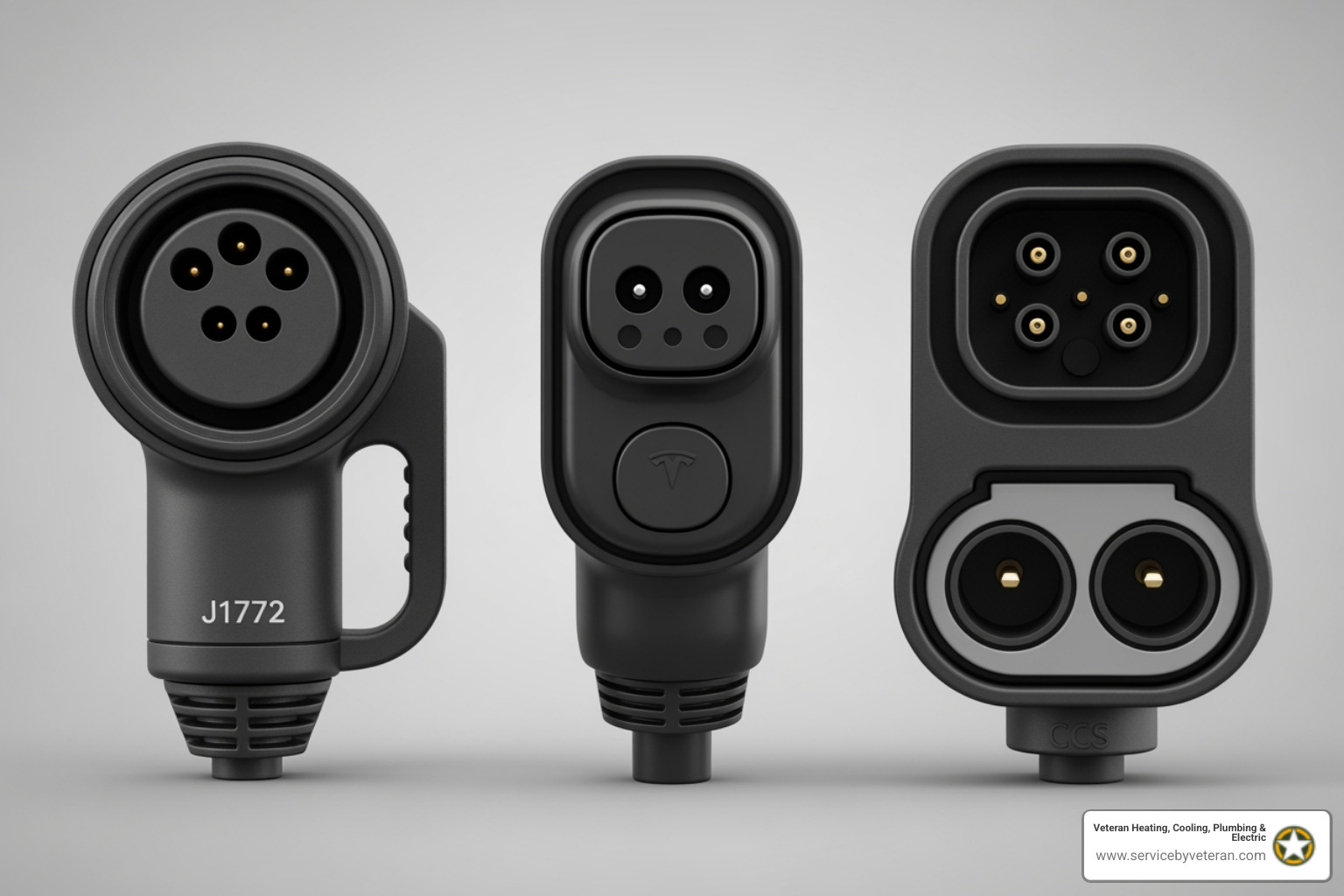
• Connector types include J1772 (universal) and NACS (Tesla), with adapters available.
• Smart features like Wi-Fi and scheduling help you save money by charging during off-peak hours.
• Installation options include plug-in (portable) or hardwired (permanent, higher power).
• Outdoor-rated models (NEMA 3R or higher) withstand weather.
If you're planning a residential ev charger installation, our certified electricians at Veteran Heating, Cooling, Plumbing & Electric can ensure your setup is safe and efficient. We combine military discipline with expert electrical service to meet your needs today and adapt to tomorrow's technology. Learn more about our electrical services or schedule a consultation.

Why Charging at Home is a Game-Changer for EV Owners
Imagine arriving home, plugging in your EV in seconds, and waking up to a full battery every morning. A residential ev charger eliminates detours to gas stations and waiting in line, giving you back valuable time. For residents in the Denver metro area, this convenience means you're always ready for your commute or a trip to the mountains.
The cost savings are significant. Charging at home, especially during off-peak hours, can cost one-third of public charging rates, potentially saving you over $1,000 annually compared to gasoline. This puts money back in your pocket every month.
Beyond savings, a home charger provides peace of mind. Range anxiety disappears when you charge overnight in your own garage or driveway. Your EV becomes as reliable as your smartphone—always ready when you are.
Finally, installing an EV charger can increase your home's value. As EVs become more popular, a dedicated charging setup is an attractive feature for future homebuyers. Home charging puts you in complete control of your schedule, budget, and peace of mind.
Understanding the Basics: EV Charging Levels and Speed
Choosing a residential ev charger requires understanding charging levels, which determine speed.
EV Charging Levels Explained
• Level 1 Charging: Uses a standard 120-volt household outlet. It's the slowest method, adding only 2-5 miles of range per hour. This is best for plug-in hybrids or emergency top-ups.
• Level 2 Charging: This is the gold standard for home charging. Operating at 240 volts, a Level 2 charger delivers 6-19 kW, adding 25-40 miles of range per hour. This is fast enough to fully charge most EVs overnight, making it the most practical choice for homeowners.
• Level 3 Charging (DC Fast Charging): These powerful stations (50-350 kW) can charge an EV to 80% in 20-60 minutes. However, they require industrial-grade power and are only found at public stations, not in homes.
How Output (kW) Affects Charging Speed
The power output of your residential ev charger, measured in kilowatts (kW), directly impacts charging speed. Higher kW means faster charging. This output is determined by amperage; for example, a 40-amp charger delivers 9.6 kW, while a 32-amp unit provides 7.7 kW.
Your actual charging speed depends on three factors:
1. Your home's electrical circuit capacity.
2. Your charger's maximum output.
3. Your vehicle's maximum acceptance rate. Your car won't charge any faster than its onboard charger allows, regardless of the station's power.
For safety, EV charging equipment follows the 80 percent rule, meaning it can only use 80% of a circuit's rated capacity continuously. For instance, a 50-amp circuit safely supports a 40-amp charger (9.6 kW). Understanding these basics helps you select a charger that balances power, safety, and your vehicle's needs.
Key Factors in Choosing Your Residential EV Charger
Choosing the right residential ev charger comes down to a few key factors. By focusing on power, compatibility, smart features, installation, and durability, you can find the perfect fit for your home and vehicle.
Power Output and Amperage
The power output of a residential ev charger, measured in kilowatts (kW), determines charging speed. Most Level 2 chargers offer adjustable amperage (from 16A to 48A or more), allowing you to balance speed with your home's electrical capacity. A 32-amp charger (7.7 kW) is a great baseline for overnight charging, while 40-amp (9.6 kW) or 48-amp (11.5 kW) units offer faster speeds. Consider a higher-amperage charger to future-proof your installation for next-generation EVs with larger batteries.
Connector Compatibility: J1772 vs. NACS
For years, the J1772 was the universal connector for non-Tesla EVs, while Tesla used its proprietary plug. Now, the industry is shifting to Tesla's design, renamed the NACS (North American Charging Standard) or J3400. Don't worry about this transition; adapters seamlessly connect J1772 chargers to NACS vehicles and vice-versa. Some chargers even come with universal connectors that fit both types.
Smart Features and Wi-Fi Connectivity
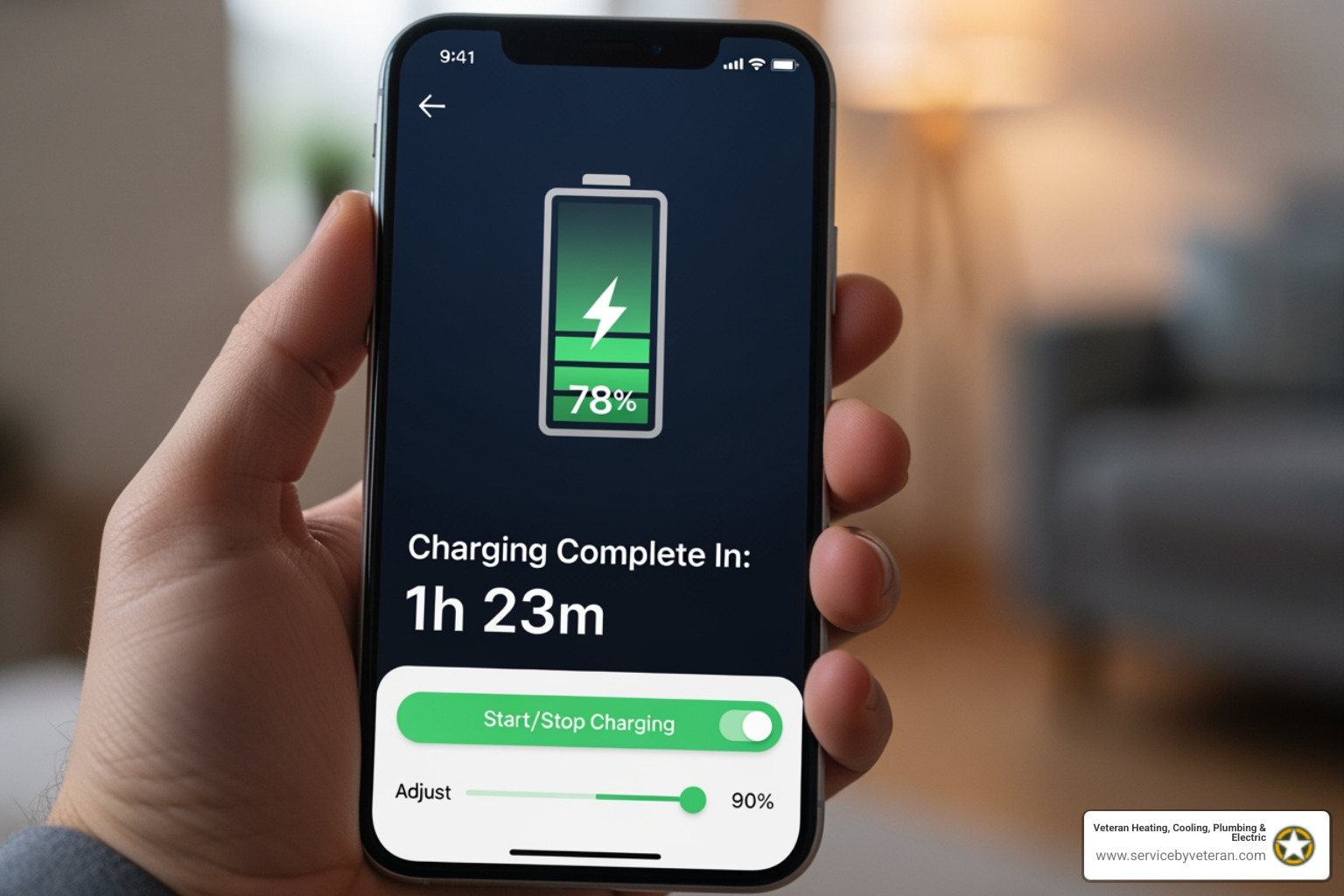
A smart residential ev charger with Wi-Fi helps you save money and adds convenience. Through a smartphone app, you can:
• Schedule charging to take advantage of cheaper off-peak electricity rates.
• Monitor energy usage and track costs.
• Remotely start or stop charging sessions and receive notifications.
• Receive firmware updates that add new features and improve security.
Installation Type: Plug-In vs. Hardwired
You have two installation options for a Level 2 charger:
• Plug-in chargers connect to a 240-volt outlet (like a NEMA 14-50). They are portable, making them a great choice if you might move. However, they are typically limited to 40 amps.
• Hardwired chargers are wired directly into your electrical panel. This permanent solution offers a cleaner look and allows for higher power outputs (48 amps or more), enabling faster charging.Both types require a licensed electrician to install a dedicated circuit.
Durability and Outdoor Use
If you need to install your residential ev charger outdoors, look for a unit with a proper weather-resistance rating. A NEMA 3R rating protects against rain and snow, while a NEMA 4X rating offers watertight and corrosion-resistant protection for harsher environments. Also, ensure the cable is long enough (typically 18-24 feet) to reach your vehicle comfortably and that the unit includes cable management to keep it tidy.
Advanced Capabilities to Consider
• Load Management: This feature monitors your home's total electricity use and adjusts the charging rate to prevent overloading your panel. It can help you avoid a costly electrical panel upgrade.
• Power Sharing: Allows two chargers to share a single circuit, intelligently distributing power between two EVs. This is a cost-effective solution for multi-EV households.
• Bidirectional Charging (V2H): This emerging technology allows your EV to power your home during an outage, acting as a large backup battery. Our electrical team can help determine if these features are right for you.
Preparing for a Professional Residential EV Charger Installation
Installing a Level 2 residential ev charger is not a DIY project. It involves high-voltage electricity and requires a licensed electrician to ensure safety and compliance with local codes. A professional handles everything from assessing your system to installing a dedicated circuit, preventing hazards like electrical fires or equipment damage. At Veteran Heating, Cooling, Plumbing & Electric, our electricians bring military precision to every installation, ensuring your charger operates safely and efficiently.
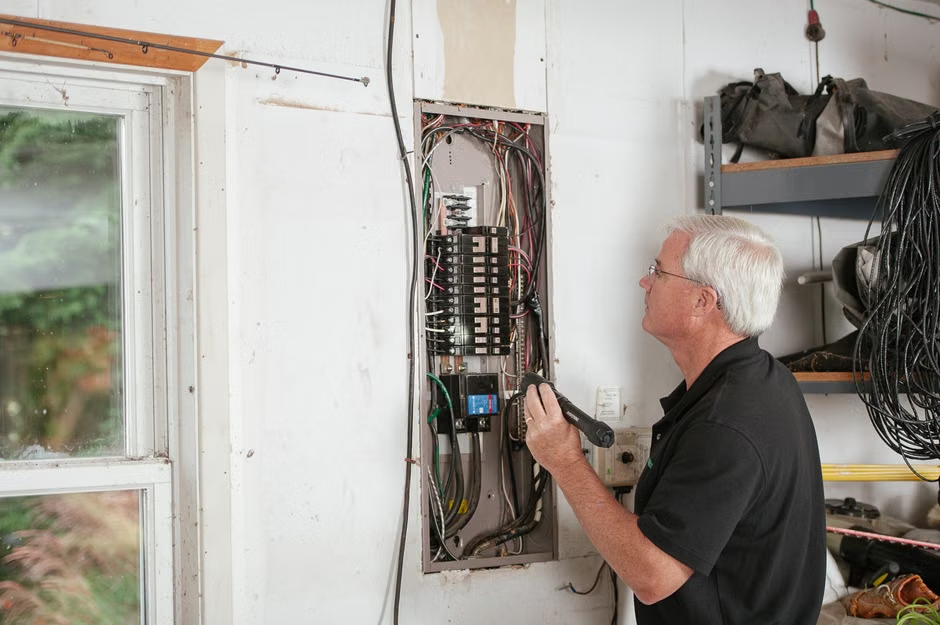
Assessing Your Home's Electrical Panel
The first step is a professional assessment of your main electrical panel. An electrician will determine your panel's total capacity (typically 100 or 200 amps) and calculate the spare capacity available after accounting for major appliances. Every Level 2 charger requires its own dedicated 240-volt circuit. If your panel lacks sufficient capacity, an upgrade may be necessary, which also improves your home's overall electrical infrastructure for future needs.
Financial Incentives for Your Residential EV Charger
Financial incentives can help offset the cost of your residential ev charger installation. Look for:
• Federal Tax Credits: The Inflation Reduction Act offers a tax credit for 30% of your total costs (up to $1,000), including the charger and installation work. This is set to expire, so acting soon is beneficial.
• State and Local Rebates: Your utility provider or city may offer rebates for installing a charger or for smart charging during off-peak hours. These programs vary by location in the Denver metro area.
• ENERGY STAR Certified Chargers: These models use less standby power and may qualify for additional utility rebates.
Always check for eligibility and pre-approval requirements before work begins. Our team can help you steer these incentives to maximize your savings.
Frequently Asked Questions about Home EV Chargers
Here are answers to common questions about adding a residential ev charger to your home.
Do I need to buy special charging equipment?
While your EV comes with a portable Level 1 cord that plugs into a standard 120-volt outlet, it is extremely slow (2-5 miles of range per hour). For practical daily use, a dedicated Level 2 residential ev charger is recommended. It uses a 240-volt circuit to fully charge your vehicle overnight (4-10 hours), offering the convenience and peace of mind that makes EV ownership effortless.
What is the difference between a plug-in and a hardwired EV charger?
The main difference is how the charger connects to your home's power.
• Plug-in chargers use a 240-volt outlet (like a NEMA 14-50). They are portable, which is ideal if you plan to move. Their power is typically limited to 40 amps.
• Hardwired chargers are wired directly to your electrical panel. This permanent installation offers a cleaner look and can support higher power (48+ amps) for faster charging.Both types require professional installation of a dedicated circuit by a licensed electrician.
Can a home EV charger be installed outdoors?
Yes, many chargers are designed for outdoor installation. Look for units with a NEMA 3R rating for protection against rain and snow, or a NEMA 4X rating for watertight and corrosion-resistant durability in harsh conditions. A professional installation is crucial to ensure that all components, including wiring and outlets, are outdoor-rated and can withstand the elements, making them as safe and reliable as indoor units.
Conclusion: Power Up Your Drive with Confidence
A dedicated residential ev charger transforms the EV ownership experience, offering convenience, cost savings, and an end to range anxiety. By choosing the right Level 2 charger—whether plug-in or hardwired—and leveraging smart features, you invest in years of reliable home charging.
Professional installation is essential. Working with high-voltage circuits requires a licensed electrician to ensure your charger is installed safely, efficiently, and in compliance with all local codes. This protects your home, your vehicle, and your investment.
At Veteran Heating, Cooling, Plumbing & Electric, we bring military precision to every residential ev charger installation across the Denver metro area. Our expert electricians will assess your home's electrical system and install the right equipment with the care you deserve.
Ready to make the switch to convenient home charging? Explore our comprehensive electrical services to power up your drive with confidence.
ABOUT Veteran Heating, Cooling, Plumbing & Electric
Veteran Heating, Cooling, Plumbing & Electric was founded on the belief that service should be personal, honest, and community-focused. Our team is built around integrity, professionalism, and a true commitment to your home’s comfort and safety.
Led by a U.S. Army veteran with over 30 years of industry experience, we’re proud to remain locally owned and operated. Every technician, plumber, and electrician is EPA-certified, background checked, and driven to exceed expectations.
- 24/7 ServiceWe offer weekend & 24/7 emergency service. We’re here whenever you need us—day, night, or weekend, no exceptions.
- $0 Trip FeesNo dispatch or trip fees. You’ll never pay just for us to show up—service starts when the work does.
OUR SERVICES
AIR CONDITIONING
.jpg)
We offer specialty and seasonal services like indoor air quality upgrades, pre-winter furnace checks, and summer AC tune-ups to keep your home prepared year-round.
Our Primary Air Conditioning Services Include:
Don't see the service you need? Call our Team today!
PLUMBING
From leaks to full system installs, our plumbing services cover everything you need for a safe, reliable home water system, 24/7.
Our Primary Plumbing Include:
- Water Heater Replacement
- Water Heater Repair
- Trenchless Sewer Line
- Water Filtration
- Slab Leak
- Sewer Line Repair
Don't see the service you need? Call our Team today!
ELECTRICAL

Our electrical services ensure your home stays safe and powered, from routine fixes to complete system upgrades.
Our Primary Electrical Services Include:
- House Rewiring
- Electrician
- Electric Panel Upgrade
- Electric Panel Replacement
- EV Chargers
- Whole House Generator
Don't see the service you need? Call our Team today!
HEATING
.jpg)
We install, repair, and maintain heating & furnace systems with expert care to keep your Colorado home comfortable and energy-efficient year-round.
Our Primary Heating Services Include:
- Heating Installation
- Heating Replacement
- Heating Maintenance
- Heating Repair
- Heating Service
- Heating Tune-Up
Don't see the service you need? Call our Team today!