Why Every Denver Metro Homeowner Should Understand How Hail and UV Exposure Affect Your Outdoor Unit
How hail and UV exposure affect your outdoor unit comes down to two distinct but equally damaging forces working against your system — one strikes fast and hard, the other works slowly and silently:
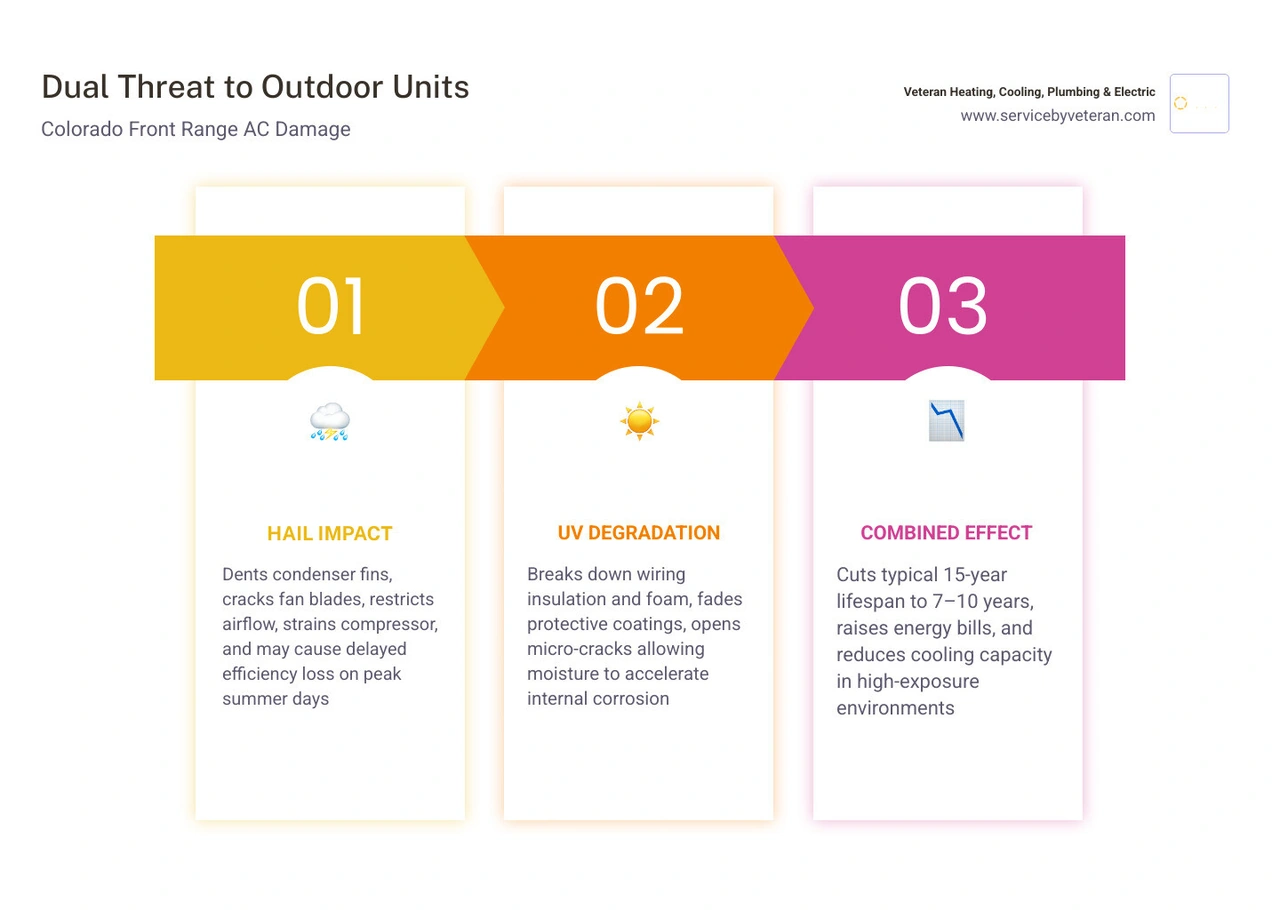
• Hail physically dents and bends the thin aluminum condenser fins, cracks fan blades, damages the cabinet, and can puncture refrigerant lines — restricting airflow, straining the compressor, and triggering efficiency losses that sometimes don't show up until weeks later on the hottest day of the year.
• UV radiation breaks down the plasticizers in wiring insulation and refrigerant line foam, causes protective coatings to fade and crack, and opens up micro-cracks that let moisture in — accelerating corrosion from the outside in.
• Together, these two forces can cut an outdoor unit's lifespan nearly in half — from a typical 15 years down to 7–10 years in high-exposure environments.
• The result is higher energy bills, reduced cooling capacity, and a system that works harder for less output.
Colorado's Front Range is one of the toughest environments for outdoor HVAC equipment in the country. The Denver Metro sees some of the highest hail frequency in the United States, and the region's high-altitude sun delivers intense UV radiation year-round — even on cool days. That combination puts outdoor AC units under stress that homeowners in milder climates simply don't face.
I'm Mike Townsend, a U.S. Army veteran with hands-on experience managing precision cooling systems in the military — experience that gives me a sharp understanding of how hail and UV exposure affect your outdoor unit and what it takes to protect it. In this guide, we'll walk through every component at risk, every protection strategy worth considering, and exactly when to call in a professional.
How Hail and UV Exposure Affect Your Outdoor Unit: The Dual Threat
Living along the Colorado Front Range means enjoying over 300 days of sunshine a year, but it also means bracing your home for sudden, violent summer storms. For homeowners in Arvada, Aurora, Broomfield, Castle Rock, Centennial, Columbine, Golden, Highlands Ranch, Lakewood, and Littleton, your outdoor air conditioner is on the front lines of this environmental battle.
When we look at how hail and UV exposure affect your outdoor unit, we are looking at a classic "one-two punch" of weather damage. The intense solar radiation associated with our high elevation constantly bakes the unit, raising the surface thermal load. On a hot July afternoon in Denver, the metal chassis of an unprotected outdoor unit can easily exceed 130°F. This extreme heat forces the system to run longer and work harder.
At the same time, the UV rays quietly degrade the structural integrity of the unit’s non-metallic parts. When a severe thunderstorm rolls off the Rocky Mountains, bringing high winds and heavy hail, those pre-weakened components are far more likely to crack, shatter, or fail completely.
This synergistic damage is why proactive Air Conditioning AC Maintenance is so critical in Colorado. Without routine care and protective measures, the physical impacts of hail combined with the relentless thermal load of the sun will steadily degrade your system’s efficiency, resulting in spiked utility bills and a premature, costly system replacement.
The Impact of Hailstorms on AC Components
A severe hailstorm is one of the most immediate threats to your home's cooling system. While your outdoor unit is housed in a heavy metal cabinet, key functional areas must remain exposed to the open air to facilitate heat transfer. This exposure makes them highly vulnerable when frozen precipitation begins to fall at terminal velocity.
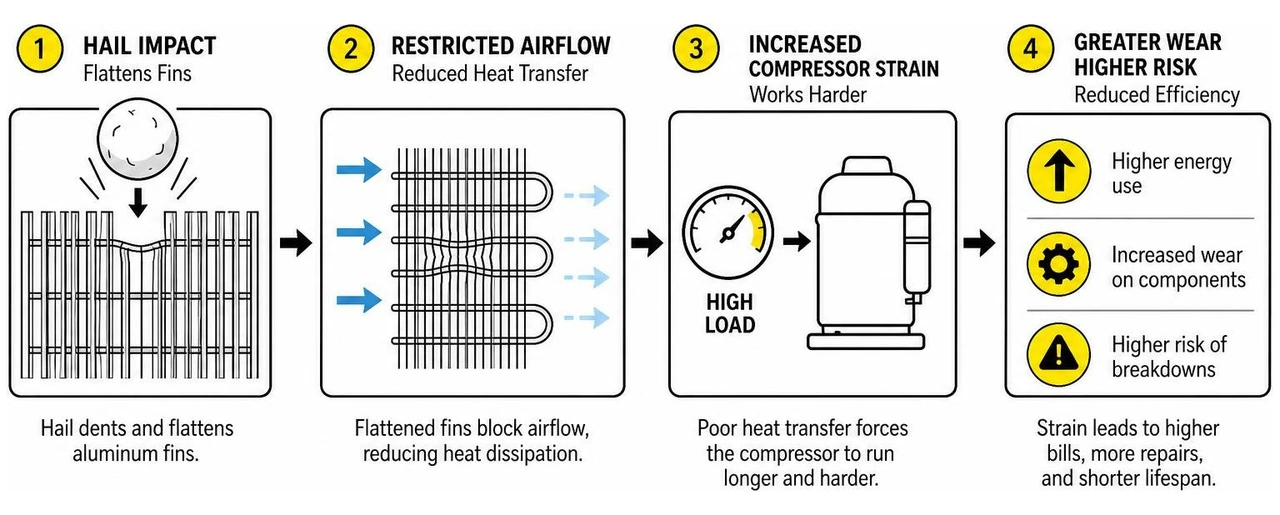
Post-storm investigations reveal that the delicate aluminum condenser fins can suffer dents twice the size of the hailstones that caused them. This mechanical damage isn't just cosmetic; it drastically alters how your system functions. When hail strikes the unit, it restricts vital airflow, forces the compressor to run under extreme strain, and often sets off a chain reaction of delayed mechanical failures. Your system might continue to run immediately after a storm, but it is essentially operating like a car with a flat tire—slowly destroying its internal components with every passing hour.
How Hail and UV Exposure Affect Your Outdoor Unit's Condenser Fins
The condenser coils of your air conditioner are wrapped in thousands of ultra-thin aluminum fins. These fins are engineered to maximize surface area, allowing heat from inside your home to quickly dissipate into the outdoor air. Because they are designed to release heat rapidly, they are incredibly thin and delicate.
When hail strikes these fins, it flattens the aluminum, effectively sealing off the gaps that allow air to pass through the coils. This restriction in airflow instantly reduces the system's heat transfer efficiency.
To make matters worse, trying to fix this yourself can often lead to further damage. While a "fin comb" can sometimes be used to gently straighten slightly bent fins, DIY attempts on severely flattened fins frequently slice into the underlying copper refrigerant tubing. If your system has been hit by a Front Range storm, securing professional HVAC Maintenance Castle Rock CO is the safest way to assess the damage and restore proper airflow without risking a catastrophic refrigerant leak.
Physical Damage to Fan Blades, Cabinets, and Coils
While the fins bear the brunt of minor hail, larger hailstones combined with high winds can cause severe damage to other critical components:
• Fan Blades: If hail passes through the top grille, it can strike the condenser fan blades. Even a minor dent or chip can unbalance the fan. An unbalanced fan blade will vibrate violently during operation, putting immense stress on the fan motor and eventually leading to a complete motor failure or a noisy, rattling system.
• Cabinet Dents: Heavy hail can dent the protective outer cabinet, pushing the metal housing inward until it rubs against internal copper lines or electrical wiring. Over time, the vibration of the running system can cause these rubbing components to wear through, resulting in sudden electrical shorts or major leaks.
• Refrigerant Leaks: The copper or aluminum coils carrying high-pressure refrigerant can be punctured directly by large hail or sliced by collapsing cabinet parts. A loss of refrigerant completely halts the cooling process and can permanently damage the compressor if the system continues to run.
• Electrical Components: Hail can crack the protective service disconnect box or the conduit piping housing the main electrical lines, exposing live wires to water and creating serious shock and fire hazards.
Identifying these issues early is key to avoiding a total system breakdown. Knowing the Most Common AC Repairs and What Causes Them can help you spot the warning signs of storm damage before they turn into emergency failures.
The Silent Threat of UV Degradation
While a hailstorm is a loud, obvious event, UV degradation is a silent, invisible threat that bakes your system day after day. In the high-altitude climate of the Denver Metro area, solar radiation is exceptionally strong. The atmosphere is thinner, meaning fewer UV-A and UV-B rays are filtered out before they reach your backyard.
Over time, this intense sunlight causes photo-degradation—a chemical process where UV light breaks down the polymer chains and destroys the plasticizers in plastics, rubbers, and protective coatings. Standard foam insulation and plastic fittings that might last a decade in a cloudy, sea-level climate can begin to crumble, crack, and fail within just a few seasons in Colorado.
How Hail and UV Exposure Affect Your Outdoor Unit's Non-Metallic Parts
The non-metallic components of your outdoor unit are the primary targets of UV radiation. Without these protective layers, your system’s most vital mechanical parts are left completely exposed:
• Refrigerant Line Foam: The black foam insulation wrapping your suction line (the cold refrigerant pipe) prevents the line from absorbing heat from the outdoor air. UV exposure quickly dries out this foam, causing it to shrink, crack, and eventually crumble away. When this insulation fails, your AC loses efficiency because the refrigerant is already warm by the time it reaches the compressor.
• Wiring Insulation & Electrical Conduits: The plastic conduits that carry high-voltage power to your unit contain plasticizers to keep them flexible. UV rays break these plasticizers down, making the conduits brittle. Once brittle, they crack easily under the stress of temperature swings or physical impact, allowing rain and snow to seep into the electrical wiring.
• Plastic Fan Blades & Grilles: Many modern units utilize composite plastic grilles or fan blades to reduce weight and noise. Unprotected plastics exposed to constant UV light undergo color fading, yellowing, and structural weakening, making them highly susceptible to shattering when struck by even small hail.
Protecting these components requires specialized care. If you are noticing cracked insulation or brittle wiring covers, scheduling an HVAC Tune-Up Broomfield CO can help identify and replace these failing parts before they cause a system-wide electrical failure.
Accelerated Corrosion and Material Aging
Corrosion is a massive problem for outdoor HVAC equipment, accounting for approximately 40% of all equipment failures. While we don't have salt-laden ocean air in the Denver area, we do have high-altitude moisture, winter road salts carried by the wind, and increasingly common wildfire ash.
UV exposure plays a major role in accelerating this corrosion. The outer surfaces of your AC unit are coated with protective paints and weather-resistant finishes. Constant UV exposure degrades these coatings, creating microscopic cracks across the metal chassis and coil surfaces.
Once these micro-cracks form, moisture, winter condensation, and corrosive dust particles penetrate deep into the metal. When moisture and dust settle between the copper tubes and aluminum fins, it triggers galvanic corrosion. This chemical reaction slowly eats away at the coils, leading to microscopic "pinhole" refrigerant leaks that are incredibly difficult to locate and expensive to repair.
Regular maintenance is your best defense against this silent decay. Our AC Tune-Up Guide for Colorado Homeowners outlines how routine cleaning and protective treatments can seal these microscopic entry points and keep corrosion at bay.
Protective Solutions and Maintenance Strategies
Protecting your outdoor unit from the elements requires a balanced approach. You must shield the system from physical impacts and intense sunlight without restricting the critical airflow it needs to keep your home cool.
• Hail Damage — Primary Components Affected: Aluminum fins, fan blades, cabinet, refrigerant coils — Warning Signs: Flattened fins, unusual vibrations, rattling noises, sudden cooling loss — Long-Term Impact: Restricted airflow, compressor failure, shortened lifespan — Best Protective Solution: Hail guards, louvered panels, emergency top covers
• UV Degradation — Primary Components Affected: Line insulation, wiring conduits, plastic grilles, paint — Warning Signs: Cracking foam, yellowed plastics, peeling paint, brittle wires — Long-Term Impact: Accelerated corrosion, electrical shorts, efficiency loss — Best Protective Solution: UV-resistant insulation, PVC jacketing, strategic shading
Hail Guards, Mesh Covers, and Shading
To protect your system from severe weather, consider implementing these proven, professional-grade shielding strategies:
• Hail Guards: These are heavy-duty, louvered metal panels or steel wire mesh screens (minimum No. 11 gauge steel wire with 0.5 to 1.0-inch openings) that install directly over the exposed coil sides of the unit. They are specifically engineered to deflect hail while allowing unrestricted airflow.
• Strategic Shading: Installing a trellis, planting deciduous trees, or placing a louvered fence on the south or west side of your unit can significantly lower the thermal load on your system. However, you must maintain a strict clearance of 2 to 3 feet on all sides and 5 feet of clear space above the unit to prevent hot air recirculation.
• Breathable Mesh Covers: During the off-season or when a severe storm is forecasted, a breathable mesh top cover can prevent debris and hail from entering the top grille. Never run your air conditioner with a solid cover installed, as this will instantly overheat and destroy the compressor.
If your system is acting up after a storm or a long stretch of hot weather, walking through some basic AC Troubleshooting Tips Before Calling a Pro can help you safely assess the situation before scheduling a service call.
Professional Inspections and Insurance Considerations
When severe weather strikes, knowing how to navigate the aftermath can save you thousands of dollars. Standard homeowners insurance policies typically cover sudden, accidental storm damage—such as a direct hit from a hailstorm. However, they do not cover gradual wear and tear, such as slowly degrading UV insulation or long-term rust.
If a major hailstorm rolls through your neighborhood, follow these steps to protect your investment:
1. Shut Down the System: Turn off the AC at the thermostat immediately to prevent internal damage if a fan blade is unbalanced or a line is leaking.
2. Document Everything: Take clear, high-resolution photos of the unit from all four sides, focusing on dented fins, cabinet damage, and any fallen branches or debris nearby.
3. Get a Professional Assessment: Contact a licensed HVAC Company Aurora CO to perform a comprehensive physical and mechanical inspection. We will provide a detailed, written report of the damage that you can submit directly to your insurance provider.
At Veteran Heating, Cooling, Plumbing & Electric, we believe in honest, transparent service. That’s why we offer upfront pricing, background-checked technicians, and a lifetime warranty on parts and labor. We can assist you with the technical documentation your insurance company needs to process your claim quickly and fairly.
Frequently Asked Questions about Weather Damage
Does homeowners insurance cover hail damage to an AC unit?
Yes, in most cases. Standard homeowners insurance policies generally cover sudden, severe storm-related damage, including hail impacts, lightning strikes, and damage from wind-blown debris. However, they will not cover gradual deterioration caused by UV exposure, lack of maintenance, or normal wear and tear. It is crucial to document hail damage immediately after a storm and file your claim promptly to avoid disputes over when the damage occurred.
Can I run my AC during a hailstorm?
It is highly recommended that you shut down your air conditioning system during an active hailstorm or severe wind event. If large hail or flying debris penetrates the top grille while the condenser fan is spinning at high speeds, it can shatter the fan blades, burn out the motor, or puncture the delicate copper coils. Turning the system off at the thermostat during a storm is a simple way to prevent major internal mechanical failures.
How often should I inspect my outdoor unit for UV damage?
You should perform a quick visual check of your outdoor unit at least twice a year—once in the spring before you turn the system on for the season, and once in the autumn. Look closely at the black foam insulation wrapping the refrigerant line and the plastic conduits protecting the electrical wiring. If the foam is crumbling or the plastic is cracked and brittle, it’s time to have those protective barriers replaced during your regular seasonal maintenance.
Conclusion
Your outdoor air conditioner is a tough piece of machinery, but the combined forces of Front Range hail and intense, high-altitude UV radiation will eventually take their toll. Understanding how hail and UV exposure affect your outdoor unit is the first step in protecting your home comfort, keeping your energy bills low, and ensuring your system lasts for its full intended lifespan.
At Veteran Heating, Cooling, Plumbing & Electric, we are proud to serve our fellow Colorado homeowners across the Denver Metro area. As a veteran-owned and operated local business led by a U.S. Army veteran with over 30 years of industry experience, we bring military precision, absolute integrity, and a deep commitment to our community to every single job.
Whether you need a post-storm safety inspection, UV-resistant insulation upgrades, or a complete system replacement, we are here for you 24/7 with no dispatch or trip fees, a lifetime warranty on parts and labor, and a 10% discount for veterans, seniors, and first responders.
Protect your home comfort today. Visit our Air Conditioning Services Page or call our office to schedule your next appointment with one of our friendly, EPA-certified HVAC technicians!
ABOUT Veteran Heating, Cooling, Plumbing & Electric
Veteran Heating, Cooling, Plumbing & Electric was founded on the belief that service should be personal, honest, and community-focused. Our team is built around integrity, professionalism, and a true commitment to your home’s comfort and safety.
Led by a U.S. Army veteran with over 30 years of industry experience, we’re proud to remain locally owned and operated. Every technician, plumber, and electrician is EPA-certified, background checked, and driven to exceed expectations.
- 24/7 ServiceWe offer weekend & 24/7 emergency service. We’re here whenever you need us—day, night, or weekend, no exceptions.
- $0 Trip FeesNo dispatch or trip fees. You’ll never pay just for us to show up—service starts when the work does.
OUR SERVICES
AIR CONDITIONING
.jpg)
We offer specialty and seasonal services like indoor air quality upgrades, pre-winter furnace checks, and summer AC tune-ups to keep your home prepared year-round.
Our Primary Air Conditioning Services Include:
Don't see the service you need? Call our Team today!
PLUMBING
From leaks to full system installs, our plumbing services cover everything you need for a safe, reliable home water system, 24/7.
Our Primary Plumbing Include:
- Water Heater Replacement
- Water Heater Repair
- Trenchless Sewer Line
- Water Filtration
- Slab Leak
- Sewer Line Repair
Don't see the service you need? Call our Team today!
ELECTRICAL

Our electrical services ensure your home stays safe and powered, from routine fixes to complete system upgrades.
Our Primary Electrical Services Include:
- House Rewiring
- Electrician
- Electric Panel Upgrade
- Electric Panel Replacement
- EV Chargers
- Whole House Generator
Don't see the service you need? Call our Team today!
HEATING
.jpg)
We install, repair, and maintain heating & furnace systems with expert care to keep your Colorado home comfortable and energy-efficient year-round.
Our Primary Heating Services Include:
- Heating Installation
- Heating Replacement
- Heating Maintenance
- Heating Repair
- Heating Service
- Heating Tune-Up
Don't see the service you need? Call our Team today!