Water Heater Options Tankless and Traditional: What Denver Homeowners Need to Know
Water heater options tankless and traditional are the two most common choices for Denver homeowners replacing or upgrading their hot water systems. Here is a quick breakdown to help you decide:
• How it works — Traditional Tank: Stores and preheats 40–80 gallons — Tankless: Heats water on demand, no storage
• Energy efficiency — Traditional Tank: Moderate; loses heat while standing by — Tankless: 24–34% more efficient for lower-use homes
• Hot water supply — Traditional Tank: Limited by tank size — Tankless: Continuous, as long as demand stays within flow rate
• Lifespan — Traditional Tank: 10–15 years — Tankless: 20+ years
• Upfront cost — Traditional Tank: Lower — Tankless: Higher
• Space required — Traditional Tank: Large floor footprint — Tankless: Compact, wall-mounted
• Best for — Traditional Tank: Tight budgets, simultaneous high-demand households — Tankless: Energy savings, small spaces, long-term value
Heating water accounts for roughly 18% of a household's energy use — making this one of the most financially meaningful appliance decisions you will make as a homeowner. And in Denver, where groundwater temperatures run colder than much of the country, the choice between these two systems carries real performance implications that go beyond what the product spec sheets tell you.
Both systems have genuine strengths and real trade-offs. The right answer depends on your household size, budget, how long you plan to stay in your home, and the realities of Colorado's climate and water quality.
I'm Mike Townsend, a U.S. Army veteran and leader of a veteran-owned home services company serving the Denver Metro area, and my team has hands-on experience helping Colorado homeowners navigate water heater options tankless and traditional in all kinds of homes and conditions. We'll walk you through everything you need to make a confident, informed decision.

Understanding Your Water Heater Options Tankless and Traditional
To make the right choice for your home in Arvada or Lakewood, you first need to understand the mechanics behind these systems. While both have the same goal—delivering hot water to your taps—they go about it in completely different ways.
Traditional Tank Water Heaters
Think of a traditional water heater as a giant insulated thermos. These units typically hold between 40 and 80 gallons of water. Inside the tank, either gas burners or electric elements keep that water at a set temperature (usually 120–140°F) 24 hours a day.
The main drawback here is "standby heat loss." Even when you aren't using hot water, the unit has to cycle on periodically to keep the tank warm. This constant reheating is why traditional tanks are generally less energy-efficient than their modern counterparts. However, because the hot water is already sitting there waiting for you, these systems are very reliable for high-volume needs—until the tank runs dry.
Tankless (On-Demand) Water Heaters
Tankless units, often called demand-type or instantaneous heaters, eliminate the storage tank entirely. When you turn on a hot water faucet, cold water travels through a pipe into the unit. A gas burner or an electric element immediately heats the water via a powerful heat exchanger.
Because they only heat water when you actually need it, they eliminate standby heat loss. For homes that use less than 41 gallons of hot water daily, these units can be 24% to 34% more energy efficient than conventional tanks. Even for high-use homes (around 86 gallons a day), they remain 8% to 14% more efficient. If you are interested in making the switch, check out our on-demand water heater installation guide for more technical details.
Performance and Supply: Which System Fits Your Lifestyle?
Choosing between water heater options tankless and traditional often comes down to how your family uses water. Do you have back-to-back showers in the morning? Do you run the dishwasher and the washing machine at the same time?
Traditional tanks offer a high "burst" capacity. You can usually run two showers and a faucet simultaneously because the hot water is already stored. The limit is the volume of the tank. Once those 50 gallons are gone, you have to wait for the "recovery rate"—the time it takes the heater to warm up a fresh batch of cold water.
Tankless heaters offer an "endless" supply of hot water, which is a dream for large families in Aurora or Centennial. You will never run out of hot water in the middle of a shower. However, they have a "flow rate" limit. Most units provide 2 to 5 gallons per minute (GPM). If you try to run the shower, the dishwasher, and the laundry all at once, the unit might struggle to keep up, leading to a drop in temperature.
To help you visualize the capacity, here is a comparison of typical performance:
• Simultaneous Showers — Traditional Tank (50 Gal): 2–3 (until tank empties) — Tankless (High Output): 1–2 (continuous)
• Recovery Time — Traditional Tank (50 Gal): 30–60 minutes — Tankless (High Output): Instant
• Supply Limit — Traditional Tank (50 Gal): Limited by tank size — Tankless (High Output): Unlimited
• Temperature Stability — Traditional Tank (50 Gal): Very stable — Tankless (High Output): Potential "cold water sandwich"
For more localized advice, residents can look into our services for a tankless water heater in Aurora CO to see how we handle these installations.
Flow Rates and Water Heater Options Tankless and Traditional
When sizing a tankless unit, we look at GPM. A standard shower head uses about 2.5 GPM. If you want to be able to run two showers at once, you need a unit that can handle at least 5 GPM. In colder climates like ours, the "temperature rise" is also a factor. Since our groundwater is colder, the heater has to work harder to reach 120°F, which can slightly lower the effective GPM.
For traditional tanks, we look at the First-Hour Rating (FHR). This tells you how much hot water the unit can deliver in one hour of peak demand. If you're in Arvada and need help calculating your household demand, our experts on tankless water heaters in Arvada CO can provide a precise assessment.
Installation and Space Requirements in Colorado Homes
Space is a major factor for many Denver Metro residents. A traditional 50-gallon tank is a large, heavy cylinder that takes up significant floor space in a basement or utility closet. As energy standards have improved, tanks have actually become wider and taller due to increased insulation, meaning a new tank might not fit in the exact spot your 15-year-old one did.
Tankless units are about the size of a carry-on suitcase and are mounted on the wall. This can free up valuable floor space for storage or other uses. However, the installation is more complex.
Colorado Climate and Infrastructure
In areas like Littleton and Lakewood, we have to consider several local factors:
• Venting: Gas tankless units require specialized Category III stainless steel venting because the exhaust is so hot. Traditional tanks often use simpler, existing chimneys or vent pipes.
• Gas Lines: Tankless units require a high volume of gas quickly. Often, we have to upgrade the gas line from a half-inch to a three-quarter-inch pipe to ensure the unit doesn't "starve" for fuel.
• Groundwater Temperature: In the winter, Denver's groundwater can be as cold as 40°F. A tankless unit has to raise that temperature by 80 degrees to reach a comfortable shower temperature. This requires more power than it would in a warmer state like Florida.
If you are considering a move to a more compact system, we provide specialized support for tankless water heaters in Littleton CO and tankless water heaters in Lakewood CO to ensure your home's infrastructure can handle the upgrade.
Long-Term Reliability and Maintenance
When comparing water heater options tankless and traditional, lifespan is where the tankless units really shine. A well-maintained traditional tank typically lasts 10 to 15 years. Eventually, the water sitting inside causes the tank to corrode and leak. A tankless unit, which doesn't store water, can easily last 20 years or more.
However, "well-maintained" is the keyword. Both systems require attention to reach their full potential, especially in the Denver area where we deal with varying water hardness.
Maintenance Tasks
• Traditional Tanks: These require an annual "flushing" to remove sediment (mineral deposits) that settles at the bottom. Without this, the sediment creates a barrier between the burner and the water, making the unit work harder and eventually causing the bottom of the tank to burn out. You also need to check the "anode rod" every few years; this rod "sacrifices" itself to corrosion so the tank doesn't have to.
• Tankless Units: These are susceptible to scale buildup inside the narrow heat exchanger tubes. In hard water areas, you must "descale" the unit annually using a vinegar solution or a commercial descaler. If you neglect this, the unit's efficiency drops rapidly, and the heat exchanger can fail prematurely.
If your current system has already reached the end of its life, our emergency water heater replacement Denver guide can help you navigate the urgent steps needed to get your hot water back.
Maximizing the Life of Water Heater Options Tankless and Traditional
To get the most out of your investment, we recommend a few best practices. For tanks, replacing the anode rod every 3 to 5 years can practically double the life of the unit. For tankless systems, installing a water softener can drastically reduce the frequency of descaling required.
If you are unsure whether to repair or replace your aging unit, check out our best water heater replacement guide Denver CO for a deeper dive into the decision-making process.
Frequently Asked Questions about Water Heaters
Which water heater is better for a large family in Denver?
For a large family, a tankless water heater is often the better choice because it provides an endless supply of hot water. You won't have to worry about the last person in line getting a cold shower. However, you must ensure the unit is sized correctly for your "peak demand"—the maximum amount of water you'll use at any one moment. If multiple people need to shower simultaneously, a high-GPM gas model or even two units may be necessary.
How long do tankless vs traditional water heaters last?
Traditional tank water heaters generally last between 10 and 15 years. Tankless water heaters are much more durable, with a life expectancy of 20 years or more. This longer lifespan often helps offset the higher initial installation cost, making tankless a better long-term value for many homeowners who plan to stay in their homes for a decade or more.
Does the Colorado climate affect tankless water heater performance?
Yes. Because our groundwater is significantly colder in the winter than in southern states, a tankless unit has to work much harder to heat the water. This can result in a lower flow rate (GPM) during the coldest months. When we install systems in the Denver Metro area, we always "oversize" the units slightly to ensure you still have plenty of hot water even when the ground is frozen.
Conclusion
Choosing between water heater options tankless and traditional isn't about finding the "best" heater—it's about finding the best fit for your home and your family. If you're on a tight budget or have high simultaneous water needs, a traditional tank is a reliable, time-tested option. If you value energy efficiency, want to save space, and love the idea of never-ending hot water, a tankless system is a fantastic investment.
At Veteran Heating, Cooling, Plumbing & Electric, we believe in the military values of integrity and service. We aren't here to sell you the most expensive system; we're here to provide an honest assessment of what will work best for your Denver, Highlands Ranch, or Castle Rock home.
We offer a lifetime warranty on all parts and labor, and because we know plumbing emergencies don't wait for business hours, we provide 24/7 weekend and emergency service with no dispatch or trip fees. Whether you need a simple repair or a full system upgrade, you can count on our background-checked, EPA-certified technicians to get the job done right.
Ready to upgrade your home's comfort? Contact our Denver plumbing experts today for a consultation. We’re proud to serve our community, and we offer a 10% discount for veterans, seniors, and first responders. Let us help you find the perfect hot water solution for your lifestyle.
ABOUT Veteran Heating, Cooling, Plumbing & Electric
Veteran Heating, Cooling, Plumbing & Electric was founded on the belief that service should be personal, honest, and community-focused. Our team is built around integrity, professionalism, and a true commitment to your home’s comfort and safety.
Led by a U.S. Army veteran with over 30 years of industry experience, we’re proud to remain locally owned and operated. Every technician, plumber, and electrician is EPA-certified, background checked, and driven to exceed expectations.
- 24/7 ServiceWe offer weekend & 24/7 emergency service. We’re here whenever you need us—day, night, or weekend, no exceptions.
- $0 Trip FeesNo dispatch or trip fees. You’ll never pay just for us to show up—service starts when the work does.
OUR SERVICES
AIR CONDITIONING
.jpg)
We offer specialty and seasonal services like indoor air quality upgrades, pre-winter furnace checks, and summer AC tune-ups to keep your home prepared year-round.
Our Primary Air Conditioning Services Include:
Don't see the service you need? Call our Team today!
PLUMBING
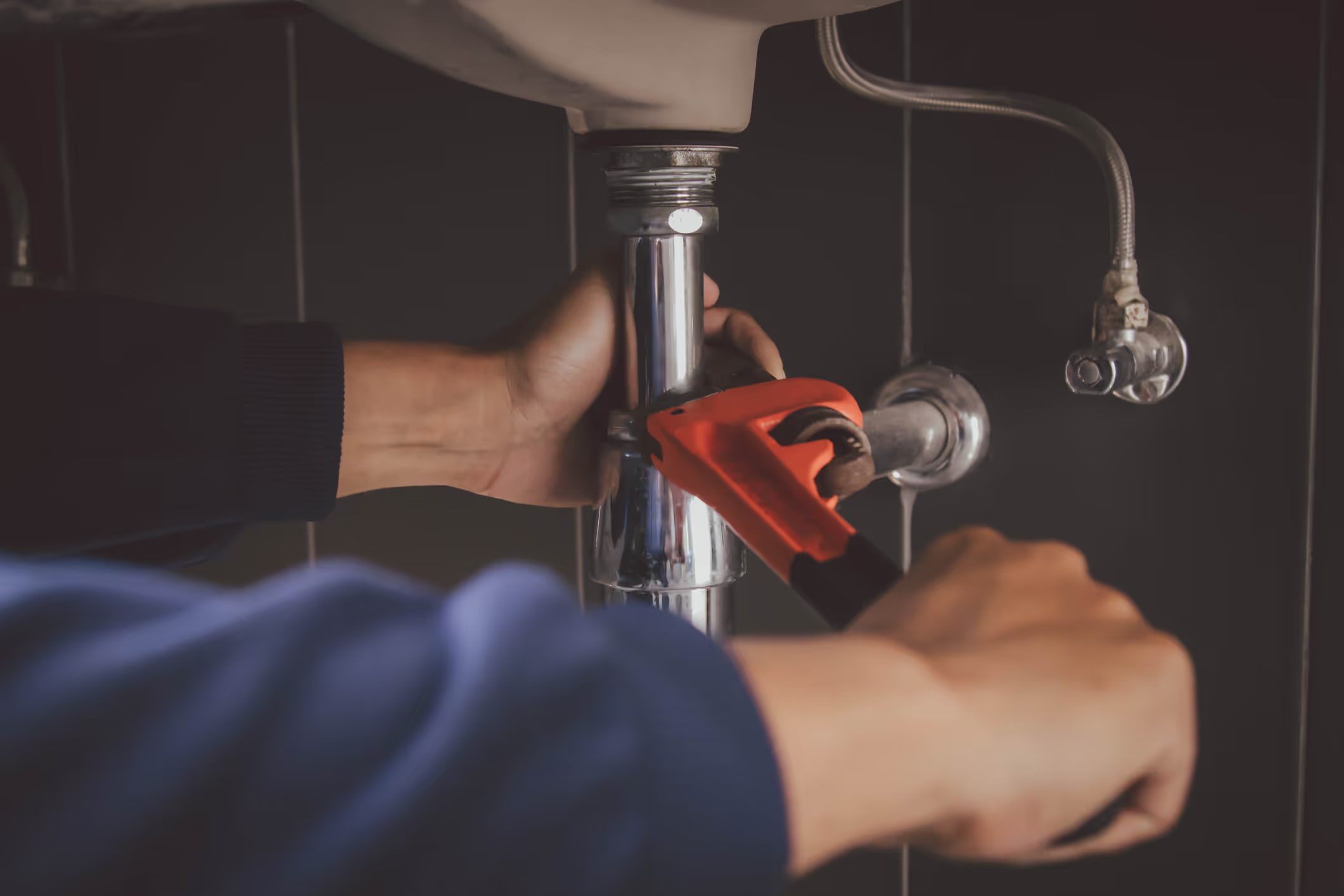
From leaks to full system installs, our plumbing services cover everything you need for a safe, reliable home water system, 24/7.
Our Primary Plumbing Include:
- Water Heater Replacement
- Water Heater Repair
- Trenchless Sewer Line
- Water Filtration
- Slab Leak
- Sewer Line Repair
Don't see the service you need? Call our Team today!
ELECTRICAL

Our electrical services ensure your home stays safe and powered, from routine fixes to complete system upgrades.
Our Primary Electrical Services Include:
- House Rewiring
- Electrician
- Electric Panel Upgrade
- Electric Panel Replacement
- EV Chargers
- Whole House Generator
Don't see the service you need? Call our Team today!
HEATING
.jpg)
We install, repair, and maintain heating & furnace systems with expert care to keep your Colorado home comfortable and energy-efficient year-round.
Our Primary Heating Services Include:
- Heating Installation
- Heating Replacement
- Heating Maintenance
- Heating Repair
- Heating Service
- Heating Tune-Up
Don't see the service you need? Call our Team today!