Why Knowing How to Choose the Right Water Heater for Your Home Could Save You Years of Headaches
Knowing how to choose the right water heater for your home is one of the most practical decisions you can make as a homeowner — and one of the most overlooked until something goes wrong.
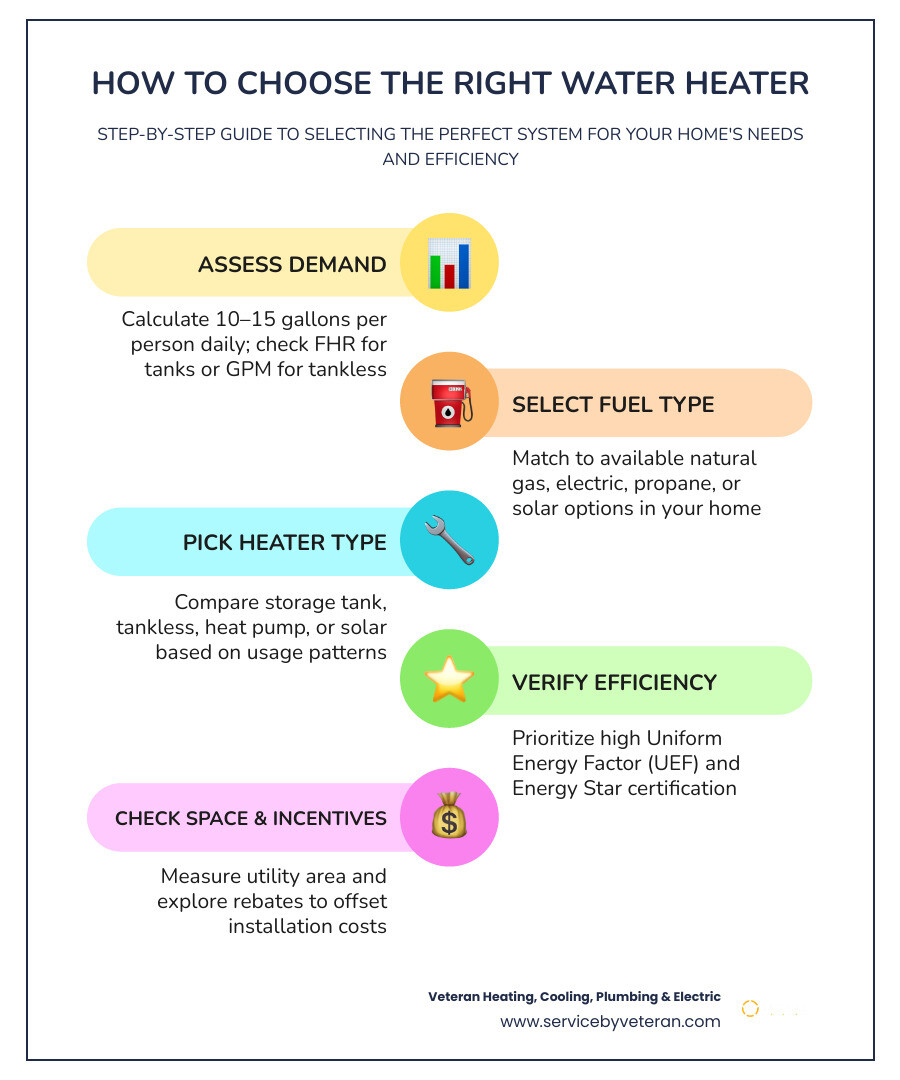
Here's a quick-reference guide to get you started:
• 1. Determine your hot water demand — What to Consider: 10–15 gallons per person per day; check first-hour rating (FHR) for tanks or GPM for tankless
• 2. Choose your fuel type — What to Consider: Natural gas, electric, propane, or solar — based on what's available in your home
• 3. Pick the right type — What to Consider: Storage tank, tankless, heat pump, or solar
• 4. Check efficiency ratings — What to Consider: Look for a high Uniform Energy Factor (UEF) and Energy Star certification
• 5. Account for space and installation — What to Consider: Measure your utility space; consider venting, electrical, and drainage needs
• 6. Look for rebates and incentives — What to Consider: Federal tax credits and local utility rebates can offset upfront costs
• 7. Plan for maintenance — What to Consider: Anode rod checks, annual flushing, and pressure relief valve inspections extend lifespan
Water heating accounts for roughly 18 percent of a typical household's energy use — making it the second-largest energy expense in most homes. Yet most homeowners don't think about their water heater until they're standing in a cold shower or mopping up a slow leak that's been quietly building for months. Experts consistently agree: the worst time to shop for a water heater is when you're already in crisis mode. Rushed decisions often mean the wrong type, the wrong size, or paying more than you should — without time to compare efficiency ratings or take advantage of available rebates.
Whether your current unit is aging, underperforming, or simply costing too much to run, understanding your options now puts you in control.
I'm Mike Townsend, a U.S. Army veteran and the owner of Veteran Heating, Cooling, Plumbing & Electric, and my background in precision systems — from military cooling technology to decades in the home services industry — gives me a practical, no-nonsense perspective on how to choose the right water heater for your home. Let's walk through everything you need to make a confident, informed decision.
How to Choose the Right Water Heater for Your Home
When we sit down with homeowners across the Denver Metro area, the first thing we look at isn't the price tag—it’s the lifestyle. Choosing a system for a home in Highlands Ranch is different than choosing one for a bungalow in Golden. As of April 2026, energy standards have become even more stringent, meaning the "standard" replacement you bought ten years ago might not even be available today.
The process of how to choose the right water heater for your home begins with four pillars: household size, peak usage patterns, fuel availability, and physical space. If you have a massive unfinished basement in Castle Rock, you have plenty of options. If you’re in a tight utility closet in a Denver condo, your choices are more restricted. We always recommend a professional Water Heater Installation Denver CO to ensure that local building codes—which are specific about venting and safety—are followed to the letter.
How to choose the right water heater for your home size and demand
Sizing is where most mistakes happen. If you buy a tank that is too small, you'll be shivering in the shower by the time the third person gets in. If it’s too large, you’re paying to heat 80 gallons of water that nobody is using.
To get it right, we look at two metrics:
1. First-Hour Rating (FHR): For tank models, this tells you how many gallons of hot water the unit can deliver in one hour starting with a full tank.
2. Gallons Per Minute (GPM): For tankless models, this measures how much water the unit can heat instantly.
A typical shower uses about 2 gallons per minute. If you’re running the dishwasher (about 1.5 GPM) and someone is showering at the same time, you need a unit that handles at least 3.5 GPM. For those in larger households, a professional Water Heater Installation Aurora CO can help you calculate these "simultaneous fixture" needs so you never run out of steam.
How to choose the right water heater for your home based on fuel type
Your existing infrastructure usually dictates your fuel choice. Switching from gas to electric—or vice versa—can involve significant modifications to your home’s "skeleton."
• Natural Gas: Generally costs about half as much to run as traditional electric. It requires proper venting and a gas line.
• Electric: Widely available and often features a lower upfront cost for the unit itself. However, high-demand electric units (like tankless) may require an electrical panel upgrade.
• Propane: A great alternative for rural areas around the Denver Metro area where natural gas lines don't reach. It offers a higher BTU "punch" than electricity.
• Solar: While the Southwest gets plenty of sun, solar water heaters in Colorado require a backup system for our snowy winters.
For residents looking at specialized setups, a Water Heater Installation Highlands Ranch CO ensures your fuel source is safely connected and optimized for our high-altitude environment.
Comparing Tank and Tankless Options in the Denver Metro Area
One of the most common questions we hear is: "Is tankless actually worth it?" In the Denver Metro area, the answer depends on your long-term goals.
• Hot Water Supply — Storage Tank Water Heater: Limited to tank size (30–80 gal) — Tankless (On-Demand) Water Heater: Endless (within GPM limits)
• Space Required — Storage Tank Water Heater: Large footprint (tall or lowboy) — Tankless (On-Demand) Water Heater: Compact, wall-mounted
• Energy Efficiency — Storage Tank Water Heater: Suffers from "standby loss" — Tankless (On-Demand) Water Heater: Heats only when needed
• Lifespan — Storage Tank Water Heater: 10–15 years — Tankless (On-Demand) Water Heater: 20+ years
• Maintenance — Storage Tank Water Heater: Annual flush, anode rod checks — Tankless (On-Demand) Water Heater: Annual descaling (essential)
A Tankless Water Heater is a marvel of modern engineering, but it isn't a "set it and forget it" appliance. Because Colorado water can be hard, these units require regular descaling to keep the heat exchanger from clogging. If you're considering this upgrade, looking into a Tankless Water Heater Arvada CO specialist is your best bet to ensure the unit is sized for our cold groundwater temperatures.
I need a high-capacity system for my large family in Centennial. What works best?
For a family of five or more in Centennial, a standard 40-gallon tank usually won't cut it. You have two main routes: a high-capacity 75-gallon storage tank or a high-GPM tankless system.
If you stick with a tank, consider adding a mixing valve. This allows you to set your water heater at a higher temperature (killing bacteria) and then mix it with cold water at the outlet, effectively increasing your hot water capacity without needing a bigger tank. When it’s time for a Water Heater Replacement Centennial CO, we can show you how these small additions make a massive difference in your morning routine.
Who specializes in space-saving tankless technology in Lakewood?
Lakewood homes often have unique layouts where every square foot counts. Tankless units are about the size of a suitcase and can be mounted on a wall, freeing up floor space for storage or laundry. These wall-mount units are perfect for smaller homes or finished basements. If you’re in the area, a Tankless Water Heater Lakewood CO or a Tankless Water Heater Columbine CO expert can help you transition to a compact system that delivers "endless" hot water without the bulky footprint.
Understanding Efficiency Ratings and Advanced Features
Efficiency isn't just a buzzword; it's a direct impact on your monthly utility bill. Since heating water accounts for nearly 20% of your energy use, choosing a high-efficiency model is like giving yourself a permanent discount on your bills.
When shopping, look for the Uniform Energy Factor (UEF). This is the Department of Energy’s standard for measuring efficiency. A higher number means more of the energy you pay for is actually turning into hot water. For a Water Heater Replacement Denver CO, we often recommend Heat Pump (Hybrid) Water Heaters. These units are two to four times more efficient than standard electric tanks because they pull heat from the surrounding air rather than creating it from scratch.
Are there rebates available for energy-efficient upgrades in Castle Rock?
Yes! Because these high-efficiency units help reduce the load on the power grid, there are often significant incentives. Many Castle Rock residents can take advantage of federal tax credits (often up to 30% of the project cost) and local utility rebates. When you book a Water Heater Installation Castle Rock CO, we provide the necessary documentation and manufacturer codes you'll need for your tax filings.
What smart features should I look for in a new unit in Littleton?
The water heater of April 2026 is smarter than ever. We highly recommend features like:
• Wi-Fi Connectivity: Track your energy usage and set "vacation mode" from your phone.
• Leak Detection: Built-in sensors that alert you the moment moisture is detected.
• Automatic Shut-off: A valve that kills the water supply if a leak is found, preventing a flooded basement.
If you’re planning a Water Heater Installation Littleton CO, these smart upgrades are worth the investment for the peace of mind they provide.
Maintenance Strategies to Extend Your Heater's Lifespan
A water heater is an investment that should last you a decade or more. However, Colorado’s water can be tough on tanks. Sediment—minerals like calcium and magnesium—settles at the bottom of the tank, creating a layer of "crust" that makes the heater work harder and eventually causes the bottom to rust out.
Routine maintenance tasks include:
• Annual Flushing: Draining a few gallons (or the whole tank) to remove sediment.
• Anode Rod Inspection: This "sacrificial" rod attracts corrosion so your tank doesn't have to. It should be checked every 2–3 years.
• T&P Valve Check: Ensuring the Temperature and Pressure relief valve isn't stuck.
If you’re noticing strange noises or "popping" sounds from your tank, it’s time for a Water Heater Repair Lakewood CO or a Water Heater Repair Golden CO visit. Catching sediment early can save you from a premature replacement.
When is it time to look for a water heater replacement in Arvada?
Most storage tanks last 10 to 12 years. If yours is pushing 15, you’re on borrowed time. Signs that you need a Water Heater Replacement Arvada CO include:
• Rusty water coming from the hot side only.
• Inconsistent temperatures during your shower.
• Moisture or puddles around the base of the unit.
• Rumbling noises indicating heavy sediment buildup.
How can I prevent leaks and water damage in my Greenwood Village home?
Prevention is always cheaper than restoration. In Greenwood Village, where many finished basements house expensive electronics or furniture, we recommend installing a drain pan and an expansion tank. The expansion tank handles the pressure changes as water heats up, protecting your pipes and the heater itself. For a Water Heater Replacement Greenwood Village CO, we can assess your home for these safety accessories to ensure a leak doesn't become a catastrophe.
Frequently Asked Questions
How long does a typical water heater last in Colorado?
In our region, a standard storage tank typically lasts 10 to 15 years. Tankless units can last 20 years or more if they are descaled annually. The lifespan depends heavily on water quality and how often the unit is maintained.
What is the most energy-efficient water heater type available?
Currently, Heat Pump (Hybrid) water heaters are the champions of efficiency. They can be 300% to 400% efficient because they move heat rather than generating it. Tankless gas models are also highly efficient, often boasting UEF ratings of 0.90 or higher. If you're looking for a Water Heater Replacement, we can help you compare the long-term utility savings of these models.
Do I need to upgrade my electrical panel for a tankless heater?
Possibly. Electric tankless heaters require a significant amount of amperage to heat water instantly. If your home has an older 100-amp panel, an upgrade to 200 amps might be necessary. However, newer 120-volt heat pump models can often replace gas units without major electrical work. A professional Water Heater Installation includes a full assessment of your home’s electrical capacity.
Conclusion
At Veteran Heating, Cooling, Plumbing & Electric, we believe in the military values of integrity and service. We aren't just here to sell you a unit; we’re here to ensure your family has reliable, efficient hot water for years to come. Whether you’re in Denver, Aurora, or Castle Rock, our veteran-led team provides a lifetime warranty on parts and labor and a money-back guarantee.
Don't wait for a flood to make a choice. If you're ready to upgrade or just need an honest assessment of your current system, reach out to us today for a professional Water Heater Installation. We’ve got your back—24/7.
ABOUT Veteran Heating, Cooling, Plumbing & Electric
Veteran Heating, Cooling, Plumbing & Electric was founded on the belief that service should be personal, honest, and community-focused. Our team is built around integrity, professionalism, and a true commitment to your home’s comfort and safety.
Led by a U.S. Army veteran with over 30 years of industry experience, we’re proud to remain locally owned and operated. Every technician, plumber, and electrician is EPA-certified, background checked, and driven to exceed expectations.
- 24/7 ServiceWe offer weekend & 24/7 emergency service. We’re here whenever you need us—day, night, or weekend, no exceptions.
- $0 Trip FeesNo dispatch or trip fees. You’ll never pay just for us to show up—service starts when the work does.
OUR SERVICES
AIR CONDITIONING
.jpg)
We offer specialty and seasonal services like indoor air quality upgrades, pre-winter furnace checks, and summer AC tune-ups to keep your home prepared year-round.
Our Primary Air Conditioning Services Include:
Don't see the service you need? Call our Team today!
PLUMBING
From leaks to full system installs, our plumbing services cover everything you need for a safe, reliable home water system, 24/7.
Our Primary Plumbing Include:
- Water Heater Replacement
- Water Heater Repair
- Trenchless Sewer Line
- Water Filtration
- Slab Leak
- Sewer Line Repair
Don't see the service you need? Call our Team today!
ELECTRICAL

Our electrical services ensure your home stays safe and powered, from routine fixes to complete system upgrades.
Our Primary Electrical Services Include:
- House Rewiring
- Electrician
- Electric Panel Upgrade
- Electric Panel Replacement
- EV Chargers
- Whole House Generator
Don't see the service you need? Call our Team today!
HEATING
.jpg)
We install, repair, and maintain heating & furnace systems with expert care to keep your Colorado home comfortable and energy-efficient year-round.
Our Primary Heating Services Include:
- Heating Installation
- Heating Replacement
- Heating Maintenance
- Heating Repair
- Heating Service
- Heating Tune-Up
Don't see the service you need? Call our Team today!