Does Your Electrical Panel Support an EV Charger? Here's What Every Denver-Area Homeowner Needs to Know
Does your electrical panel support an EV charger? Here's a quick way to gauge where you stand before reading further:
• 60-amp panel — Likely Compatible with Level 2 EV Charger?: No — upgrade required
• 100-amp panel — Likely Compatible with Level 2 EV Charger?: Maybe — depends on existing load; professional assessment needed
• 200-amp panel — Likely Compatible with Level 2 EV Charger?: Usually yes — most can handle a dedicated Level 2 circuit
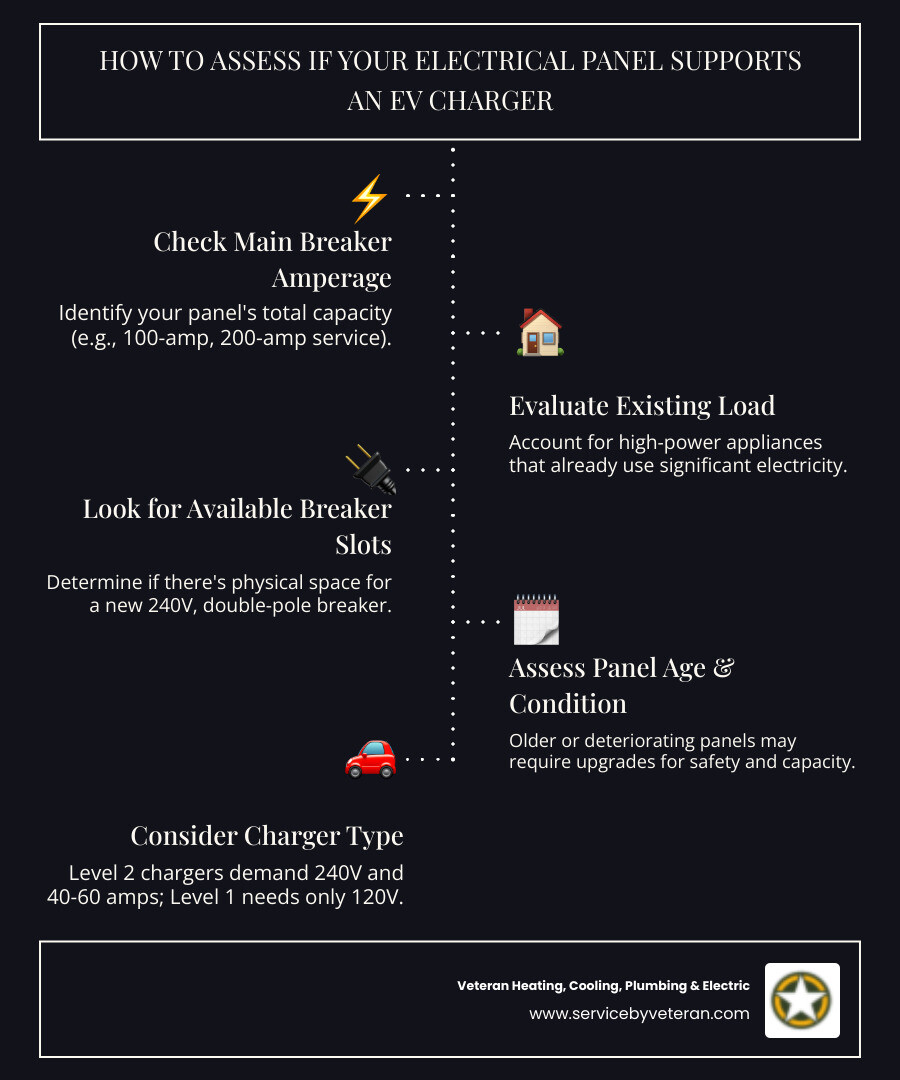
Key factors that determine compatibility:
• Your panel's main breaker amperage rating
• How many high-draw appliances are already running (HVAC, electric dryer, oven, etc.)
• Whether your panel has available breaker slots for a new 240-volt double-pole breaker
• The age and condition of your panel and wiring
• The type of EV charger you plan to install (Level 1 vs. Level 2)
If your home has a modern 200-amp panel with room to spare, you're likely in good shape. If you have a 100-amp panel — common in homes built more than 20 years ago — the answer is far less certain. And if you're still running on 60-amp service, an upgrade isn't optional.
The excitement of bringing home a new electric vehicle can hit a wall fast once you start asking the right questions about your home's electrical system. About 20% of homes require some kind of electrical upgrade before an EV charger can be safely installed — and many homeowners don't find out until an electrician is already standing in front of their panel. Most Level 2 EV chargers demand a dedicated 240-volt circuit drawing 40 to 60 amps of continuous power. That's a significant load — roughly equivalent to adding another electric dryer to your home's electrical system. For older homes in the Denver Metro area, including neighborhoods across Arvada, Lakewood, and Littleton, panels that were perfectly adequate a decade ago can quickly become a bottleneck the moment EV charging enters the picture.
I'm Mike Townsend, a U.S. Army veteran and leader of Veteran Heating, Cooling, Plumbing & Electric, and my background working with precision power systems in the military gives me a understanding of how critical it is to match electrical capacity to real-world demand — which is exactly why I take the question of does your electrical panel support an EV charger seriously for every homeowner we serve. Let's walk through exactly what you need to know to make a safe, informed decision for your home.
Understanding Your Home's Electrical Capacity and Amperage
Think of your electrical panel as the "brain" of your home's power system. It takes the high-voltage electricity coming from the utility line and distributes it safely into various circuits throughout your house. Each panel has a maximum capacity, known as its amperage rating. This rating tells us the total amount of electricity your home can safely draw at any one time.
In the Denver Metro area, we typically see three main sizes:
• 60-Amp Panels: Found in very old homes. These are insufficient for modern life, let alone an EV.
• 100-Amp Panels: Common in homes built between the 1950s and 1980s. These are often "on the edge" when adding an EV charger.
• 200-Amp Panels: The modern standard. If your home was built in the last 20 years or has had an Electric Panel Upgrade, you likely have this capacity.
When you plug in an EV, you aren't just adding a small gadget; you are adding a "continuous load." In the electrical world, a continuous load is something that runs at full power for three hours or more. Because these loads generate consistent heat, the National Electrical Code (NEC) requires that the circuit be sized at 125% of the charger's output. For example, a 48-amp charger actually requires a 60-amp breaker. This is why understanding your total power demand is the first step in home electrification.
A Homeowner's Guide: How to Tell if Does Your Electrical Panel Support an EV Charger
Before you call us out to your home in Golden or Highlands Ranch, you can perform a quick visual "recon" of your own. Open the door to your electrical panel (usually located in the garage, basement, or on an exterior wall).
1. Find the Main Breaker: Look for the largest switch, usually located at the very top or bottom of the panel. It should have a number stamped on it (100, 125, 150, or 200). This is your total amperage.
2. Check for "Open" Slots: A Level 2 EV charger requires a 240-volt circuit. In your panel, this looks like a "double-pole" breaker—one switch that is twice as wide as a standard light circuit. If your panel is completely full of switches with no blank plastic covers left, you lack the physical space for a new dedicated circuit.
3. Look for Tandem Breakers: If you see "thin" breakers (two switches in the space of one), your panel might already be crowded. While these save space, they don't increase the total amperage coming into the house.
If you are unsure about what you're looking at, an Electrician Golden CO from our team can perform a safety inspection to verify your panel's physical and electrical readiness.
Does your electrical panel support an ev charger if you live in an older home with 100-amp service?
This is the most common dilemma we face in older Denver neighborhoods. A 100-amp panel was plenty of power in 1975 when "high tech" meant a microwave and a color TV. Today, between central air conditioning, electric ranges, and high-powered computers, that 100-amp limit is often pushed to 70% or 80% capacity during a hot Colorado summer.
Adding a 40-amp or 50-amp EV charger to a 100-amp panel is often the "straw that breaks the camel's back." If you try to charge your car while the AC is running and someone starts the dryer, you will likely trip the main breaker, plunging the whole house into darkness. In these cases, an Electric Panel Replacement Denver CO is usually the safest and most reliable path forward.
Why a professional load calculation is the only way to know if does your electrical panel support an ev charger
You might hear neighbors say, "I have a 100-amp panel and it works fine!" However, electrical safety isn't based on luck; it's based on math. We use NEC Article 220 to perform a "Load Calculation."
We don't just look at the panel size; we look at:
• The square footage of your home.
• The demand of your HVAC system (especially important for our customers needing EV Chargers Aurora CO).
• Fixed appliances like water heaters, ovens, and hot tubs.
• The 125% safety margin required for continuous loads.
If the math shows your total potential draw exceeds 80% of your panel's rating, the code prohibits us from adding the charger without an upgrade. This protects your home from wire degradation and fire risks.
Comparing Level 1 and Level 2 Charging Requirements
Not all chargers are created equal. Depending on your daily commute in Centennial or Broomfield, you might not need the most powerful charger available.
• Voltage — Level 1 (Standard Outlet): 120 Volts — Level 2 (High Power): 240 Volts
• Amperage Draw — Level 1 (Standard Outlet): 12–16 Amps — Level 2 (High Power): 16–80 Amps (Commonly 40-50)
• Charging Speed — Level 1 (Standard Outlet): 3–5 miles per hour — Level 2 (High Power): 20–60 miles per hour
• Panel Impact — Level 1 (Standard Outlet): Minimal — Level 2 (High Power): Significant
• Circuit Type — Level 1 (Standard Outlet): Shared or Dedicated — Level 2 (High Power): Always Dedicated
If you drive less than 30 miles a day, a Level 1 charger (which plugs into a standard wall outlet) might suffice and rarely requires a panel upgrade. However, most of our customers opting for EV Chargers Centennial CO prefer Level 2 for the "empty-to-full" overnight capability.
Warning Signs Your Panel is Overloaded or Outdated
Sometimes the question isn't just about capacity—it's about safety. As we move through April 2026, many older panels are reaching the end of their functional lifespan. If you notice any of the following, do not attempt to install an EV charger until you've spoken with a professional:
• Flickering Lights: Especially when the refrigerator or AC kicks on.
• Frequent Breaker Trips: A sign that a circuit is consistently overloaded.
• Heat or Smells: If the panel door feels warm to the touch or smells like "fish" or burning plastic, you have a serious arc-fault or overheating issue.
• Recalled Brands: If your home has a Zinsco or Federal Pacific (Stab-Lok) panel, these are documented fire hazards. They often fail to trip even when overloaded, which is a recipe for disaster with a high-draw EV charger.
• Corrosion: Rust or white powdery residue on breakers indicates moisture hit the panel, which can lead to "hot spots."
For residents in Arvada, an Electric Panel Replacement Arvada CO is often necessary if these warning signs are present, regardless of whether you buy an EV.
Smart Alternatives to a Full Electrical Service Upgrade
If your load calculation comes back slightly over the limit, you might not always need a full $5,000 service upgrade. In 2026, technology has given us some clever workarounds:
• Load Management Systems: These "smart" devices monitor your home's total power draw. If you turn on the electric oven and the dryer at the same time, the device will temporarily pause or slow down the EV charger to keep the total house draw within safe limits.
• Circuit Sharing (Smart Splitters): If you have an electric dryer in the garage, a smart splitter allows the dryer and the EV charger to share the same 240V outlet. It prioritizes the dryer and switches power to the car once the laundry is done.
• Subpanels: If your main panel has the amperage (capacity) but is physically out of room for more breakers, we can install a subpanel to add more "slots." This is a popular option for EV Chargers Broomfield CO installations.
At Veteran Heating, Cooling, Plumbing & Electric, we always provide an up-front pricing policy, so you'll know exactly which of these options makes the most sense for your budget and safety before we turn a single screw.
Frequently Asked Questions About EV Panel Compatibility
Can I charge an EV on a 60-amp panel?
In almost every scenario, no. A 60-amp panel is barely enough to run a modern kitchen and a small air conditioner. Adding a Level 2 charger would consume nearly the entire capacity of the home, leading to immediate safety risks and constant power outages.
Do I need a permit for EV charger installation in Lakewood?
Yes. Nearly every jurisdiction in the Denver Metro area, including Lakewood, requires an electrical permit for a new 240V circuit. This ensures a city inspector verifies the work is up to code, which is vital for your homeowner's insurance and future home resale.
What happens if I install a charger on an inadequate panel?
The best-case scenario is that you constantly trip your main breaker. The worst-case scenario is a house fire. Overloaded wires generate heat; if the breaker doesn't trip to stop the flow, that heat can melt insulation and ignite surrounding materials.
Conclusion
Determining does your electrical panel support an EV charger is the most important "pre-flight" check you can do for your new vehicle. While many modern homes in the Denver area are ready to go, older properties often need a little help to join the electric revolution safely.
As a veteran-led, locally owned company, we believe in the military values of integrity and service. We aren't here to sell you an upgrade you don't need, but we will never compromise on your family's safety. Whether you need a simple circuit run or a complex Electric Panel Replacement, our EPA-certified and background-checked technicians are ready to help. We offer a lifetime warranty on parts and labor, and a 10% discount for veterans, seniors, and first responders.
Ready to get your home "EV-ready"? Contact us today to schedule your professional load calculation and safety assessment. From Castle Rock to Broomfield, we've got your back.
ABOUT Veteran Heating, Cooling, Plumbing & Electric
Veteran Heating, Cooling, Plumbing & Electric was founded on the belief that service should be personal, honest, and community-focused. Our team is built around integrity, professionalism, and a true commitment to your home’s comfort and safety.
Led by a U.S. Army veteran with over 30 years of industry experience, we’re proud to remain locally owned and operated. Every technician, plumber, and electrician is EPA-certified, background checked, and driven to exceed expectations.
- 24/7 ServiceWe offer weekend & 24/7 emergency service. We’re here whenever you need us—day, night, or weekend, no exceptions.
- $0 Trip FeesNo dispatch or trip fees. You’ll never pay just for us to show up—service starts when the work does.
OUR SERVICES
AIR CONDITIONING
.jpg)
We offer specialty and seasonal services like indoor air quality upgrades, pre-winter furnace checks, and summer AC tune-ups to keep your home prepared year-round.
Our Primary Air Conditioning Services Include:
Don't see the service you need? Call our Team today!
PLUMBING
From leaks to full system installs, our plumbing services cover everything you need for a safe, reliable home water system, 24/7.
Our Primary Plumbing Include:
- Water Heater Replacement
- Water Heater Repair
- Trenchless Sewer Line
- Water Filtration
- Slab Leak
- Sewer Line Repair
Don't see the service you need? Call our Team today!
ELECTRICAL

Our electrical services ensure your home stays safe and powered, from routine fixes to complete system upgrades.
Our Primary Electrical Services Include:
- House Rewiring
- Electrician
- Electric Panel Upgrade
- Electric Panel Replacement
- EV Chargers
- Whole House Generator
Don't see the service you need? Call our Team today!
HEATING
.jpg)
We install, repair, and maintain heating & furnace systems with expert care to keep your Colorado home comfortable and energy-efficient year-round.
Our Primary Heating Services Include:
- Heating Installation
- Heating Replacement
- Heating Maintenance
- Heating Repair
- Heating Service
- Heating Tune-Up
Don't see the service you need? Call our Team today!