
The Hidden Danger Behind Your Walls This Holiday Season
Before the winter weather fully sets in and the festive displays go up, you need to recognize the signs of overloaded electrical circuits, especially if you live in a home with aging infrastructure. As the season shifts, households undergo a massive, sudden change in power consumption. Families simultaneously plug in high-draw space heaters, string up hundreds of decorative lights, and spend more time indoors running appliances. This abrupt demand creates a perfect storm for hidden thermal damage inside older electrical panels that were never designed to handle modern, high-capacity loads.
When the power suddenly cuts out in the middle of your November holiday prep, you face an immediate decision point. Most homeowners simply walk over to the basement or garage, flip the tripped breaker back to the "on" position, and go about their evening. However, treating a tripped breaker as a minor inconvenience rather than a critical warning sign often leads to dangerous consequences. In our experience inspecting older panels, our teams see the hazardous aftermath of these ignored warnings every single winter. Wires overheat, insulation melts, and the risk of an electrical fire grows silently behind the drywall.
If you are dealing with persistent power losses or concerning electrical symptoms, our veteran-led team triages emergency electrical calls to keep your home safe and secure.
Why Denver's First Freeze Pushes Older Electrical Systems to the Brink
The timing of electrical failures is rarely a coincidence. Here in the region, Denver's average low temperatures drop below freezing in November, which rapidly accelerates the use of supplemental indoor heating right as holiday lighting goes up. This specific window of the year pushes residential electrical systems to their absolute limits.
The Perfect Storm of Seasonal Electricity Demand
A standard space heater operates at roughly 1,500 watts. When you plug that heater into a standard 15-amp bedroom circuit, it consumes nearly the entire capacity of that wiring all by itself. If you then add a string of decorative lights, a television, or a vacuum cleaner to that same circuit, you instantly exceed the safe operating limit. According to data from the National Fire Protection Association (NFPA), heating equipment and electrical distribution are leading causes of winter home structure fires. The combination of sustained, high-draw heating and continuous lighting creates a thermal load that older wiring simply cannot dissipate fast enough.
The Vulnerability of Aging Electrical Panels
Older homes are particularly vulnerable during this seasonal shift. Homes built several decades ago were often equipped with 60-amp or 100-amp electrical panels. Today, a modern household typically requires a 200-amp service just to handle standard daily life safely. When you layer your November holiday prep on top of an already maxed-out 100-amp panel, the system struggles to keep up.
Furthermore, the damage caused by overloading is cumulative. Every time an older panel is forced to handle a load slightly beyond its safe capacity, the internal components degrade. The metal bus bars heat up and cool down, causing expansion and contraction that loosens vital connections. Over several winters, this repeated thermal stress weakens the entire system, making a catastrophic failure much more likely during the next cold snap.
The Danger of Treating a Tripping Breaker as a Nuisance
A circuit breaker is not just an on-off switch for your convenience; it is a highly calibrated, vital safety mechanism. Its sole purpose is to monitor the flow of electricity and immediately stop that flow before the wires inside your walls overheat and catch fire. When a breaker trips, it is doing exactly what it was engineered to do: protecting your property from an active threat.
How Repeated Resets Degrade Safety Mechanisms
Every time you force a tripped breaker back into the "on" position without resolving the underlying overload, you inflict physical wear on the breaker's internal mechanisms. The springs lose their tension, and the internal contacts become pitted and scarred from electrical arcing. If you continually reset a struggling breaker during your November holiday prep, that breaker will eventually fail to trip when a true emergency occurs.
When a compromised breaker fails to cut the power during an overload, the electrical wires behind your drywall act just like the glowing coils inside a toaster. The copper wiring heats up rapidly, melting the protective plastic insulation and transferring that extreme heat directly to the wooden studs and paper-backed drywall surrounding it.
When to Call a Professional
If a breaker trips more than once under the same seasonal load, it requires professional evaluation, not another reset. A technician needs to determine whether the circuit is simply overtaxed by your appliances or if the panel itself is failing.
• Trips once when a new high-draw device is plugged in — Probable Cause: Temporary overload on a single circuit — Recommended Action: Unplug the device, reset the breaker once. Relocate the device to a different circuit.
• Trips repeatedly when the same device is used — Probable Cause: Sustained overload exceeding circuit capacity — Recommended Action: Leave the breaker off. Do not reset. Call a professional to evaluate the load.
• Breaker feels loose, spongy, or won't stay in the "on" position — Probable Cause: Internal mechanical failure of the breaker — Recommended Action: Leave the breaker alone. A professional must inspect and likely replace the component.
• Multiple different breakers trip simultaneously — Probable Cause: Total panel capacity exceeded or main bus bar failure — Recommended Action: Immediate professional assessment required. You may need a panel upgrade.
Touch and Smell: Detecting Hidden Thermal Damage
Because electrical wires are hidden behind drywall, the most dangerous thermal damage occurs entirely out of sight. However, as an electrical overload progresses, it produces clear sensory warning signs that indicate safety mechanisms are already failing. Using your senses of touch and smell can help you catch a severe hazard before it escalates.
Sensory Red Flags to Watch For
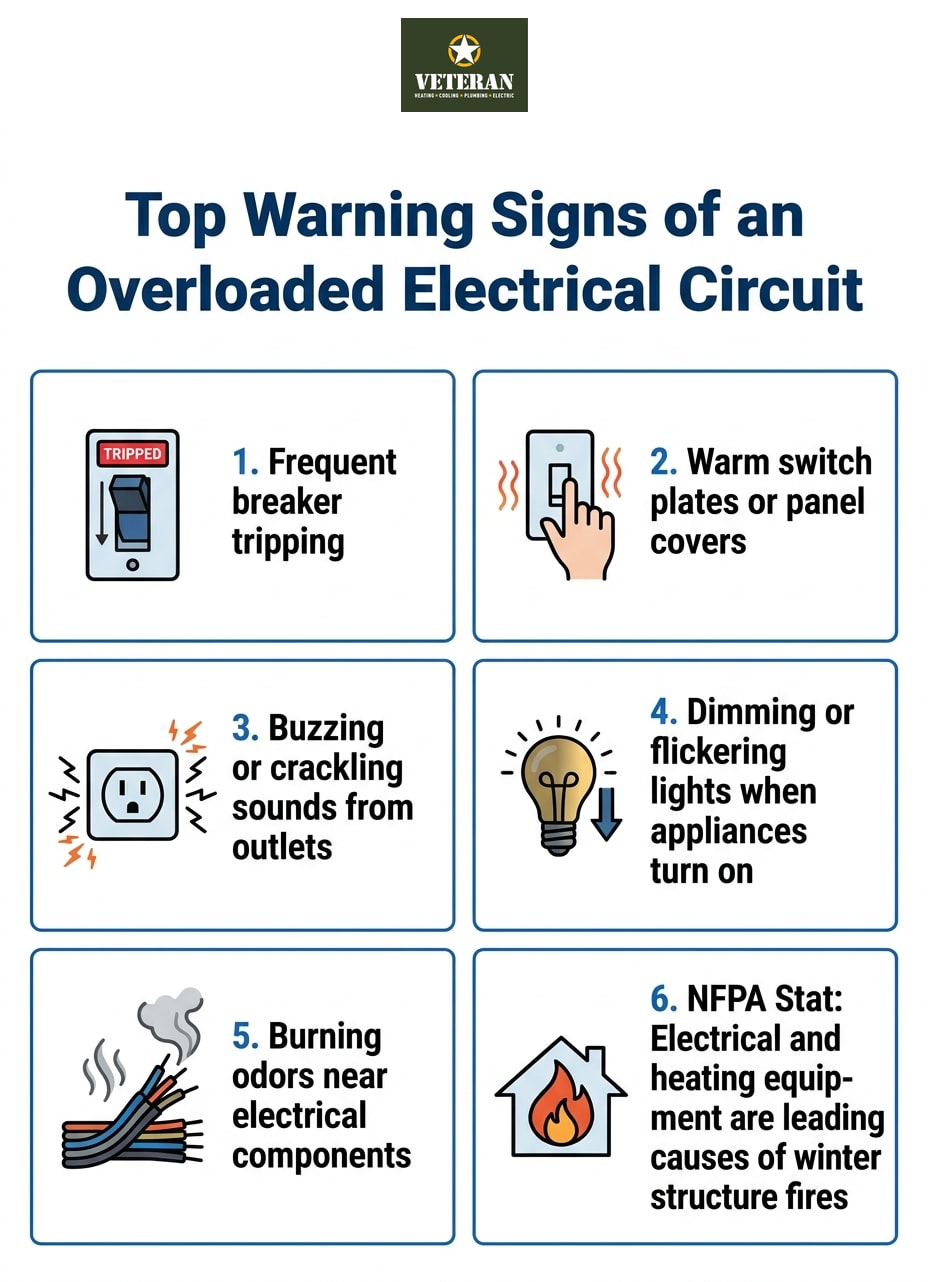
• Warm switch plates or panel covers: Electrical components should always feel room temperature to the touch. If you place your hand on a wall outlet, a light switch, or the metal door of your electrical panel and it feels noticeably warm, excess heat is actively building up behind the surface. This is a primary indicator of an overloaded circuit.
• Discoloration or scorch marks: Look closely at the plastic faceplates of your outlets. If you see yellowing, browning, or black soot-like marks around the plug slots, the wiring behind the plate has been repeatedly overheating. This means the insulation is likely melting away.
• Persistent burning plastic odors: A distinct smell of burning plastic near an outlet or a closed electrical panel is an immediate red flag. This odor occurs when the protective sheathing on the wiring gets hot enough to melt.
• A sharp, ozone-like smell: Sometimes described as a "fishy" or "metallic" odor, an ozone smell indicates that electricity is jumping through the air (arcing) due to loose connections. This requires immediate intervention.
If you detect any of these sensory clues, the risk of an electrical fire is active. Turn off the power to that area at the main breaker if it is safe to do so, and reach out for help with a serious electrical issue immediately.
Dimming Lights and Buzzing Outlets: What They Tell Us
Your home's electrical system should deliver a steady, uninterrupted flow of power. When you begin to notice auditory and visual fluctuations, your panel is communicating that it is overtaxed. While a very slight dimming might seem normal in much older homes, it is actually a clear indicator that the electrical panel is struggling to distribute power safely under modern demands.
Understanding Voltage Drops
If the lights in your living room dim or flicker every time a space heater, vacuum cleaner, or refrigerator cycles on, you are witnessing a voltage drop. This happens when a high-draw appliance demands a massive surge of current to start its motor or heating element. If the circuit or the main panel lacks the capacity to supply that surge, it pulls power away from other devices on the line, causing the lights to dim. Frequent voltage drops put unnecessary strain on all the sensitive electronics plugged into your home, shortening their lifespan and indicating that the circuit is severely overloaded.
The Danger of Buzzing and Crackling
Electricity should flow silently. If you hear a buzzing, humming, or crackling sound emerging from a wall switch, an outlet, or the main breaker box, you are listening to electrical arcing. Arcing occurs when electricity jumps across a gap between loose, degraded, or damaged wire connections. These miniature electrical jumps create intense, localized heat—often reaching thousands of degrees in a fraction of a second. If you hear these sounds alongside finding warm switch plates or panel covers, the hardware is actively deteriorating and poses a severe fire risk.
Our Disciplined Approach to Diagnosing Electrical Overloads
Working with a veteran-owned company means you are getting the same level of discipline, accountability, and rigorous methodology that military service demands. We approach electrical safety with a strict, safety-first mindset. We do not guess when it comes to the structural integrity of your home's wiring, and we never recommend a "wait and see" approach when hidden thermal damage is suspected.
The Professional Inspection Methodology
When our technicians arrive to evaluate an older panel, the first step is always securing the area and identifying immediate hazards. We never advise homeowners to open their own electrical panels or attempt DIY diagnostics, as the voltage inside can be lethal. Instead, our professionals use specialized diagnostic tools to measure the actual amperage draw on the circuits in real-time, comparing that data directly against the panel's rated capacity.
Next, we inspect the physical condition of the wiring inside the panel box. We look for melted insulation, scorched bus bars, and signs of oxidation that indicate long-term overheating. If an overload is confirmed, we trace the circuit to inspect behind the drywall for compromised insulation at the outlet level.
Once the immediate danger is mitigated, we outline a clear triage process. If the issue is isolated, we may redistribute the load by running a new, dedicated circuit for your heavy appliances. If the entire system is maxed out, we will recommend a comprehensive electrical load assessment to determine if a full panel upgrade is required to handle your home's modern energy needs safely.
Frequently Asked Questions About Overloaded Circuits
What happens if an electrical circuit is overloaded?
The circuit breaker is designed to trip and cut off the power supply immediately. This is a vital safety response. If the circuit breaker fails to trip or is faulty, the excess electrical current forces the wiring to overheat rapidly. This intense heat melts the plastic wire insulation and creates a severe fire hazard inside your walls.
Can an overloaded circuit cause a fire?
Yes, overloaded circuits are one of the leading causes of electrical fires in residential homes. When excess current flows through a wire that is not rated to handle it, the wire generates extreme heat. This heat degrades the protective insulation over time and can easily ignite surrounding combustible materials, such as wooden wall studs, insulation, or drywall paper.
What are the signs of a bad electrical panel?
Frequent breaker trips, burning smells, buzzing sounds, and visible scorch marks are primary indicators. You might also notice breakers that will not stay in the reset position, breakers that feel loose or spongy when switched, or visible rust inside the panel box. Any of these symptoms mean the panel is failing to distribute power safely and requires professional replacement.
How do you fix an overloaded circuit?
The immediate fix is to unplug high-draw devices and redistribute them to different circuits. However, this is only a temporary management strategy. The long-term, safe fix requires having a professional electrician perform an assessment. They will likely need to install new, dedicated circuits for heavy appliances or upgrade the entire main panel to increase the home's total amperage capacity.
Is it safe to run a space heater and holiday lights on the same circuit?
Generally, no, it is not safe to combine these loads on a standard circuit. Space heaters require a massive amount of continuous power to generate heat. Combining a 1,500-watt space heater with strings of decorative lights on a standard 15-amp bedroom or living room circuit during your November holiday prep easily exceeds the safe capacity of the wiring, leading to tripped breakers and overheating.
Secure Your Home's Safety Before the Holidays
When your home's electrical system starts communicating through tripping breakers, flickering lights, or warm switch plates or panel covers, it is time to stop resetting the system and take definitive action. These clear, recognizable warning signs indicate that your older panel is struggling to safely manage the seasonal demand. Catching these issues early prevents catastrophic holiday emergencies and protects your property from the hidden dangers of thermal damage.
Do not wait for a complete power failure to find out your system is dangerously overtaxed. If you have noticed any signs of overloaded electrical circuits this season, schedule a professional evaluation today to ensure your home can handle the winter demand safely and reliably.
ABOUT Veteran Heating, Cooling, Plumbing & Electric
Veteran Heating, Cooling, Plumbing & Electric was founded on the belief that service should be personal, honest, and community-focused. Our team is built around integrity, professionalism, and a true commitment to your home’s comfort and safety.
Led by a U.S. Army veteran with over 30 years of industry experience, we’re proud to remain locally owned and operated. Every technician, plumber, and electrician is EPA-certified, background checked, and driven to exceed expectations.
- 24/7 ServiceWe offer weekend & 24/7 emergency service. We’re here whenever you need us—day, night, or weekend, no exceptions.
- $0 Trip FeesNo dispatch or trip fees. You’ll never pay just for us to show up—service starts when the work does.
OUR SERVICES
AIR CONDITIONING

We offer specialty and seasonal services like indoor air quality upgrades, pre-winter furnace checks, and summer AC tune-ups to keep your home prepared year-round.
Our Primary Air Conditioning Services Include:
Don't see the service you need? Call our Team today!
PLUMBING
From leaks to full system installs, our plumbing services cover everything you need for a safe, reliable home water system, 24/7.
Our Primary Plumbing Include:
- Water Heater Replacement
- Water Heater Repair
- Trenchless Sewer Line
- Water Filtration
- Slab Leak
- Sewer Line Repair
Don't see the service you need? Call our Team today!
ELECTRICAL

Our electrical services ensure your home stays safe and powered, from routine fixes to complete system upgrades.
Our Primary Electrical Services Include:
- House Rewiring
- Electrician
- Electric Panel Upgrade
- Electric Panel Replacement
- EV Chargers
- Whole House Generator
Don't see the service you need? Call our Team today!
HEATING

We install, repair, and maintain heating & furnace systems with expert care to keep your Colorado home comfortable and energy-efficient year-round.
Our Primary Heating Services Include:
- Heating Installation
- Heating Replacement
- Heating Maintenance
- Heating Repair
- Heating Service
- Heating Tune-Up
Don't see the service you need? Call our Team today!