
The Cold Shower Surprise: When Standard Sizing Meets Holiday Reality
Your house is full of visiting relatives, the dishwasher is running from last night's feast, and the third guest to take a shower is suddenly hit with freezing water. Wait—didn't you invest in a "limitless" hot water system? When it comes to tankless water heater sizing, standard calculations often fail to account for the simultaneous demand of a full house combined with freezing late-fall groundwater.
Many homeowners assume that buying any tankless unit guarantees unlimited hot water forever. The reality is that sizing a system for a typical Tuesday in May is entirely different from sizing it for peak November holiday hosting. When the guest rooms are full and the temperature outside plummets, your plumbing system faces a massive stress test.
The core decision you face before upgrading is whether to size your new unit based strictly on year-round average use, or to upsize the capacity specifically for peak holiday hosting. At Veteran Heating, Cooling, Plumbing & Electric, our team has responded to countless panicked calls on Thanksgiving morning. In our experience serving Denver homeowners, achieving true endless hot water requires a deep understanding of local climate variables and peak demand scenarios. If you do not account for the coldest days and the busiest mornings, that "endless" system will leave your guests shivering.
Understanding the Fundamentals of Tankless Capacity
To understand why a supposedly limitless system can suddenly run out of hot water, we first need to look at how these units actually operate. "Endless" hot water is a bit of a marketing term. The supply is endless in duration—you will never drain a storage tank—but it is strictly limited by how fast the water can be heated at any given moment. This performance is governed by two critical metrics.
Gallons Per Minute (GPM) Explained
Gallons Per Minute (GPM) is the volume of water the unit can physically process and push through your pipes at one time. Every fixture in your home demands a certain GPM flow rate. When multiple fixtures run at once, their demands add up quickly.
• Standard showerheads: Typically demand 2.0 to 2.5 GPM each.
• Kitchen sinks: Usually draw about 1.5 to 2.0 GPM.
• Dishwashers: Generally require 1.0 to 2.0 GPM while filling.
• Washing machines: Can pull anywhere from 1.5 to 3.0 GPM depending on the cycle.
If you have two showers running while the dishwasher is on, your home is demanding roughly 6.0 to 7.0 GPM simultaneously. If your tankless unit is only rated to deliver 5.0 GPM under current conditions, it cannot keep up. The system will either restrict the water flow to a trickle to ensure it reaches the target temperature, or it will let the water pass through without fully heating it.
The Role of Temperature Rise (Delta T)
The second, and arguably more important, metric is Temperature Rise, often referred to as Delta T. This is the difference between the temperature of the incoming cold water from the city main and your desired hot water output (usually set to 120 degrees Fahrenheit for safety and comfort).
There is an inverse relationship between Temperature Rise and GPM capacity. As the required Temperature Rise increases, the maximum GPM capacity of the unit decreases. The heat exchanger inside the unit only has so much heating power (measured in BTUs). If it has to work twice as hard to heat freezing water, it can only process half as much water per minute. The advertised maximum GPM printed on the outside of the box is usually based on warm southern climates with a very low Delta T requirement—not realistic winter conditions in colder regions.
The Hidden Factor: How Freezing Groundwater Changes the Math
The biggest variable that generic manufacturer sizing charts ignore is the extreme drop in local water temperatures. Municipal water pipes are buried underground, but they are still heavily influenced by the frost line and the ambient temperature of the soil above them.
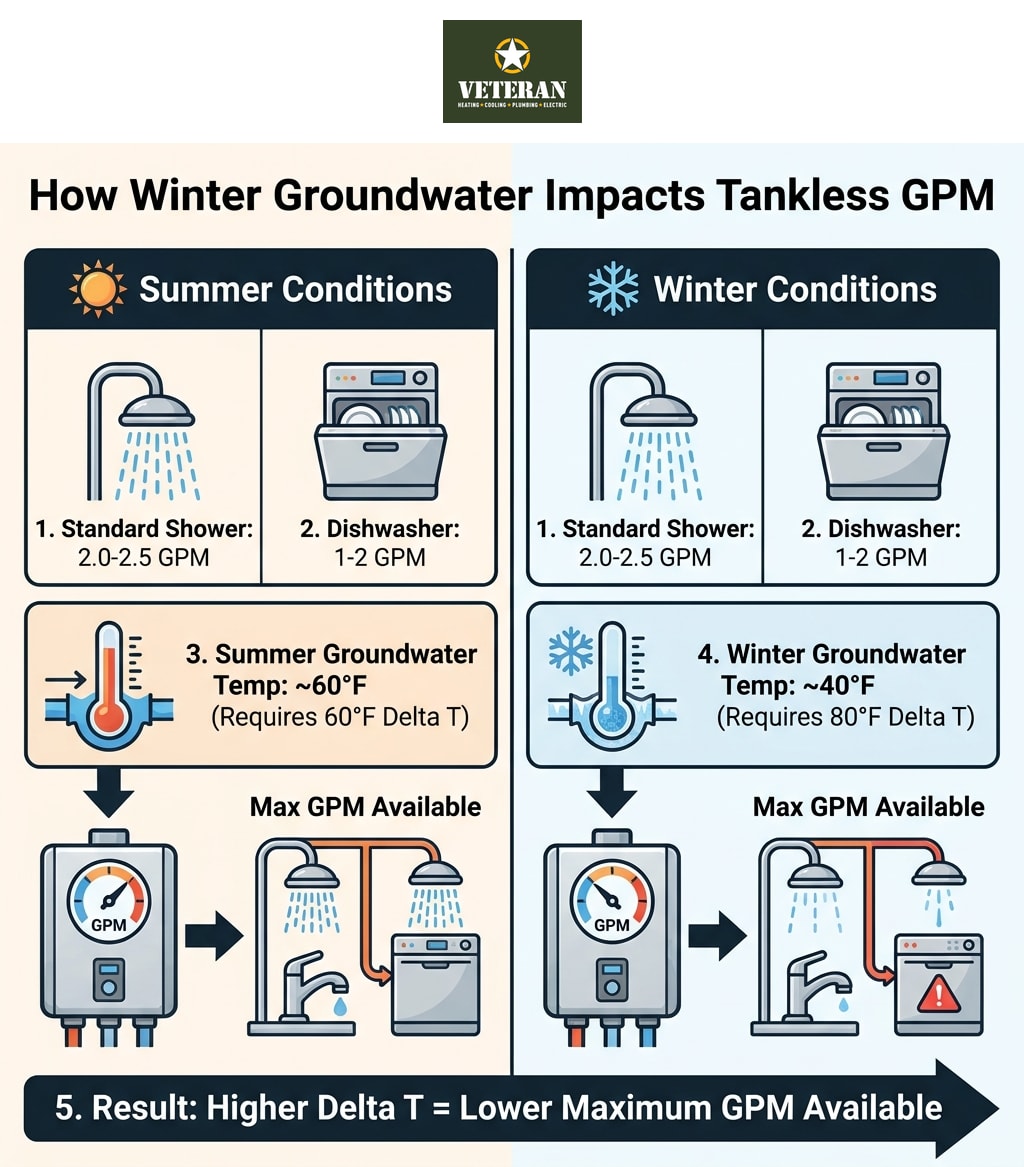
In Denver, our technicians see winter groundwater temperatures drop significantly compared to national averages. During the late fall and winter months, incoming water can plummet to 40 degrees Fahrenheit or even lower. To reach a safe, comfortable 120-degree output at your showerhead, the tankless unit must execute an 80-degree temperature rise.
This massive Delta T requirement drastically reduces the unit's effective flow capacity. A unit that effortlessly delivers 8.0 GPM in Florida during the summer might only be capable of delivering 4.0 GPM in Denver during the winter. This severe reduction in capacity happens right when homeowners need hot water the most.
• Summer (National Average) — Incoming Water Temp: 65°F — Target Output Temp: 120°F — Required Delta T: 55°F — Effective GPM Capacity: High (Often matches box rating)
• Denver Winter — Incoming Water Temp: 40°F — Target Output Temp: 120°F — Required Delta T: 80°F — Effective GPM Capacity: Low (Severely reduced)
The climate reality: If you size your system based on a national chart that assumes a 50-degree Delta T, your system will be fundamentally undersized for a Denver winter, regardless of how many bathrooms you have.
The Breaking Point: Simultaneous Demand During the Holidays
When you combine the climate factor with the seasonal usage factor, you uncover the worst-case scenario that every homeowner must plan for. The breaking point rarely happens during a normal workweek. It happens when you are hosting.
Consider a typical morning during November holiday hosting. You have extended family staying in the guest rooms. At 7:30 AM, two showers are running back-to-back or simultaneously. Downstairs, the dishwasher is running from the night before, or perhaps the washing machine is churning through a load of guest towels. Your home is suddenly demanding 7.0 GPM of hot water.
Because it is late November, the incoming groundwater is freezing cold. Your tankless unit, which is working overtime to achieve an 80-degree Delta T, has had its maximum capacity reduced to 4.5 GPM. The math simply does not work.
The result: The system hits its breaking point. To protect the heat exchanger and attempt to reach the target temperature, the unit restricts the water flow. The showers lose pressure, the water turns lukewarm, and your guests are left shivering. Sizing for the average Tuesday in May guarantees failure on Thanksgiving morning. You must plan for the peak load.
Our Methodology: Calculating Real-World Flow Rates
Properly sizing a tankless system is not a matter of guessing based on the square footage of your home or the number of bathrooms you have. It requires a rigorous, professional load calculation. As a veteran-owned company, the team at Veteran Heating, Cooling, Plumbing & Electric applies strict discipline to this process. Whether we are working in a historic Denver home or a newer build, we do not guess sizes based on national averages; we perform precise local load calculations to ensure the unit handles peak holiday demand without failing.
In our experience, a reliable sizing methodology involves a strict two-step formula to determine the exact Gallons Per Minute (GPM) flow rate with cold incoming water.
1. Calculate Peak Simultaneous GPM: We map out every hot water fixture in the home. We then consult with you about your lifestyle. Do you host extended family? Do you run the dishwasher while people are showering? We tally up the absolute maximum GPM your home will demand at any one time.
2. Determine Required Winter Temperature Rise: We factor in the specific winter groundwater temperatures for your neighborhood. We calculate the exact Delta T required to take that freezing water up to 120 degrees.
3. Cross-Reference the Performance Curve: Finally, we take that peak GPM demand and cross-reference it against the specific manufacturer's performance curve for that exact Delta T. We find a unit whose reduced winter capacity still exceeds your home's peak simultaneous demand.
This is a complex professional calculation. It also involves assessing your home's gas line and venting infrastructure, as upsizing a unit to meet high winter demand often requires a system capable of drawing significantly more BTUs.
The Verdict: Why Upsizing is the Safest Bet for Peak Demand
When winter weather and houseguests collide, a pattern we see often across the Front Range is that standard sizing leaves zero margin for error. The verdict is clear: upsizing the unit's capacity is the safest bet for reliable comfort.
Choosing a model with a higher maximum GPM at a high Delta T acts as an insurance policy. It guarantees that even on the coldest morning of the year, with every guest room occupied, your plumbing system will deliver the hot water you need. You are essentially buying the capacity to handle the worst-case scenario.
A common concern homeowners have is that an upsized unit will waste energy. Fortunately, modern tankless technology makes this a non-issue. An upsized tankless unit does not waste energy like an oversized traditional storage tank would. Tankless systems modulate their burners. If you only turn on one bathroom sink, the upsized unit will simply fire at a very low capacity, using only the precise amount of energy needed for that small demand. It still only heats water on demand.
The slight difference in initial equipment choice pays off massively in guaranteed reliability and peace of mind when hosting.
Preparing Your Home: Timelines and Next Steps
If you are planning to upgrade your water heating system before the holidays, do not wait until your guests are already on their way. Proper sizing, permitting, and professional installation require advance planning.
Because upsizing a unit to handle heavy winter loads might require modifications to your gas lines, electrical connections, or venting, the process takes coordination. A professional assessment is the first step to ensuring your home's infrastructure can support the high-capacity unit you need.
Understanding what happens after you select your unit is just as important as the sizing calculation itself. To set the right expectations for the process, we highly recommend learning more about tankless water heater installation timelines. Knowing the steps involved will help you schedule your upgrade well before the first freeze—and the first wave of relatives—arrives.
Frequently Asked Questions About Tankless Sizing for Winter
What size tankless water heater do I need for a family of 4?
A family of four typically needs a tankless water heater capable of delivering at least 7.0 to 9.0 GPM, but this depends heavily on your local climate. In colder regions where winter groundwater temperatures drop significantly, you will likely need a higher-capacity unit (often 199,000 BTUs) to maintain that flow rate. The exact size requires calculating how many showers and appliances your family runs simultaneously during the morning rush. A professional load calculation is always the safest approach.
How many GPM do I need for 2 showers running at once?
Two standard showers running simultaneously will require between 4.0 and 5.0 GPM of hot water. However, you must also account for any background appliances that might be running, such as a dishwasher or washing machine. To guarantee uninterrupted flow for those two showers during the winter, your tankless unit must be capable of delivering that 5.0 GPM even when the incoming water is freezing cold, which requires a high-capacity heat exchanger.
Does winter groundwater temperature affect tankless water heaters?
Yes, winter groundwater drastically affects tankless water heater performance. As the incoming water temperature drops, the unit has to work much harder to heat the water to your desired output temperature. This increased workload (a higher Temperature Rise or Delta T) forces the unit to slow down the flow of water to ensure it gets fully heated. Consequently, a unit's maximum GPM capacity is significantly lower in the winter than in the summer.
How do I calculate tankless water heater size for holiday guests?
To calculate for holiday guests, you must plan for the peak simultaneous demand rather than your everyday usage. Count the maximum number of showers that will run at the exact same time, add the GPM of your dishwasher or washing machine if they run concurrently, and total the required GPM. Then, cross-reference that peak GPM against a manufacturer's performance chart specifically looking at the extreme winter temperature drop for your area, not the national average.
What is temperature rise (Delta T) in water heaters?
Temperature rise, or Delta T, is the difference between the temperature of the cold water entering your home and the desired hot water temperature leaving the heater. If your incoming city water is 40 degrees and you want 120-degree water at your shower, your required Delta T is 80 degrees. The higher the required temperature rise, the lower the volume of water the tankless unit can heat per minute.
Will upsizing my tankless water heater waste energy?
No, upsizing a tankless water heater does not waste energy. Unlike traditional tank water heaters that suffer from standby heat loss by keeping a massive reservoir of water hot 24/7, tankless units only fire when there is a demand for hot water. Modern upsized units feature modulating gas valves that can turn down the flame for small tasks like washing your hands, meaning they only consume the exact amount of energy required for the task at hand.
Ensure Your Home is Ready for the Holidays
Understanding the severe impact of winter groundwater and the heavy simultaneous usage of houseguests empowers you to make the right choice for your home. By acknowledging these factors, you can avoid the frustration of cold showers and restricted water pressure right when you need comfort the most. Proper tankless water heater sizing is not a guessing game; it is a precise calculation designed to protect your peace of mind. Before the holiday season arrives and the temperatures drop, consult with a professional to perform an accurate load calculation and explore high-demand water heating options tailored to your specific needs.
ABOUT Veteran Heating, Cooling, Plumbing & Electric
Veteran Heating, Cooling, Plumbing & Electric was founded on the belief that service should be personal, honest, and community-focused. Our team is built around integrity, professionalism, and a true commitment to your home’s comfort and safety.
Led by a U.S. Army veteran with over 30 years of industry experience, we’re proud to remain locally owned and operated. Every technician, plumber, and electrician is EPA-certified, background checked, and driven to exceed expectations.
- 24/7 ServiceWe offer weekend & 24/7 emergency service. We’re here whenever you need us—day, night, or weekend, no exceptions.
- $0 Trip FeesNo dispatch or trip fees. You’ll never pay just for us to show up—service starts when the work does.
OUR SERVICES
AIR CONDITIONING

We offer specialty and seasonal services like indoor air quality upgrades, pre-winter furnace checks, and summer AC tune-ups to keep your home prepared year-round.
Our Primary Air Conditioning Services Include:
Don't see the service you need? Call our Team today!
PLUMBING
From leaks to full system installs, our plumbing services cover everything you need for a safe, reliable home water system, 24/7.
Our Primary Plumbing Include:
- Water Heater Replacement
- Water Heater Repair
- Trenchless Sewer Line
- Water Filtration
- Slab Leak
- Sewer Line Repair
Don't see the service you need? Call our Team today!
ELECTRICAL

Our electrical services ensure your home stays safe and powered, from routine fixes to complete system upgrades.
Our Primary Electrical Services Include:
- House Rewiring
- Electrician
- Electric Panel Upgrade
- Electric Panel Replacement
- EV Chargers
- Whole House Generator
Don't see the service you need? Call our Team today!
HEATING

We install, repair, and maintain heating & furnace systems with expert care to keep your Colorado home comfortable and energy-efficient year-round.
Our Primary Heating Services Include:
- Heating Installation
- Heating Replacement
- Heating Maintenance
- Heating Repair
- Heating Service
- Heating Tune-Up
Don't see the service you need? Call our Team today!