The Simple Idea Behind Home Cooling
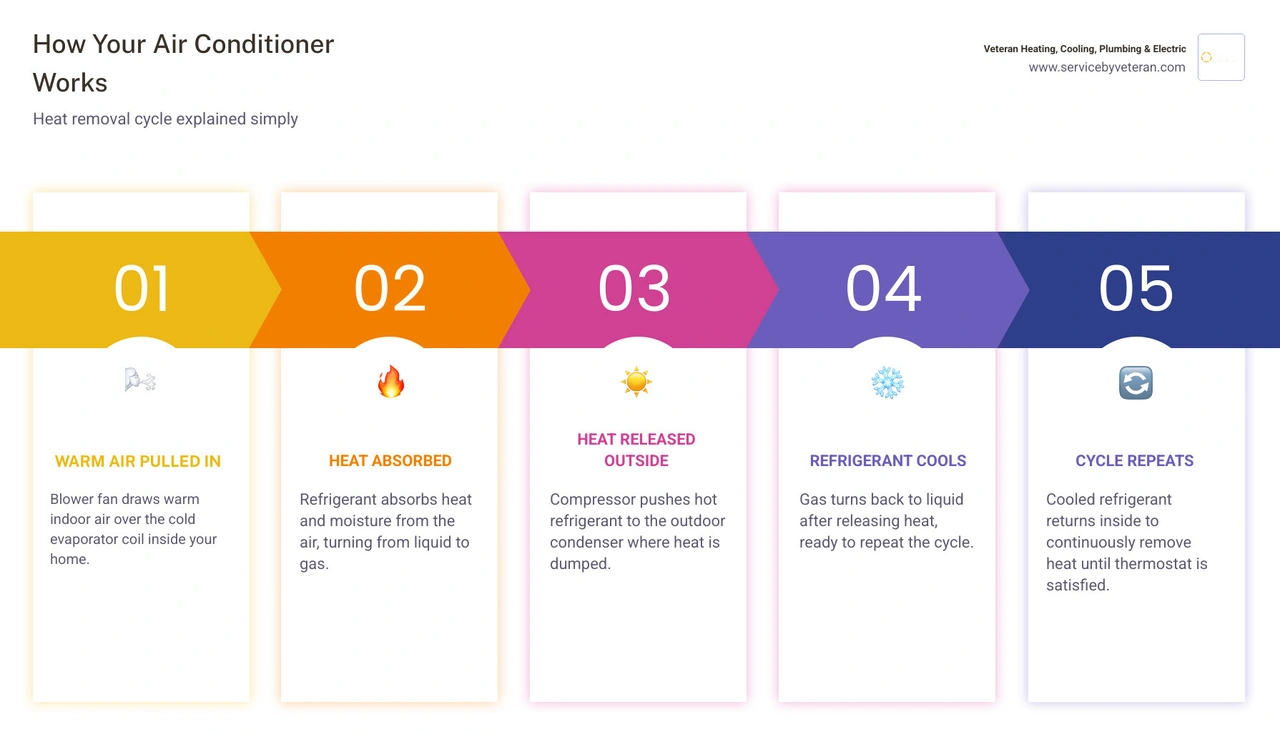
How your air conditioner works explained simply comes down to one core idea: your AC does not create cold air — it removes heat from inside your home and moves it outside. Here is a quick breakdown:
1. Warm air from inside your home is pulled over a cold coil
2. Refrigerant inside that coil absorbs the heat (and moisture) from the air
3. The heated refrigerant travels outside to the condenser unit, where that heat is released outdoors
4. The cooled refrigerant cycles back inside and the process repeats until your thermostat reaches the set temperature
That loop runs continuously, quietly transferring heat out of your living space while also reducing humidity — which is a big part of why your home feels comfortable on a hot summer day.
Most people assume an AC is pumping cold air in. In reality, it is a heat removal machine. Understanding that one shift in thinking makes everything else about your system much easier to follow.
At Veteran Heating, Cooling, Plumbing & Electric, we help homeowners across the Denver Metro area better understand and care for their cooling systems. As a veteran-owned and operated company led by a U.S. Army veteran with over 30 years of industry experience, we bring a service-first approach rooted in integrity, craftsmanship, and community values.
How Your Air Conditioner Works Explained Simply
Think of your AC like a refrigerator for your house. It does not “make cold.” It moves heat from one place to another using a sealed refrigerant loop.
In simple terms, warm indoor air goes in, heat gets removed, and cooler air comes back out. Behind the scenes, the same four-stage refrigeration cycle keeps repeating:
1. Evaporation
2. Compression
3. Condensation
4. Expansion
That may sound technical, but the idea is simple: refrigerant absorbs heat inside your home, carries it outside, releases it there, and then resets to do it again.
One important point: most home AC systems do not pull in outdoor air for day-to-day cooling. They usually recirculate indoor air, cool it, dehumidify it, and send it back through your vents.
Step 1: Your AC pulls warm indoor air over a cold coil
Your system starts by drawing air from inside your home through return vents. That air passes through an air filter, which helps catch dust and debris, and then moves across the evaporator coil.
The evaporator coil is cold because it contains low-pressure refrigerant. As warm indoor air blows over that coil:
• Heat leaves the air and moves into the refrigerant
• Moisture in the air condenses on the coil
• The blower fan sends the cooler, drier air back into your home
This is why AC helps with comfort in two ways at once: lower temperature and lower humidity.
If you have ever seen a cold drink “sweat” on a summer day, you already understand the basic idea. Warm, humid air touches a cold surface, and water forms on that surface.
Step 2: Refrigerant carries heat outside and dumps it there
Once the refrigerant absorbs indoor heat, it leaves the evaporator as a warmer vapor and travels to the outdoor unit.
Outside, the compressor pressurizes that refrigerant. When pressure rises, temperature rises too. That matters because now the refrigerant is hot enough to release its heat to the outdoor air.
Then the refrigerant moves through the condenser coil. The outdoor fan blows air across that coil and pushes the heat outdoors.
So the outdoor unit is not just sitting there making noise for fun. It is doing the hard work of rejecting the heat your home no longer wants.
All of this happens in a closed system. Refrigerant should not get “used up” like gasoline in a car. If refrigerant is low, that usually points to a leak and should be checked by a professional.
Step 3: The cycle resets and repeats until your thermostat is satisfied
After the refrigerant releases heat outdoors, it passes through an expansion valve or metering device.
This part lowers the refrigerant’s pressure quickly. When pressure drops, temperature drops too. That turns the refrigerant back into a cold, low-pressure state so it can head indoors and absorb more heat again.
The cycle keeps repeating until your thermostat senses that your home has reached the set temperature. Then the system cycles off or slows down, depending on the equipment.
That is the whole process in plain English: pull in warm air, remove heat and moisture, send the heat outside, and repeat.
The Main Parts That Make an Air Conditioner Work
A typical central AC system has indoor parts, outdoor parts, and a few supporting pieces that help everything work together. If you want help with the full system, here is more about our AC service.
Indoor parts: where cooling and dehumidifying happen
The indoor side usually includes:
• Evaporator coil
• Blower motor
• Air filter
• Condensate pan
• Condensate drain line
• Supply plenum and vents
The evaporator coil is where heat absorption happens. The blower motor moves air across the coil and through your ductwork. The filter protects airflow and indoor air quality by catching dust and particles.
As humidity condenses on the coil, water drips into the condensate pan and exits through the drain line. If that drain gets clogged, you can end up with water leaks or shutdowns.
Outdoor parts: where the heat is rejected
The outdoor unit usually contains:
• Compressor
• Condenser coil
• Fan motor and fan blade
• Cabinet
• Refrigerant lines connected to the indoor coil
The compressor is often called the heart of the system because it keeps refrigerant moving and raises its pressure. The condenser coil lets that refrigerant release heat, and the fan helps carry that heat away into the outdoor air.
In a split system, the indoor and outdoor pieces work as one matched cooling system.
Why refrigerant is so important
Refrigerant is the heat-transfer fluid that makes air conditioning possible.
Its job is to change state over and over in a sealed loop:
• Liquid refrigerant absorbs heat and boils into a gas
• Gas refrigerant is compressed and becomes hotter
• Hot refrigerant releases heat and condenses back into a liquid
• The liquid expands, cools down, and starts over
That repeated liquid-to-gas and gas-to-liquid change is the engine behind cooling. Without refrigerant, your AC has no practical way to pick up heat indoors and dump it outside.
Modern refrigerants have also changed over time because of environmental regulations. Older chlorine-containing refrigerants were phased out to reduce harm to the ozone layer, and newer systems use updated refrigerants designed with those concerns in mind.
How AC Removes Heat and Humidity From Your Home
Cooling is only half the comfort story. Humidity matters a lot too.
When indoor air is humid, your home feels sticky and warmer than the thermostat says. When your AC removes moisture, the same room can feel noticeably more comfortable even if the temperature only changes a little.
Most modern air-conditioning systems aim to help keep indoor relative humidity in a comfortable range, often around 30% to 60% in occupied spaces.
Does an air conditioner pull air from outside or recirculate indoor air?
In most homes, your air conditioner mainly recirculates indoor air.
Here is the usual path:
1. Air enters return vents
2. Air passes through the filter and over the evaporator coil
3. Air is cooled and dried
4. Air returns to rooms through supply vents
So if you have ever wondered whether central AC is constantly bringing in hot summer air from outside, the answer is usually no.
Some homes may have separate ventilation equipment or fresh-air systems, but the cooling process itself typically works by reusing and conditioning the air already inside your home.
How your air conditioner works explained simply when humidity is high
High humidity makes your AC work harder because it is removing both heat and moisture.
When warm, damp air hits the cold evaporator coil:
• Water vapor condenses into liquid water
• That water collects and drains away
• The air blowing back into your home feels less muggy
This is why your home can feel better before the thermostat drops much. Drier air feels cooler to your body. On very humid days, a residential AC can remove a surprising amount of water from the air.
And yes, that little drain line is carrying away real water your AC pulled from your house. Your system is basically cooling and wringing out the air at the same time.
Why airflow matters for even cooling
Even the best AC cannot perform well without proper airflow.
Good airflow helps your system:
• Cool rooms evenly
• Prevent hot and cold spots
• Protect the evaporator coil from freezing
• Reduce unnecessary energy use
Poor airflow can come from:
• Dirty filters
• Closed or blocked vents
• Dirty coils
• Blower problems
• Leaky or damaged ductwork
Duct issues matter more than many homeowners realize. Leaky ducts can waste a large share of conditioned air before it reaches your rooms. If your system is struggling, uneven airflow may be part of the problem. Learn more about AC repair.
Different Types of Air Conditioners and How They Work
Not every home uses the same kind of cooling equipment. The good news is that most types still rely on the same basic refrigeration cycle.
If you are planning a new system, you can also explore our AC installation services.
• Central AC — How it works: Uses indoor and outdoor units plus ductwork to cool the whole home — Best fit: Homes with existing ducts
• Ductless mini-split — How it works: Uses an outdoor unit and one or more indoor air handlers for zoned cooling — Best fit: Homes without ducts or room-by-room control
• Window unit — How it works: Self-contained unit cools one room — Best fit: Smaller spaces
• Portable AC — How it works: Pulls room air, cools it, and exhausts heat through a hose — Best fit: Temporary or spot cooling
• Packaged unit — How it works: All major components are housed in one cabinet — Best fit: Homes with limited indoor equipment space
• Heat pump — How it works: Similar to AC, but can reverse operation for heating too — Best fit: Year-round heating and cooling
Central air conditioners
Central AC is the most common whole-home system.
It usually has:
• An indoor evaporator coil
• An outdoor condenser unit
• A thermostat
• Ductwork to distribute air throughout the home
The thermostat tells the system when cooling is needed. The blower moves air through the ducts, and cooled air reaches multiple rooms through supply vents.
For many homes in the Denver Metro area, central air is the go-to choice when ductwork is already in place.
Ductless mini-splits, window units, and portable ACs
Ductless mini-splits work a lot like central AC, but without ductwork. Instead, individual indoor units cool specific rooms or zones. That can be useful when you want different temperatures in different areas of the house.
Window units are compact systems that cool a single room. Portable units also cool a room, but they typically vent heat through a hose to a nearby window.
All three systems still remove heat from indoors and send it elsewhere. The main difference is how they distribute the cooled air and how much space they can handle.
For a closer look at system differences, see our Central AC vs Ductless Mini Split Comparison.
Heat pumps: similar system, extra capability
A heat pump is very similar to an air conditioner. In cooling mode, it works almost the same way.
The big difference is the reversing valve. That component allows the system to reverse the refrigerant flow, so it can move heat into your home in winter and out of your home in summer.
So if an air conditioner is a one-way heat mover, a heat pump is a two-way heat mover.
You can learn more in our guide on How Does a Heat Pump Work.
How to Keep Your AC Running Efficiently
Air conditioning is important for comfort and health. Research cited above notes that AC helps prevent an estimated 190,000 heat-related deaths globally each year. But cooling also uses a lot of energy. As of 2022, air conditioning accounted for about 7% of global electricity use and roughly 3% of greenhouse gas emissions.
That is why efficiency matters so much in 2026. A more efficient system can improve comfort, reduce wear, and lower energy use at the same time.
For ongoing care, check out our AC maintenance page.
Simple maintenance homeowners can do
A few basic habits go a long way:
• Change or clean your air filter regularly, often every 1 to 3 months
• Check it more often during heavy summer use
• Keep supply and return vents open and unblocked
• Clear leaves, grass, and debris from around the outdoor unit
• Maintain open space around the condenser for airflow
• Watch the condensate drain for signs of clogging or backup
• Use sensible thermostat settings rather than extreme swings
If you leave home during the day, raising the set temperature by several degrees instead of shutting the system off completely can help manage energy use while keeping the home from getting excessively hot.
Professional service that protects performance
There are also maintenance tasks that should be handled professionally, including:
• Checking refrigerant performance
• Inspecting and cleaning coils
• Testing electrical components
• Measuring airflow
• Verifying thermostat operation
• Inspecting drain operation
• Catching wear before it becomes a breakdown
An annual tune-up helps your system run closer to the way it was designed to run. It can also reduce the chance of surprise failures in the hottest part of summer, which is never a fun time for your AC to develop opinions. If it is time for seasonal service, visit our AC tune up page.
Why energy efficiency matters in modern air conditioners
Modern systems are built with better efficiency features than older equipment, including:
• Improved coil design
• Better fan motors
• Variable-speed operation
• Smarter controls
• Higher SEER2 performance levels
SEER2 is the current efficiency standard used for residential cooling systems. In general, higher SEER2 ratings mean the system delivers more cooling for the electricity it uses.
Variable-speed systems can be especially helpful because they do not just blast on at full power every time. They can adjust output more precisely, which may improve humidity control, comfort, and efficiency.
Smart thermostats can help too. Some households see meaningful annual energy savings by using scheduling, learning features, and remote adjustments. They also help avoid cooling an empty home all day.
Frequently Asked Questions About How Your Air Conditioner Works Explained Simply
Does my AC bring in outdoor air?
Usually, no. Most residential systems cool and recirculate indoor air. Air moves from return vents to the air handler, across the evaporator coil, and back out through supply vents.
Some homes have separate ventilation systems, but the AC itself is generally not pulling in outside air for routine cooling.
Why can my home feel cooler even before the temperature drops a lot?
Because your AC is also removing humidity.
When air is less humid, sweat evaporates from your skin more easily, which helps your body feel cooler. That is why comfort can improve quickly, even before the thermostat reading changes much.
What should I do if my AC is blowing warm air or struggling to keep up?
Start with the basics:
• Check the thermostat setting
• Replace a dirty filter
• Make sure vents are open
• Look for ice on the refrigerant line or indoor coil area
• Clear debris around the outdoor unit
If it still is not cooling properly, the issue could involve low airflow, a frozen coil, refrigerant problems, electrical faults, or an aging system. That is when professional diagnosis matters. If your system is older or facing major issues, learn more about AC replacement.
Conclusion: Understand the Basics, Then Get the Right Help
Once you understand that air conditioning is really about moving heat, the whole system makes a lot more sense. Warm air passes over a cold coil, refrigerant absorbs heat and moisture, that heat gets released outside, and the cycle repeats until your home feels comfortable.
That is the heart of how your air conditioner works explained simply.
At Veteran Heating, Cooling, Plumbing & Electric, we help homeowners across Denver, Greenwood Village, Arvada, Aurora, Broomfield, Castle Rock, Centennial, Columbine, Golden, Highlands Ranch, Lakewood, and Littleton keep their cooling systems working the way they should. As a veteran-led, locally owned company, we believe in honest recommendations, personal service, and doing the job right. We also stand behind our work with a lifetime warranty on parts and labor and a money-back guarantee.
If you need help with cooling service, repair, maintenance, or a system upgrade, visit our air conditioning services page.
ABOUT Veteran Heating, Cooling, Plumbing & Electric
Veteran Heating, Cooling, Plumbing & Electric was founded on the belief that service should be personal, honest, and community-focused. Our team is built around integrity, professionalism, and a true commitment to your home’s comfort and safety.
Led by a U.S. Army veteran with over 30 years of industry experience, we’re proud to remain locally owned and operated. Every technician, plumber, and electrician is EPA-certified, background checked, and driven to exceed expectations.
- 24/7 ServiceWe offer weekend & 24/7 emergency service. We’re here whenever you need us—day, night, or weekend, no exceptions.
- $0 Trip FeesNo dispatch or trip fees. You’ll never pay just for us to show up—service starts when the work does.
OUR SERVICES
AIR CONDITIONING
.jpg)
We offer specialty and seasonal services like indoor air quality upgrades, pre-winter furnace checks, and summer AC tune-ups to keep your home prepared year-round.
Our Primary Air Conditioning Services Include:
Don't see the service you need? Call our Team today!
PLUMBING
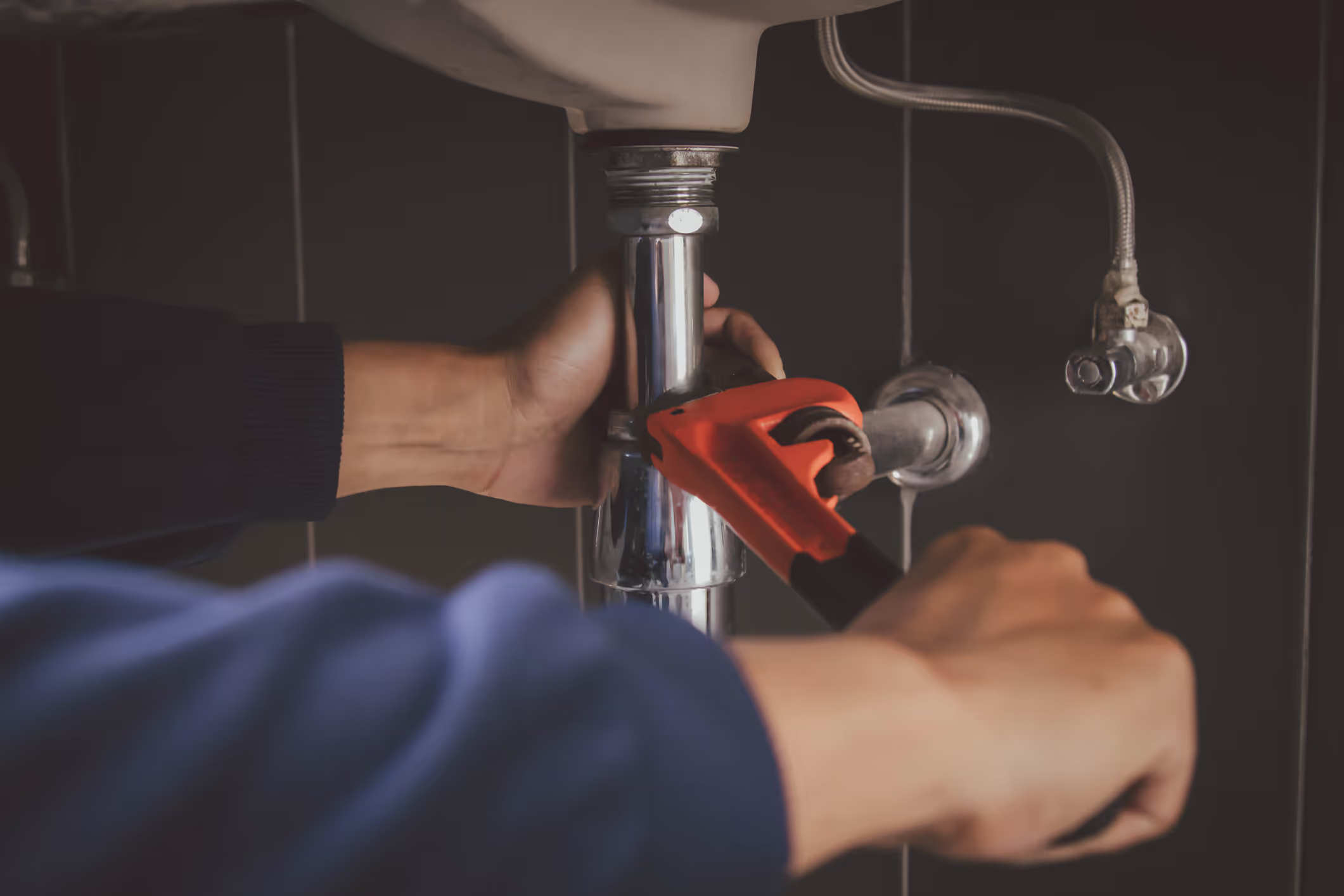
From leaks to full system installs, our plumbing services cover everything you need for a safe, reliable home water system, 24/7.
Our Primary Plumbing Include:
- Water Heater Replacement
- Water Heater Repair
- Trenchless Sewer Line
- Water Filtration
- Slab Leak
- Sewer Line Repair
Don't see the service you need? Call our Team today!
ELECTRICAL

Our electrical services ensure your home stays safe and powered, from routine fixes to complete system upgrades.
Our Primary Electrical Services Include:
- House Rewiring
- Electrician
- Electric Panel Upgrade
- Electric Panel Replacement
- EV Chargers
- Whole House Generator
Don't see the service you need? Call our Team today!
HEATING
.jpg)
We install, repair, and maintain heating & furnace systems with expert care to keep your Colorado home comfortable and energy-efficient year-round.
Our Primary Heating Services Include:
- Heating Installation
- Heating Replacement
- Heating Maintenance
- Heating Repair
- Heating Service
- Heating Tune-Up
Don't see the service you need? Call our Team today!