The June Illusion: Why Systems Suddenly Fail When Peak Summer Hits
Summer is officially here, and understanding exactly how Denver's July heat waves expose undersized AC units is a harsh reality many homeowners are facing right now. Before the first major temperature spike hits, there is one critical performance factor every homeowner should check. If you are looking for professional HVAC services, our team is ready to help with your air conditioning replacement and installation.
Understanding How Denver's July Heat Waves Expose Undersized AC Units
There is a distinct seasonal shift that catches many homeowners off guard every single year. During a mild 85-degree afternoon in early June, almost any functional air conditioner can easily maintain a comfortable 72 degrees indoors. The system cycles on, cools the house, and cycles off. This creates a false sense of security. Homeowners assume their equipment is in perfect working order, ready to handle whatever the rest of the season brings. But an AC unit that easily maintains your preferred temperature in early summer can completely lose ground a month later.
The concrete problem emerges when extreme heat sets in. Undersized units begin to run continuously without ever reaching the thermostat set point. You might set the dial to 70 degrees, but by 4 p.m., the indoor temperature has crept up to 78 degrees and continues to climb. The system is mechanically functional—blowing cold air and using electricity—but it simply lacks the capacity to remove heat as fast as the home absorbs it.
This creates a difficult decision point for you as a homeowner. Do you keep paying for emergency service calls, refrigerant top-offs, and minor repairs on a struggling unit, or do you demand proper diagnostic math to see if it is fundamentally undersized? In our years of dispatching technicians across the metro area, our team at Veteran Heating, Cooling, Plumbing & Electric consistently sees that sizing, not mechanical failure, is often the true culprit behind these mid-summer breakdowns. July heat waves in Denver push systems to their absolute limits, stripping away the "June illusion" and revealing whether your equipment actually has the tonnage required to protect your home.
How High Altitude and Intense UV Exposure Compound Thermal Load
Standard air conditioning sizing rules that work perfectly in coastal cities or the Midwest often fail completely in Colorado. The specific regional climate factors at play here make traditional guesswork obsolete. At a mile-high altitude, there is significantly less atmosphere to filter out intense solar radiation. The air is thinner, which means the sun's rays strike your home with much greater intensity than they would at sea level.
This intense UV exposure rapidly heats the home's outer envelope. Roofs, siding, and windows absorb this energy at an accelerated rate. As a local crew that spends every July working in blistering Denver attics and backyards, we know firsthand how fast temperatures can spike into the upper 90s and 100s. When these extreme spikes occur, they create peak thermal loads that easily overwhelm systems sized only for mild early-summer averages. The system is suddenly fighting a two-front war: the high ambient air temperature outside and the aggressive radiant heat baking into the building materials.
The Impact of Solar Heat Gain on Indoor Comfort
Solar heat gain is the increase in indoor temperature caused by the sun's radiation absorbing into your home. Think of your house like a car parked in a sunny lot; even if the air outside is only moderately warm, the inside becomes an oven because the glass traps the radiant heat.
Windows, especially those on south- and west-facing walls, are the primary entry points for solar heat gain. Even with modern double-pane glass, a significant amount of thermal energy passes through and warms your floors, furniture, and interior walls. Your roof orientation also plays a massive role. A large, dark-shingled roof facing the afternoon sun acts like a giant radiator, pushing heat down into your attic and eventually into your living spaces.
This external pressure forces the AC unit to work exponentially harder. It is no longer just cooling the air; it has to actively fight the continuous influx of new radiant heat. During July heat waves in Denver, this solar heat gain reaches its maximum intensity, which is exactly why our technicians so often find undersized systems falling behind and never catching up until the sun finally sets.
Telltale Signs Your AC Is Actually Undersized for Peak Heat
It can be incredibly frustrating to figure out if your system is broken or just too small. Before you assume a major component has failed, look for the behavioral patterns that indicate a capacity issue. When our team arrives at a sweltering Denver home, here are the clear signs we look for to determine if your equipment is undersized for July heat waves:
• Continuous operation: The most obvious red flag is a system that runs all day. If your condenser outside is buzzing from noon until 9 p.m., but the indoor temperature never matches the thermostat setting, the unit simply lacks the cooling power for the space.
• Uneven cooling across floors: Certain rooms, especially upstairs bedrooms or sun-facing living areas, remain uncomfortably hot while the basement or interior hallways freeze. An undersized unit cannot push enough conditioned air through the ductwork to overcome the heat gain in vulnerable rooms.
• Spiking energy bills without comfort: The unit consumes maximum electrical power for extended hours, driving your utility bills through the roof, yet you still find yourself sweating in your living room. You are paying for maximum effort but receiving minimal results.
• Inability to handle afternoon peaks: The system works fine in the morning but starts losing ground by 2 p.m. As the outdoor temperature climbs, the indoor temperature climbs right along with it, despite the AC running at full blast.
Understanding the difference between sizing issues:
• Undersized Unit — Primary Operational Symptom: Runs continuously for hours without stopping — Impact on Home Comfort: Fails to reach the target temperature during peak afternoon heat
• Oversized Unit — Primary Operational Symptom: Short-cycles (turns on and off rapidly every few minutes) — Impact on Home Comfort: Cools the air too quickly but fails to remove humidity, leaving the home feeling clammy
• Correctly Sized Unit — Primary Operational Symptom: Runs in steady, predictable 15-20 minute cycles — Impact on Home Comfort: Maintains consistent temperature and effectively dehumidifies the indoor air
The Danger of 'Rule of Thumb' Sizing in Extreme Climates
For decades, many contractors historically sized air conditioning units based purely on the home's square footage. The old industry "rule of thumb" usually dictated one ton of cooling capacity for every 400 to 600 square feet of living space. While this lazy math might be fast and easy for a salesperson, our team regularly replaces units that failed miserably when subjected to extreme high-altitude thermal loads.
Guessing capacity leads to disastrous results for homeowners. If a contractor guesses too high, you end up with an oversized unit that short-cycles. It blasts the house with cold air, satisfies the thermostat in five minutes, and shuts off before it has a chance to dehumidify the space. If they guess too low, you get an undersized unit that runs endlessly, burning out its compressor prematurely and leaving you miserable during a heat wave.
True comfort requires replacing this outdated guesswork with rigorous, disciplined calculations. As a veteran-owned company serving Denver, our team brings the same level of discipline and accountability to our work that military service demands. We do not guess. We measure. Contrast the lazy "rule of thumb" sizing with the precision we use to execute accurate heat load math. A proper Manual J heat load calculation is the only acceptable standard for determining exactly how much cooling power your specific home requires to conquer the summer heat.
Deconstructing the Manual J Heat Load Calculation
The ACCA (Air Conditioning Contractors of America) Manual J standard is the gold standard for residential load calculations. It is a highly detailed mathematical process that determines exactly how much heating and cooling a house actually needs. Instead of just looking at the floor plan, when our team performs a Manual J heat load calculation, we account for the unique physics of your specific property.
Here is a look at the variables our technicians measure during this disciplined process:
1. Local climate history: We input the extreme temperature data specific to our region, ensuring the system can handle the hottest days of the year, not just the averages.
2. Home orientation: We map exactly how the house sits on the lot to calculate the specific solar heat gain on south and west-facing walls.
3. Insulation R-values: We measure the thermal resistance of your attic, walls, and crawlspace to see how well the house traps conditioned air.
4. Window types and quantities: We evaluate whether you have single-pane, double-pane, or Low-E glass, and exactly how many square feet of glass face the sun.
5. Occupant count and appliances: Human bodies and running appliances generate internal heat, which must be factored into the total cooling load.
This exact math ensures that both the indoor coil and the outdoor compressor are perfectly matched to your home's thermal envelope. Understanding how your indoor and outdoor AC units are connected is vital, because both sides of the system rely on this calculation to sync properly and handle stress without breaking down.
Why Tonnage Matters During Thermal Spikes
In HVAC terms, a "ton" of cooling does not refer to the weight of the equipment. It refers to the unit's ability to remove 12,000 BTUs (British Thermal Units) of heat per hour from your home. If your home absorbs 36,000 BTUs of heat per hour during a 95-degree afternoon, you need exactly a 3-ton system to neutralize that heat gain.
Precision math prevents the system from falling behind. If your home requires 3.5 tons of cooling based on a Manual J heat load calculation, but a contractor installed a 3-ton unit based on a square-footage guess, you are missing 6,000 BTUs of heat removal every single hour. That deficit stacks up quickly, which is why your indoor temperature climbs steadily throughout the afternoon.

Stop Paying for Band-Aids: Making an Educated Replacement Decision
When you are sweating in your own living room, the immediate reaction is to call for a repair. But you have to revisit the core decision point: paying for emergency refrigerant top-offs, swapping out capacitors, or cleaning coils won't fix a unit that is fundamentally too small for the house. In our experience, you cannot repair your way out of a sizing deficit.
Just last summer, our team helped a Denver homeowner who reached out during a brutal heat wave needing HVAC service after dealing with persistent cooling issues. Our punctual, knowledgeable technicians arrived, thoroughly explained the entire HVAC service process, and provided clear guidance on what their undersized system could and could not do. The homeowner received honest advice rather than a sales pitch, walked away with top-tier workmanship, and finally understood the importance of proper sizing and system maintenance. That is the value of having our experts explain the entire process honestly.
A properly sized system, backed by a routine AC maintenance plan, provides reliable peace of mind even during the hottest weeks of the year. If your current system is failing you, do not settle for another temporary band-aid. Encourage your contractor to prove their recommendations. Always demand a formal Manual J heat load calculation before agreeing to any major equipment replacement.
Frequently Asked Questions About AC Sizing in Extreme Heat
Why is my AC running constantly but not cooling the house?
If your AC is running constantly but not cooling the house, it usually means the system is undersized, low on refrigerant, or suffering from severe airflow restrictions. An undersized unit lacks the capacity to remove heat as fast as the sun bakes it into your home. It runs continuously in a futile attempt to reach the thermostat setting. A proper diagnostic can confirm if the issue is mechanical failure or a fundamental lack of tonnage.
How do I know if my AC is undersized for my house?
The most common sign of an undersized AC is a system that runs non-stop during the afternoon but still allows the indoor temperature to rise. You may also notice that certain rooms never cool down, and your energy bills spike dramatically during summer months. The only definitive way to know is to have a professional perform a Manual J heat load calculation on your home.
What is a Manual J heat load calculation?
A Manual J heat load calculation is the industry-standard mathematical formula used to determine exactly how much heating and cooling capacity a specific home requires. It factors in your local climate, the home's orientation to the sun, insulation R-values, window types, and square footage. This rigorous math replaces outdated "rule of thumb" guessing to ensure your new system is perfectly sized.
At what temperature does an AC struggle to cool?
An AC typically begins to struggle when the outdoor temperature exceeds the specific design temperature it was sized for, which in many regions is around 90 to 95 degrees. When outdoor temps push toward 100 degrees, the thermal load on the house increases drastically. If the system was sized using averages rather than peak extremes, it will fall behind and run continuously without satisfying the thermostat.
How many tons of AC do I need for my home?
You cannot accurately determine how many tons of AC you need based solely on square footage. While older rules of thumb suggested one ton per 500 square feet, true sizing depends heavily on your insulation, windows, ceiling height, and local climate. A formal Manual J heat load calculation is required to give you the exact tonnage necessary for your specific property.
Can adding refrigerant fix an undersized AC?
No, adding refrigerant cannot fix an undersized AC. Refrigerant levels must match the manufacturer's exact specifications for the equipment to function properly; overcharging a system will actually damage the compressor and reduce efficiency. If your system is fully charged and mechanically sound but still cannot cool the house, the unit simply lacks the physical capacity required for the space.
Secure True Cooling Comfort Before the Next Heat Wave Strikes
Surviving the peak of summer requires a system precisely matched to your home's unique thermal load. As we have seen firsthand across Denver, true comfort relies on exact math, not lazy guesswork. When the outdoor temperature climbs past 95 degrees, you need the confidence that your equipment has the exact capacity to keep your family comfortable.
Now that you know how Denver's July heat waves expose undersized AC units, you can take action before the next extreme weather event arrives. Stop paying for temporary fixes on equipment that will never keep up. Schedule a comprehensive inspection with Veteran Heating, Cooling, Plumbing & Electric today, demand a precise Manual J calculation, and let our team solve your cooling woes permanently with a system designed specifically for your home.
ABOUT Veteran Heating, Cooling, Plumbing & Electric
Veteran Heating, Cooling, Plumbing & Electric was founded on the belief that service should be personal, honest, and community-focused. Our team is built around integrity, professionalism, and a true commitment to your home’s comfort and safety.
Led by a U.S. Army veteran with over 30 years of industry experience, we’re proud to remain locally owned and operated. Every technician, plumber, and electrician is EPA-certified, background checked, and driven to exceed expectations.
- 24/7 ServiceWe offer weekend & 24/7 emergency service. We’re here whenever you need us—day, night, or weekend, no exceptions.
- $0 Trip FeesNo dispatch or trip fees. You’ll never pay just for us to show up—service starts when the work does.
OUR SERVICES
AIR CONDITIONING
.jpg)
We offer specialty and seasonal services like indoor air quality upgrades, pre-winter furnace checks, and summer AC tune-ups to keep your home prepared year-round.
Our Primary Air Conditioning Services Include:
Don't see the service you need? Call our Team today!
PLUMBING
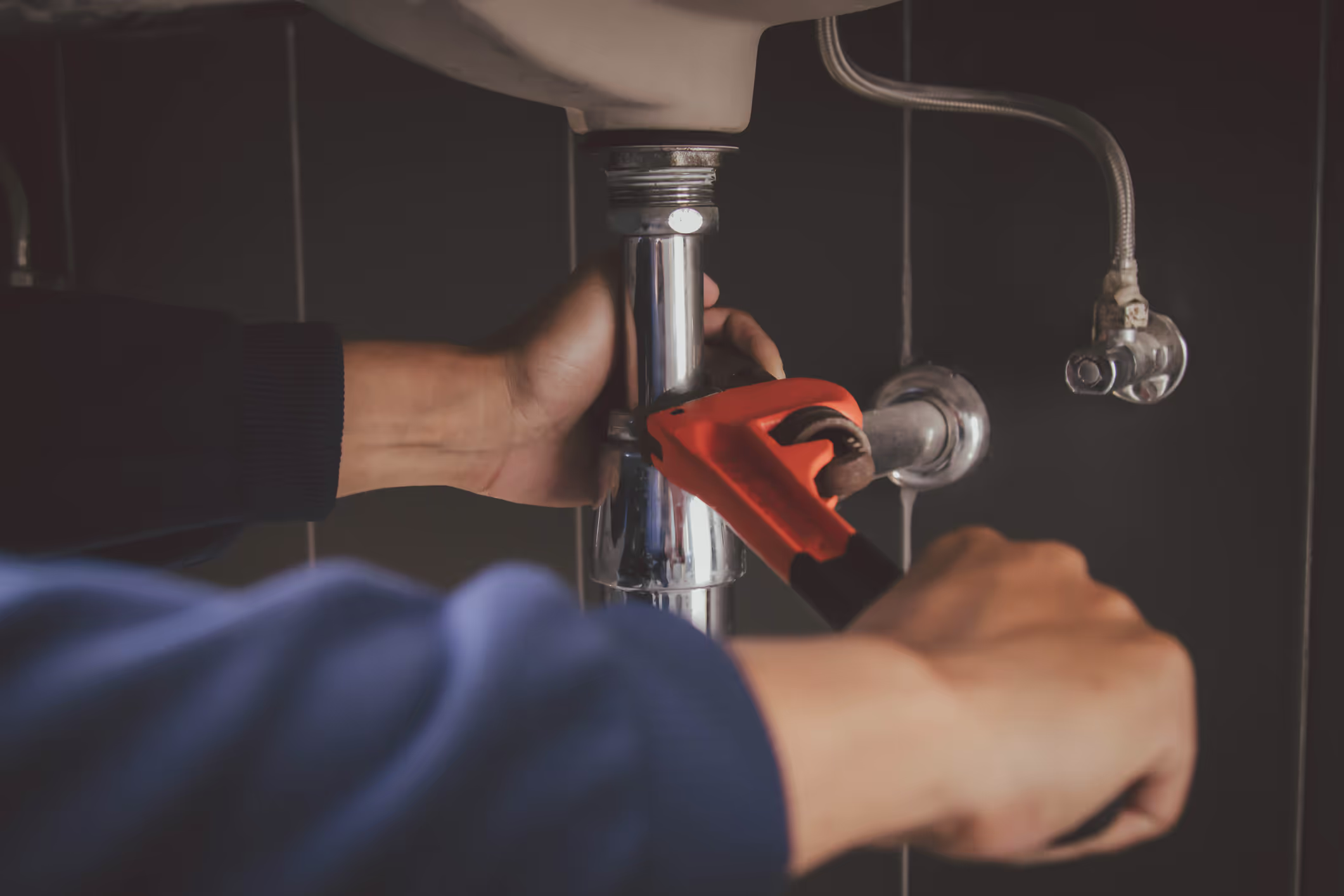
From leaks to full system installs, our plumbing services cover everything you need for a safe, reliable home water system, 24/7.
Our Primary Plumbing Include:
- Water Heater Replacement
- Water Heater Repair
- Trenchless Sewer Line
- Water Filtration
- Slab Leak
- Sewer Line Repair
Don't see the service you need? Call our Team today!
ELECTRICAL

Our electrical services ensure your home stays safe and powered, from routine fixes to complete system upgrades.
Our Primary Electrical Services Include:
- House Rewiring
- Electrician
- Electric Panel Upgrade
- Electric Panel Replacement
- EV Chargers
- Whole House Generator
Don't see the service you need? Call our Team today!
HEATING
.jpg)
We install, repair, and maintain heating & furnace systems with expert care to keep your Colorado home comfortable and energy-efficient year-round.
Our Primary Heating Services Include:
- Heating Installation
- Heating Replacement
- Heating Maintenance
- Heating Repair
- Heating Service
- Heating Tune-Up
Don't see the service you need? Call our Team today!