Is Your Home's Wiring Trying to Tell You Something?
Signs your home needs rewiring include flickering or dimming lights, frequently tripped circuit breakers, burning smells near outlets, warm or discolored outlet covers, buzzing or crackling sounds from walls or switches, sparking outlets, electrical shocks when plugging in devices, loose outlets, visible cracked or frayed wiring insulation, and the presence of outdated wiring types such as aluminum, knob-and-tube, or two-prong ungrounded outlets — especially in homes over 40 years old.
Your home's electrical system is one of those things that's easy to ignore — until something goes wrong. Most wiring issues don't announce themselves with a dramatic failure. Instead, they build quietly behind your walls, showing up as small, easy-to-dismiss clues: a light that flickers when the microwave runs, a breaker that trips a little too often, or an outlet that feels just slightly warm to the touch.
But those small clues matter. According to the National Fire Protection Association, electrical malfunctions contribute to nearly 50,000 house fires every year in the United States. U.S. fire departments respond to an estimated 24,200 residential electrical malfunction fires annually, resulting in around 295 deaths, 900 injuries, and $1.2 billion in property damage. And many of those fires trace back to aging wiring that was never updated to handle the demands of modern living.
If your home was built before the 1980s — or even the early 1990s — there's a real chance your electrical system wasn't designed to power today's high-demand appliances, EV chargers, smart home devices, or the sheer number of electronics the average household now uses every day.
I'm Mike Townsend, a U.S. Army veteran and leader of a veteran-owned home services company serving the Denver Metro area, and I've seen how often homeowners overlook the signs your home needs rewiring until a small problem becomes a serious — and costly — safety hazard. Below, I'll walk you through exactly what to look for so you can act before it becomes an emergency.
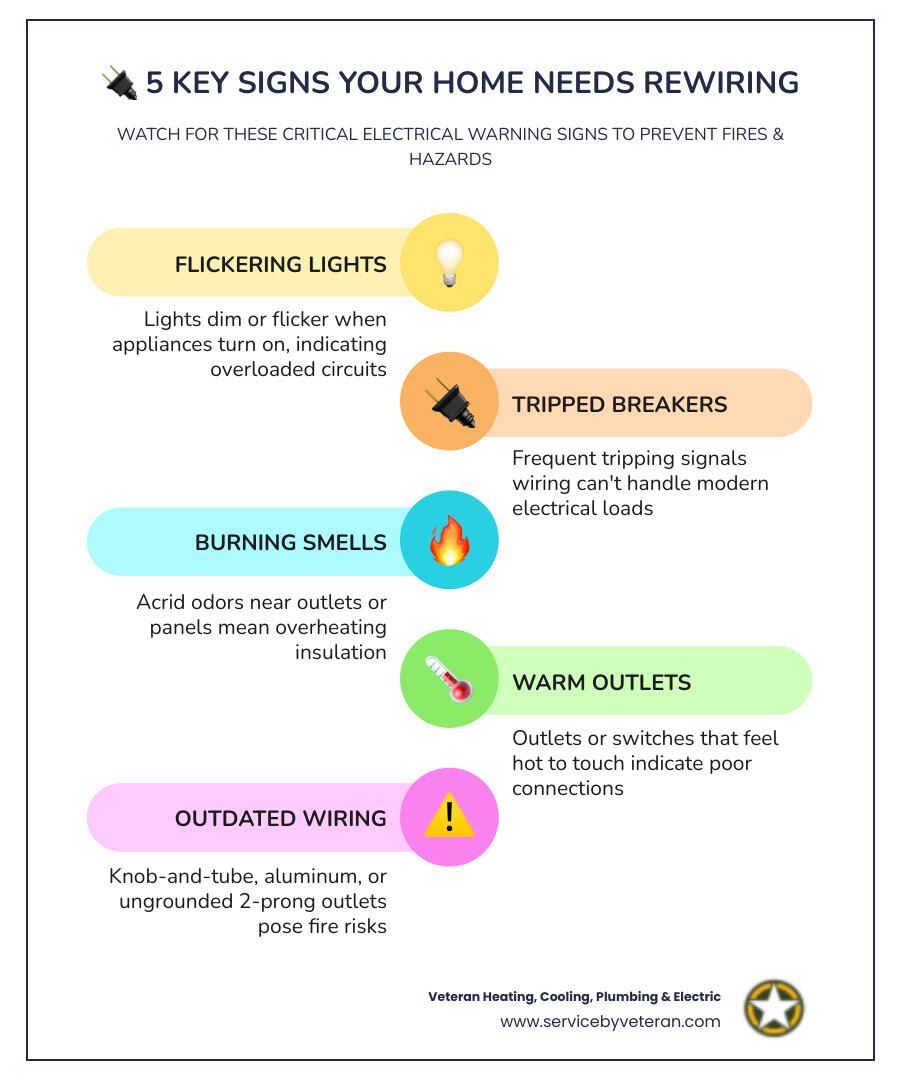
10 Critical Signs Your Home Needs Rewiring to Prevent Hazards
When we talk about electrical safety in places like Columbine or Littleton, we’re often dealing with beautiful older homes that have "character." Unfortunately, that character often includes wiring that is past its prime. Wiring issues rarely show up all at once; they drop hints. If you notice any of these ten warning signs, it’s time to call in the professionals.
1. Frequently Tripped Circuit Breakers
Circuit breakers are designed to shut off power when a circuit is overloaded. If you find yourself trekking to the garage or basement to flip a switch back on every time you use the toaster and the coffee maker at once, your system is struggling. While an occasional trip might happen, frequent trips are a major indicator that your wiring can no longer handle your household’s electrical load.
2. Flickering or Dimming Lights
Do your lights dim when the air conditioner kicks on? This is a classic sign of an overloaded circuit. It often means the appliance is "stealing" power from the lights because the wiring isn't robust enough to supply both simultaneously. In some cases, this can also point to loose connections behind the walls, which are a significant fire risk.
3. Buzzing, Sizzling, or Crackling Sounds
Electricity should be silent. If you hear a faint buzzing or a "sizzling" sound coming from an outlet or a light switch, it’s a sign of electrical arcing. This happens when electricity jumps across a gap in damaged or loose wiring. It’s essentially a tiny lightning bolt inside your wall, and it generates intense heat.
4. Burning Smells Near Outlets or Panels
This is an electrical emergency. If you notice a faint smell of burning plastic or ozone near an outlet, switch off the power at the main breaker immediately. This smell indicates that the insulation on your wires is melting due to excessive heat. Don't wait for the smell to "go away"—it usually means a fire is imminent.
5. Warm or Discolored Outlet Covers
Touch your outlet covers occasionally. They should be room temperature. If an outlet feels warm to the touch or shows signs of discoloration (brown or black scorch marks), the wiring inside is overheating. This is often caused by loose connections or degraded wires that are struggling to carry the current. If you're seeing this in your home, it's time to look into House Rewiring Columbine CO.
6. Electrical Shocks When Plugging in Devices
A "tingle" or a sharp shock when you touch an appliance or plug something in is a major red flag. This often points to a grounding issue. In older systems, the electricity has nowhere to go when there's a fault, so it uses you as the path to the ground. This is not just annoying; it can be fatal.
7. Loose Outlets
When you plug something in, does the outlet move or feel like it’s falling into the wall? Loose outlets can pull on the wire connections behind the scenes. Over time, those wires can work themselves loose, leading to arcing and fires.
8. Sparking Fixtures or Outlets
A tiny spark when you first plug in a large appliance can sometimes be normal, but frequent or large sparks are not. If a switch or outlet sparks every time you use it, the internal components have likely worn out or the wiring is damaged.
9. Persistent Power Instabilities
If one room randomly loses power while the rest of the house is fine, or if some outlets work only intermittently, the "veins" of your home are failing. This suggests that connections have corroded or broken over the decades.
10. Cracked or Frayed Insulation
If you can see the wiring in your attic, basement, or crawlspace, check the outer jacket. If the insulation is brittle, cracked, or looks like it's been chewed by rodents, the copper inside is exposed. Exposed wire is a direct path to a house fire.
Identifying Outdated Wiring Types in Older Denver Homes
In the Denver Metro area, from Golden to Aurora, we see a wide variety of home ages. Depending on when your house was built, you might be living with wiring materials that were considered "state of the art" at the time but are now known to be hazardous. Identifying these is a key step in knowing if you need a House Rewiring Aurora CO.
Knob-and-Tube Wiring (Pre-1950s)
Common in homes built before the 1950s, knob-and-tube (K&T) wiring consists of single-insulated copper conductors run through porcelain "knobs" and "tubes." The biggest problem with K&T is that it has no ground wire. Furthermore, the cloth insulation becomes brittle over time and can crumble away. If you’ve added modern insulation to your attic, you may have accidentally covered these wires, which need air space to dissipate heat, creating a major fire hazard.
Aluminum Wiring (1960s - 1970s)
During the mid-60s to the late 70s, copper prices spiked, and many builders switched to aluminum wiring. We now know that aluminum expands and contracts much more than copper when it gets hot. This leads to "cold creep," where connections at outlets and switches become loose over time. Loose connections lead to overheating and fires. You can often tell if you have this if you see "AL" printed on the wire jackets in your electrical panel.
Lead-Sheathed and Fabric-Insulated Cables
Used until the 1950s and 60s, these cables rely on materials that simply weren't meant to last 70+ years. Fabric insulation absorbs moisture and rots, while lead sheathing can become a conductor itself if the inner insulation fails.
Ungrounded Two-Prong Outlets
If your home is full of outlets that only have two slots (no round hole for a ground prong), your system is outdated. These outlets offer no protection against electrical surges or faults, leaving your expensive modern electronics — and your family — vulnerable to shocks and damage.
Why Homes Over 40 Years Old Struggle with Modern Electrical Demands
If your home is over 40 years old, it was likely built when the biggest electrical draws were a refrigerator, a few lamps, and a black-and-white TV. Today, the average household is a high-tech hub. We’re plugging in multiple computers, high-definition TVs, air fryers, and high-performance HVAC systems.
Many homes in the Denver area built in the 1960s, 70s, or 80s were equipped with 60-amp or 100-amp electrical panels. By today's standards, that is barely enough to get by. A modern home typically requires at least a 200-amp service to safely handle everything we throw at it.
When you add a modern "extra" like an EV charger, you're adding a massive load. A Level 2 EV charger requires a dedicated 240-volt circuit, which can pull as much power as an entire small house from the 1950s. If your infrastructure is 40+ years old, trying to force that much power through old wires is like trying to push a fire hose's worth of water through a straw. Something is going to burst.
Beyond the panel, the actual layout of the circuits in older homes is often insufficient. You might have one circuit powering three different bedrooms. In 2026, with every family member having their own devices, that circuit is constantly running at its limit. This "chronic overloading" degrades the wire insulation faster, leading to the signs your home needs rewiring mentioned earlier. If you're feeling the strain, talking to an Electrician Denver CO is the best way to future-proof your investment.
The Difference Between Partial and Full Rewiring Projects
Not every home requires a total "gut job." Depending on the age and condition of your system, we might recommend either a partial or a full rewire.
Partial Rewiring
This is appropriate when the bulk of your home's wiring is in good shape, but specific areas are problematic or outdated. For example, if you are remodeling your kitchen in Castle Rock, you’ll likely need to rewire that specific area to meet modern codes for GFCI outlets and dedicated appliance circuits. Partial rewiring is also common when adding an addition or an EV charger. It allows us to address the highest-risk or highest-demand areas without the disruption of a whole-house project.
Full Rewiring
A full rewire involves removing every foot of old wire, every outlet, and every switch, and replacing them with modern, grounded copper wiring. This is usually necessary for homes with knob-and-tube, widespread aluminum wiring, or systems that have been dangerously modified by "DIY-ers" over the years. While it is a larger project, it is the only way to ensure 100% safety and code compliance.
When you work with a professional Electrician Castle Rock CO, we’ll start with a thorough inspection. We look at your panel, test your grounding, and check the condition of the wires at various points throughout the house. We then provide a clear plan that prioritizes safety while minimizing the disruption to your daily life.
Benefits of Professional Electrical Upgrades for Your Property
Rewiring your home is a significant undertaking, but the benefits go far beyond just "keeping the lights on." It is an investment in your home’s future and your family’s safety.
• Improved Safety and Peace of Mind: This is the big one. Knowing that your home is protected by modern breakers and grounded wiring means you can sleep better at night. You won't have to worry about a hidden arc starting a fire in the middle of the night.
• Increased Property Value: In the Denver real estate market, a home that has been fully rewired and brought up to code is a major selling point. It tells buyers that the home has been well-maintained and won't require immediate, expensive repairs.
• Insurance Eligibility: Many insurance companies are becoming stricter about older homes. Some may refuse to cover homes with knob-and-tube or aluminum wiring, or they may charge significantly higher premiums. Providing proof of a professional rewire can lower your rates and ensure you stay covered.
• Enhanced Energy Efficiency: Modern wiring and panels are more efficient at delivering power, which can lead to lower energy bills over time. Plus, you’ll have the capacity to add energy-saving smart home technologies.
• Reliability for Modern Tech: No more flickering lights when the vacuum runs. No more searching for an adapter for your three-prong plugs. You’ll have the outlets you need, where you need them.
For homeowners in Centennial, these upgrades are often the key to turning an older house into a modern, functional home. If you're ready to make the move, checking in with a House Rewiring Centennial CO expert is the first step.
Frequently Asked Questions about Home Rewiring
Is aluminum wiring one of the signs your home needs rewiring?
Yes, absolutely. While aluminum wiring isn't "illegal," it is widely considered a significant fire hazard in residential applications due to how it expands and contracts. If your home has aluminum wiring, we strongly recommend having it evaluated by an Electrician Centennial CO. In many cases, a full copper rewire is the safest long-term solution.
How long does the professional rewiring process typically take?
A full home rewire typically takes between 5 to 10 days, depending on the size of the home and how easy it is to access the walls (attics and crawlspaces make the job much faster). We often work in phases so that you don't have to move out during the process. We aim to keep at least some circuits live so you can still live your life while we work.
What are the dangerous signs your home needs rewiring immediately?
If you smell burning plastic, see smoke, hear loud crackling sounds from your walls, or if your electrical panel is hot to the touch, you need to act immediately. Turn off the main power and call an Electrician Aurora CO for emergency service. These are signs of an active electrical fault that could lead to a fire at any second.
Conclusion
Your home should be your sanctuary, not a source of stress. Dealing with outdated wiring can feel overwhelming, but you don't have to do it alone. At Veteran Heating, Cooling, Plumbing & Electric, we bring the values of integrity, service, and excellence to every job we do. As a veteran-owned and locally operated company, we take pride in keeping our Denver Metro neighbors safe.
Whether you're in Lakewood, Highlands Ranch, or Arvada, our team of EPA-certified and background-checked technicians is ready to help. We offer a lifetime warranty on parts and labor, so you can trust that when we rewire your home, it’s done right the first time.
Don’t wait for a spark to tell you it’s time for an upgrade. If you’ve noticed any of the signs your home needs rewiring, contact us today for a professional inspection. Let’s make sure your home’s electrical system is ready for the next 40 years.
ABOUT Veteran Heating, Cooling, Plumbing & Electric
Veteran Heating, Cooling, Plumbing & Electric was founded on the belief that service should be personal, honest, and community-focused. Our team is built around integrity, professionalism, and a true commitment to your home’s comfort and safety.
Led by a U.S. Army veteran with over 30 years of industry experience, we’re proud to remain locally owned and operated. Every technician, plumber, and electrician is EPA-certified, background checked, and driven to exceed expectations.
- 24/7 ServiceWe offer weekend & 24/7 emergency service. We’re here whenever you need us—day, night, or weekend, no exceptions.
- $0 Trip FeesNo dispatch or trip fees. You’ll never pay just for us to show up—service starts when the work does.
OUR SERVICES
AIR CONDITIONING
.jpg)
We offer specialty and seasonal services like indoor air quality upgrades, pre-winter furnace checks, and summer AC tune-ups to keep your home prepared year-round.
Our Primary Air Conditioning Services Include:
Don't see the service you need? Call our Team today!
PLUMBING
From leaks to full system installs, our plumbing services cover everything you need for a safe, reliable home water system, 24/7.
Our Primary Plumbing Include:
- Water Heater Replacement
- Water Heater Repair
- Trenchless Sewer Line
- Water Filtration
- Slab Leak
- Sewer Line Repair
Don't see the service you need? Call our Team today!
ELECTRICAL

Our electrical services ensure your home stays safe and powered, from routine fixes to complete system upgrades.
Our Primary Electrical Services Include:
- House Rewiring
- Electrician
- Electric Panel Upgrade
- Electric Panel Replacement
- EV Chargers
- Whole House Generator
Don't see the service you need? Call our Team today!
HEATING
.jpg)
We install, repair, and maintain heating & furnace systems with expert care to keep your Colorado home comfortable and energy-efficient year-round.
Our Primary Heating Services Include:
- Heating Installation
- Heating Replacement
- Heating Maintenance
- Heating Repair
- Heating Service
- Heating Tune-Up
Don't see the service you need? Call our Team today!