What Are the Best Thermostat Settings for Summer AC Savings?
Finding the best thermostat settings for summer AC savings does not have to mean sweating through July to keep your energy bill down. Here is a quick-reference guide to the settings most recommended by the U.S. Department of Energy and Energy Star:
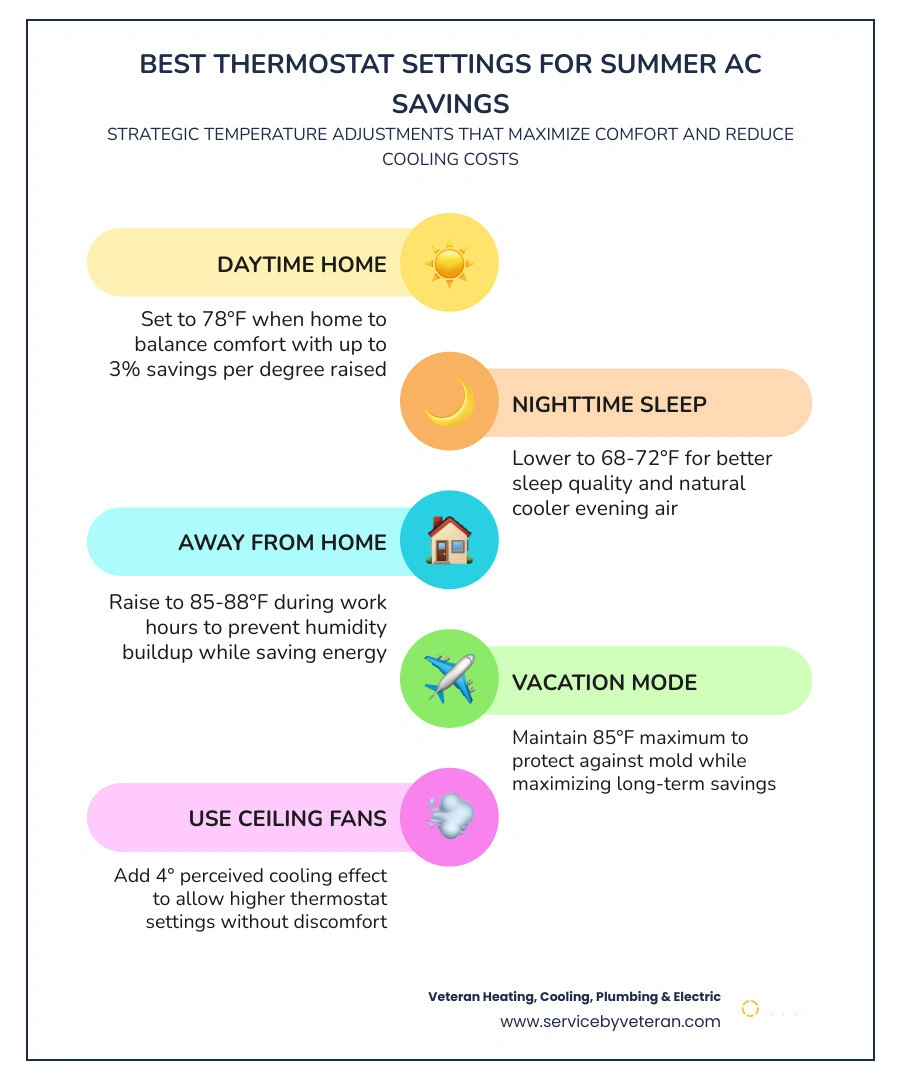
• Home during the day — Recommended Setting: 78°F
• Sleeping at night — Recommended Setting: 68°F – 72°F
• Away from home — Recommended Setting: 85°F – 88°F
• On vacation — Recommended Setting: 85°F
A few key points to keep in mind:
• Every degree you raise above 72°F can save up to 3% on cooling costs
• Adjusting your thermostat 7-10°F for 8 hours a day can save up to 10% annually on cooling bills
• Ceiling fans can make a room feel up to 4 degrees cooler, letting you raise your thermostat without losing comfort
• Never set your AC more than 20 degrees below the outdoor temperature to avoid overworking the system
• Do not turn your AC completely off when you leave — humidity and mold can build up quickly
Most homeowners set their thermostat based on comfort first and cost second. Then the energy bill arrives, and the number feels higher than expected. The good news is that small, strategic adjustments — not dramatic sacrifices — are usually all it takes to bring those numbers down without making your home feel like a sauna.
If you live in the Denver Metro area, summer cooling is a real concern. While Colorado is not the most humid state, daytime highs can push your AC hard, and older or poorly maintained systems will struggle to keep up with even modest thermostat targets.
I’m Mike Townsend, founder of Veteran Heating, Cooling, Plumbing & Electric and a U.S. Army veteran who spent part of my military career managing precision cooling systems for heat-seeking missile heads — so understanding how to dial in the best thermostat settings for summer AC savings is something I take seriously. That same attention to detail and mission-first mindset shapes how our team helps Denver Metro homeowners get the most out of every cooling dollar.
The Best Thermostat Settings for Summer AC Savings When You Are Home
When the Colorado sun is beating down on your roof in the middle of July, your first instinct might be to crank the thermostat down to 68°F. However, keeping your home at a refrigerator-like temperature is a surefire way to send your utility bills skyrocketing.

According to the U.S. Department of Energy and Energy Star, the magic number for daytime cooling when you are home is 78°F (26°C). While 78°F might sound a bit warm at first glance, it represents the ideal intersection of system efficiency, cost management, and basic indoor comfort.
Let’s look at the math behind this recommendation. The energy required to cool your home is directly related to the difference between the outdoor temperature and your indoor setting. The wider that gap, the harder your air conditioner has to work, and the longer its compressor has to run.
Industry data shows that each degree you set your thermostat above 72°F can save you up to 3% on your cooling costs. If you make the leap and move your daytime setting from 72°F to 78°F, you can reduce your cooling energy consumption by roughly 18% to 30%. For a typical home in the Denver Metro area, that translates to significant savings over the course of a single summer.
However, your air conditioner cannot achieve these savings if it is struggling to perform. An inefficient system with dirty coils, clogged filters, or worn-out parts will run longer and consume more electricity just to reach 78°F than a well-maintained system would to reach 74°F. That is why staying on top of seasonal AC Maintenance is absolutely critical. Keeping your system clean and optimized ensures that when you choose an energy-saving thermostat setting, your system actually has the physical capability to run efficiently and deliver those savings to your wallet.
Finding Your Personal Best Thermostat Settings for Summer AC Savings
If the thought of immediately setting your thermostat to 78°F makes you break out in a sweat, do not worry. You do not have to make the jump all at once. Instead, we highly recommend utilizing the gradual adjustment method.
Our bodies are remarkably adaptable, but they do not like sudden changes. If you are used to keeping your home at 71°F, shifting straight to 78°F will feel incredibly hot. Instead, try raising your thermostat by just 1 degree per day.
1. Start at your baseline temperature (e.g., 72°F).
2. The next morning, raise it to 73°F. You likely won’t even notice the difference.
3. The following day, bump it to 74°F.
4. Continue this 1-degree daily increase until you find the point where you actually start to feel slightly too warm.
5. Once you hit that threshold of discomfort, dial the thermostat back down by exactly 1 degree.
This simple, trial-and-error approach helps you find your personalized comfort limit. Many homeowners who thought they could never handle a home warmer than 73°F find themselves perfectly comfortable at 76°F or 77°F once their bodies have had a few days to acclimate.
You can also make higher thermostat settings feel much cooler by leveraging ceiling fans. It is important to remember a fundamental rule of home physics: fans cool people, not rooms. Ceiling fans create a wind-chill effect on your skin, evaporating moisture and making the ambient air feel up to 4 degrees cooler than it actually is.
By running a ceiling fan in the room you are currently occupying, a thermostat setting of 78°F will feel like a highly comfortable 74°F. Just remember to turn the fan off when you leave the room; running a fan in an empty room does nothing but waste electricity.
If you find that your air conditioner is blowing lukewarm air or running constantly without ever reaching your target temperature, it may be time for a professional system evaluation. Our team provides comprehensive AC Tune-Up Denver services to ensure your system is fully charged, clean, and ready to handle the summer heatwaves.
Nighttime Adjustments for Comfort and Sleep
While 78°F is a fantastic target for daytime hours when you are active, sleeping in a warm room is a recipe for a restless night. The National Sleep Foundation notes that the human body naturally cools down as it prepares for sleep, and a bedroom temperature between 68°F and 72°F is generally considered ideal for high-quality, uninterrupted rest.
This creates a bit of a conflict with the Department of Energy’s standard summer sleeping recommendation of 82°F. Frankly, for the vast majority of people, 82°F is simply too warm for comfortable sleep. We believe that no amount of utility savings is worth sacrificing your health, sleep quality, and daytime productivity.
Fortunately, you can still save money at night because of how outdoor temperatures behave. Once the sun goes down, the outdoor air temperature naturally drops. Because the temperature difference between the inside of your home and the outside air is much smaller at night, your air conditioner does not have to work nearly as hard to maintain a cooler setting as it does during the heat of the day.
To optimize your nighttime settings:
• Set your thermostat between 68°F and 72°F shortly before you go to bed.
• Keep bedroom ceiling fans running on medium speed to promote continuous air movement.
• Take advantage of Colorado’s cool summer nights by opening windows when the outdoor humidity is low and the temperature drops below your indoor setting. However, be mindful of pollen levels if you suffer from seasonal allergies.
If you live in Aurora and find that your upstairs bedrooms are consistently warmer than the rest of your home at night, you are not alone. Heat naturally rises, making two-story homes notoriously difficult to balance. Scheduling an AC Tune-Up Aurora can help identify airflow imbalances, ductwork issues, or system calibration problems that might be preventing your bedrooms from cooling down properly at night.
Adjusting Your Thermostat When Away or on Vacation
One of the easiest ways to waste money on summer cooling is leaving your air conditioner running at “occupied” temperatures when nobody is home. If you are heading out to work for eight hours, or taking a week-long summer trip, your thermostat settings should reflect that.
The U.S. Department of Energy states that you can save as much as 10% a year on your heating and cooling bills by simply turning your thermostat back 7 to 10 degrees Fahrenheit from its normal setting for eight hours a day.
If your standard at-home temperature is 75°F, you should set your thermostat to 82°F to 85°F before you leave for work. This simple habit keeps your AC from cycling on and off all day to cool an empty house.
When it comes to long vacations, many homeowners assume the best strategy is to turn the air conditioner off completely. However, this is actually a major mistake for several reasons:
• Extreme Heat Recovery Strain: If you turn your system completely off during a hot summer week, your walls, furniture, flooring, and drywall will absorb massive amounts of heat. When you return home and turn the AC back on, the system will have to run continuously for hours — or even days — to remove all that stored thermal energy. This puts immense strain on your compressor and can lead to sudden system breakdowns.
• Humidity and Mold Risks: Even in relatively dry climates like Colorado, indoor humidity can build up in a completely sealed, uncooled home. Keeping your AC running at a moderate level ensures that the system continues to dehumidify the air, preventing mold growth and protecting sensitive electronics, wood flooring, and musical instruments.
• Pet Safety: If you have pets staying at home while you are away, you must keep their safety in mind. For dogs, the thermostat should never be set higher than 82°F. For cats, the maximum safe limit is around 88°F.
A safe, highly efficient vacation setting is 85°F. This keeps your home safe, manages indoor humidity, and prevents your system from having to perform a brutal “recovery run” when you get back.
If you are located in Lakewood and want to make sure your system is reliable enough to handle these temperature setbacks without failing while you are away, consider booking an AC Tune-Up Lakewood before your next big trip.
Smart Thermostat Schedules for the Best Thermostat Settings for Summer AC Savings
If remembering to manually adjust your thermostat every time you leave the house feels like an impossible chore, technology is here to help. Upgrading to a smart or programmable thermostat is one of the smartest investments you can make for long-term energy savings.
Unlike old-fashioned manual thermostats, smart thermostats allow you to establish automated schedules that align perfectly with your daily routine.
• Set-and-Forget Automation: You can program your thermostat to automatically raise the temperature to 83°F at 8:00 AM when you leave for work, and bring it back down to a comfortable 76°F at 4:30 PM so the house is cool right when you walk through the door.
• Geofencing Technology: Many modern smart thermostats connect to your smartphone. Using geofencing, the thermostat can detect when you have left a certain radius around your home and will automatically shift into “Eco Mode” to save energy. When you start heading back home, the system detects your approach and begins cooling the house down.
• Remote Access: If you are away on vacation and realize you forgot to adjust the thermostat, you can easily log into an app on your phone and change the settings from anywhere in the world.
• Pre-Cooling Strategies: If your local Colorado utility provider uses “Time-of-Use” (TOU) rate structures, electricity is significantly more expensive during peak afternoon hours. You can program your smart thermostat to “pre-cool” your home to 73°F during the cheaper late-morning hours, and then allow the temperature to drift up to 79°F during peak hours, keeping your AC from running when electricity rates are at their highest.
How Humidity and Home Factors Impact Your Cooling Efficiency
Temperature is only one half of the comfort equation; the other half is humidity. High humidity levels prevent sweat from evaporating off your skin, which makes the air feel much hotter and stickier than the thermometer indicates.
When indoor humidity is high, homeowners often make the mistake of lowering their thermostat setting to feel cooler. However, this is an inefficient way to manage comfort. Instead, focus on keeping your indoor relative humidity between 30% and 50%. Your air conditioner naturally removes moisture from the air as it runs, but only if it runs in complete, balanced cycles.
This brings us to an important concept: the 20-degree rule. Air conditioning systems are thermodynamically designed to cool indoor air by a maximum of 20 degrees lower than the outdoor temperature. If it is 98°F outside in Castle Rock, setting your thermostat to 68°F is practically impossible for your system to achieve. The compressor will run continuously, overheat, and drive your electricity bills through the roof. On extremely hot days, aim for a setting that is no more than 20 degrees cooler than the outdoor air.
Other physical factors in your home can heavily impact how easily your system maintains your target temperature:
• Insulation: Poor attic and wall insulation allows outdoor heat to rapidly transfer into your living spaces, forcing your AC to run constantly.
• Sunlight and Windows: Unprotected windows act like greenhouse heaters. Keeping your blinds, drapes, or solar shades closed during the hottest parts of the day can block up to 76% of solar heat gain.
• Ductwork Leaks: Did you know that 25% to 40% of conditioned air escapes through cracks and holes in typical home ductwork? If your ducts are leaking in your crawlspace or attic, you are paying to cool areas of your home that nobody lives in.
To help you visualize how different thermostat habits impact your wallet, here is a breakdown of estimated savings based on common summer adjustments:
• Keeping AC at a constant 72°F — Estimated Annual Cooling Savings: Baseline Cost (0% savings) — System Impact: High wear-and-tear, continuous compressor cycling
• Raising home setting from 72°F to 78°F — Estimated Annual Cooling Savings: 18% – 30% savings — System Impact: Balanced runtime, moderate system wear
• Implementing a daily 7-10°F setback for 8 hours — Estimated Annual Cooling Savings: Up to 10% savings — System Impact: Reduced overall runtime, extends system lifespan
• Using ceiling fans to raise thermostat by 4°F — Estimated Annual Cooling Savings: 12% savings — System Impact: Low system strain, highly cost-effective
• Cleaning dirty filters and coils (DIY/Maintenance) — Estimated Annual Cooling Savings: 5% – 15% savings — System Impact: Maximizes airflow, prevents emergency breakdowns
Frequently Asked Questions About Summer AC Settings
Is 78 degrees too hot for a house in the summer?
For some people, 78°F can feel a bit warm initially, especially if they are accustomed to cooler indoor environments. However, by using the gradual 1-degree daily adjustment method, most people acclimate easily. Supplementing this setting with ceiling fans makes the air feel like 74°F, providing excellent comfort while drastically reducing your energy consumption.
Should I turn my AC off completely when I leave for work?
No, you should not turn your AC completely off. Doing so allows heat and humidity to build up inside your home’s walls, furniture, and structure. When you return, your system will have to run under extreme load for hours to cool the home back down. Instead, use a moderate setback of 7 to 10 degrees (setting it to 82°F–85°F) while you are away.
How much can I save by raising my thermostat by 5 degrees?
Raising your thermostat by 5 degrees can reduce your air conditioner’s energy consumption by 15% to 25% depending on your starting temperature and home insulation. This significantly reduces compressor runtime, which not only lowers your monthly utility bills but also extends the operational lifespan of your HVAC equipment.
Conclusion
Managing your summer cooling costs in the Denver Metro area does not require you to sacrifice your indoor comfort. By implementing strategic thermostat schedules, utilizing gradual temperature adjustments, leveraging ceiling fans, and protecting your home from solar heat gain, you can enjoy a comfortable home while keeping your utility bills under control.
However, even the most optimized thermostat settings cannot overcome an inefficient, dirty, or malfunctioning air conditioning system. Regular professional maintenance is the foundation of energy-efficient cooling.
At Veteran Heating, Cooling, Plumbing & Electric, we bring military-grade precision, absolute honesty, and a community-first mindset to every home services job we perform. As a veteran-led, locally owned company serving Denver, Greenwood Village, Arvada, Aurora, Broomfield, Castle Rock, Centennial, Columbine, Golden, Highlands Ranch, Lakewood, and Littleton, we back our expert craftsmanship with a lifetime warranty on parts and labor, alongside a comprehensive money-back guarantee.
Don’t let an inefficient AC system steal your summer savings. Schedule your summer AC service with Veteran Heating, Cooling, Plumbing & Electric today, and let our EPA-certified, background-checked technicians ensure your cooling system is running at peak efficiency all season long.
ABOUT Veteran Heating, Cooling, Plumbing & Electric
Veteran Heating, Cooling, Plumbing & Electric was founded on the belief that service should be personal, honest, and community-focused. Our team is built around integrity, professionalism, and a true commitment to your home’s comfort and safety.
Led by a U.S. Army veteran with over 30 years of industry experience, we’re proud to remain locally owned and operated. Every technician, plumber, and electrician is EPA-certified, background checked, and driven to exceed expectations.
- 24/7 ServiceWe offer weekend & 24/7 emergency service. We’re here whenever you need us—day, night, or weekend, no exceptions.
- $0 Trip FeesNo dispatch or trip fees. You’ll never pay just for us to show up—service starts when the work does.
OUR SERVICES
AIR CONDITIONING
.jpg)
We offer specialty and seasonal services like indoor air quality upgrades, pre-winter furnace checks, and summer AC tune-ups to keep your home prepared year-round.
Our Primary Air Conditioning Services Include:
Don't see the service you need? Call our Team today!
PLUMBING
From leaks to full system installs, our plumbing services cover everything you need for a safe, reliable home water system, 24/7.
Our Primary Plumbing Include:
- Water Heater Replacement
- Water Heater Repair
- Trenchless Sewer Line
- Water Filtration
- Slab Leak
- Sewer Line Repair
Don't see the service you need? Call our Team today!
ELECTRICAL

Our electrical services ensure your home stays safe and powered, from routine fixes to complete system upgrades.
Our Primary Electrical Services Include:
- House Rewiring
- Electrician
- Electric Panel Upgrade
- Electric Panel Replacement
- EV Chargers
- Whole House Generator
Don't see the service you need? Call our Team today!
HEATING
.jpg)
We install, repair, and maintain heating & furnace systems with expert care to keep your Colorado home comfortable and energy-efficient year-round.
Our Primary Heating Services Include:
- Heating Installation
- Heating Replacement
- Heating Maintenance
- Heating Repair
- Heating Service
- Heating Tune-Up
Don't see the service you need? Call our Team today!