Coming Home to the Unexpected: The Post-Vacation Plumbing Shock
When addressing the sudden spike in emergency plumbing calls in Aurora as families return from summer vacations, one clear pattern emerges: the problem often isn't a burst pipe, but a completely dry one. You drop your bags in the hallway after a long summer trip, expecting the familiar comfort of home, only to be hit by the unmistakable smell of sewer gas or the startling sound of sputtering pipes when you turn on the kitchen faucet. It is a jarring experience that immediately turns post-vacation relaxation into homeowner panic.
This predictable, localized phenomenon is often referred to as "vacation plumbing syndrome." When a house sits completely empty for weeks, the plumbing system loses the regular water flow it relies on to maintain proper pressure and seal integrity. Without daily showers, toilet flushes, and running sinks, the system falls out of its baseline equilibrium. As families rush back into their homes during the late-summer weeks, they suddenly reactivate these dormant systems, leading to a wave of unexpected odors and sudden leaks.
The immediate decision point for any homeowner is determining whether they are facing a harmless dry trap that simply needs a rush of water, or a genuine mechanical failure that requires professional intervention. Before you start tearing apart cabinets or assuming the worst, it helps to understand the foundational knowledge needed to identify early warning signs of hidden plumbing problems before they escalate into costly water damage. Many of these post-vacation symptoms are simply mechanical responses to inactivity, not catastrophic failures of your home's infrastructure.
The Science of 'Vacation Plumbing Syndrome' in Colorado
To understand why plumbing systems act up when left unused, you have to look at the environmental mechanics at play. Standard residential plumbing is designed for constant use. Water flowing through the pipes keeps seals moist, maintains trap barriers, and regulates internal temperatures. When you leave an Aurora house empty for several weeks, you disrupt this vital cycle.
The timing of these issues is highly specific. During the August back-to-school transition, a massive volume of families return to their homes simultaneously. This mass reactivation creates a predictable surge in local service requests for emergency plumbing in Aurora. The local climate plays a massive role in accelerating this syndrome. Aurora's arid, hot late-summer climate—featuring average highs in the upper 80s and relative humidity often dropping below 35%—causes indoor evaporation to happen much faster than it would in humid, coastal regions. This evaporation goes into overdrive if you set your HVAC system to a higher, energy-saving temperature while you are away.
How Inactivity Affects Your Pipes
When water stops flowing through your home for an extended period, several environmental shifts occur within the plumbing system:
1. Accelerated Evaporation: The dry indoor air pulls moisture directly out of standing water in toilet bowls and drain traps.
2. Stagnant Conditions: A lack of fresh water flow allows residual minerals, soap scum, and organic matter in the pipes to dry out and harden, potentially causing slow drains upon your return.
3. Thermal Expansion and Contraction: Temperature fluctuations in an empty, warmer house impact the natural expansion and contraction of metal and plastic pipes, putting unusual stress on joints that are accustomed to being cooled by regular water flow.
Reassuringly, many of the symptoms that arise from these conditions look much worse than they actually are. Understanding the science behind the syndrome is the first step in diagnosing the issue without unnecessary panic.
The Culprit Behind the Sewer Smell: Rapidly Evaporating P-Traps
The Problem: You walk through the front door and are immediately greeted by a foul, rotten-egg odor that seems to be coming from the bathrooms and laundry room.
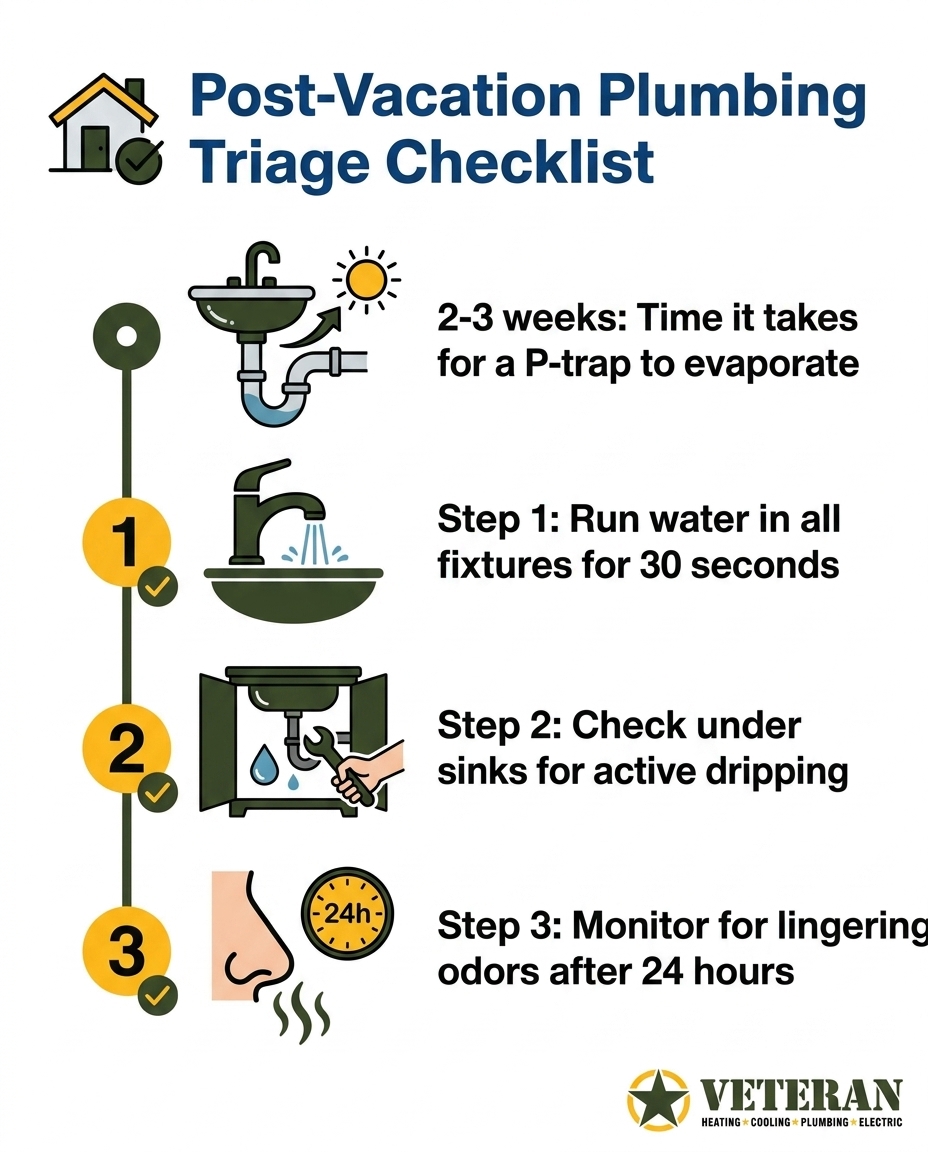
The Cause: The culprit is almost always a dry P-trap. A P-trap is the U-shaped curved section of piping located directly under your sinks, showers, and tubs. Its crucial role is to hold a small, constant pool of water. This water acts as an airtight physical barrier, blocking hydrogen sulfide (sewer gas) from rising out of the municipal sewer lines and entering your living space. Under the right conditions—especially in a warm, dry Aurora home—the water in a standard P-trap can evaporate completely in as little as 2 to 3 weeks.
Once that water barrier evaporates, there is nothing stopping the sewer gas from drifting freely out of your drains. Because the odor is so potent and alarming, this sudden influx of gas is frequently mistaken for a major pipe breach or a collapsed sewer line, prompting frantic emergency plumbing calls.
The Solution: Fortunately, restoring this barrier is a safe, non-DIY triage step that requires zero tools.
• Odor Location — Harmless Dry P-Trap: Isolated to specific unused sinks or guest bathroom tubs. — Severe Sewer Line Issue: Pervasive throughout the yard, basement, and lower floors.
• Drainage Speed — Harmless Dry P-Trap: Water drains normally once the faucet is turned on. — Severe Sewer Line Issue: Multiple fixtures back up simultaneously when flushed.
• Resolution Time — Harmless Dry P-Trap: Odor dissipates within a few hours of running water and venting the room. — Severe Sewer Line Issue: Odor persists or worsens despite running water and ventilation.
By simply running water in all fixtures for about 30 seconds, you refill the P-trap and re-establish the protective seal. Once you open a few windows to clear the existing gas, the problem is usually resolved entirely.
Why Rubber Seals and Gaskets Fail During Extended Vacations
While a dry P-trap is a harmless annoyance, extended vacations can also trigger actual mechanical failures that cause sudden leaks. The most common victims of inactivity are the rubber plumbing seals and gaskets that connect your pipes, valves, and supply lines.
These rubber components rely on regular exposure to moisture to remain pliable, flexible, and watertight. When a house sits empty during the August back-to-school transition and water stops flowing, these extended dry periods cause the rubber to shrink, crack, or become highly brittle. The seals under your kitchen sink, inside your toilet tank, and around your washing machine hoses are particularly vulnerable to this drying effect.
The Repressurization Shock
The real damage usually happens the moment you return. When the main water supply is turned back on—or when fixtures are heavily used for the first time in weeks—the sudden rush of water repressurizes the system. This repressurization shock forces water hard against seals that are no longer flexible enough to hold it back. Microscopic cracks in the dried-out rubber suddenly give way, resulting in active dripping or spraying under cabinets.
For example, one local homeowner recently faced several issues with their kitchen sink immediately following a period of disuse. The dried-out connections failed under pressure, causing a steady leak into the cabinetry. A technician arrived, addressed the sink issues, picked up a necessary replacement part for the compromised seals, and finished the job to permanently stop the leak. This type of pipe repair is incredibly common in late summer. Because these failure points are often hidden under counters or behind appliances, immediate visual inspection upon returning home is absolutely critical to catch leaks before they destroy your flooring.
A Safe, Non-Alarmist Triage Checklist for Returning Homeowners
If you have just returned to your Aurora home after a long trip, running a systematic check of your plumbing can save you from a flooded kitchen or unnecessary panic. This actionable guide helps you assess your plumbing safely, strictly advising against taking wrenches to pipes or attempting unlicensed DIY repairs.
• Step 1: Systematically refill the traps. Walk through your home and run cold water in every sink, shower, and tub for roughly 30 to 45 seconds. Flush every toilet once. This restores the water barrier in all your P-traps and safely pushes out stagnant water.
• Step 2: Visually inspect high-risk connection points. Grab a flashlight and look inside the cabinets under your kitchen and bathroom sinks. Check the supply lines behind your toilets and your washing machine. You are looking for pooling water, active dripping, or fresh water stains on the wood.
• Step 3: Monitor for lingering odors. After refilling the traps and opening a few windows to ventilate the house, pay attention to the air quality. If the sewer smell was caused by a dry trap, it should completely dissipate within a few hours.
• Step 4: Check the water heater perimeter. Ensure the area around the base of your water heater is completely dry, especially if you placed the unit in "vacation mode" before leaving. Temperature fluctuations can sometimes cause older pressure relief valves to weep.
Recognizing When to Call for Rapid Professional Deployment
While running a faucet is an easy fix for a dry trap, it is crucial to clearly delineate the boundary between normal post-vacation quirks and genuine emergencies requiring professional intervention. Ignoring the red flags of a failing plumbing system can quickly escalate into devastating water damage, especially if a cracked gasket gives way entirely while you are asleep or at work.
You need to call a professional if you notice persistent odors that linger for more than 24 hours after refilling the traps and ventilating the house. This indicates a potential breach in the actual sewer line or a failed vent stack, not just a dry trap. Likewise, any active dripping from supply lines, pooling water under cabinets, or mysterious water stains appearing on ceilings below upstairs bathrooms are immediate red flags. Small leaks from cracked gaskets do not heal themselves; they only grow larger under continuous water pressure.
When facing a compromised system during the busy August back-to-school transition, you need a response team you can trust. Working with a veteran-owned company means you benefit from military-level discipline and rapid deployment. When a home's infrastructure is at risk, having a highly trained professional assess, diagnose, and secure the compromised system with precision ensures the problem is resolved efficiently and correctly the first time.
Frequently Asked Questions About Post-Vacation Plumbing
Why does my house smell like sewer after vacation?
The most common reason a house smells like sewer gas after a vacation is that the water inside your drain P-traps has evaporated. These traps hold a small amount of water to block gases from the municipal sewer line from entering your home. When the house sits unused, especially in a dry climate like Aurora, that water dries up, leaving an open pathway for foul odors to drift into your bathrooms and kitchen. Refilling the traps usually solves the problem immediately.
How long does it take for a P-trap to dry out?
Under typical indoor conditions, a standard P-trap can dry out in roughly three to four weeks. However, in hot, arid environments with low indoor humidity, evaporation happens much faster, and a trap can dry out in as little as two to three weeks. Leaving your HVAC system set to a higher temperature while you are away accelerates this evaporation process significantly.
What to do if plumbing leaks after vacation?
If you discover a leak upon returning home, your first step should be to isolate the water supply to that specific fixture using the shut-off valve located behind the toilet or under the sink. If you cannot isolate the leak, shut off the main water valve to the entire house to prevent further water damage. Once the water is secured, contact a licensed professional to inspect and replace the dried-out seals or cracked supply lines.
How do you fix a dry drain trap?
Fixing a dry drain trap is a simple process that requires no tools or plumbing experience. Simply turn on the cold water faucet for the affected sink, shower, or tub and let it run for about 30 to 45 seconds. This action flushes out any stagnant debris and refills the U-shaped curve of the pipe with fresh water, instantly restoring the airtight seal against sewer gases.
Why is my pipe leaking after being turned off for weeks?
Pipes and fixtures often leak after being turned off for weeks because the rubber gaskets and seals inside them have dried out. These rubber components require regular moisture to stay pliable and watertight. When they dry out, they shrink and become brittle, so when you finally turn the water back on, the sudden repressurization forces water through the newly formed micro-cracks in the compromised seals.
Restoring Your Home's Comfort with Trusted Local Expertise
Returning home from a relaxing summer trip should not end in stress over sputtering pipes and strange odors. While some post-vacation plumbing quirks—like a dry P-trap—are easily resolved with a quick turn of the faucet, true leaks stemming from dried-out seals require expert attention. Having a clear explanation of these common issues helps prevent unnecessary panic and allows you to triage the situation safely.
If you have run through the basic checklist and are still experiencing persistent sewer odors, active dripping under your sinks, or unexpected water stains, it is time to bring in professional support. Do not let a minor post-vacation leak turn into major water damage. Reach out to a trusted professional in Aurora to inspect your system, secure any failing connections, and restore your home's comfort reliably and efficiently.
ABOUT Veteran Heating, Cooling, Plumbing & Electric
Veteran Heating, Cooling, Plumbing & Electric was founded on the belief that service should be personal, honest, and community-focused. Our team is built around integrity, professionalism, and a true commitment to your home’s comfort and safety.
Led by a U.S. Army veteran with over 30 years of industry experience, we’re proud to remain locally owned and operated. Every technician, plumber, and electrician is EPA-certified, background checked, and driven to exceed expectations.
- 24/7 ServiceWe offer weekend & 24/7 emergency service. We’re here whenever you need us—day, night, or weekend, no exceptions.
- $0 Trip FeesNo dispatch or trip fees. You’ll never pay just for us to show up—service starts when the work does.
OUR SERVICES
AIR CONDITIONING
.jpg)
We offer specialty and seasonal services like indoor air quality upgrades, pre-winter furnace checks, and summer AC tune-ups to keep your home prepared year-round.
Our Primary Air Conditioning Services Include:
Don't see the service you need? Call our Team today!
PLUMBING
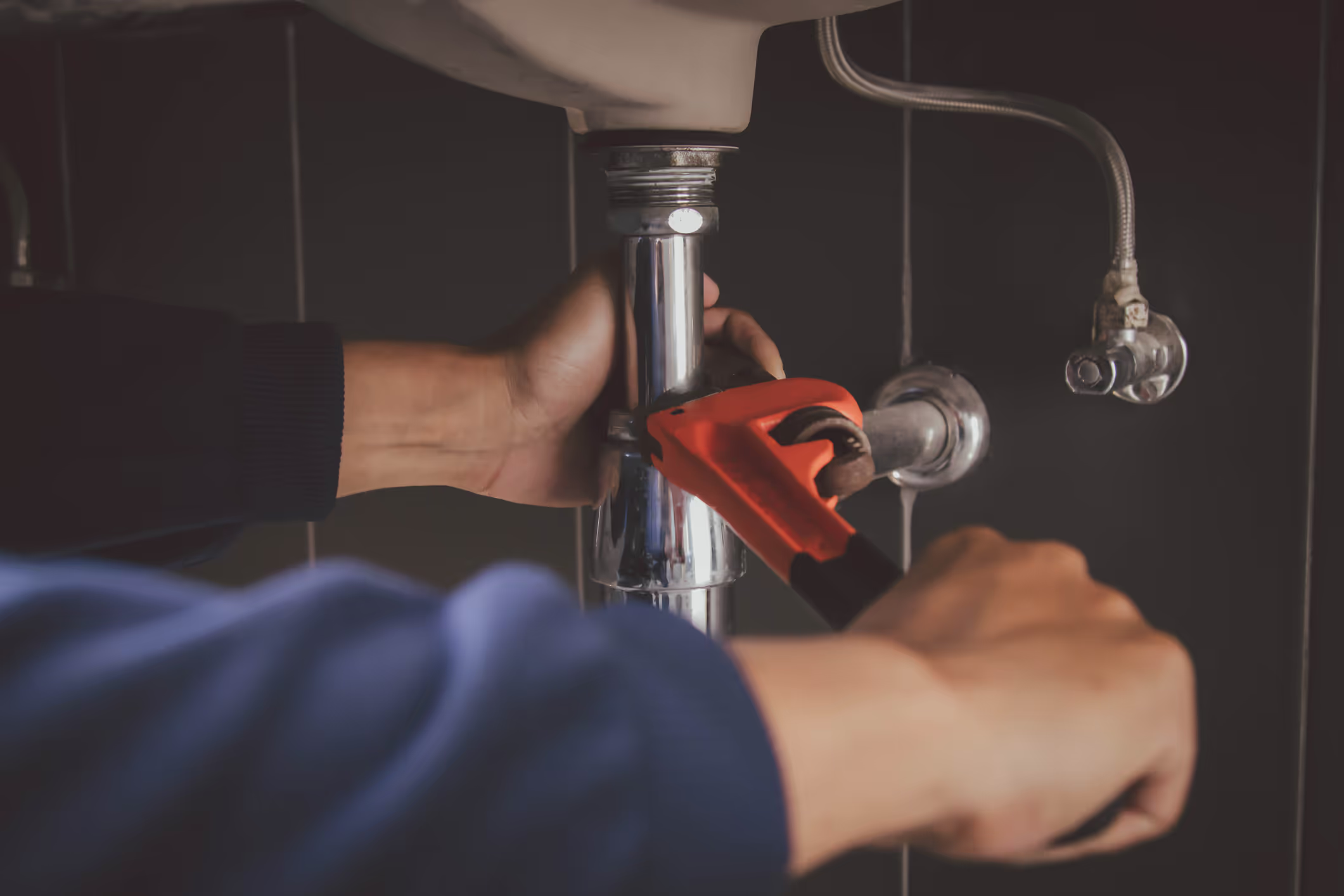
From leaks to full system installs, our plumbing services cover everything you need for a safe, reliable home water system, 24/7.
Our Primary Plumbing Include:
- Water Heater Replacement
- Water Heater Repair
- Trenchless Sewer Line
- Water Filtration
- Slab Leak
- Sewer Line Repair
Don't see the service you need? Call our Team today!
ELECTRICAL

Our electrical services ensure your home stays safe and powered, from routine fixes to complete system upgrades.
Our Primary Electrical Services Include:
- House Rewiring
- Electrician
- Electric Panel Upgrade
- Electric Panel Replacement
- EV Chargers
- Whole House Generator
Don't see the service you need? Call our Team today!
HEATING
.jpg)
We install, repair, and maintain heating & furnace systems with expert care to keep your Colorado home comfortable and energy-efficient year-round.
Our Primary Heating Services Include:
- Heating Installation
- Heating Replacement
- Heating Maintenance
- Heating Repair
- Heating Service
- Heating Tune-Up
Don't see the service you need? Call our Team today!