The Hidden Threat of Denver's Changing Seasons
Late August is just around the corner, and while the daytime sun still feels intensely hot, those late-summer evenings are starting to carry a familiar, crisp chill. Preparing Your Denver Home's Plumbing for the Transition from Peak Summer to Early Fall Temperatures is a critical step that you need to take long before the leaves actually drop. In our experience serving the Front Range, our team at Veteran Heating, Cooling, Plumbing & Electric often sees homeowners mistakenly believe that plumbing protection is a chore reserved for late October or November. However, the reality of living in the Denver metro area is that weather patterns change rapidly, and a sudden cold snap can catch you completely off guard.
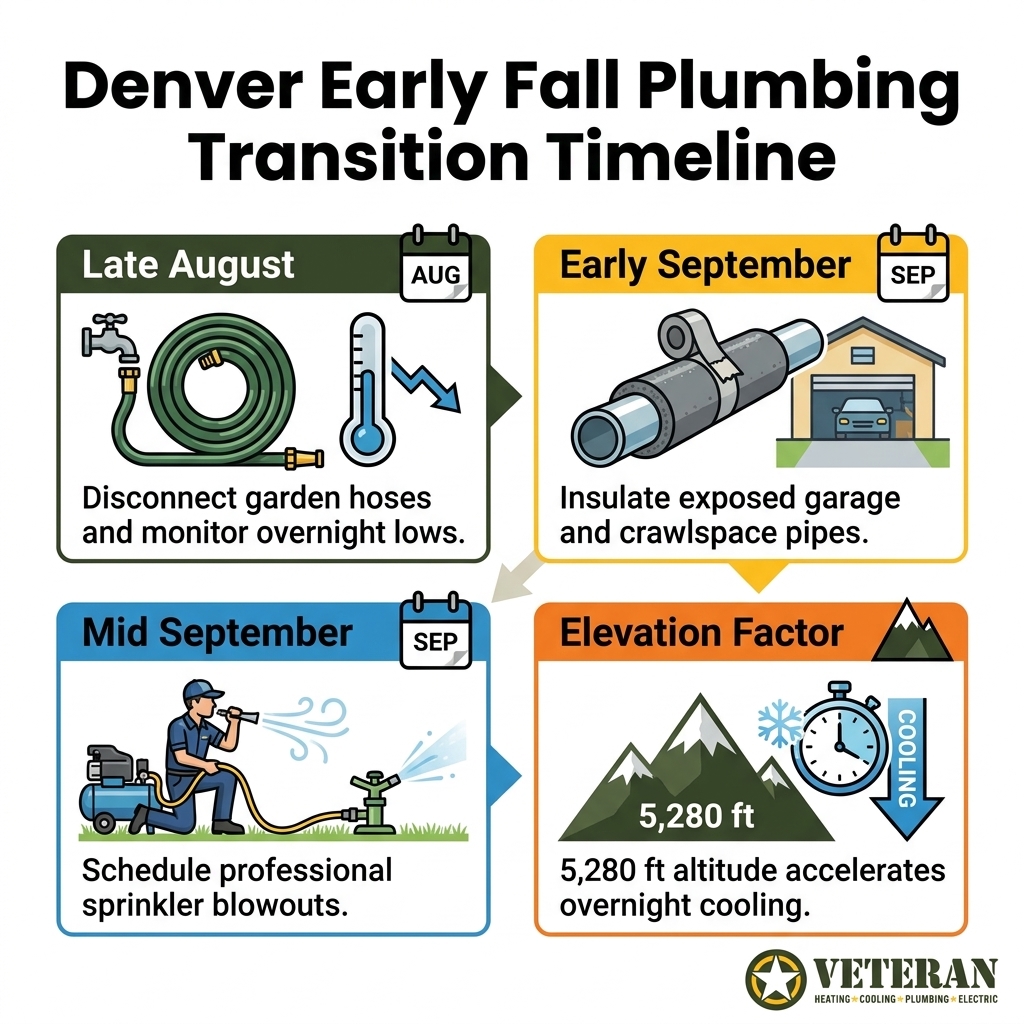
The core problem is the late-August overnight temperature descent. When the sun goes down, the heat escapes the atmosphere quickly, leaving your home's exterior vulnerable. Your outdoor hose bibs, shallow irrigation lines, and unheated garage pipes are suddenly exposed to near-freezing conditions while you are comfortably asleep inside. If you wait for the local news to announce a hard freeze warning, you are already behind schedule.
Transitioning your home's exterior and unheated plumbing from heavy summer usage to early fall protection is a decision you need to make proactively. Taking action now prevents the stressful, reactive scramble that happens when the first unexpected frost hits. By shifting your mindset from "summer mode" to "transition mode" right now, you protect your property from hidden damage, avoid emergency service calls, and ensure your home is ready for whatever the changing season brings.
Understanding High-Altitude Radiational Cooling
To understand why early preparation is so vital, you have to look at the unique science behind the Denver high-altitude climate. Sitting at 5,280 feet above sea level means our atmosphere is significantly thinner than it is in coastal or lower-elevation cities. We also have very low humidity levels during the late summer months. This combination creates a meteorological phenomenon known as radiational cooling.
During the day, the strong, high-altitude sun heats up the ground, your home, and your yard. But as soon as the sun sets, there is no thick, humid atmosphere to act as a thermal blanket. The heat radiates rapidly back into space. This is why we experience extreme diurnal temperature variations—a fancy way of saying the temperature swings wildly from day to night. It is incredibly common to experience an 80-degree afternoon followed by a late-August overnight temperature descent that plummets to 35 degrees or lower.
These specific microclimate conditions mean Denver homeowners face freezing risks weeks or even months before people living in the Midwest or on the East Coast. The ambient air temperature might hover just above freezing, but the wind chill and the rapid heat loss from metal fixtures can easily cause the water trapped inside them to freeze, expand, and cause damage.
Our local technicians always warn against following traditional, national advice that tells you to winterize your home in late October or November. Doing so leaves your property exposed during the most unpredictable weather window of the year. Understanding this high-altitude cooling effect is the first step in taking control of your home's seasonal maintenance.
Securing Outdoor Hose Bibs Before the First Freeze
Your outdoor faucets, commonly known as hose bibs, are your home's first line of defense against the changing weather. They sit directly exposed to the elements, making them highly susceptible to the late-August overnight temperature descent. The absolute most important step you can take right now is managing these exterior fixtures properly.
In our years of responding to plumbing emergencies, a pattern we see often is the forgotten garden hose. One local homeowner contacted us during a busy spring season with a broken outdoor faucet that was heavily leaking water against their foundation. We arrived to repair the fixture so they could use it for spring gardening, but after inspecting the damage, it became clear the failure hadn't happened in the spring at all. The homeowner had left a garden hose attached during a sudden early fall cold snap the previous year. The water froze, expanded, and cracked the brass fitting, but the damage remained hidden all winter until they turned the water back on months later.
Here is a straightforward process to secure your hose bibs before that first freeze hits:
1. Disconnect all garden hoses: Even if you plan to water the garden again the next day, detach the hose every evening. A connected hose traps water inside the fixture, preventing it from draining properly.
2. Drain the hose completely: Stretch the hose out on a downward slope to remove all standing water, then coil it up and store it in a shed or garage.
3. Inspect the fixture for leaks: Turn the faucet on and off, checking for any drips. A dripping faucet will slowly form an ice block inside the pipe as temperatures drop.
4. Install insulated covers: Foam faucet covers provide an excellent buffer against rapid radiational cooling, keeping the metal fixture closer to the ambient temperature of your home's interior.
Many modern Denver homes feature "frost-free" hose bibs. These are designed with a long stem that pushes the actual water shut-off valve deeper inside the warm walls of your house. However, a frost-free bib is completely useless if a hose is left attached. The hose prevents the internal water from draining out, leading to the exact same freezing and cracking risks as a standard fixture.
Navigating Sprinkler System Shut-Offs and Irrigation
As summer winds down, your lawn requires less water, marking the transition phase between heavy summer irrigation and early fall dormancy. Your sprinkler system is incredibly vulnerable during this time because many of its components—like the backflow preventer, manifold, and shallow PVC lines—sit right at or above the soil surface.
Because these components lack the insulation of deep earth, they bear the full brunt of the Denver high-altitude climate. A single unexpected overnight freeze can shatter a backflow preventer, leading to massive leaks and expensive replacements. However, managing this transition requires caution.
There is a massive difference between simply turning off your sprinkler system at the control box and actually preparing the pipes for freezing temperatures. Turning off the controller stops new water from entering the system, but it does absolutely nothing to remove the gallons of water already sitting in the shallow lines.
• Turning off the controller — What It Does: Stops the automated watering schedule. — Protection Level Against Freezing: Zero. Water remains trapped in all pipes and sprinkler heads.
• Closing the main shut-off valve — What It Does: Cuts off the water supply to the irrigation system. — Protection Level Against Freezing: Low. Prevents continuous flooding, but water remains in the lines.
• Professional System Blowout — What It Does: Uses regulated compressed air to evacuate all water from the system. — Protection Level Against Freezing: Maximum. Leaves pipes empty and safe from ice expansion.
Our team strongly advises against attempting a DIY sprinkler blowout using a standard garage air compressor. Professional technicians use specialized, high-volume (CFM) air compressors rather than high-pressure (PSI) machines. Pushing too much pressure through your PVC lines can blow apart the fittings and damage the sprinkler heads. Conversely, using a small home compressor usually lacks the volume to push all the water out, leaving dangerous puddles in the low spots of your yard that will freeze solid in late September.
Protecting Exposed Pipes in Garages and Crawlspaces
While exterior fixtures are obvious targets, the late-August overnight temperature descent also threatens transition zones inside your home. Unheated garages, exterior wall cavities, and crawlspaces are notorious trouble spots during early fall. Because these areas are not directly heated by your furnace, their temperatures can drop drastically, even while you remain perfectly warm in your living room.
Garages are particularly deceptive. Every time you open the large overhead door on a chilly evening, you flush out the trapped ambient heat. If you have exposed water lines running along the garage ceiling to a bonus room, or a utility sink against an uninsulated exterior wall, those pipes are at severe risk.
Based on the patterns we see often in Denver homes, our technicians recommend following this early fall checklist to secure these transition zones:
• Inspect pipe insulation: Walk through your garage, basement, and crawlspace. Look for any bare copper or PEX water lines. Wrap them in high-quality foam pipe insulation, ensuring the corners and joints are completely covered.
• Seal drafts and air leaks: Cold air blowing directly on a pipe accelerates freezing dramatically. Use weatherstripping around garage doors and expanding foam to seal gaps where pipes enter the house through the foundation.
• Close crawlspace vents: If your home has operable crawlspace vents, early fall is the time to ensure they are closed and sealed tightly against the incoming cold air.
• Monitor ambient temperatures: Place a basic digital thermometer in your garage or crawlspace. During the first few cold snaps, check the reading in the early morning to see how close these spaces actually get to the freezing mark.
By taking these steps now, you create a thermal buffer that protects your plumbing long before the deep winter freeze sets in.
A Disciplined Approach to Seasonal Maintenance
Transitioning your home for the changing season shouldn't feel like a chaotic, last-minute scramble. At Veteran Heating, Cooling, Plumbing & Electric, working with our veteran-owned team means applying a military-grade sense of discipline and proactive precision to your home's maintenance. We view seasonal preparation not as a reaction to bad weather, but as a scheduled, strategic mission to protect your property.
The Denver high-altitude climate demands respect and routine. When you establish a strict timeline for your home's maintenance, you eliminate the stress of uncertainty. You aren't guessing if your pipes are safe; you know they are secure because you executed the checklist.
Adopting this disciplined approach provides several distinct advantages:
• Predictability: Scheduled maintenance happens on your timeline, not at 2:00 AM during a freezing emergency.
• Financial control: Replacing an inexpensive foam cover or a piece of pipe insulation today prevents major water damage and structural repairs tomorrow.
• Peace of mind: Knowing your home is battened down allows you to actually enjoy the changing seasons without anxiety.
We encourage homeowners to adopt this checklist-driven mentality. Treat your home's plumbing systems with the same preventative care you give your vehicle. Regular inspections, timely interventions, and a refusal to cut corners will keep your water flowing safely all year long.
Recognizing When Professional Intervention is Required
While there is plenty you can do to prepare your home for the late-August overnight temperature descent, it is equally important to know where your responsibilities end and when professional expertise is required. Disconnecting hoses, wrapping exposed garage pipes in foam, and monitoring your crawlspace temperatures are all safe, highly effective homeowner tasks.
However, if you discover a pipe that is already bulging, a fixture that is leaking inside a wall cavity, or a main shut-off valve that is corroded and stuck, it is time to call in the professionals. Attempting DIY repairs on pressurized plumbing systems—especially when those systems have already been weakened by temperature stress—can lead to sudden bursts and severe water damage.
Our licensed professionals have the diagnostic tools and experience to see what you cannot. We can safely assess the integrity of your transition zones and ensure that your home's critical infrastructure is truly ready for the dropping temperatures.
Understanding Professional Repair Approaches
When a pipe has suffered stress or micro-fractures from early freezing, simple patches or tape will not hold up to the constant water pressure. Our Denver plumbing experts utilize advanced diagnostic techniques to locate hidden vulnerabilities in exposed lines, often finding weak points behind drywall or under concrete.
If damage is found, we employ specialized pipe repair methods that ensure a permanent, winter-ready solution. This might involve cutting out the compromised section of copper, properly soldering a new joint, or upgrading vulnerable segments to more resilient materials. The goal is never a temporary fix; the goal is to restore the system to full strength so it can withstand the harsh Denver climate.
Frequently Asked Questions
At what temperature should I worry about my pipes freezing in Colorado?
You should start taking precautions when the outside temperature drops to 32°F, but pipes typically freeze when the ambient air around them hits 20°F for several consecutive hours. In unheated spaces like garages or crawlspaces, drafts can accelerate this process rapidly. Always monitor the temperature inside these transition zones, not just the weather report.
How do I protect my hose bibs in early fall?
The most crucial step is to disconnect all garden hoses every evening so water can drain out of the fixture. Next, check the faucet for any slow drips and install an insulated foam cover over the bib. Even if you have a frost-free fixture, you must remove the hose to allow the internal mechanism to function properly.
When should I winterize my sprinkler system in Denver?
You should plan to schedule your professional sprinkler blowout by mid-to-late September. Because surface-level backflow preventers and shallow PVC lines are highly exposed, they can easily freeze during an early cold snap. Waiting until late October leaves your expensive irrigation components at serious risk.
Can an unheated garage cause pipes to freeze as early as September?
Yes, an unheated garage can absolutely drop below freezing in September, especially if the overhead door is opened frequently during cold evenings. Pipes running along exterior walls or across the garage ceiling are highly vulnerable. Adding proper foam insulation and sealing air drafts are critical early fall steps.
What is the difference between early fall plumbing transition and deep winterization?
Early fall transition focuses on securing the most exposed, vulnerable elements like hose bibs, sprinkler backflows, and uninsulated garage pipes against sudden overnight freezes. Deep winterization involves more comprehensive steps, such as servicing the primary heating system and preparing the entire home for sustained sub-zero temperatures. Proactive early transition prevents the immediate damage caused by unpredictable autumn weather.
The shift from summer heat to crisp autumn air happens fast in the Front Range, but it doesn't have to catch you off guard. By taking a disciplined, proactive approach to your home's exterior and unheated plumbing, you can secure your property without resorting to dangerous DIY guesswork. Having clear guidelines and executing them early ensures your home remains safe, dry, and fully prepared for the changing season.
ABOUT Veteran Heating, Cooling, Plumbing & Electric
Veteran Heating, Cooling, Plumbing & Electric was founded on the belief that service should be personal, honest, and community-focused. Our team is built around integrity, professionalism, and a true commitment to your home’s comfort and safety.
Led by a U.S. Army veteran with over 30 years of industry experience, we’re proud to remain locally owned and operated. Every technician, plumber, and electrician is EPA-certified, background checked, and driven to exceed expectations.
- 24/7 ServiceWe offer weekend & 24/7 emergency service. We’re here whenever you need us—day, night, or weekend, no exceptions.
- $0 Trip FeesNo dispatch or trip fees. You’ll never pay just for us to show up—service starts when the work does.
OUR SERVICES
AIR CONDITIONING
.jpg)
We offer specialty and seasonal services like indoor air quality upgrades, pre-winter furnace checks, and summer AC tune-ups to keep your home prepared year-round.
Our Primary Air Conditioning Services Include:
Don't see the service you need? Call our Team today!
PLUMBING
From leaks to full system installs, our plumbing services cover everything you need for a safe, reliable home water system, 24/7.
Our Primary Plumbing Include:
- Water Heater Replacement
- Water Heater Repair
- Trenchless Sewer Line
- Water Filtration
- Slab Leak
- Sewer Line Repair
Don't see the service you need? Call our Team today!
ELECTRICAL

Our electrical services ensure your home stays safe and powered, from routine fixes to complete system upgrades.
Our Primary Electrical Services Include:
- House Rewiring
- Electrician
- Electric Panel Upgrade
- Electric Panel Replacement
- EV Chargers
- Whole House Generator
Don't see the service you need? Call our Team today!
HEATING
.jpg)
We install, repair, and maintain heating & furnace systems with expert care to keep your Colorado home comfortable and energy-efficient year-round.
Our Primary Heating Services Include:
- Heating Installation
- Heating Replacement
- Heating Maintenance
- Heating Repair
- Heating Service
- Heating Tune-Up
Don't see the service you need? Call our Team today!