The Mystery of the August Energy Spike at 72 Degrees
Your air conditioner is running nonstop, and while the house eventually cools down, your latest utility report shows a massive spike in electricity usage. The physics behind why your electricity bill spikes in August even when the thermostat stays at 72 can feel like a frustrating mystery. You haven't touched the dial, your daily routine remains exactly the same, yet the energy consumption tells a completely different story.
Most homeowners immediately face a stressful decision point: is the air conditioning unit malfunctioning and drawing excess power, or is there an invisible environmental force at play? It is incredibly common to assume that a sudden jump in utility usage means a compressor is failing or a motor is burning out. However, before you panic about a costly repair, it helps to understand the invisible battle happening just outside your walls.
This spike usually comes down to the fundamental physics of heat load and thermal transfer. Maintaining a strict 72 degrees indoor thermostat setting requires vastly different amounts of energy depending on the specific environmental pressures pushing against your home's exterior. By breaking down the science of how heat moves—without relying on dense engineering jargon—you can better assess whether your system needs a mechanic or if it is simply doing exactly what it was designed to do.
Understanding Delta T: The Hidden Math of Home Cooling
The problem: Homeowners often assume that if the thermostat is set to 72 degrees, the air conditioner uses the same amount of energy to maintain that temperature every day of the summer. When the usage spikes, it feels like the system is broken.
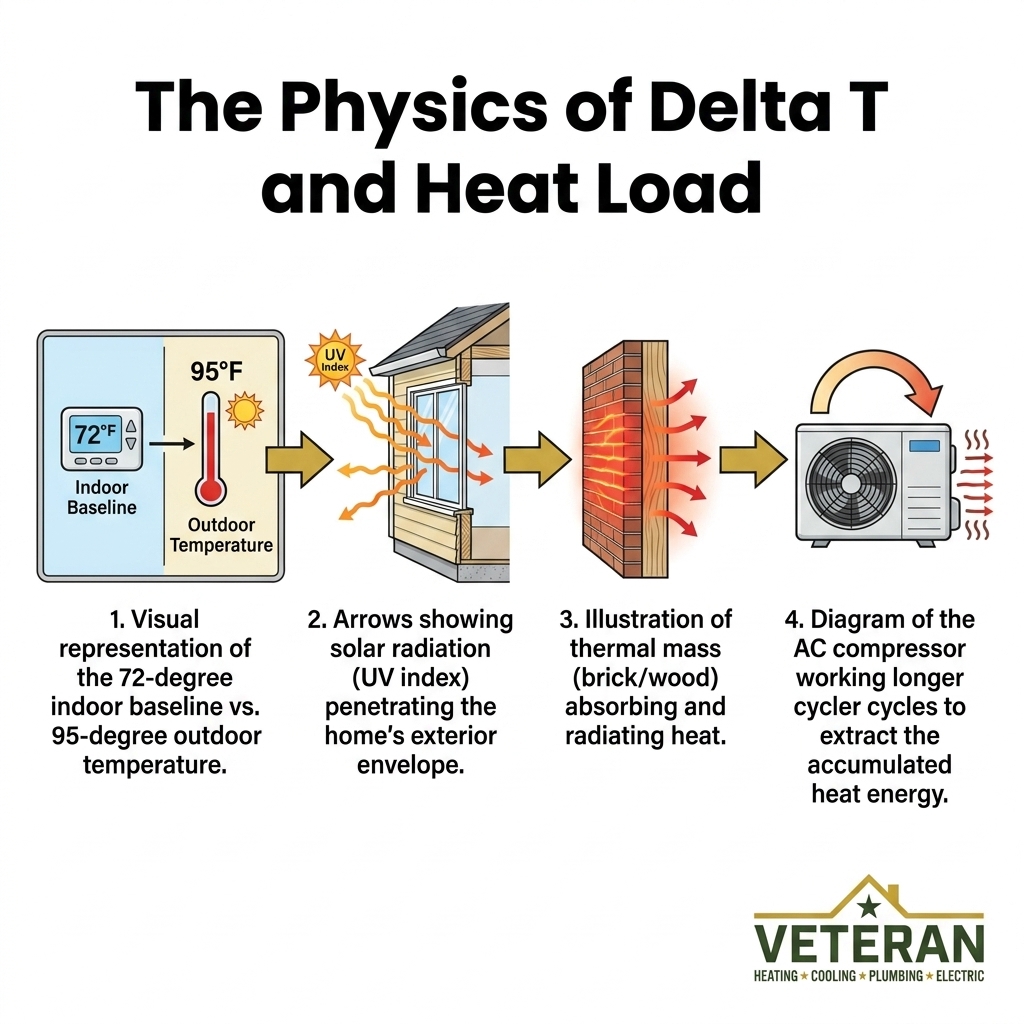
The cause: The amount of energy your system uses is not determined by the number on your thermostat, but by the gap between that number and the outdoor temperature. In the HVAC industry, this gap is known as Delta T (temperature differential). The wider the temperature gap, the faster heat energy attempts to transfer into your cooler indoor environment.
The solution: Recognizing how Delta T impacts energy consumption helps reset expectations for late-summer cooling. Here is how the hidden math actually works:
• The baseline effort: If it is 80 degrees outside and you want to maintain a 72 degrees indoor thermostat setting, your system is fighting an 8-degree temperature differential. The heat transfer is relatively slow, and the system easily cycles on and off.
• The exponential effort: If the outdoor temperature climbs to 95 degrees, that differential jumps to 23 degrees. Physics dictates that heat transfer accelerates exponentially as the gap widens. Your home absorbs heat much faster, forcing the system to work exponentially harder to keep up.
• The reality of cooling: Air conditioners do not actually "create" cold air. They are heat transfer machines. They actively absorb heat energy from inside your home and pump it outside. When the Delta T is extreme, there is simply more heat energy flooding into the house that must be mechanically removed.
Because the volume of heat entering the home is so much higher during a severe heatwave, the system must run longer cycles to extract it all. Those extended run times are the direct cause of the increased electricity usage, even though your thermostat setting never moved.
Thermal Mass and the Cumulative Effect of Late Summer
Beyond the daily outdoor temperature, your home is subject to a phenomenon known as thermal mass. Every building material—brick, stucco, wood framing, roofing shingles, and attic insulation—has the capacity to absorb and store heat energy. You can think of your home's physical structure as a giant thermal battery that charges up in the sun.
In early June, the structure of your home is still relatively cool from the mild spring weather. Even if you have a hot afternoon, the building materials haven't absorbed enough deep heat to become fully saturated. The air conditioner only has to cool the air inside the rooms.
However, by the time late August heatwaves arrive, the dynamic changes entirely. Weeks of relentless daytime sun fully saturate the thermal mass of the house. The brick and wood become completely heat-soaked. Because heat always moves toward cold, these materials begin radiating that stored thermal energy inward toward your 72-degree living space.
The Nighttime Heat Load
This thermal retention explains why your air conditioner might still be running at 9:00 PM, long after the sun has gone down and the outdoor air has cooled off. The outdoor temperature may have dropped to 75 degrees, but your attic and walls are still radiating 90-degree heat down into your ceiling.
This continuous radiant heat dramatically increases the overall "heat load"—the total volume of thermal energy the AC must battle. Your system is no longer just cooling the air; it is actively fighting the heat radiating out of the very bones of your house. This cumulative late-summer effect is a primary driver of heavy electricity usage.
High Altitude, High Impact: The Denver UV Factor
While thermal mass affects homes everywhere, Denver high-altitude sun exposure introduces a unique set of physics that accelerates heat transfer. At 5,280 feet above sea level, the climate realities change how both your home and your HVAC equipment perform.
First, the thinner air mass at elevation means there is less atmospheric protection against solar radiation. The UV index in the Front Range is significantly more intense than in coastal or sea-level climates. This intense, direct sunlight bakes a home's exterior envelope much faster. Windows, siding, and roofs absorb solar heat gain at an accelerated rate, driving up the indoor heat load rapidly during peak afternoon hours.
The Thinner Air Penalty
Second, this altitude directly impacts the mechanical efficiency of your outdoor condensing unit. An air conditioner cools your home by transferring indoor heat to the refrigerant, pumping it outside, and using a fan to blow outdoor air across the condenser coils to carry that heat away.
Because the air in Denver is roughly 17% less dense than at sea level, there are fewer air molecules passing over those coils to absorb and carry away the rejected heat. The condenser fan has to run longer, and the compressor has to work harder, to reject the same amount of heat that a sea-level system could reject easily. When you combine rapid solar heat gain from extreme UV exposure with reduced heat rejection efficiency due to thin air, your system is fighting a localized environmental battle that inevitably requires more electricity.
The Mechanics of Heat Removal: Why Your Compressor Works Overtime
To fully grasp why your usage spikes, it helps to connect the physics of heat load to the mechanical operation of the AC system itself. As we established, a 72 degrees indoor thermostat setting during a heatwave allows an enormous amount of thermal energy into the home. That energy must be mechanically extracted.
The indoor evaporator coil absorbs the ambient heat from your return air, and the refrigerant carries it outside. To understand this process completely, you can learn more about the connection between your indoor and outdoor AC units. The critical component in this cycle is the compressor, which pressurizes the refrigerant so it can release the heat outside.
The compressor is the most power-hungry component in your entire home. It draws a significant amount of continuous amperage while running. When the heat load is low, the compressor might run for 15 minutes, shut off for 20 minutes, and repeat. But when the heat load is extreme, the compressor may need to run for 45 minutes out of every hour just to keep the indoor temperature from rising.
A typical pattern we see is homeowners assuming a constantly running system is a broken system. For example, during a recent fall season, one local customer reached out because their furnace was not working correctly. Our technician, Jeff, professionally and efficiently fixed the furnace problem, but the true value came from taking the time to explain the underlying mechanics of the failure so the homeowner understood how the system operated. We apply that exact same educational standard to summer cooling. When your AC compressor runs in long, continuous cycles to extract heavy heat loads, it draws high continuous amperage. The system isn't broken; it is simply doing the heavy lifting required by the environment.
Diagnosing the Difference: Thermal Physics vs. Equipment Failure
The problem: Because a high heat load and a failing air conditioner both result in a system that runs constantly, it can be difficult to know when to call for professional help.
The cause: An AC battling late August heatwaves will run continuously, but it will still extract heat. A failing AC will run continuously because a mechanical defect prevents it from extracting heat at all.
The solution: You can diagnose the difference by observing how the system behaves across a 24-hour cycle. Here is a breakdown of what to look for:
• Airflow Temperature — Normal Heat Load Operation: Air coming from vents is consistently cold, even if the house feels warm. — Potential Equipment Failure: Air coming from vents is lukewarm or room temperature.
• Nighttime Recovery — Normal Heat Load Operation: The system catches up and reaches the thermostat setting after the sun goes down. — Potential Equipment Failure: The system runs all night and still cannot reach the target temperature.
• Cycle Length — Normal Heat Load Operation: Long, steady, continuous run times during peak afternoon hours. — Potential Equipment Failure: Rapid short-cycling (turning on and off every 3-5 minutes) regardless of time of day.
• System Noises — Normal Heat Load Operation: A steady, consistent hum from the outdoor compressor and indoor blower. — Potential Equipment Failure: Grinding, squealing, or heavy rattling noises from the equipment.
If your system is exhibiting the signs of normal heat load operation, the worst thing you can do is lower the thermostat further. Dropping the setting to 68 degrees will not make the air coming out of the vents any colder; it only forces the compressor to work harder against an already steep thermal gradient.
This commitment to education over high-pressure sales is a core value. During a winter consultation, one customer needed information on a new system. Our team member Jim Anderson explained all features, benefits, and options, ensuring the customer was fully informed before making a choice. That same military-grade discipline and transparency—a hallmark of Veteran Heating, Cooling, Plumbing & Electric—applies when diagnosing an air conditioner. We focus on educating the homeowner on the "why" rather than pushing a quick sale for a perceived broken unit.
Frequently Asked Questions About Summer Heat Load
Does AC use more electricity when it's hotter outside?
Yes, because the system must run much longer cycles to remove the increased heat energy entering the home. A wider temperature gap between the indoors and outdoors accelerates heat transfer into your living space. Additionally, higher outdoor temperatures reduce the efficiency of the outdoor unit's heat rejection process, forcing it to draw more continuous amperage.
What exactly is thermal heat load in a house?
Thermal heat load is the total amount of heat energy that must be mechanically removed from the indoor space to maintain your desired temperature. It is not just about the outdoor air temperature; it factors in solar radiation, humidity levels, the thermal mass of the building materials, and even the heat generated by appliances and people indoors.
Why does my AC run constantly in August?
The cumulative effect of thermal mass means your home's structure is constantly radiating heat indoors, especially during late August heatwaves. Over the summer, your brick, wood, and insulation absorb deep heat. By August, they are fully saturated and release that heat into your home continuously, requiring the AC to run nonstop to extract it.
Is my AC broken if it struggles to reach 72 degrees during a heatwave?
Not necessarily. Most residential cooling systems are intentionally sized for average summer highs, not extreme, peak heatwaves. If the system maintains your target temperature overnight and through the morning, but struggles during mid-afternoon, it is likely dealing with an overwhelming heat load rather than a mechanical failure.
How can I reduce solar heat gain in my home?
The most effective method is to block the sun before it heats your home's interior. Keep blinds, shades, and heavy curtains closed on south- and west-facing windows during peak sun hours. Furthermore, ensuring you have proper attic insulation and active roof ventilation will prevent trapped radiant heat from transferring down through your ceiling.
Managing Your Home's Heat Load for the Rest of Summer
Understanding the physics behind your home's energy consumption can completely shift how you view your utility reports. When you factor in the realities of Delta T, the thermal mass of your building materials, and the intense Denver high-altitude sun exposure, a spike in electricity usage makes perfect logical sense. Your air conditioner is simply fighting a much steeper thermal gradient to maintain the comfort you expect.
As we move through the rest of the summer, focus on managing the heat load rather than overworking the thermostat. Utilize window treatments to block direct UV rays, ensure your attic is properly ventilated, and keep your air filters clean so the blower motor doesn't have to fight restricted airflow on top of everything else.
If you have checked the symptoms and suspect that your system is suffering from a true mechanical failure rather than just battling the physics of late summer, it is time for a professional assessment. Reach out to schedule a thorough inspection. We believe in providing transparent, educational service that diagnoses the real issue, ensuring your home stays comfortable without unnecessary stress.
ABOUT Veteran Heating, Cooling, Plumbing & Electric
Veteran Heating, Cooling, Plumbing & Electric was founded on the belief that service should be personal, honest, and community-focused. Our team is built around integrity, professionalism, and a true commitment to your home’s comfort and safety.
Led by a U.S. Army veteran with over 30 years of industry experience, we’re proud to remain locally owned and operated. Every technician, plumber, and electrician is EPA-certified, background checked, and driven to exceed expectations.
- 24/7 ServiceWe offer weekend & 24/7 emergency service. We’re here whenever you need us—day, night, or weekend, no exceptions.
- $0 Trip FeesNo dispatch or trip fees. You’ll never pay just for us to show up—service starts when the work does.
OUR SERVICES
AIR CONDITIONING
.jpg)
We offer specialty and seasonal services like indoor air quality upgrades, pre-winter furnace checks, and summer AC tune-ups to keep your home prepared year-round.
Our Primary Air Conditioning Services Include:
Don't see the service you need? Call our Team today!
PLUMBING
From leaks to full system installs, our plumbing services cover everything you need for a safe, reliable home water system, 24/7.
Our Primary Plumbing Include:
- Water Heater Replacement
- Water Heater Repair
- Trenchless Sewer Line
- Water Filtration
- Slab Leak
- Sewer Line Repair
Don't see the service you need? Call our Team today!
ELECTRICAL

Our electrical services ensure your home stays safe and powered, from routine fixes to complete system upgrades.
Our Primary Electrical Services Include:
- House Rewiring
- Electrician
- Electric Panel Upgrade
- Electric Panel Replacement
- EV Chargers
- Whole House Generator
Don't see the service you need? Call our Team today!
HEATING
.jpg)
We install, repair, and maintain heating & furnace systems with expert care to keep your Colorado home comfortable and energy-efficient year-round.
Our Primary Heating Services Include:
- Heating Installation
- Heating Replacement
- Heating Maintenance
- Heating Repair
- Heating Service
- Heating Tune-Up
Don't see the service you need? Call our Team today!