Why Is My AC Suddenly Blowing Warm Air Right Now?
Are you trying to figure out exactly what to do when your AC starts blowing warm air during the final heatwave of August, even though the system sounds like it is running normally? It is one of the most frustrating experiences a homeowner can face. You rely on your cooling system to provide relief from the intense late-summer sun, and discovering that your vents are pushing out 80-degree air creates immediate discomfort and concern. When your equipment fails at the exact moment you need it most, it is easy to assume the worst-case scenario.
However, an air conditioner blowing warm air does not automatically mean the entire system is destroyed. Distinguishing between a simple settings issue, a minor maintenance oversight, and a catastrophic mechanical failure requires a calm, step-by-step approach. Many of the most common cooling failures stem from the cumulative wear and tear your system has endured since early June. By understanding the basic mechanics of your HVAC system, you can perform a few safe, preliminary checks before you pick up the phone.
Understanding how your air conditioner works is the critical first step to diagnosing these issues and avoiding common AC repairs altogether. This guide will walk you through a disciplined triage process to help you safely identify the problem.
The Cumulative Effect of Summer Strain on Your HVAC System
To understand why your system is struggling right now, you have to look at what it has been doing for the past three months. Air conditioners do not usually fail randomly; they fail because of cumulative mechanical stress. Continuous operation through June and July creates immense wear and tear on your compressor, blower motor, and electrical components. By the time a late August heatwave arrives, these parts have already cycled on and off thousands of times.
This continuous strain is heavily amplified for homes in the Denver metro area. Because of Denver's high altitude, the air density is significantly lower than it is at sea level. This physiological reality forces your HVAC system to work much harder to move the same mass of cooling air through your home. The compressor runs longer cycles, the blower fan pushes against lower atmospheric pressure, and the entire system operates under a higher baseline of stress.
When sudden late-summer temperature spikes hit, they push these already-stressed components past their safe operational limits. The heat outside prevents the system from efficiently releasing the heat it absorbed from inside your house. This cumulative strain often presents as warm air blowing from your indoor vents rather than a complete, sudden system shutdown. The indoor fan keeps running, but the outdoor heat-transfer process has essentially given up.
Early Summer vs. Late Summer AC Strain
• Component Wear — Early Summer (June): Fresh from spring maintenance; parts are well-lubricated. — Late Summer (August): High friction; capacitors and motors are heavily worn.
• Air Filter Status — Early Summer (June): Typically clean, allowing maximum airflow over the coil. — Late Summer (August): Often clogged with months of dust, pollen, and pet dander.
• Outdoor Condenser — Early Summer (June): Clear of debris and able to vent heat efficiently. — Late Summer (August): Often choked by summer vegetation, dirt, and cottonwood seeds.
• System Response — Early Summer (June): Cools the home quickly in short, efficient cycles. — Late Summer (August): Runs continuously, struggling to lower indoor temperatures.
Step 1: Verify Your Thermostat Settings (A Safe DIY Check)
Before assuming your compressor has failed, you must rule out user error and basic communication faults. The thermostat is the brain of your cooling system, and if it sends the wrong signal—or no signal at all—the equipment will not perform correctly. This is the safest and most common reason for an AC blowing warm air in August.
Follow these specific steps to check your thermostat before moving on to more complex diagnostics:
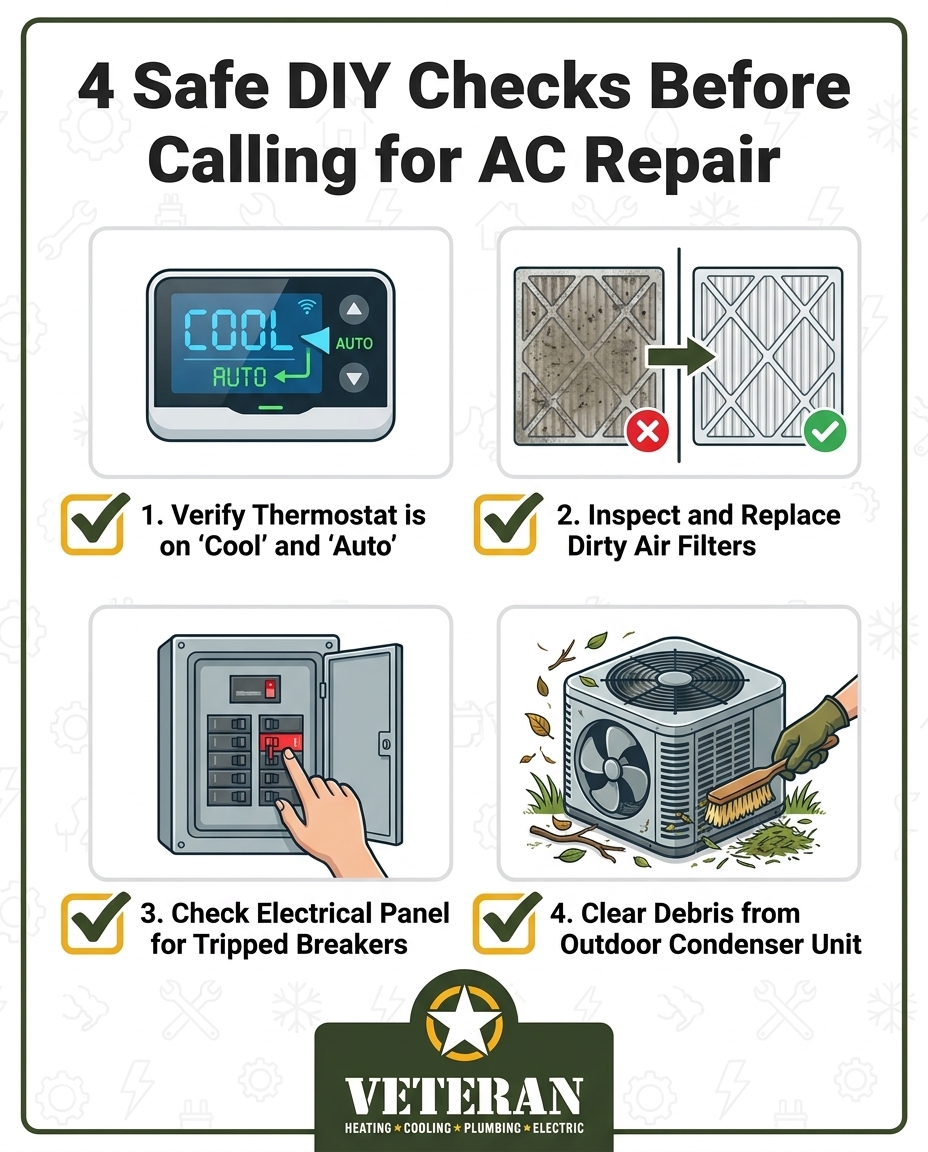
1. Verify the System Mode: Confirm that the thermostat is explicitly set to the "Cool" position. It is incredibly common for thermostats to get bumped into "Heat" or "Off" during routine dusting, or for a programmable schedule to revert to an incorrect default setting.
2. Check the Fan Setting: Look closely at the fan switch. It should be set to "Auto" rather than "On". When the fan is set to "On", the indoor blower motor runs continuously 24/7, even between cooling cycles. This means it will blow uncooled, room-temperature air through your vents while the outdoor compressor is resting, which feels like warm air.
3. Inspect the Display and Batteries: If your thermostat screen is blank, unresponsive, or flashing a low-battery warning, it cannot send the proper 24-volt signal to the outdoor unit. Replace the batteries with fresh ones and wait five minutes for the system to reboot and re-establish communication.
4. Monitor the Temperature Drop: Once you have confirmed the settings are correct, lower the target temperature by three degrees and wait fifteen minutes. If the air coming from the vents remains warm, the issue lies deeper in the mechanical or electrical system.
Step 2: Inspect for a Severely Dirty Air Filter
If your thermostat is communicating correctly, the next step is evaluating your system's airflow. The mechanical relationship between your air filter and your cooling output is absolute. Your air conditioner does not actually "create" cold air; it removes heat from the existing air in your home. It does this by pulling warm indoor air across a freezing-cold evaporator coil located inside your furnace or air handler.
When you have a severely clogged air filter, that critical airflow is restricted. The blower motor cannot pull enough warm air across the coil to absorb the cold temperature. Without that constant flow of warm air, the temperature of the evaporator coil drops rapidly below freezing. The natural humidity and condensation that normally drips safely into a drain pan instantly turns into solid ice on the coil.
The result of a frozen coil: Once the coil is encased in a block of ice, the system can no longer remove heat from your home. The indoor fan continues to run, but it is just blowing air over a blocked, frozen surface. This results in warm, unconditioned air circulating through your home, even though the system sounds like it is working perfectly. During a late August heatwave, an air filter can easily become overloaded with summer dust, wildfire smoke, and pet hair.
What you should do: Turn off your system entirely at the thermostat. Locate your air filter and pull it out. Hold it up to a light source—if you cannot see light shining through the material, it is too dirty. Replace it with a fresh, clean filter. If you suspect the coil is frozen, you must leave the system turned off for several hours to allow the ice to melt completely before turning it back on.
Step 3: Check the Electrical Circuit Breakers
Your central air conditioning system is a split system, meaning it operates using two entirely separate electrical circuits. The indoor blower motor (which pushes air through your vents) is usually tied to your furnace on a standard 120-volt circuit. The outdoor condenser (which houses the heavy-duty compressor) requires a massive amount of power and operates on a dedicated 240-volt circuit.
Because they are on separate breakers, it is entirely possible for the outdoor unit to lose power while the indoor unit keeps running. If the outdoor unit's breaker trips due to a power surge, overheating, or a mechanical strain, the compressor shuts down. However, the indoor fan will continue to run, pulling warm air from your rooms and blowing it right back out, uncooled.
How to safely check your electrical panel:
• Locate the main panel: Find your home's primary electrical breaker box, typically located in a basement, garage, or utility room in the Denver metro area.
• Find the AC breaker: Look for a large, double-pole breaker labeled "AC", "Condenser", or "HVAC".
• Check the switch position: A tripped breaker will not always rest in the "Off" position; it often sits loosely in the middle.
• Reset the breaker once: Firmly push the switch all the way to the "Off" position until it clicks, then push it firmly back to the "On" position.
A critical safety warning: You should only attempt to reset a tripped breaker exactly one time. If you reset the breaker and it instantly trips again, or if it trips a few minutes after the system starts up, do not reset it again. A repeatedly tripping breaker is a critical safety mechanism doing its job. It indicates a serious electrical short, a failing compressor, or melted wiring. Forcing the system to run under these conditions can cause an electrical fire or permanently destroy the equipment.
Step 4: Ensure the Outdoor Condenser is Clear
The indoor and outdoor units must work in perfect tandem to cool your home. The indoor unit absorbs the heat from your living space, and the outdoor unit releases that absorbed heat into the outside air. If the outdoor unit cannot "breathe," the heat stays trapped in the system, and your vents will eventually start blowing warm air.
The outdoor condenser is covered in hundreds of delicate, paper-thin metal fins that facilitate this heat transfer. Throughout the summer, these fins act like a giant vacuum, pulling in massive amounts of air. In the process, they also pull in overgrown vegetation, lawn clippings, dirt, and massive amounts of cottonwood seeds. When these materials form a blanket over the exterior of the unit, the compressor overheats and the system's cooling capacity drops to zero.
If you are dealing with an AC blowing warm air in August, you must visually inspect the exterior unit. Walk outside and look closely at the metal grilles. If you see a thick layer of debris blocking the fins, the unit cannot vent heat. You can safely and gently clear away loose leaves, branches, and debris from the exterior using your hands or a soft brush. Understanding how the indoor and outdoor AC units are connected highlights why this airflow is so vital.
What to avoid: Never use a high-pressure power washer on your air conditioner. High-pressure water will instantly flatten the delicate aluminum fins, permanently ruining the unit's ability to transfer heat. Furthermore, never open the external casing or attempt to clean the internal electrical components yourself. Safe DIY maintenance stops at the exterior surface of the unit.
The "Stop Here" Threshold: When to Call for Professional Diagnostics
There is a definitive line between safe homeowner maintenance and dangerous mechanical troubleshooting. If you have verified your thermostat settings, replaced a dirty filter, checked the breaker, and ensured the outdoor unit is clear, you have reached the "stop here" threshold. If the system is still blowing warm air during a late August heatwave, the issue is internal and mechanical.
At this point, the problem is likely a refrigerant leak, a blown dual-run capacitor, a failing blower motor, or a locked-up compressor. Handling pressurized chemical refrigerant requires an EPA certification and specialized gauges. Testing high-voltage capacitors exposes you to stored electrical energy that can cause severe injury even when the power is turned off. These are not DIY projects; they require a licensed professional.
When you reach this threshold, you need an honest, disciplined diagnostic approach to avoid unnecessary upsells. Working with a veteran-owned company ensures you receive military-grade discipline, honesty in diagnostics, and a swift emergency response when your family is desperate for cooling. Real-world execution matters. For example, during a severe winter storm, technicians Bryan and Diego were dispatched to a home with a failing system. What was scheduled as a massive two-day job was expedited and completed in a single day, ensuring the family was not left without climate control—and the neighbor's house was serviced on the same run with zero complaints. That exact same dedication to rapid, reliable service applies to catastrophic summer compressor failures.
If the technician discovers that the system has suffered a catastrophic compressor failure, pouring money into a dying unit is rarely the best choice. In those instances, exploring AC replacement in Aurora or the surrounding areas might be the most cost-effective, long-term solution for your home.
Frequently Asked Questions About AC Units Blowing Warm Air
Why is my AC running but blowing warm air suddenly?
This usually indicates a frozen evaporator coil, a tripped outdoor unit breaker, or a sudden refrigerant leak. The indoor fan continues to circulate air through your ductwork, which makes the system sound like it is running normally. However, because the outdoor compressor is either shut down or starved of refrigerant, no heat is actually being removed from the air.
How do you fix an AC that is blowing warm air?
Start by checking the thermostat settings, replacing dirty air filters, and ensuring the outdoor unit is clear of debris. These safe DIY steps solve a large percentage of airflow and communication issues. If these safe checks fail, a licensed technician must evaluate the refrigerant levels and test the high-voltage electrical components to find the root cause.
Can a dirty filter cause the AC to blow warm air?
Yes. A severely dirty filter restricts airflow, causing the indoor coil to freeze solid. Once the coil is encased in ice, the system cannot cool the air passing over it. The blower motor will continue to push air past the block of ice, resulting in warm, unconditioned air blowing out of your living room vents.
What should I check before calling an AC repair company?
Verify your thermostat is explicitly set to 'Cool' and 'Auto'. Check your main electrical panel for a tripped circuit breaker connected to the AC unit. Inspect your indoor air filter and replace it if it is clogged with dust. Finally, ensure the outdoor unit is free of leaves, tall grass, and debris so it can properly vent heat.
How do you reset an AC unit that is blowing warm air?
Turn the system completely off at the thermostat first. Locate the AC circuit breaker in your home's main electrical panel and flip it completely off, then firmly push it back to the "on" position. Wait at least 15 minutes before turning the thermostat back to 'Cool' to allow the internal pressures to equalize before the compressor restarts.
Get Fast, Honest AC Diagnostics Today
Enduring a sweltering, hot house is unnecessary and potentially unsafe during the peak temperatures of late summer. If you have completed the safe DIY checks and your system is still struggling, it is time to bring in a local, disciplined team you can trust. Do not let a minor mechanical issue turn into a total system failure. Reach out today to schedule a professional diagnostic evaluation in the Denver metro area, and get your home back to a comfortable, cool environment.
ABOUT Veteran Heating, Cooling, Plumbing & Electric
Veteran Heating, Cooling, Plumbing & Electric was founded on the belief that service should be personal, honest, and community-focused. Our team is built around integrity, professionalism, and a true commitment to your home’s comfort and safety.
Led by a U.S. Army veteran with over 30 years of industry experience, we’re proud to remain locally owned and operated. Every technician, plumber, and electrician is EPA-certified, background checked, and driven to exceed expectations.
- 24/7 ServiceWe offer weekend & 24/7 emergency service. We’re here whenever you need us—day, night, or weekend, no exceptions.
- $0 Trip FeesNo dispatch or trip fees. You’ll never pay just for us to show up—service starts when the work does.
OUR SERVICES
AIR CONDITIONING
.jpg)
We offer specialty and seasonal services like indoor air quality upgrades, pre-winter furnace checks, and summer AC tune-ups to keep your home prepared year-round.
Our Primary Air Conditioning Services Include:
Don't see the service you need? Call our Team today!
PLUMBING
From leaks to full system installs, our plumbing services cover everything you need for a safe, reliable home water system, 24/7.
Our Primary Plumbing Include:
- Water Heater Replacement
- Water Heater Repair
- Trenchless Sewer Line
- Water Filtration
- Slab Leak
- Sewer Line Repair
Don't see the service you need? Call our Team today!
ELECTRICAL

Our electrical services ensure your home stays safe and powered, from routine fixes to complete system upgrades.
Our Primary Electrical Services Include:
- House Rewiring
- Electrician
- Electric Panel Upgrade
- Electric Panel Replacement
- EV Chargers
- Whole House Generator
Don't see the service you need? Call our Team today!
HEATING
.jpg)
We install, repair, and maintain heating & furnace systems with expert care to keep your Colorado home comfortable and energy-efficient year-round.
Our Primary Heating Services Include:
- Heating Installation
- Heating Replacement
- Heating Maintenance
- Heating Repair
- Heating Service
- Heating Tune-Up
Don't see the service you need? Call our Team today!