The Heavy-Up Dilemma: Navigating New AC Power Requirements
There is a persistent myth among homeowners that holding off on major electrical work until cooler weather arrives makes the process less disruptive. However, when it comes to upgrading your electrical panel: doing it during a late summer AC replacement vs waiting for winter heating is a decision that directly impacts your home's safety, comfort, and logistical convenience. In our years serving the Denver area, our team at Veteran Heating, Cooling, Plumbing & Electric frequently sees homeowners discover their aging electrical infrastructure is inadequate only after their current air conditioner fails at the end of the season. You expect a straightforward equipment swap, but our installation crew has to inform you that your old electrical panel simply cannot handle the power draw of a modern cooling system.
This creates an immediate logistical dilemma. Do you bundle the necessary electrical heavy-up with your AC replacement right now, or do you attempt to delay the electrical upgrade until the weather cools down? Navigating the August late-summer cooling to winter transition means you have to weigh the inconvenience of a scheduled power outage now against the severe risks of losing heat later in the year. We always remind our clients that modern, high-efficiency cooling and heating systems demand robust, dedicated circuits to operate safely. Making the right decision requires understanding exactly why your new air conditioner needs more electrical support and how the timing of that upgrade affects your entire household.
The Electrical Reality of Modern Air Conditioners
When our electricians inspect older homes across the Denver metro area, we typically find they were built with 100-amp or 150-amp electrical panels. At the time of construction, these panels were perfectly sufficient to run standard lighting, kitchen appliances, and earlier generations of heating and cooling equipment. Today, however, upgrading to a modern high-efficiency air conditioner or heat pump almost always triggers the need for a 200-amp electrical service panel to comply with current National Electrical Code (NEC) safety standards.
Modern HVAC systems are sophisticated pieces of machinery. While they are far more energy-efficient overall, they require significant, stable bursts of power to start their compressors and variable-speed motors. When our technicians calculate your home's electrical load—factoring in your electric range, dryer, water heater, and daily plug loads—adding a high-capacity cooling system often pushes an older panel past its safe operational threshold. Overloading an outdated panel is a serious hazard that we've seen lead to tripped breakers, overheating wires, and electrical fires. Furthermore, understanding the connection between your indoor and outdoor AC units reveals that both components require dedicated, synchronized power to communicate and function without interruption. An outdated panel simply cannot provide that stable baseline.
NEC Compliance and HVAC Installations
Strict safety standards: The National Electrical Code requires dedicated circuits for major appliances, including your HVAC system. This means your air conditioner must have its own breaker that does not share power with any other outlets or lights in the house.
Inspection requirements: Any reputable installation involves pulling local municipal permits. If an inspector sees a high-draw air conditioner wired into an overloaded or outdated panel, the installation will fail inspection. Avoiding the necessary upgrade not only creates a safety hazard but also leaves you with an unpermitted, non-compliant home system that could complicate future real estate transactions.
The Logistical Nightmare of Separate Contractors
When homeowners decide to upgrade their HVAC equipment but try to manage the electrical work separately, they often stumble into a complex web of scheduling conflicts. The disjointed experience of hiring an HVAC installer and a separate electrician is one of the most frustrating aspects of home improvement we hear about from new clients.
The scheduling domino effect: The core problem arises when your HVAC contractor finishes installing the physical equipment, but the system cannot be turned on until the electrician arrives to upgrade the panel. If the electrician is booked out for two weeks, your brand-new air conditioner sits completely useless while your house continues to bake in the August late-summer cooling to winter transition heat.
Double the downtime: A home electric panel upgrade requires the local utility company to shut off power to your house for several hours. When you use separate contractors, you are forced to endure multiple days of disruption—one day for the AC crew to tear out and replace your ductwork and equipment, and an entirely separate day for the electrician to kill the power and rebuild your panel.
The unified solution: This is where working with a multi-trade provider fundamentally changes the experience. At Veteran Heating, Cooling, Plumbing & Electric, we developed our multi-trade capabilities precisely to solve this problem for our Denver neighbors. Because our HVAC technicians and licensed electricians operate under the same roof, we seamlessly coordinate the AC installation and the panel heavy-up in a single visit. We schedule the necessary utility disconnects and sequence the workflow together. We eliminate the contractor scheduling conflicts, ensuring your new cooling system is powered up and cooling your home before we leave the driveway.
Double the Appointments, Double the Disruption
Beyond the obvious scheduling headaches, managing two separate companies introduces hidden time costs. You have to wait at home for two different estimation visits, review two separate contracts, and coordinate two different municipal inspections. When one company handles both the mechanical and electrical scopes, our dedicated project managers oversee the entire permitting and inspection process, streamlining the timeline and keeping the project moving forward without administrative delays.
Winter Panel Upgrades: The Hidden Risks of Delaying
If you manage to patch your current system together and decide to put off the electrical upgrade until the colder months, you are inadvertently gambling with your home's thermal safety. Upgrading an electrical panel is not a quick swap of a few breakers; it requires completely severing the home's main power supply from the utility grid for anywhere from 4 to 8 hours while the new housing, grounding, and breakers are installed.
In the Denver metro area, enduring a multi-hour power outage during the late summer is a minor inconvenience. You might get a little warm, but you can open windows, head to a local coffee shop, or handle back-to-school shopping while our crews work. Enduring that exact same 4-to-8-hour power outage in the dead of winter is a completely different scenario with severe consequences that our emergency dispatchers know all too well.
1. Loss of primary heating: Even if you have a gas furnace, the blower motor that circulates the warm air throughout your home runs on electricity. When the main panel is shut down for an upgrade, your heating system is completely disabled.
2. Rapid temperature drops: Denver's winter temperatures routinely sit below freezing. Without an active heating system, a home's internal temperature can plummet dramatically in just a few hours, making the indoor environment dangerously cold for young children, elderly family members, and pets.
3. The threat of frozen pipes: As the indoor temperature drops during a prolonged winter power outage, the plumbing running through your exterior walls and unheated crawlspaces becomes highly vulnerable. A frozen and burst pipe can cause catastrophic water damage, turning a planned electrical upgrade into a massive home restoration emergency.
4. Weather delays: Winter storms and heavy snowfall can delay utility crews from arriving to disconnect or reconnect your power, potentially extending your planned 6-hour outage into a multi-day emergency.
Because Denver experiences rapid autumn temperature drops, securing a fully operational, electrically supported heating system before the first freeze is vital. Delaying the panel work means you will be forced to shut down your heat exactly when you need it most.
Side-by-Side Comparison: Summer Bundling vs. Winter Waiting
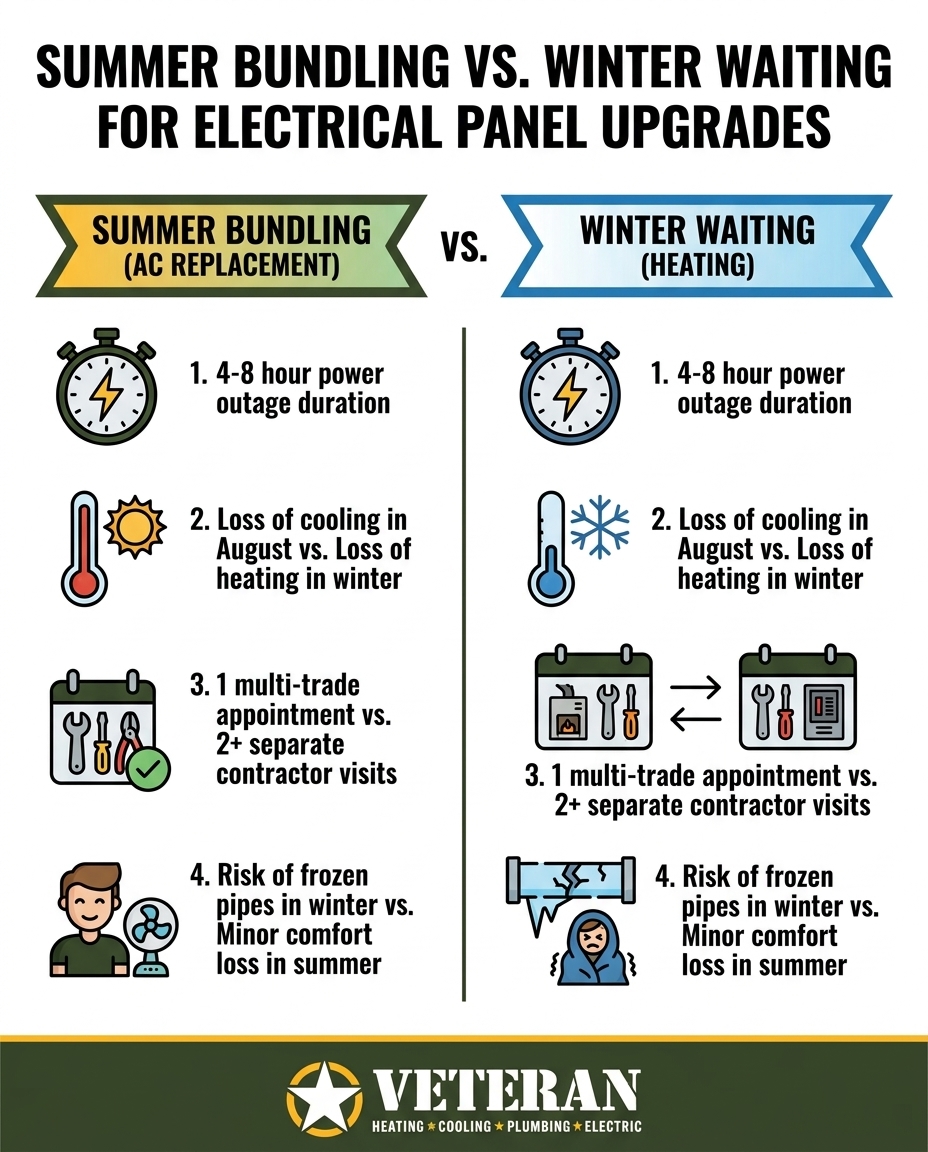
To make the best logistical choice for your household, it helps to view the trade-offs clearly. Bundling an electric panel replacement with your August AC installation provides distinct advantages over pushing the project into the winter months. Here is how our team compares the two approaches across key logistical categories.
• Impact on Home Comfort — Summer Bundling (August AC Install): Mild inconvenience. The house may get warm during the 4-8 hour outage, but windows can be opened. — Winter Waiting (Delayed Upgrade): Severe risk. Losing heating during freezing Denver temperatures causes rapid indoor chilling.
• Scheduling Logistics — Summer Bundling (August AC Install): Streamlined. One combined multi-trade visit handles both HVAC and electrical seamlessly. — Winter Waiting (Delayed Upgrade): Fragmented. Requires coordinating separate electrical appointments and utility disconnects later.
• System Readiness — Summer Bundling (August AC Install): Proactive. Infrastructure is fully upgraded and ready before the winter heating season begins. — Winter Waiting (Delayed Upgrade): Reactive. Leaves your home vulnerable to electrical failures during severe winter cold snaps.
• Overall Cost-Efficiency — Summer Bundling (August AC Install): High. Consolidates labor, mobilization, and permitting into a single project. Bonus: qualifying high-efficiency installations may be eligible for generic federal tax credits or local utility incentives. — Winter Waiting (Delayed Upgrade): Lower. Paying for separate contractor mobilizations and pulling multiple individual permits.
• Property Risk — Summer Bundling (August AC Install): Low. The August late-summer cooling to winter transition poses no freezing risks to plumbing. — Winter Waiting (Delayed Upgrade): High. A 4-8 hour heating outage in winter introduces a serious risk of frozen and burst pipes.
Navigating the Transition: Preparing for Upgrade Day
Once you decide to move forward with a combined HVAC and electrical project, knowing what to expect on installation day ensures a smooth process for your household. While all electrical and mechanical work must be performed strictly by our licensed professionals, your role as a homeowner involves preparing your living space for the scheduled power outage. In our experience coordinating multi-trade teams across the Denver metro area, we sequence the workflow tightly to minimize overall downtime.
Our project managers always recommend this checklist to help you prepare for the 4-to-8-hour window when your main power is shut off:
• Manage the refrigerator and freezer: Keep appliance doors strictly closed during the outage. A closed refrigerator will keep food safely cold for about 4 hours, and a full freezer will hold its temperature for up to 48 hours. If you have critical medications that require refrigeration, transfer them to a small cooler with ice packs before the power is cut.
• Plan for medical devices: If anyone in your home relies on electricity-dependent medical equipment (like CPAP machines or oxygen concentrators), arrange for backup battery power or plan to spend the day at a relative's fully powered home.
• Prepare for remote work: Wi-Fi routers and desktop computers will be offline. Charge all laptops, power banks, and cell phones the night before. If you work from home, plan to relocate to a local library or coffee shop for the duration of the heavy-up.
• Secure pets and children: Installation day involves our technicians moving heavy equipment, carrying ladders, and leaving exterior doors open. Keep pets secured in a specific room or consider sending them to daycare to reduce stress and prevent them from escaping.
• Clear the work zones: Ensure our licensed electricians have at least three feet of clear workspace around your current electrical panel. Move storage boxes, shelving, or vehicles out of the way so the team can work safely and efficiently.
By preparing your household in advance, you allow our coordinated multi-trade team to sequence the HVAC tear-out and the electrical panel rebuild simultaneously, ensuring your new system is online as quickly as possible.
Frequently Asked Questions About Upgrading Your Electrical Panel and AC
Do I need a new electrical panel for a new AC?
The short answer is that it depends on the age and capacity of your current panel, but upgrades are very common. Modern high-efficiency air conditioners draw significant power to operate their advanced compressors. If your home still has a 100-amp service panel, our electricians note that adding a new cooling system will likely overload it, making a 200-amp panel upgrade necessary to meet National Electrical Code safety standards.
Is it better to upgrade electrical panels in summer or winter?
It is significantly safer and more convenient to upgrade your panel during the late summer or early fall. Panel replacements require shutting off your home's main power for several hours. During the August late-summer cooling to winter transition, losing power means a temporary loss of air conditioning—often just while the kids are heading back to school—whereas a winter upgrade means losing your furnace during freezing temperatures, which can lead to dangerously cold indoor conditions and frozen pipes.
How long will my power be out during a panel upgrade?
You can generally expect your home to be without power for 4 to 8 hours during a standard electrical heavy-up. This window gives our licensed electricians enough time to disconnect from the utility grid, remove the old panel, install the new hardware, wire the breakers, and safely restore power. Multi-trade companies often coordinate this downtime to overlap with the physical installation of your new HVAC equipment.
Why does a new HVAC system require electrical work?
A new HVAC system requires dedicated electrical work because modern units must operate on their own isolated circuits to prevent overloading your home's electrical grid. Older homes were not wired to support the load of modern heat pumps or high-capacity air conditioners. Upgrading the wiring and the panel ensures the system receives stable, uninterrupted power without tripping breakers or causing fire hazards.
Can I run my new AC on an old electrical panel temporarily?
No, running a new, high-draw AC on an inadequate electrical panel is highly dangerous and violates safety codes. If the panel cannot support the electrical load, it will constantly trip breakers, potentially overheat the wiring, and risk starting an electrical fire. Furthermore, our licensed installers will not turn on a new system if the electrical infrastructure fails to pass municipal safety inspections.
What are the signs my current panel cannot handle my HVAC load?
If you notice your lights dimming or flickering every time your air conditioner kicks on, your panel is likely struggling to handle the load. Other warning signs we frequently see include frequently tripped breakers, a buzzing sound coming from the breaker box, or a panel that feels warm to the touch. If you experience any of these symptoms, you should have a licensed electrician evaluate your system immediately.
Secure Your Home's Comfort and Safety Before the Freeze
Understanding the logistics of upgrading your electrical panel: doing it during a late summer AC replacement vs waiting for winter heating ultimately comes down to protecting your home and your family. In our experience at Veteran Heating, Cooling, Plumbing & Electric, bundling these vital services into a single project prevents the miserable experience of enduring a freezing, multi-hour power outage during a Denver winter. By tackling the heavy-up now, you ensure your electrical infrastructure is robust, code-compliant, and fully prepared to support your heating system when the harsh weather arrives.
You do not have to navigate the stress of coordinating separate contractors or suffering through days of disrupted comfort. A streamlined, single-day approach is entirely possible when you rely on our unified multi-trade team. If you are planning an end-of-season AC replacement, have our experts evaluate your current electrical panel today to secure your home's comfort and safety long before the first freeze hits.
ABOUT Veteran Heating, Cooling, Plumbing & Electric
Veteran Heating, Cooling, Plumbing & Electric was founded on the belief that service should be personal, honest, and community-focused. Our team is built around integrity, professionalism, and a true commitment to your home’s comfort and safety.
Led by a U.S. Army veteran with over 30 years of industry experience, we’re proud to remain locally owned and operated. Every technician, plumber, and electrician is EPA-certified, background checked, and driven to exceed expectations.
- 24/7 ServiceWe offer weekend & 24/7 emergency service. We’re here whenever you need us—day, night, or weekend, no exceptions.
- $0 Trip FeesNo dispatch or trip fees. You’ll never pay just for us to show up—service starts when the work does.
OUR SERVICES
AIR CONDITIONING
.jpg)
We offer specialty and seasonal services like indoor air quality upgrades, pre-winter furnace checks, and summer AC tune-ups to keep your home prepared year-round.
Our Primary Air Conditioning Services Include:
Don't see the service you need? Call our Team today!
PLUMBING
From leaks to full system installs, our plumbing services cover everything you need for a safe, reliable home water system, 24/7.
Our Primary Plumbing Include:
- Water Heater Replacement
- Water Heater Repair
- Trenchless Sewer Line
- Water Filtration
- Slab Leak
- Sewer Line Repair
Don't see the service you need? Call our Team today!
ELECTRICAL

Our electrical services ensure your home stays safe and powered, from routine fixes to complete system upgrades.
Our Primary Electrical Services Include:
- House Rewiring
- Electrician
- Electric Panel Upgrade
- Electric Panel Replacement
- EV Chargers
- Whole House Generator
Don't see the service you need? Call our Team today!
HEATING
.jpg)
We install, repair, and maintain heating & furnace systems with expert care to keep your Colorado home comfortable and energy-efficient year-round.
Our Primary Heating Services Include:
- Heating Installation
- Heating Replacement
- Heating Maintenance
- Heating Repair
- Heating Service
- Heating Tune-Up
Don't see the service you need? Call our Team today!