What Flickering Lights Mean for Your Wiring — And When to Worry
Flickering lights and what they mean for your wiring depends almost entirely on one thing: the pattern. Here is a quick reference so you can get your bearings right away:
• One bulb, one fixture — Most Likely Cause: Loose bulb or failing fixture — Urgency Level: Low — check the bulb first
• One room only — Most Likely Cause: Loose connection at switch, outlet, or circuit breaker — Urgency Level: Moderate — inspect soon
• Whole house, follows appliance use — Most Likely Cause: Overloaded circuit or loose panel connection — Urgency Level: High — call an electrician
• Whole house, random or constant — Most Likely Cause: Loose neutral, service wire damage, or utility issue — Urgency Level: Urgent — act immediately
• Any flickering + burning smell, buzzing, or warm outlets — Most Likely Cause: Active arcing or wiring failure — Urgency Level: Emergency — cut power and call now
Flickering lights are one of the most common electrical complaints homeowners bring to electricians — and one of the most misunderstood. A light that blinks when you flip a switch might just have a loose bulb. But lights that dim across multiple rooms when your HVAC kicks on, or that flicker randomly with no clear trigger, can point to something far more serious. According to the U.S. Consumer Product Safety Commission, loose connections and faulty wiring are among the leading contributors to residential electrical fires. That means what looks like a minor annoyance could quietly be creating a fire hazard inside your walls.
The good news is that the pattern of flickering — where it happens, when it happens, and what else is going on at the same time — tells you a great deal about what layer of your electrical system is involved. That pattern is your first and most useful diagnostic clue, and it is exactly what this guide walks you through.
I'm Mike Townsend, a U.S. Army veteran and the founder of Veteran Heating, Cooling, Plumbing & Electric, serving the Denver Metro area. My background in precision systems — from military service to three decades in the home services trades — gives me a clear perspective on flickering lights and what they mean for your wiring, and I have seen how quickly an ignored flicker can turn into a serious safety hazard. Let's break down exactly what is happening and what to do about it.
Discover more about flickering lights what they mean for your wiring:
• burning smell from outlets causes and solutions
• signs your home needs electrical repair
Flickering Lights: What They Mean for Your Wiring
When we look beyond a simple loose bulb, persistent flickering is often a physical symptom of an electrical connection that is failing. To understand why this happens, we have to look at how electricity behaves inside your walls.
Electric current relies on a continuous, uninterrupted path to flow safely from your main breaker panel to your fixtures and back again. When a wire connection becomes loose, that path is compromised. Normal thermal cycling plays a major role in this process. As electricity flows through a wire, the metal naturally heats up and expands. When the power is turned off, the metal cools and contracts. Over years of these temperature swings, wire connections under screw terminals, inside wire nuts, or behind switches can gradually back out and loosen.
Once a connection is loose, the electrical current is forced to "jump" across the microscopic gap to complete the circuit. This phenomenon is known as electrical arcing. Arcing is incredibly dangerous because it does not just cause your lights to blink; the temperatures generated by active arcing can easily exceed 10,000°F. This extreme heat can melt the surrounding plastic insulation on the wires, char the drywall, and eventually ignite nearby wood framing or attic dust.
If your home was built between the mid-1960s and the mid-1970s, there is an added risk factor: aluminum branch wiring. Due to copper shortages during that era, many homes in the Denver Metro area were wired with aluminum. Aluminum expands and contracts at a much higher rate than copper, and it is highly prone to oxidation. As aluminum oxidizes, it creates a high-resistance film over the wire. This resistance generates localized heat, which accelerates the loosening of the connection, creating a progressive loop of degradation that often manifests first as flickering lights before culminating in a structural fire.
Similarly, older homes built before the 1950s may still have active knob-and-tube wiring. This early system lacks a grounding conductor and relies on porcelain knobs to run hot and neutral wires separately through joists. Over time, the protective rubberized cloth insulation becomes brittle, cracks, and flakes away. When these bare wires are exposed to air currents, moisture, or vibrations, they can arc intermittently, causing systemic flickering and presenting an immediate safety hazard. If you suspect your system is reaching the end of its lifespan, understanding the Signs Your Home Needs Rewiring is an essential first step in safeguarding your household.
To help you distinguish between minor, easily fixable issues and serious structural wiring hazards, we have compiled a comparison table below:
• A loose incandescent or LED bulb in its socket — Serious Wiring & Panel Hazards (High Risk): A loose neutral wire at the main electrical panel
• An outdated dimmer switch paired with a non-dimmable LED — Serious Wiring & Panel Hazards (High Risk): Loose screw terminals behind a wall switch or outlet
• A single failing light bulb reaching the end of its lifespan — Serious Wiring & Panel Hazards (High Risk): Oxidized aluminum wire connections at junction boxes
• A loose plug in a wall outlet — Serious Wiring & Panel Hazards (High Risk): A failing circuit breaker or pitted bus bar contacts
One Room vs. Whole-House: Diagnosing the Scope of the Issue
The single most helpful diagnostic clue you have is the physical scope of the flickering. Determining whether the issue is isolated to a single room or is occurring across your entire home allows us to pinpoint exactly where the breakdown is happening in your electrical architecture.
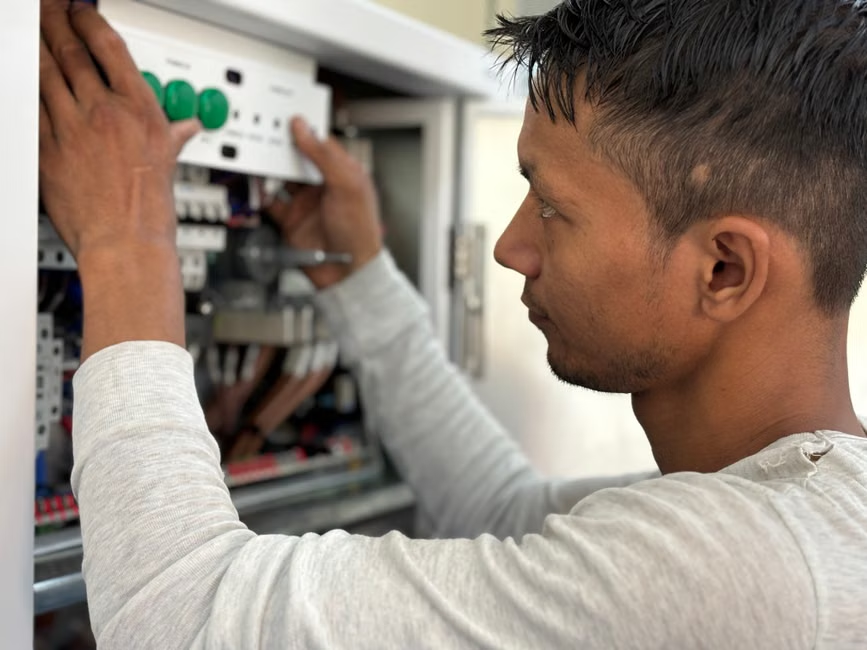
When flickering is confined to a single room or a single circuit, the root cause is almost always downstream of your main breaker panel. It could be a failing local switch, a series of loose wire nuts inside a junction box, or an overloaded circuit. For example, if your kitchen lights flicker every time your microwave runs, or your bathroom lights dim when a hairdryer is turned on, you are likely dealing with a circuit overload. Most residential lighting and outlet circuits are rated for 15 or 20 amps, and modern high-draw appliances can easily push those circuits to their absolute limit, causing a localized drop in voltage.
Conversely, when lights are flickering across multiple rooms, on entirely different breakers, or throughout the entire house, the problem is upstream. This indicates that the electrical disruption is occurring at the main panel, the service entrance cables, or on the utility side of your meter. This is not a localized issue that can be solved by swapping a switch. It requires a systematic inspection of your home's main electrical infrastructure. If you are experiencing widespread flickering across your home, consulting a licensed Electrician Lakewood CO is critical to isolate the issue before it damages your appliances or panel.
Single Circuit Issues and Flickering Lights: What They Mean for Your Wiring
If the flickering is isolated to one room or circuit, we can narrow down the potential culprits by examining the fixtures and controls. One of the most common benign causes of modern light flickering is the transition to energy-efficient LED bulbs.
LEDs operate on direct current (DC) and rely on internal driver circuits to convert the alternating current (AC) from your home's wiring. Older dimmer switches were designed specifically for incandescent bulbs, which resist current to dim. When you place a highly sensitive LED bulb on an older, incompatible dimmer, the driver cannot properly interpret the chopped voltage signal, resulting in a rapid, visible strobing or flickering. This is easily resolved by replacing the switch with a modern, LED-compatible dimmer and ensuring your bulbs are explicitly marked as dimmable.
However, if you have verified that your bulbs and dimmers are compatible, yet all the lights on a single circuit continue to flicker, the issue is likely a loose connection at a device. A common culprit in homes built over the last few decades is the "backstabbed" connection. Many builders historically used the quick-push terminals on the back of outlets and switches instead of wrapping the wire securely around the side screw terminals. Over time, the internal spring clips in these backstab terminals weaken, leading to intermittent contact, localized arcing, and persistent flickering.
To resolve these localized circuit issues safely, our certified technicians at Veteran Heating, Cooling, Plumbing & Electric provide comprehensive diagnostic and repair services. If you need professional assistance tracing a circuit fault, you can rely on our dedicated team for expert Electrical Services Lakewood CO.
Upstream Panel Problems and Flickering Lights: What They Mean for Your Wiring
When flickering spans across multiple breakers, the danger level increases significantly. The most serious panel-level issue we encounter is a loose or failing service neutral connection.
Your home's electrical service consists of two 120-volt "hot" legs and a shared neutral wire, which returns the current safely back to the utility grid. Under normal conditions, this neutral wire keeps the voltage balanced between the two hot legs. If the main service neutral connection becomes loose at the weather head, the meter base, or inside your main breaker panel, the neutral begins to "float."
A floating neutral causes extreme, unpredictable voltage swings. While one 120V leg might drop to 20 or 30 volts (causing lights on those circuits to dim to a dull glow), the other leg can spike to 180 or even 190 volts. This massive overvoltage can instantly destroy sensitive electronics, ruin major appliances, and create a severe, immediate fire hazard due to extreme overheating.
Other upstream issues include a failing main breaker or physical degradation of the panel's bus bars. Over decades of service, loose connections where the breakers clip onto the bus bars can cause electrical arcing, which pits and corrodes the metal. This corrosion creates high resistance, leading to chronic voltage drops and whole-house flickering. If your panel is showing signs of age, buzzing, or struggling to support modern electrical loads, planning an Electric Panel Upgrade Denver CO is one of the most effective ways to restore safety and stability to your home.
How to Safely Troubleshoot and Distinguish Utility-Side Problems
Before you call in the professionals, there are several safe, non-invasive troubleshooting steps you can perform to help identify whether the issue lies within your home's wiring or with your local utility provider.
First, observe the timing and triggers of the flickering. If the lights throughout your house flicker uniformly only during high winds or major storms, the issue is highly likely on the utility side. Tree branches making intermittent contact with overhead service lines can cause brief voltage dips on the grid. Similarly, if you notice your neighbors' lights flickering at the exact same time as yours, the problem lies with the utility transformer or grid distribution lines, and you should contact your power provider immediately.
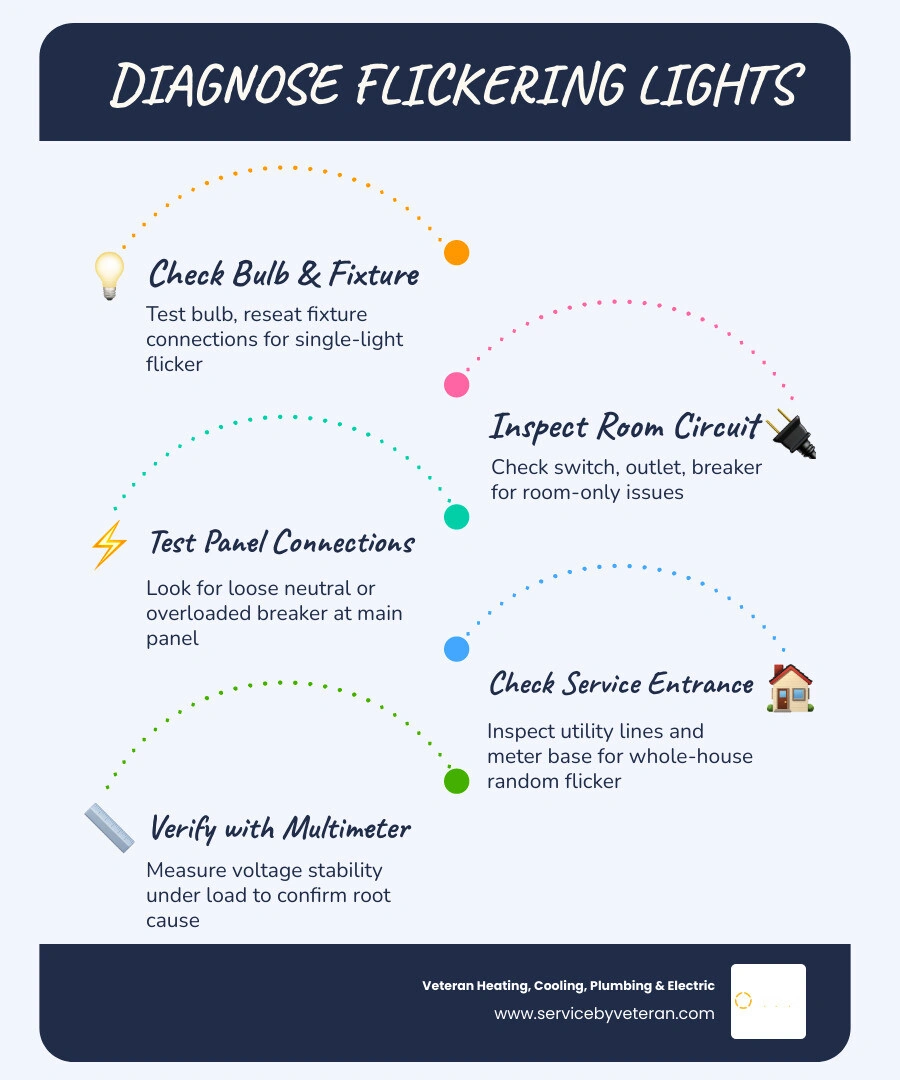
If the flickering is constant and restricted to your home, you can perform a safe diagnostic check using the following steps:
1. Isolate the Fixture: Turn off the flickering light, allow the bulb to cool completely, and verify that it is screwed tightly into the socket. If the fixture uses a plug, ensure it is firmly seated in the outlet.
2. Swap the Bulb: Replace the flickering bulb with a known working bulb of the same type. If the flickering stops, the original bulb was simply failing.
3. Test the Switch: Gently wiggle the toggle of the wall switch. If the light flickers or cuts out only when you touch or move the switch, you have an internal switch failure or a loose wire connection inside that specific switch box.
4. Monitor Appliance Cycles: Pay close attention to when the flickering occurs. Does it coincide precisely with your air conditioner, refrigerator, or washing machine cycling on? A brief, half-second dimming when a major motor starts is relatively common in older homes, but prolonged or severe flickering indicates an overloaded circuit or panel bottleneck.
5. Check the Breaker Panel (Visual Only): Open the door to your main electrical panel. Without touching any wires or removing the protective cover plate, look for signs of overheating, discoloration, or rust, and listen closely for any unusual buzzing, clicking, or popping sounds. If you detect a sweet, metallic burning smell, shut off power immediately.
Preventive Upgrades and When to Call a Professional
While basic bulb swaps and switch checks are perfectly safe for homeowners, working inside an electrical panel or handling live branch wiring carries a high risk of severe shock or fire. If your troubleshooting points to an upstream issue, a loose neutral, or degraded historical wiring, it is time to bring in a licensed, background-checked electrician.
Modernizing your home's electrical safety starts with key preventive upgrades. One of the most effective upgrades is the installation of Arc Fault Circuit Interrupter (AFCI) breakers. Unlike standard breakers that only trip during a massive overload or short circuit, AFCI breakers utilize advanced microprocessors to constantly monitor the circuit's electrical waveform. If they detect the unique signature of an active, sparking arc—such as a loose wire behind an outlet—they instantly trip the circuit before the arcing can generate enough heat to start a fire.
If your home still relies on an outdated, recalled panel (such as Federal Pacific or Zinsco), or if your electrical demands have outgrown your existing service capacity, a complete panel replacement is highly recommended. For homeowners in Golden, securing an Electrical Panel Replacement in Golden, CO ensures your electrical system is fully compliant with modern safety codes and capable of handling modern appliances, electric vehicle chargers, and HVAC systems.
Similarly, if your home features compromised aluminum wiring or aging knob-and-tube insulation, localized repairs are often temporary band-aids. Investing in a comprehensive House Rewiring Denver CO removes these high-risk materials entirely, replacing them with modern, grounded copper wiring that will protect your family for decades to come. If you reside in the Lakewood area, our team can assist you with a safe, code-compliant Electric Panel Replacement Lakewood CO to eliminate flickering at the source.
Frequently Asked Questions about Flickering Lights
Why do my lights flicker only when the wind blows?
When flickering is strictly tied to windy weather, the issue is almost always located on the utility side of your electrical service. High winds cause overhead power lines to sway, which can lead to tree branches making intermittent contact with the wires, causing temporary voltage drops. Additionally, the service drop wires running from the utility pole to your home's weather head can experience physical strain, exposing loose connections at the connection point. You should contact your local utility provider to inspect the overhead lines and trim any encroaching branches.
Can a loose wire cause flickering if the light usually works fine?
Yes, absolutely. A loose wire can maintain intermittent contact for days, weeks, or even months, allowing the light to function normally most of the time. However, subtle vibrations from footsteps, closing doors, or natural thermal expansion and contraction as the wire warms up can cause the loose connection to temporarily separate. This creates a microscopic gap where electricity arcs, manifesting as sporadic, unexplained flickering. Because arcing generates intense localized heat, a loose wire that "usually works fine" remains a serious hidden fire hazard.
What is a lost neutral and why is it dangerous?
A lost neutral occurs when the neutral conductor in your main electrical service fails or becomes disconnected. In a standard split-phase residential system, the neutral wire is responsible for returning unbalanced current to the grid and keeping the voltage stable at 120 volts on each hot leg. Without a solid neutral connection, the voltage "floats," causing one leg to drop in voltage while the other leg surges drastically. This voltage imbalance can destroy computers, televisions, and major appliances in an instant, while creating an extreme electrical fire hazard inside your breaker panel.
Conclusion
Understanding flickering lights what they mean for your wiring is the first step toward maintaining a safe, reliable, and comfortable home. While a single blinking bulb is rarely cause for alarm, widespread or persistent flickering is a clear warning sign from your electrical system that should never be ignored.
At Veteran Heating, Cooling, Plumbing & Electric, we bring military-grade precision, honesty, and dedication to every home service call in the Denver Metro area. Led by a U.S. Army veteran with over 30 years of industry experience, our locally owned company is built on a foundation of absolute integrity. We back our craftsmanship with a lifetime warranty on parts and labor, alongside a comprehensive satisfaction guarantee and money-back policy.
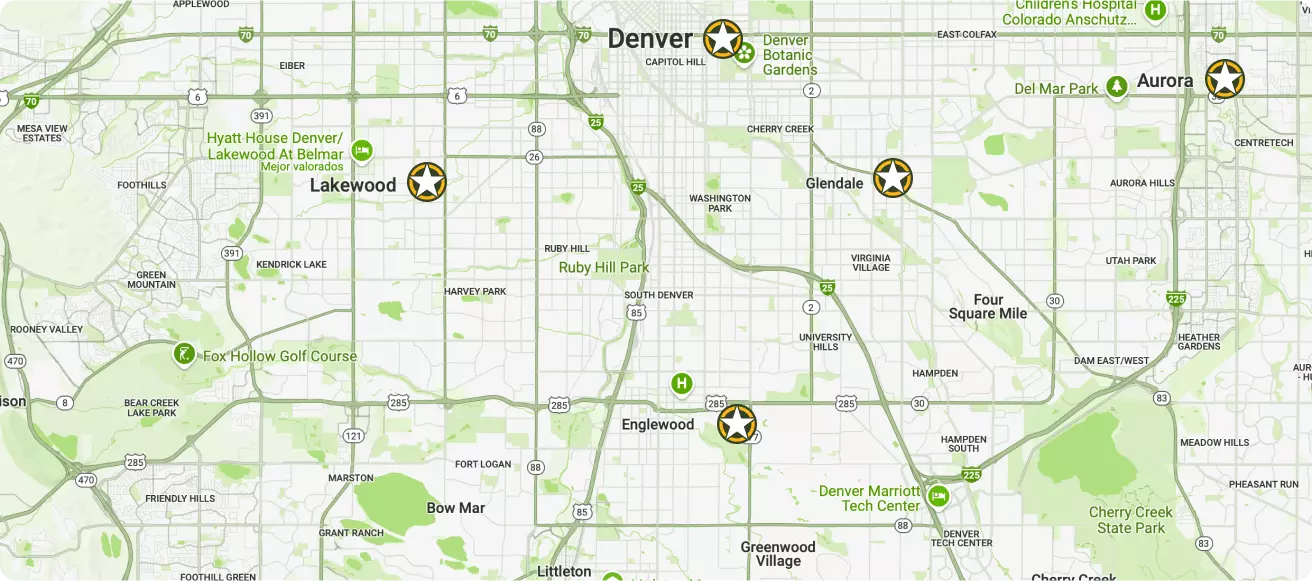
Whether you are in Denver, Lakewood, Golden, Arvada, Aurora, Broomfield, Castle Rock, Centennial, Columbine, Highlands Ranch, Littleton, or Greenwood Village, we are here to serve you. We operate 24/7 for emergency needs with absolutely no dispatch or trip fees, and we proudly offer a 10% discount for veterans, seniors, and first responders. For ongoing peace of mind, ask our team about our $9.99/month maintenance plan, which includes priority scheduling and exclusive repair discounts.
Don't let a minor flicker turn into a major hazard. Contact us today to secure your home's electrical safety. More info about electrical services is just a click away!
ABOUT Veteran Heating, Cooling, Plumbing & Electric
Veteran Heating, Cooling, Plumbing & Electric was founded on the belief that service should be personal, honest, and community-focused. Our team is built around integrity, professionalism, and a true commitment to your home’s comfort and safety.
Led by a U.S. Army veteran with over 30 years of industry experience, we’re proud to remain locally owned and operated. Every technician, plumber, and electrician is EPA-certified, background checked, and driven to exceed expectations.
- 24/7 ServiceWe offer weekend & 24/7 emergency service. We’re here whenever you need us—day, night, or weekend, no exceptions.
- $0 Trip FeesNo dispatch or trip fees. You’ll never pay just for us to show up—service starts when the work does.
OUR SERVICES
AIR CONDITIONING
.jpg)
We offer specialty and seasonal services like indoor air quality upgrades, pre-winter furnace checks, and summer AC tune-ups to keep your home prepared year-round.
Our Primary Air Conditioning Services Include:
Don't see the service you need? Call our Team today!
PLUMBING
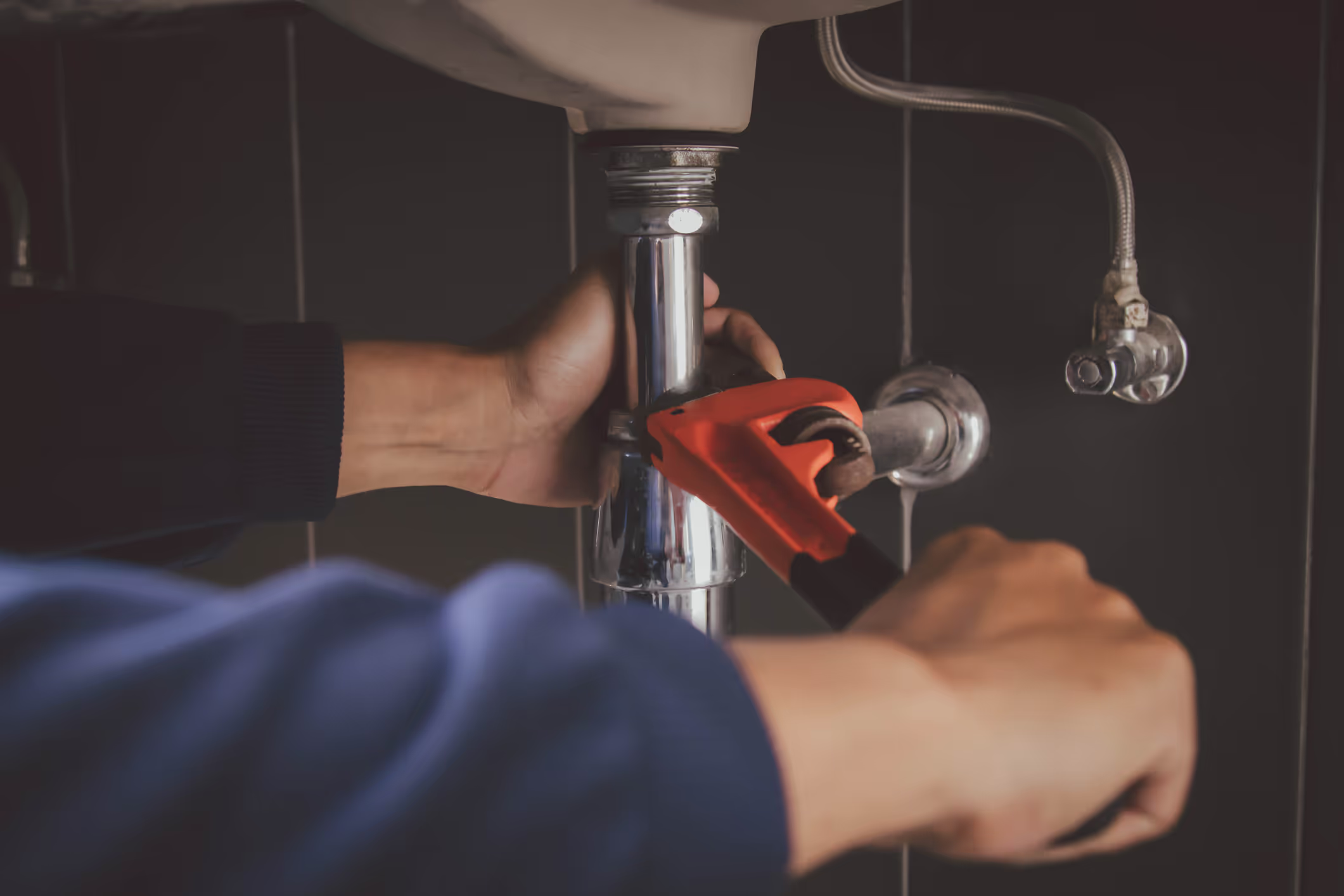
From leaks to full system installs, our plumbing services cover everything you need for a safe, reliable home water system, 24/7.
Our Primary Plumbing Include:
- Water Heater Replacement
- Water Heater Repair
- Trenchless Sewer Line
- Water Filtration
- Slab Leak
- Sewer Line Repair
Don't see the service you need? Call our Team today!
ELECTRICAL

Our electrical services ensure your home stays safe and powered, from routine fixes to complete system upgrades.
Our Primary Electrical Services Include:
- House Rewiring
- Electrician
- Electric Panel Upgrade
- Electric Panel Replacement
- EV Chargers
- Whole House Generator
Don't see the service you need? Call our Team today!
HEATING
.jpg)
We install, repair, and maintain heating & furnace systems with expert care to keep your Colorado home comfortable and energy-efficient year-round.
Our Primary Heating Services Include:
- Heating Installation
- Heating Replacement
- Heating Maintenance
- Heating Repair
- Heating Service
- Heating Tune-Up
Don't see the service you need? Call our Team today!