Why Does My Heating System Smell Like It's Burning?
If you are looking for the most urgent common homeowner questions answered, figuring out why your vents suddenly smell like smoke on the first cold night of the year is likely at the top of your list. You walk over to the thermostat, switch the system from cooling to heating, and within minutes, a harsh, dusty, burning odor fills the hallways. For many, this immediate sensory alarm triggers a wave of panic. At Veteran Heating, Cooling, Plumbing & Electric, fielding these urgent calls is a regular part of our mid-fall routine. We always reassure our customers that while that strange smell from your furnace is not something you should ignore, it also does not automatically mean your house is in danger.
The core decision point you face during this mid-fall heating-startup is determining whether you are experiencing a harmless seasonal event or a severe mechanical hazard that requires an emergency shutdown. Understanding the source of the odor is the first critical step in a disciplined approach to home safety. When a heating system sits dormant for months, it undergoes physical changes that become highly apparent the moment the burners ignite.
While a brief, dusty scent is a normal part of the seasonal transition, persistent chemical odors, the smell of melting plastic, or electrical burning indicate a severe failure. Navigating this distinction requires knowing exactly what is happening inside your ductwork and equipment. By learning how to interpret these start-up smells, you can protect your home, avoid unnecessary panic, and know exactly when it is time to call in a professional for a repair or a full system upgrade.
The Science Behind the Initial Fall Start-Up Odor
To understand why your furnace emits a burning odor, you have to look at what happens to the equipment during the long summer months. Your furnace contains a critical component called a heat exchanger. This is a series of metal coils or tubes that heat up when the burners ignite, transferring that warmth to the air blowing through your vents. During the summer, while your air conditioner is running, the heat exchanger sits completely dormant.
The Accumulation of Airborne Particulates
Over several months of inactivity, airborne particulates naturally settle on the cold metal surfaces of the heat exchanger. These particulates include household dust, pet dander, microscopic fabric fibers, and dead skin cells. The climate plays a massive role in this process. In our years of servicing HVAC systems across the Front Range, our team has seen firsthand how Denver's dry, high-altitude climate at 5,280 feet accelerates this dry dust accumulation. With less humidity in the air to weigh particles down, dust circulates freely and settles thickly onto dormant furnace components throughout the summer. By the time October arrives, your heat exchanger is essentially wearing a thin blanket of combustible dust.
The Thermal Vaporization Process
When you initiate that mid-fall heating-startup, the furnace burners ignite, and the metal heat exchanger rapidly climbs to temperatures exceeding several hundred degrees. The sudden introduction of intense heat causes the accumulated dust layer to instantly vaporize. This thermal reaction is what creates the distinct burning smell.
It is important to understand that this process does not involve actual flames escaping the burner or fire spreading through your ductwork. The odor is simply the byproduct of organic matter vaporizing on a hot metal surface. Once that initial layer of summer dust is burned away, the metal is clean again, and the smell will naturally dissipate. Demystifying this mechanical process helps reduce the anxiety associated with turning on the heat for the first time.
Comparing Normal Burn-Off to Emergency Warning Smells
Distinguishing between harmless dust vaporization and a dangerous mechanical failure comes down to specific scent profiles and strict time limits. According to the National Fire Protection Association (NFPA), heating equipment is a leading cause of home fires, which underscores exactly why you must accurately identify what you are smelling.
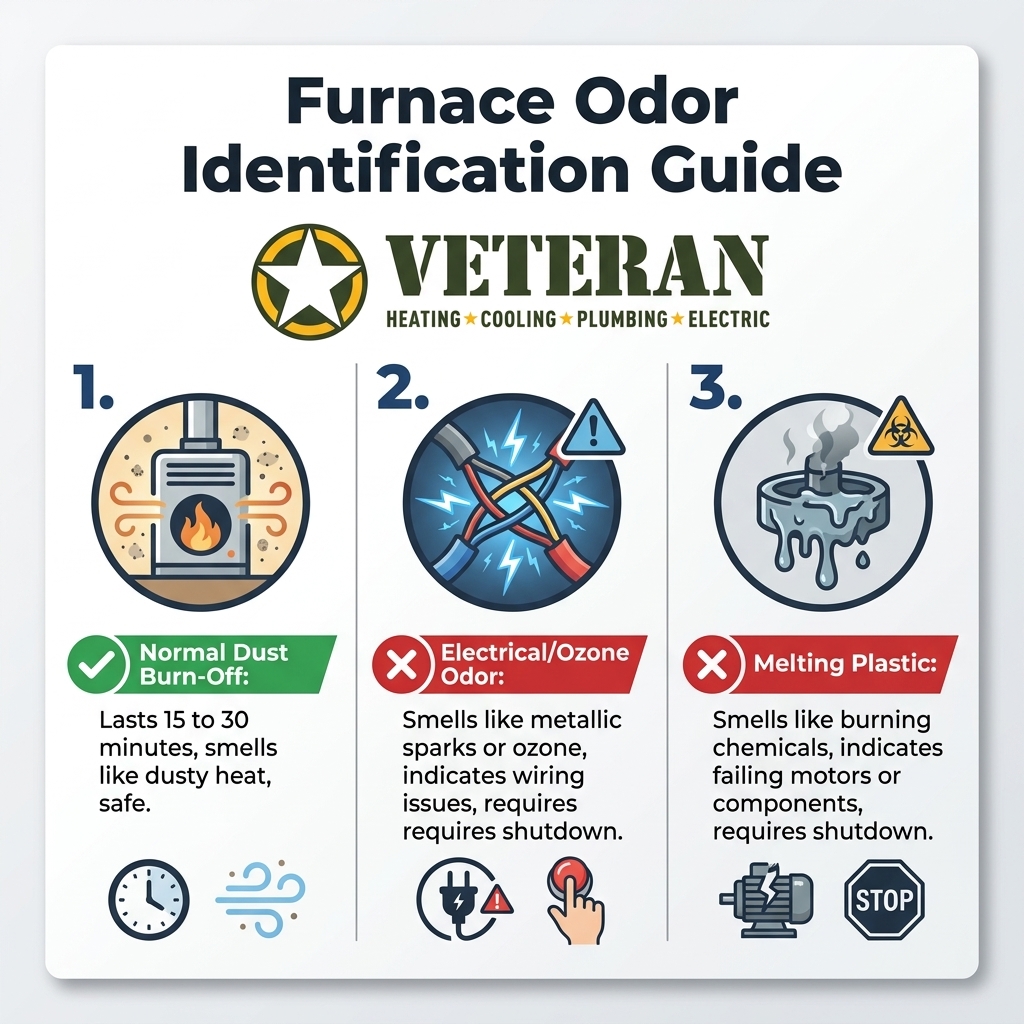
• Dry, dusty burning (like singed hair) — Probable Cause: Summer dust vaporizing on the heat exchanger — Safety Level: Normal / Safe — Required Action: Monitor closely; should dissipate quickly.
• Harsh, acrid melting plastic — Probable Cause: Failing capacitors, seized blower motors, or melted wire casings — Safety Level: Hazardous — Required Action: Shut down system immediately at the thermostat and breaker.
• Sharp, metallic electrical (ozone) — Probable Cause: Overheating circuits, frayed wiring, or failing transformers — Safety Level: Hazardous — Required Action: Shut down system immediately and call for emergency service.
• Rotten eggs or sulfur — Probable Cause: Natural gas leak — Safety Level: Extreme Danger — Required Action: Evacuate the home, leave doors open, and call the gas company.
The 30-Minute Rule
The most reliable metric for diagnosing a start-up odor is the clock. A standard 15 to 30 minutes of normal burn-off duration is all it takes for a healthy furnace to clear its heat exchanger of summer dust. If the smell is purely dusty and begins to fade within this specific timeframe, the system is functioning exactly as designed. However, our technicians always advise that you must monitor the smell closely without leaving the house during this initial window. If you turn the heat on and immediately leave for the grocery store, you miss the critical observation period needed to ensure the smell dissipates safely.
Precision Safety Protocol: Evaluating Your Furnace Odors
When dealing with potential fire hazards, guesswork is not an option. Applying a military precision safety protocol—a standard our team lives by at Veteran Heating, Cooling, Plumbing & Electric—ensures that no corners are cut when evaluating the health of your heating system. This disciplined, step-by-step checklist empowers you to assess the situation calmly and accurately before you dial a technician.
1. Start the clock immediately: The moment you notice the burning smell, note the exact time. You are tracking the strict 15 to 30 minutes of normal burn-off duration. If the odor persists past the 30-minute mark, you must move to emergency protocols.
2. Categorize the exact scent: Walk to the nearest vent and carefully smell the airflow. Is it a dry, dusty smell, or does it carry the harsh, chemical sting of melting plastic or the sharp tang of electrical ozone? Chemical and electrical smells are never normal.
3. Inspect your air filter: A severely clogged air filter restricts vital airflow, causing the heat exchanger to retain too much heat. This overheating can exacerbate dust smells and even trigger the system's high-limit safety switch. Pull the filter out and hold it up to a light; if you cannot see light through it, replace it immediately.
4. Execute an emergency shutdown if necessary: If the smell is distinctly electrical, smells like plastic, or lasts beyond the safe 30-minute window, immediately shut off the system at the thermostat. Next, locate your home's electrical panel and flip the breaker for the furnace to the "off" position to completely sever power.
Real-world reliability: One local homeowner reached out last fall when their furnace began emitting a strange, persistent odor during startup. Following our strict safety protocol, they shut the system down at the breaker. Our technician Jeff was dispatched to the home, where he quickly identified a failing component. Because the homeowner acted decisively, Jeff was able to resolve the furnace problem efficiently, restoring safe and dependable heat the very same day.
When a Burning Smell Signals the Need for a Furnace Replacement
Sometimes, an unusual odor is more than just a passing seasonal nuisance—it is a glaring symptom of systemic mechanical failure. Repeated electrical or plastic odors often point to internal components that are degrading beyond repair. When wire casings melt or blower motors seize up and overheat, the damage is rarely isolated. These warning signs indicate that an older unit is no longer safe to operate.
The problem of diminishing returns: As heating systems age, the metal in the heat exchanger undergoes constant expansion and contraction. Over a decade or more, this thermal stress can lead to micro-cracks. A cracked heat exchanger not only emits strange odors but also poses a severe carbon monoxide risk. When diagnosing these issues, our experts find that homeowners eventually face a mathematical threshold where continuous, expensive repairs on failing components outweigh the investment in a brand-new system.
The efficiency factor: If you are deciding between a furnace replacement and a repair, consider how well the current unit actually heats your home. Older units that emit burning smells often struggle to maintain temperature. This leads to longer run cycles, overworked components, and inevitable overheating. Upgrading to a high-efficiency replacement before the harshest winter weather arrives eliminates the safety hazards of an aging unit while drastically improving your daily comfort.
Navigating High-Altitude Heating Efficiency and System Upgrades
Installing a new heating system in Denver is not the same as installing one at sea level. The specific atmospheric conditions of a high-altitude environment demand specialized technical knowledge and precise equipment calibration. At 5,280 feet, the air is significantly thinner, which directly impacts combustion efficiency and airflow dynamics.
The physics of high-altitude heating: A furnace requires a specific mixture of oxygen and natural gas to burn cleanly. Because there is less oxygen per cubic foot of air at high altitudes, a furnace that performs perfectly at sea level will struggle, run rich, and operate inefficiently here. Our veteran-led installation teams know that improper combustion can lead to soot buildup, strange odors, and premature component failure. To combat this, professionals must perform proper load calculations (known as a Manual J calculation) tailored specifically to regional atmospheric pressure and your home's unique footprint.
Modern upgrade options: Upgrading to a modern, variable-speed system provides a massive advantage. These advanced units adapt seamlessly to environmental demands, adjusting their blower speeds and gas valves to maintain optimal combustion and consistent temperatures, regardless of the thin air. Furthermore, generic energy rebates or federal tax credits may apply to qualifying high-efficiency heat pump or furnace upgrades, making a new system a financially sound decision. Always verify current federal or local utility programs, as they frequently reward homeowners for upgrading to environmentally friendly technology.
Expert guidance matters: During a winter consultation, one local customer needed clear information and options for replacing a struggling system. Our team member Jim Anderson provided a highly professional walkthrough, answering all questions and explaining the features, benefits, and generic discount options available. This thorough approach ensured the customer had all the precise data needed to choose a new, altitude-appropriate heating system.
Common Homeowner Questions Answered: Furnace Start-Up Smells
Why does my heater smell like burning when I turn it on?
This is usually caused by the vaporization of dust and debris that has settled on your heat exchanger over the summer. When the burners ignite for the first time in months, the high temperatures burn off this accumulation, creating a temporary, dusty odor throughout the house.
Is it normal for a furnace to smell like burning dust?
Yes, it is entirely normal during the mid-fall heating-startup. Because the system has been dormant, the initial activation will almost always produce a slight burning dust smell. As long as the scent is strictly dusty and not chemical, it is a routine part of the seasonal transition.
How long does a furnace burning smell last?
You should expect exactly 15 to 30 minutes of normal burn-off duration. The smell will be strongest in the first few minutes and gradually fade as the heat exchanger is cleared of debris. If the smell persists past 30 minutes, shut the system down.
What does an electrical fire smell like in a furnace?
An electrical fire produces a sharp, metallic odor that often smells like ozone, melting plastic, or a harsh chemical tang. Unlike the dry smell of burning dust, an electrical odor is acrid and irritating. This indicates overheating wires or failing motors and requires immediate professional attention.
Can a dirty air filter cause a burning smell?
Absolutely. A severely clogged air filter blocks the necessary airflow your furnace needs to distribute heat. Without proper airflow, the heat exchanger retains too much thermal energy and overheats, which can amplify burning dust smells and eventually trigger emergency safety shutdowns.
At what point should I replace a furnace that constantly smells like burning plastic?
If your furnace routinely smells like melting plastic or burning wires, it should be evaluated for replacement immediately. These odors indicate that internal mechanical components are actively degrading or melting, meaning the system is no longer safe to operate in your home.
Secure Your Home's Comfort Before Winter Arrives
Getting your common homeowner questions answered is the best way to approach the heating season with confidence. While a brief, 15 to 30-minute dust odor is a normal part of your mid-fall heating-startup, any persistent, chemical, or electrical smells demand immediate professional attention. Do not ignore the warning signs of a failing system. Prioritize your family's safety and your home's energy efficiency by scheduling an expert evaluation or a replacement consultation with Veteran Heating, Cooling, Plumbing & Electric today. With a disciplined, precise approach to your HVAC system, you can secure reliable comfort long before the freezing winter weather arrives.
ABOUT Veteran Heating, Cooling, Plumbing & Electric
Veteran Heating, Cooling, Plumbing & Electric was founded on the belief that service should be personal, honest, and community-focused. Our team is built around integrity, professionalism, and a true commitment to your home’s comfort and safety.
Led by a U.S. Army veteran with over 30 years of industry experience, we’re proud to remain locally owned and operated. Every technician, plumber, and electrician is EPA-certified, background checked, and driven to exceed expectations.
- 24/7 ServiceWe offer weekend & 24/7 emergency service. We’re here whenever you need us—day, night, or weekend, no exceptions.
- $0 Trip FeesNo dispatch or trip fees. You’ll never pay just for us to show up—service starts when the work does.
OUR SERVICES
AIR CONDITIONING
.jpg)
We offer specialty and seasonal services like indoor air quality upgrades, pre-winter furnace checks, and summer AC tune-ups to keep your home prepared year-round.
Our Primary Air Conditioning Services Include:
Don't see the service you need? Call our Team today!
PLUMBING
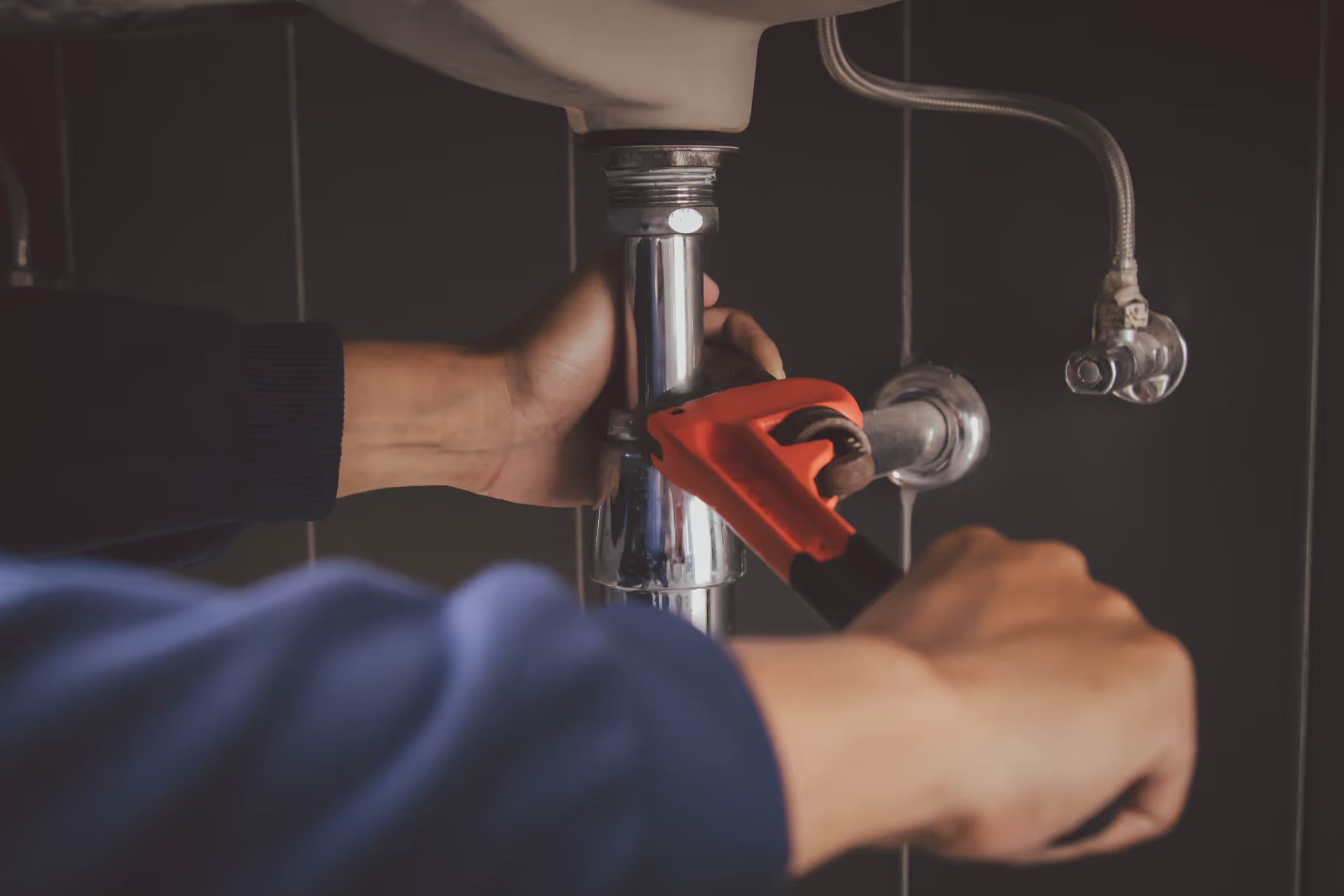
From leaks to full system installs, our plumbing services cover everything you need for a safe, reliable home water system, 24/7.
Our Primary Plumbing Include:
- Water Heater Replacement
- Water Heater Repair
- Trenchless Sewer Line
- Water Filtration
- Slab Leak
- Sewer Line Repair
Don't see the service you need? Call our Team today!
ELECTRICAL

Our electrical services ensure your home stays safe and powered, from routine fixes to complete system upgrades.
Our Primary Electrical Services Include:
- House Rewiring
- Electrician
- Electric Panel Upgrade
- Electric Panel Replacement
- EV Chargers
- Whole House Generator
Don't see the service you need? Call our Team today!
HEATING
.jpg)
We install, repair, and maintain heating & furnace systems with expert care to keep your Colorado home comfortable and energy-efficient year-round.
Our Primary Heating Services Include:
- Heating Installation
- Heating Replacement
- Heating Maintenance
- Heating Repair
- Heating Service
- Heating Tune-Up
Don't see the service you need? Call our Team today!