Why Heat Pump Efficiency at High Altitude Is a Real Challenge for Denver Metro Homeowners
Heat pump efficiency at high altitude drops measurably as elevation rises — and for homeowners across the Denver Metro area, that's not a minor footnote. It's a core factor in how well your home heating system actually performs. Here's a quick breakdown of what the research shows:
• Every 1,000 feet of elevation reduces air pressure by roughly 4%, thinning the air your heat pump relies on to transfer heat
• At 5,000 feet, a heat pump operates at approximately 83% of its sea-level capacity
• At 8,000 feet, that drops to around 74% — a 26% reduction in output
• Overall efficiency loss at Colorado elevations typically ranges from 10% to as much as 20–26% depending on the unit and conditions
• Cold-climate heat pumps still deliver 220–280% seasonal heating efficiency at 6,000+ feet — far better than electric resistance heating
• Backup heat is generally needed only around 10–15 days per winter at these elevations, typically when temperatures fall below 0°F
That's the short answer. But if you're making a real decision about heating your home in Highlands Ranch, Castle Rock, Centennial, or anywhere else in the Denver Metro area, the details matter — a lot.
Living at elevation means your HVAC equipment is working under conditions it was never tested for. Most manufacturer ratings are established at sea level under controlled lab conditions. The moment that equipment is installed at 5,920 feet in Highlands Ranch or higher, those ratings no longer tell the full story. Research from the National Renewable Energy Laboratory (NREL), field data from Andes-based studies, and manufacturer engineering bulletins all confirm the same thing: altitude changes the physics of heat transfer, and your heating system needs to be selected, sized, and installed with that in mind.
I'm Mike Townsend, a U.S. Army veteran and leader of Veteran Heating, Cooling, Plumbing & Electric, and my background — from managing precision cooling systems in the military to overseeing HVAC installations across the Denver Metro area — gives me a understanding of how heat pump efficiency at high altitude can make or break a home comfort system. In the sections ahead, we'll walk through exactly what elevation does to your heat pump, and what you can do about it.

The Science of Thin Air: Why Elevation Matters for HVAC
When we talk about "thin air," we aren't just talking about why you get winded walking up a flight of stairs in Golden. In the HVAC world, thin air refers to a reduction in air density. To understand why this matters, we have to look at the Ideal Gas Law (PV=nRT). As altitude increases, atmospheric pressure (P) decreases. Because the pressure is lower, the air molecules are spread further apart.
For a heat pump, air is the medium of exchange. In the winter, the outdoor unit tries to "squeeze" heat out of the freezing air and move it inside. In the summer, it takes heat from your home and dumps it outside. If the air is 20% to 25% thinner (which it is at 6,000 feet compared to sea level), there are simply fewer air molecules passing over the evaporator coils to carry that heat. This directly impacts the heat transfer coefficient—essentially, the air's ability to pick up or drop off thermal energy.
Furthermore, lower oxygen levels don't just affect our lungs; they affect combustion in traditional gas furnaces, often leading to incomplete combustion if not properly derated. However, for heat pumps, the challenge is purely thermodynamic. When there is less air mass moving across the outdoor unit, the system has to work harder, run longer, and use more electricity to achieve the same temperature change inside your home. This is a primary reason why Heat Pump Benefits for Colorado Homeowners often hinge on choosing the right specialized equipment rather than a "one-size-fits-all" model designed for the coast.
Understanding Heat Pump Efficiency at High Altitude Metrics
To get technical for a moment, let’s look at the Coefficient of Performance (COP). The COP is a ratio of how much heat a system produces compared to the electricity it consumes. A COP of 3.0 means for every 1 unit of electricity, you get 3 units of heat. At sea level, modern heat pumps boast impressive COPs. But at high altitude, several factors drag that number down:
1. Mass Flow Rate Reduction: Because the air is less dense, the actual mass of air moving through the fans is lower. This means the refrigerant in the coils can't absorb or release heat as efficiently.
2. Suction Pressure Drop: Lower atmospheric pressure leads to lower suction pressures in the compressor. This forces the compressor to work at a higher compression ratio to reach the necessary discharge pressure, which consumes more energy and increases wear and tear.
3. 4% Pressure Drop per 1,000 Feet: This is the "golden rule" of altitude. For every 1,000-foot gain, you lose about 4% of your air pressure. By the time you reach a home in Castle Rock or Highlands Ranch, you're looking at a roughly 24% reduction in pressure compared to sea level.
When these metrics aren't accounted for, homeowners often experience "short cycling" or, conversely, systems that run for hours without ever reaching the set temperature.
Maximizing Heat Pump Efficiency at High Altitude
Despite the challenges of thin air, heat pumps remain one of the most efficient ways to heat a home in the Denver Metro area. However, "maximizing" that efficiency requires moving beyond standard installation practices. Research, including studies by Xcel Energy and NREL, suggests that air-source heat pumps can lose up to 10% of their efficiency and capacity just by being moved to a high-altitude environment.
To combat this 10% decline, we look at "derating factors." Derating is the process of adjusting the expected output of a piece of equipment to reflect its real-world performance in specific conditions. For example, if a heat pump is rated for 36,000 BTUs (3 tons) at sea level, it might only deliver 30,000 BTUs at 6,000 feet. If your home actually needs 36,000 BTUs to stay warm, a "standard" 3-ton unit will leave you shivering in January.
This is why we emphasize the Heat Pump Installation Broomfield CO Guide for our neighbors to the north. Proper installation involves more than just bolting a unit to a pad; it requires calculating the altitude-adjusted load of the home.
Sizing for Heat Pump Efficiency at High Altitude
Sizing is the most critical step in high-altitude HVAC design. In the industry, we often use a 5,000-foot baseline for Colorado installations. If a unit is operating at 5,000 feet, it typically sees a 17% reduction in capacity. To ensure your home stays comfortable, we often have to "oversize" the unit relative to what a sea-level calculator would suggest.
Consider this comparison of a standard heat pump's capacity:
• Sea Level — Capacity Percentage: 100% — Real-World Output (of a 48k BTU Unit): 48,000 BTU
• 2,000 Feet — Capacity Percentage: 93% — Real-World Output (of a 48k BTU Unit): 44,640 BTU
• 4,000 Feet — Capacity Percentage: 86% — Real-World Output (of a 48k BTU Unit): 41,280 BTU
• 6,000 Feet — Capacity Percentage: 80% — Real-World Output (of a 48k BTU Unit): 38,400 BTU
• 8,000 Feet — Capacity Percentage: 74% — Real-World Output (of a 48k BTU Unit): 35,520 BTU
As you can see, a unit that works perfectly in Florida would be significantly undersized for a home in Centennial or Castle Rock. If we don't account for that 20% loss at 6,000 feet, the system will rely too heavily on expensive backup heat, defeating the purpose of installing an efficient heat pump in the first place.
Cold-Climate Solutions for Colorado Elevations
The good news is that technology has caught up with the mountains. Modern "cold-climate" heat pumps (CCHPs) are specifically engineered to handle the twin challenges of low temperatures and thin air. These systems utilize DC inverter technology, which allows the compressor to modulate its speed. Instead of being "all on" or "all off," an inverter-driven system can slow down or speed up to match the exact heating load of the home.
Another key feature is precise refrigerant flow control. Because the boiling point of refrigerant changes with atmospheric pressure, high-altitude systems need electronic expansion valves that can adjust on the fly. This prevents "slugging" (liquid refrigerant entering the compressor) and ensures that the system maintains a stable COP even when the air is thin. This level of sophistication is why regular maintenance is so vital; our Heat Pump Service Aurora CO Guide explains how keeping these sensors and valves clean is the only way to maintain that high-altitude edge.
Backup Heating and Hybrid Systems
Even the best cold-climate heat pumps have a "balance point"—a temperature where the heat pump can no longer extract enough heat from the outside air to keep up with the home's heat loss. At 6,000 feet, this often happens around 10°F to 15°F. Below this threshold, performance drops noticeably.
For Denver Metro homeowners, we often recommend a "Dual-Fuel" or hybrid setup. This pairs a high-efficiency heat pump with a gas furnace backup.
• Above 40°F: The heat pump handles everything with incredible efficiency.
• Between 15°F and 40°F: The heat pump still does the heavy lifting, often at 200%+ efficiency.
• Below 15°F (or during extreme cold snaps): The system automatically switches to the gas furnace.
In a typical Colorado winter, you may only need that backup heat for 10 to 15 days. By using the gas furnace as a "safety net," you ensure reliability during a blizzard without sacrificing the energy savings of a heat pump during the rest of the year.
Installation Best Practices in the Denver Metro Area
Installation quality is the "silent" factor in heat pump efficiency at high altitude. At sea level, you can get away with minor ductwork leaks. At 6,000 feet, those leaks are magnified. Because the air is thinner, the blower fan has to move more volume (CFM) to deliver the same amount of heating "mass." This puts more pressure on your ductwork.
In areas like Highlands Ranch, Castle Rock, and Littleton, we focus on:
1. Ductwork Sealing: Ensuring every joint is mastic-sealed to prevent the loss of already "thin" conditioned air.
2. Airflow Tuning: Adjusting the blower speed to compensate for the lower air density. If the fan spins too slow, the coils can freeze; too fast, and the air won't stay in contact with the coils long enough to heat up.
3. Outdoor Unit Placement: In the mountains, we have to consider snow drifts and wind. A heat pump buried in snow or facing a direct 40 mph wind will struggle to defrost, killing its efficiency.
For those in the northern metro area, following the Best Heat Pump Installation Broomfield standards means looking at the home as a complete system, including insulation and air sealing.
Localized Performance in Highlands Ranch and Centennial
Highlands Ranch sits at approximately 5,920 feet. At this elevation, the air is roughly 24% thinner than at sea level. This impacts more than just the heat pump; it also affects your home's humidity. Dry air feels colder than moist air. By integrating a whole-home humidifier with your heat pump, you can actually keep your thermostat a few degrees lower while feeling just as warm.
Despite the altitude, a properly calibrated system in Centennial or Highlands Ranch can still achieve a seasonal efficiency of 220–280%. That means for every dollar you spend on electricity, you’re getting nearly three dollars' worth of heat. Compare that to electric baseboard heating (100% efficiency) or an old gas furnace (80% efficiency), and the winner is clear. Using a smart thermostat further optimizes this by learning how your home reacts to the thin, dry Colorado air and adjusting run cycles to avoid the "overshoot" that wastes energy.
Frequently Asked Questions about High-Altitude Heat Pumps
How much efficiency is lost at 5,000 feet?
Generally, you can expect a 10% decline in overall efficiency and about a 17% reduction in heating capacity. This is why professional sizing is non-negotiable; you can't just buy a unit based on square footage alone when you live a mile above sea level.
Do I need a backup furnace for a heat pump in Colorado?
While "cold-climate" models can work down to -15°F, most Denver Metro homeowners prefer a hybrid system. Having a gas furnace backup for those 10-15 "deep freeze" days a year provides peace of mind and ensures you aren't relying on expensive electric resistance "emergency heat."
Can a standard heat pump work at 8,000 feet?
A standard heat pump designed for sea level will struggle significantly at 8,000 feet, potentially losing 26% of its capacity. At that elevation, we exclusively recommend advanced inverter-driven cold-climate models that can compensate for the extreme lack of air density and the colder ambient temperatures.
Conclusion
Navigating heat pump efficiency at high altitude doesn't have to be an uphill battle. While the physics of thin air presents real challenges—from reduced mass flow rates to higher compression ratios—the right technology and expert installation can overcome them. For homeowners across the Denver Metro area, the goal is clear: a system that provides year-round comfort without the "altitude tax" of sky-high utility bills.
At Veteran Heating, Cooling, Plumbing & Electric, we bring a mission-focused approach to home comfort. As a veteran-led, locally owned company with over 30 years of industry experience, we understand the unique demands of the Colorado climate. We don't just guess at sizing; we calculate it based on the specific elevation of your home in Arvada, Aurora, Broomfield, Castle Rock, Centennial, Columbine, Golden, Highlands Ranch, Lakewood, or Littleton.
We stand behind our work with a lifetime warranty on parts and labor, a money-back satisfaction guarantee, and a commitment to honest, transparent service. Whether you're looking for a new installation or need to tune up your existing system for the winter ahead, our EPA-certified and background-checked technicians are ready to help.
Ready to take your home comfort to new heights? Check out our Heat Pump Installation Guide for more tips, or visit our service page for More info about heat pump services and to schedule your high-altitude evaluation today. We’re here 24/7 to ensure your home stays a sanctuary, no matter how thin the air gets.
ABOUT Veteran Heating, Cooling, Plumbing & Electric
Veteran Heating, Cooling, Plumbing & Electric was founded on the belief that service should be personal, honest, and community-focused. Our team is built around integrity, professionalism, and a true commitment to your home’s comfort and safety.
Led by a U.S. Army veteran with over 30 years of industry experience, we’re proud to remain locally owned and operated. Every technician, plumber, and electrician is EPA-certified, background checked, and driven to exceed expectations.
- 24/7 ServiceWe offer weekend & 24/7 emergency service. We’re here whenever you need us—day, night, or weekend, no exceptions.
- $0 Trip FeesNo dispatch or trip fees. You’ll never pay just for us to show up—service starts when the work does.
OUR SERVICES
AIR CONDITIONING
.jpg)
We offer specialty and seasonal services like indoor air quality upgrades, pre-winter furnace checks, and summer AC tune-ups to keep your home prepared year-round.
Our Primary Air Conditioning Services Include:
Don't see the service you need? Call our Team today!
PLUMBING
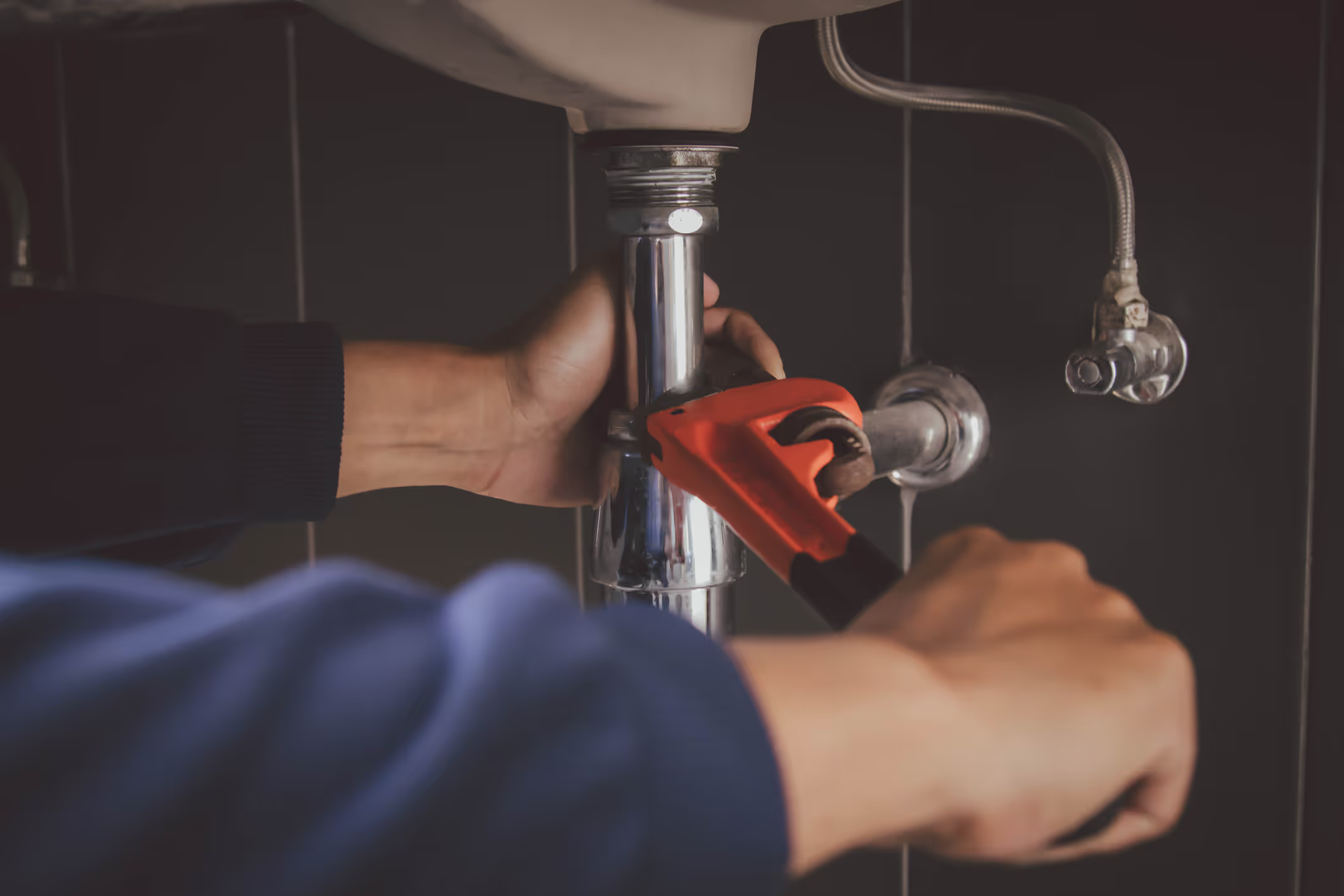
From leaks to full system installs, our plumbing services cover everything you need for a safe, reliable home water system, 24/7.
Our Primary Plumbing Include:
- Water Heater Replacement
- Water Heater Repair
- Trenchless Sewer Line
- Water Filtration
- Slab Leak
- Sewer Line Repair
Don't see the service you need? Call our Team today!
ELECTRICAL

Our electrical services ensure your home stays safe and powered, from routine fixes to complete system upgrades.
Our Primary Electrical Services Include:
- House Rewiring
- Electrician
- Electric Panel Upgrade
- Electric Panel Replacement
- EV Chargers
- Whole House Generator
Don't see the service you need? Call our Team today!
HEATING
.jpg)
We install, repair, and maintain heating & furnace systems with expert care to keep your Colorado home comfortable and energy-efficient year-round.
Our Primary Heating Services Include:
- Heating Installation
- Heating Replacement
- Heating Maintenance
- Heating Repair
- Heating Service
- Heating Tune-Up
Don't see the service you need? Call our Team today!