What Is a Heat Pump and How Does It Work? A Quick Answer for Denver Homeowners
How does a heat pump work is one of the most common questions homeowners ask before upgrading their home comfort system — and the short answer might surprise you. A heat pump does not generate heat. Instead, it moves heat from one place to another, using a small amount of electricity to transfer a much larger amount of thermal energy. That single distinction is why heat pumps are 3 to 5 times more energy-efficient than conventional gas boilers or electric resistance heaters.
Here is the quick breakdown:
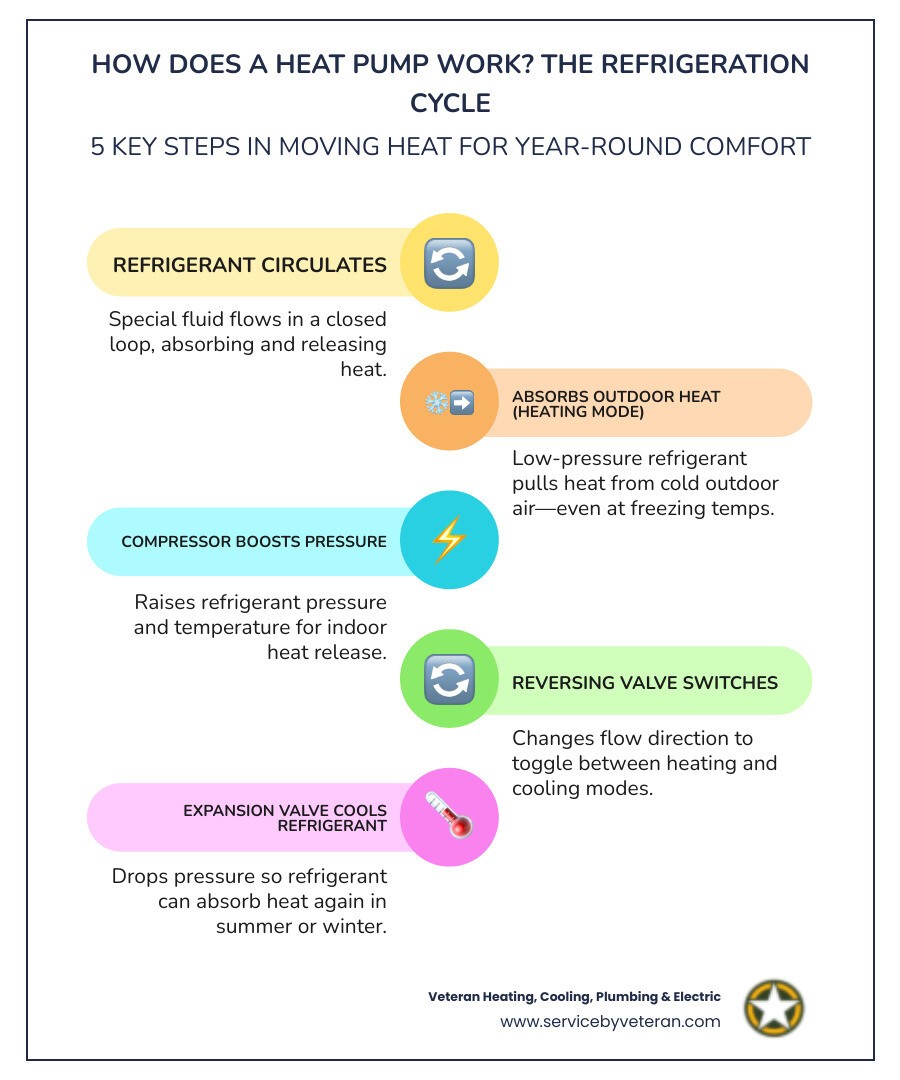
1. A refrigerant circulates through a closed loop inside the system
2. In winter, the refrigerant absorbs heat from outdoor air (even cold air contains usable heat energy) and carries it indoors
3. In summer, the process reverses — heat is pulled from inside your home and released outside
4. A compressor raises the pressure of the refrigerant, which raises its temperature, allowing heat to be released where it is needed
5. An expansion valve drops the pressure, cooling the refrigerant so it can absorb heat again
6. A reversing valve switches the direction of refrigerant flow to toggle between heating and cooling modes
For every 1 kilowatt-hour of electricity used, a typical heat pump can move 3 to 4.5 kilowatt-hours of thermal energy — making it one of the most efficient home comfort technologies available in April 2026.
It may seem like the system is almost breaking the laws of physics. But millions of homeowners across the country — including many right here in the Denver Metro area — rely on heat pumps every day to stay comfortable year-round. This guide walks through the full science, step by step, so you know exactly what is happening inside your system.
I am Mike Townsend, and my background managing precision cooling systems for heat-seeking missile technology during my eight years in the U.S. Army gave me a deep, hands-on understanding of how refrigerant cycles and thermal transfer work — the same principles that answer how does a heat pump work in your home. That technical foundation drives everything we do at Veteran Heating, Cooling, Plumbing & Electric, and it is the reason we can explain and service these systems with a level of precision most homeowners rarely see.
Defining the Heat Pump: Transfer vs. Generation
To understand the core of the technology, we have to look at how we have traditionally stayed warm. For centuries, humans have relied on “generation.” We burn wood, coal, or natural gas to create fire. In a modern furnace, we burn gas to heat a metal heat exchanger, which then warms the air blowing over it. Even electric baseboard heaters use “resistive heating,” which is essentially like a giant toaster—running electricity through a wire until it gets red hot.
A heat pump takes a completely different approach. It uses the principles of thermodynamics to “transfer” heat. Think of it like a refrigerator. Your fridge doesn’t “create” cold; it pulls the heat out of the insulated box and dumps it into your kitchen (if you’ve ever felt the warm air blowing from the bottom of your fridge, you’ve felt that heat transfer in action).
By moving heat instead of creating it, we bypass the 100% efficiency limit of traditional heaters. A perfect electric heater can only ever be 100% efficient—1 unit of energy in equals 1 unit of heat out. Because a heat pump just uses electricity to run a pump and a compressor, it can achieve efficiencies of 300% to 500%. In the HVAC world, we call this the Coefficient of Performance (COP). If you are considering this upgrade, our Heat Pump Installation services can help you transition to this high-efficiency model.
How Does a Heat Pump Work to Provide Year-Round Comfort?
One of the coolest things about a heat pump is that it replaces both your furnace and your air conditioner. In the Denver Metro area, where we can see a 40-degree temperature swing in a single afternoon, having one system that handles both is a massive advantage.
The “magic” component that allows this is called the reversing valve. This four-way valve sits inside the outdoor unit and acts like a traffic controller for the refrigerant. When you want cooling, the valve directs the refrigerant to flow one way. When you flip your thermostat to “heat,” the valve slides into a new position, reversing the flow and turning the outdoor coil into the “heater” and the indoor coil into the “cooler” (or vice versa).
This versatility is governed by the Second Law of Thermodynamics: heat naturally flows from a hot place to a cold place. By manipulating the pressure of the refrigerant, we can make the refrigerant colder than the outside air (to soak up heat) or hotter than the inside air (to release heat). If your system ever struggles to make this transition, our Heat Pump Service team can diagnose the reversing valve or pressure issues.
The Core Components: How Does a Heat Pump Work to Move Energy?
To move that energy, the system relies on four heavy-hitting components working in a continuous loop:
1. The Compressor: This is the heart of the system. It takes low-pressure, cool refrigerant gas and “squeezes” it. Just like a bike pump gets hot when you use it, compressing a gas makes it very hot and high-pressure.
2. The Condenser: In heating mode, this is your indoor coil. The hot gas enters the coil, and as your home’s air blows over it, the gas releases its heat and “condenses” into a liquid.
3. The Expansion Valve: The liquid refrigerant, still under high pressure, passes through a tiny opening. As it expands into a larger area, its pressure and temperature plummet. It becomes extremely cold.
4. The Evaporator: In heating mode, this is the outdoor coil. Because the refrigerant is now much colder than the outdoor air, it absorbs heat from the environment, “evaporating” back into a gas to start the cycle over.
When parts like the compressor or expansion valve fail, the whole cycle grinds to a halt. That is when you need expert Heat Pump Repair to restore the delicate balance of the refrigerant cycle.
Seasonal Versatility: How Does a Heat Pump Work in Winter?
This is where most people get skeptical. “How,” they ask, “can a heat pump find heat in Arvada or Aurora when it’s 20 degrees outside?”
The answer lies in the definition of “heat.” To a scientist, anything above absolute zero (-459.67°F) contains heat energy. Even at 0°F, there is a massive amount of thermal energy in the air. By using a refrigerant that boils at -15°F or lower, we can make the outdoor coils so cold that the 20-degree air feels “warm” by comparison. The refrigerant soaks up that “latent heat,” and the compressor then concentrates it to a temperature high enough to warm your living room.
Modern cold-climate heat pumps are designed specifically for the Front Range. If your old system is struggling to keep up with Colorado winters, it might be time for a Heat Pump Replacement Aurora CO to take advantage of these technological leaps.
The Refrigeration Cycle: The Science of Moving Heat
The “hero” of the story is the refrigerant. Refrigerants are special chemicals that have very low boiling points. In the past, the industry used Freon (R-22), which was tough on the ozone layer. Then came R-410A. Today, in 2026, we are moving toward low-GWP (Global Warming Potential) refrigerants like R-32 or R-290 (propane), which are much better for the environment.
The science of how does a heat pump work relies on the “Phase Change.” It takes a lot more energy to turn a liquid into a gas than it does to just warm up a liquid. By forcing the refrigerant to evaporate and condense, we can move massive amounts of heat with very little chemical.
To keep this cycle efficient, the coils must be clean. Dust and debris act like an insulator, preventing the heat from moving through the metal. A regular Heat Pump Tune-Up Littleton CO ensures your coils are spotless and your refrigerant levels are precise.
Summer Operation: Extracting Indoor Heat
In the summer, your heat pump is essentially a high-performance air conditioner. It identifies your home as the “heat source” and the outdoors as the “heat sink.” It absorbs the heat from your bedrooms and living areas and pumps it outside.
An added benefit of this cycle is dehumidification. As the warm, moist air in your home hits the cold indoor coil, water vapor condenses into liquid (just like on a cold soda can). This water is collected and drained away, making your home feel much cooler even at higher temperatures. If your system is leaking water or failing to cool, you may need a professional HVAC Repair.
How Does a Heat Pump Work with Existing Ductwork?
Many homeowners in Lakewood or Centennial worry that they need to tear out their walls to install a heat pump. Fortunately, most air-source heat pumps are designed to be “drop-in” replacements for your central AC and furnace. They use your existing ductwork to distribute air.
However, if you have a home with boiler-fed baseboard heat or an older home in Denver without ducts, we can install ductless mini-splits. These systems use small indoor units mounted on the wall, connected to the outdoor unit by thin refrigerant lines. This allows for “zoned comfort,” where you can keep your bedroom at 68 degrees while the guest room stays at 72. Whether you need a central system or a ductless option, we specialize in HVAC Installation Lakewood CO.
Efficiency Ratings and Environmental Impact in 2026
When you are shopping for a system, you will see several acronyms. Here is what they mean for your wallet:
• COP (Coefficient of Performance): The real-time efficiency. A COP of 4.0 means for every $1 of electricity you spend, you get $4 worth of heat.
• SEER2 (Seasonal Energy Efficiency Ratio): Measures cooling efficiency over a typical summer.
• HSPF2 (Heating Seasonal Performance Factor): Measures heating efficiency over a typical winter.
As of April 2026, the federal government and ENERGY STAR have raised the bar for these ratings. High-efficiency systems can reduce your home’s carbon footprint significantly because they don’t burn fossil fuels on-site. When paired with solar panels—common in our sunny Colorado climate—you can essentially heat and cool your home for free.
• Electric Resistance Heater — Typical COP: 1.0 — Efficiency: 100%
• Gas Boiler/Furnace — Typical COP: N/A — Efficiency: 80% – 98%
• Air-Source Heat Pump — Typical COP: 3.0 – 4.5 — Efficiency: 300% – 450%
• Ground-Source Heat Pump — Typical COP: 3.0 – 6.0 — Efficiency: 300% – 600%
To keep these high ratings, maintenance is non-negotiable. Our HVAC Maintenance Broomfield CO plan ensures your system stays in peak condition, protecting your investment and the environment.
Selecting the Best System for Denver Metro Homes
Choosing the right system depends on your specific geography.
• Air-Source Heat Pumps (ASHP): The most common choice. They are easier to install and work great for most Denver Metro homes.
• Ground-Source Heat Pumps (GSHP): Also known as geothermal. These use the constant 50-60°F temperature of the earth. They are incredibly efficient but require digging trenches or wells.
• Dual-Fuel (Hybrid) Systems: In some very cold or high-altitude areas, we pair a heat pump with a high-efficiency gas furnace. The heat pump handles the mild days, and the furnace kicks in only when temperatures drop into the negatives.
If you are in the South Metro area, our experts in Heat Pump Installation Centennial CO can help you decide which configuration is best for your home’s layout and your family’s comfort needs.
Frequently Asked Questions about Heat Pumps
Do heat pumps work in extreme cold?
Yes! While older models struggled below 25°F, modern “cold-climate” heat pumps can maintain high efficiency down to -5°F and continue providing heat down to -22°F. For the rare Colorado “bomb cyclone” where temperatures drop lower, many systems include auxiliary electric heat strips or can be integrated into a dual-fuel setup. For more details on local performance, check out our Heat Pump Installation Broomfield Guide.
How long do heat pump systems last?
On average, a well-maintained heat pump will last between 10 and 25 years. Because the outdoor unit works year-round (unlike a central AC that rests in winter), regular inspections are critical. If you are in the Littleton area, our Heat Pump Service Littleton CO ensures your system’s components are lubricated and calibrated for maximum lifespan.
Are heat pumps better for the environment?
Absolutely. By eliminating the combustion of natural gas or propane in your home, you reduce local emissions and eliminate the risk of carbon monoxide leaks. As our local grid in Colorado incorporates more wind and solar, your heat pump becomes cleaner every year. We also provide information for our Spanish-speaking neighbors via our HVAC (Spanish) resources to ensure everyone in our community can access green technology.
Conclusion
Understanding how does a heat pump work is the first step toward a more comfortable, efficient, and sustainable home. At Veteran Heating, Cooling, Plumbing & Electric, we take pride in bringing military-grade precision to your home services. As a veteran-led, locally owned company, we aren’t just contractors; we are your neighbors in Denver, Arvada, Aurora, and across the Front Range.
We stand behind our work with a lifetime warranty on parts and labor and a money-back satisfaction guarantee. Whether you need a quick repair or a full system design, we are here to serve you with honesty and integrity.
Ready to experience the science of moving heat for yourself? Contact us for expert Heat Pump Service today, and let’s get your home ready for whatever the Colorado weather throws our way.
ABOUT Veteran Heating, Cooling, Plumbing & Electric
Veteran Heating, Cooling, Plumbing & Electric was founded on the belief that service should be personal, honest, and community-focused. Our team is built around integrity, professionalism, and a true commitment to your home’s comfort and safety.
Led by a U.S. Army veteran with over 30 years of industry experience, we’re proud to remain locally owned and operated. Every technician, plumber, and electrician is EPA-certified, background checked, and driven to exceed expectations.
- 24/7 ServiceWe offer weekend & 24/7 emergency service. We’re here whenever you need us—day, night, or weekend, no exceptions.
- $0 Trip FeesNo dispatch or trip fees. You’ll never pay just for us to show up—service starts when the work does.
OUR SERVICES
AIR CONDITIONING
.jpg)
We offer specialty and seasonal services like indoor air quality upgrades, pre-winter furnace checks, and summer AC tune-ups to keep your home prepared year-round.
Our Primary Air Conditioning Services Include:
Don't see the service you need? Call our Team today!
PLUMBING
From leaks to full system installs, our plumbing services cover everything you need for a safe, reliable home water system, 24/7.
Our Primary Plumbing Include:
- Water Heater Replacement
- Water Heater Repair
- Trenchless Sewer Line
- Water Filtration
- Slab Leak
- Sewer Line Repair
Don't see the service you need? Call our Team today!
ELECTRICAL

Our electrical services ensure your home stays safe and powered, from routine fixes to complete system upgrades.
Our Primary Electrical Services Include:
- House Rewiring
- Electrician
- Electric Panel Upgrade
- Electric Panel Replacement
- EV Chargers
- Whole House Generator
Don't see the service you need? Call our Team today!
HEATING
.jpg)
We install, repair, and maintain heating & furnace systems with expert care to keep your Colorado home comfortable and energy-efficient year-round.
Our Primary Heating Services Include:
- Heating Installation
- Heating Replacement
- Heating Maintenance
- Heating Repair
- Heating Service
- Heating Tune-Up
Don't see the service you need? Call our Team today!