Understanding Cold Climate Heat Pump Performance in Colorado Winters
To understand cold climate heat pump performance in Colorado winters, we have to look at the massive technological leap the industry took around 2018-2019. Traditional heat pumps were essentially air conditioners that could run in reverse, but they struggled once the mercury dipped below freezing. Modern cold climate units are different animals entirely.
The secret lies in inverter-driven compressors and flash injection technology. Instead of being "on" or "off" like a traditional furnace, an inverter compressor can scale its speed up or down with incredible precision. Flash injection (or vapor injection) allows the system to bypass some of the refrigerant cycle to boost heating capacity exactly when the outdoor air is at its coldest.
This technology allows units to maintain high efficiency even when it feels like the arctic outside. When we talk about performance, we often refer to the Coefficient of Performance (COP). A COP of 3.0 means that for every 1 unit of electricity the system uses, it moves 3 units of heat into your home. For comparison, a standard electric space heater has a COP of 1.0. Even in extreme cold, a cold climate heat pump usually maintains a COP well above 1.75, making it significantly more efficient than any other electric heating option.
• Minimum Operating Temp — Standard Heat Pump: 15°F to 25°F — Cold Climate Heat Pump: -13°F to -22°F
• Capacity at 5°F — Standard Heat Pump: Drops significantly (often <40%) — Cold Climate Heat Pump: Maintains 70% to 100% capacity
• Compressor Type — Standard Heat Pump: Single or Two-Stage — Cold Climate Heat Pump: Inverter-Driven Variable Speed
• Flash Injection — Standard Heat Pump: No — Cold Climate Heat Pump: Yes (in most premium models)
• COP at 5°F — Standard Heat Pump: Often near 1.0 (if running) — Cold Climate Heat Pump: 1.75 to 2.2+
If you are considering an upgrade, our Heat Pump Installation Broomfield Guide provides more localized details on how these systems integrate into Colorado homes.
Real-World Cold Climate Heat Pump Performance in Colorado Winters
Theory is great, but Colorado homeowners care about what happens when a "bomb cyclone" hits. During the December 2022 polar vortex, temperatures across the Front Range plummeted to -15°F. Skeptics expected heat pumps to fail, but the data told a different story.
In dozens of monitored installations across Denver, Arvada, and Aurora, properly sized cold climate systems held indoor temperatures at a steady 68-69°F. While a gas furnace might provide a "blast" of 120°F air, these heat pumps provided a steady stream of air in the high 80s. It’s a different kind of comfort—more consistent and less "cycle-heavy" than a traditional furnace. We've seen Heat Pump Installation Broomfield CO Guide results that prove these systems are more than capable of handling the most aggressive Colorado cold snaps.
Technical Standards for Cold Climate Heat Pump Performance in Colorado Winters
Not every heat pump qualifies as a "cold climate" model. To earn that badge—and to qualify for significant rebates from providers like Xcel Energy—the system must meet strict performance tiers.
The industry standard, often verified by the Northeast Energy Efficiency Partnerships (NEEP), requires these units to maintain at least 70% of their rated heating capacity at 5°F while maintaining a COP of 1.75 or higher. Some top-tier models, like the Mitsubishi Hyper-Heat or Bosch IDS Ultra, actually maintain 100% capacity down to 5°F. You can learn more about the mechanics behind this in our guide on How Does a Heat Pump Work.
The Impact of Altitude and Dry Air on Front Range Systems

Colorado presents a unique challenge that many manufacturers don't account for in their sea-level laboratories: altitude. In Denver and surrounding areas like Highlands Ranch or Castle Rock, we live at roughly 5,280 feet (or higher).
At this elevation, the air is approximately 17% less dense than it is at sea level. Because a heat pump works by moving heat that exists in the air, thinner air means there is less "fuel" for the system to grab. This results in an altitude derating of about 5% to 10% in real-world heating capacity.
When we design a system for a home in Golden or Lakewood, we don't just look at the box's specs. We calculate the "derated" capacity to ensure the unit is large enough to handle the load despite the thin air. This is a critical step that many out-of-state contractors miss. For a deeper dive into this phenomenon, check out How Does Altitude Affect Your HVAC System.
Advantages of Colorado's Dry Climate
It’s not all bad news at high altitude! Colorado’s famous dry air is actually a secret weapon for cold climate heat pump performance in Colorado winters.
In humid states, frost builds up on the outdoor coils very quickly when temperatures are near freezing. This forces the heat pump into a "defrost cycle," where it temporarily stops heating the home to melt the ice off itself. Because Colorado is so dry, our systems experience significantly fewer defrost cycles than systems in the Midwest or Northeast. This means more "up-time" for heating and better overall seasonal efficiency. The Heat Pump Benefits for Colorado Homeowners are amplified by our unique climate.
Sizing, Installation, and Backup Heat Strategies
The most expensive heat pump in the world will perform poorly if it isn't sized correctly. In the old days, contractors used "rules of thumb" (e.g., one ton of cooling for every 500 square feet). In heat pumps, that is a recipe for disaster.
We use Manual J load calculations, which is a scientific way of determining exactly how much heat your home loses through its walls, windows, and roof. We also look at your electrical panel. Since a heat pump is fully electric, some older homes in places like Littleton or Arvada may need a panel upgrade to handle the increased load.
Properly assessing the Heat Pump needs of your specific structure is the only way to guarantee performance when it's -10°F outside.
Ducted vs. Ductless Solutions
Depending on your home’s layout, you have two main paths:
1. Centrally Ducted Systems: These replace your existing furnace and use your current ductwork. This is the most common choice for newer homes in Aurora or Centennial.
2. Ductless Mini-Splits: These are perfect for older homes in Golden or Denver that rely on baseboard heat or lack ductwork. They allow for "zone heating," where you only heat the rooms you're actually using.
Both options are highly effective, but ductless systems often boast higher efficiency ratings because they don't lose heat through leaky attic ducts. You can find more on this in our Heat Pump Installation Broomfield Guide.
Dual Fuel vs. Fully Electric
One of the biggest debates for cold climate heat pump performance in Colorado winters is whether to go "dual fuel" or "fully electric."
• Fully Electric: This involves a heat pump paired with electric resistance "heat strips" in the air handler. These strips act as a safety net for those rare days when it hits -20°F.
• Dual Fuel (Hybrid): This pairs a heat pump with a high-efficiency gas furnace. The heat pump handles the heating about 90% of the time, and the gas furnace only kicks in when temperatures drop below a certain "switchover point" (usually around 15°F to 30°F).
Dual fuel offers the ultimate peace of mind and allows you to switch between gas and electric depending on which utility rate is cheaper at the moment. Many Heat Pump Benefits for Colorado Homeowners are realized through these hybrid configurations.
Preparing Your Home for Maximum Efficiency
A heat pump is only as good as the "envelope" it’s heating. To get the best cold climate heat pump performance in Colorado winters, we recommend a few "whole-house" steps:
• Air Sealing: Use caulk or spray foam to stop leaks around windows, doors, and rim joists.
• Attic Insulation: Ensure your attic is at least R-49 to R-60. Most older Colorado homes are woefully under-insulated.
• Duct Sealing: If you have a ducted system, sealing your ducts can improve efficiency by up to 20%.
• Blower Door Tests: This professional test identifies exactly where your home is losing heat, allowing for targeted repairs.
Regular Heat Pump Service ensures that your system isn't working harder than it has to.
Frequently Asked Questions
Do heat pumps work effectively during extreme Colorado cold snaps like -15°F?
Yes. Modern cold climate heat pumps are specifically designed for these conditions. While their efficiency (COP) drops as it gets colder, models like the Mitsubishi Hyper-Heat are rated to provide effective heating down to -13°F and beyond. Real-world data from the 2022 Denver polar vortex showed these units maintained indoor comfort even at -15°F.
Is a backup gas furnace necessary for a heat pump in Denver?
It is not strictly necessary for a "cold climate" rated unit, but it is often recommended for "dual fuel" setups. A backup source (either gas or electric heat strips) provides redundancy during extreme weather or in the event of a mechanical failure, ensuring your family stays safe no matter what.
How does Colorado's altitude affect the heating capacity of a heat pump?
Because the air is roughly 17% less dense at 5,280 feet, there is less mass for the heat pump to extract heat from. This typically results in a 5-10% reduction in heating capacity compared to the manufacturer's sea-level ratings. We account for this during the sizing process to ensure your unit isn't undersized.
Conclusion
At Veteran Heating, Cooling, Plumbing & Electric, we believe in the "mission first" approach to home comfort. As a veteran-owned and locally operated company, we serve the entire Denver Metro area—from the historic streets of Golden to the growing neighborhoods of Aurora and Castle Rock.
We understand that switching to a heat pump is a big decision. That’s why we offer a lifetime warranty on parts and labor and a 10% discount for our fellow veterans, seniors, and first responders. We don't just install equipment; we build long-term relationships based on honesty and integrity.
If you're ready to see how a heat pump can transform your home's comfort and efficiency, contact us for a professional Heat Pump Service consultation today. We’ll help you navigate the "cold hard truth" and find the perfect solution for your Colorado home.
ABOUT Veteran Heating, Cooling, Plumbing & Electric
Veteran Heating, Cooling, Plumbing & Electric was founded on the belief that service should be personal, honest, and community-focused. Our team is built around integrity, professionalism, and a true commitment to your home’s comfort and safety.
Led by a U.S. Army veteran with over 30 years of industry experience, we’re proud to remain locally owned and operated. Every technician, plumber, and electrician is EPA-certified, background checked, and driven to exceed expectations.
- 24/7 ServiceWe offer weekend & 24/7 emergency service. We’re here whenever you need us—day, night, or weekend, no exceptions.
- $0 Trip FeesNo dispatch or trip fees. You’ll never pay just for us to show up—service starts when the work does.
OUR SERVICES
AIR CONDITIONING
.jpg)
We offer specialty and seasonal services like indoor air quality upgrades, pre-winter furnace checks, and summer AC tune-ups to keep your home prepared year-round.
Our Primary Air Conditioning Services Include:
Don't see the service you need? Call our Team today!
PLUMBING
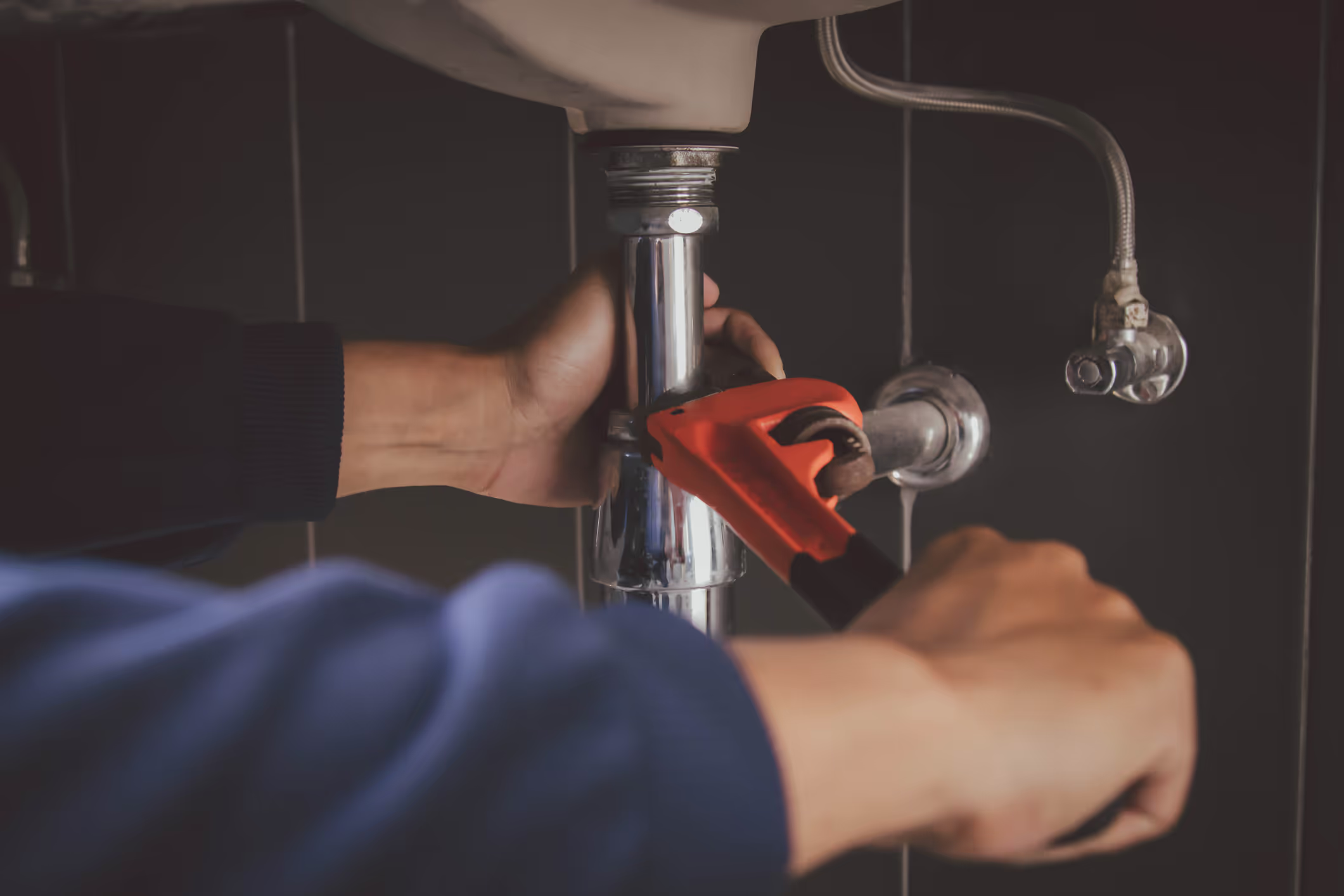
From leaks to full system installs, our plumbing services cover everything you need for a safe, reliable home water system, 24/7.
Our Primary Plumbing Include:
- Water Heater Replacement
- Water Heater Repair
- Trenchless Sewer Line
- Water Filtration
- Slab Leak
- Sewer Line Repair
Don't see the service you need? Call our Team today!
ELECTRICAL

Our electrical services ensure your home stays safe and powered, from routine fixes to complete system upgrades.
Our Primary Electrical Services Include:
- House Rewiring
- Electrician
- Electric Panel Upgrade
- Electric Panel Replacement
- EV Chargers
- Whole House Generator
Don't see the service you need? Call our Team today!
HEATING
.jpg)
We install, repair, and maintain heating & furnace systems with expert care to keep your Colorado home comfortable and energy-efficient year-round.
Our Primary Heating Services Include:
- Heating Installation
- Heating Replacement
- Heating Maintenance
- Heating Repair
- Heating Service
- Heating Tune-Up
Don't see the service you need? Call our Team today!