Why High Altitude and HVAC Performance Don't Always Get Along in Denver
How does altitude affect your HVAC system is one of the most important questions any Denver-area homeowner can ask — and the answer affects everything from your monthly energy bill to your family's safety.
Here's the short version:
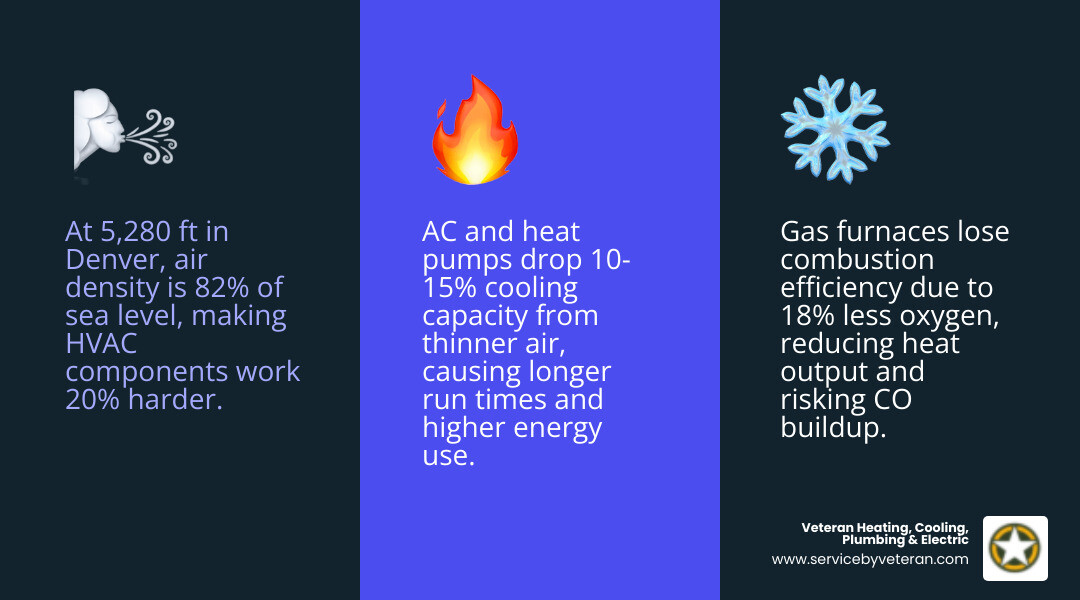
• Thinner air — At 5,280 feet, Denver's air is only about 82% as dense as sea-level air, meaning every component in your system has to work harder to move, heat, or cool it.
• Furnace inefficiency — Less oxygen means gas furnaces can't burn fuel completely, reducing heat output and raising the risk of carbon monoxide production.
• Reduced cooling capacity — Air conditioners and heat pumps lose roughly 10–15% of their rated capacity due to lower air density, leading to longer run times and higher energy use.
• Fan and motor strain — The same fan that moves 90,000 pounds of air per hour at sea level can only move about 72,000 pounds per hour at 6,000 feet — an 20% drop in performance.
• Humidity challenges — High-altitude air is naturally dry, making it harder to maintain comfortable indoor humidity levels year-round.
• Accelerated wear — Systems that aren't properly adjusted for elevation experience more stress, leading to earlier breakdowns and shorter lifespans.
If you live in Denver, Littleton, Castle Rock, or anywhere else in the Denver Metro area, altitude isn't just a fun fact — it's a daily challenge your HVAC system faces every single hour it runs.
I'm Mike Townsend, a U.S. Army veteran whose military career included managing precision cooling systems for heat-seeking missile heads — work that demanded the same kind of technical exactness that high-altitude HVAC requires. Understanding how does altitude affect your HVAC system has been central to how I've built and led our team to serve Denver-area homeowners with the precision and integrity this environment demands.
I'm worried about my home's efficiency in Denver. How does altitude affect your HVAC system?
When we talk about altitude in the Denver Metro area, we aren't just talking about beautiful mountain views. We are talking about physics. In April 2026, as we look at the latest energy standards, the impact of our "thin air" is more relevant than ever.
At sea level, the air is heavy and packed with molecules. As you climb toward the Mile High City, atmospheric pressure drops. While sea-level pressure sits at about 14.7 PSI, here in Denver, it’s closer to 12 PSI. This means there is roughly 18% less air mass in every cubic foot of space.
So, how does altitude affect your HVAC system efficiency? It creates a "mass flow" problem. Your air conditioner, furnace, and heat pump move heat by moving air. If the air is 18% thinner, there are 18% fewer molecules available to carry that heat. Imagine trying to move a pile of sand with a shovel that has holes in it — you have to work much harder and take more swings to move the same amount of material.
The Air Density vs. Fan Performance Reality
To put this into perspective, consider the weight of the air your system moves. A standard blower fan that moves 90,000 pounds of air per hour at sea level will only move about 72,000 pounds per hour at an elevation of 6,000 feet. That is a massive drop in performance. Because the air is less dense, your system has to run longer cycles to achieve the same temperature change, which can increase your energy consumption by 30% to 50% compared to a sea-level home.
At Veteran Heating, Cooling, Plumbing & Electric, we see the results of this every day. Systems that aren't calibrated for these conditions don't just cost more to run; they struggle to maintain a steady climate. If you've noticed your energy bills spiking or your home feeling "stuffy," it’s likely because your system is fighting the altitude. You can learn more about how we address these unique local challenges on our Services page.
• Air Density % — Sea Level (0 ft): 100% — Mile High (5,280 ft): ~82% — High Mountain (8,000 ft): ~75%
• Oxygen Availability — Sea Level (0 ft): High — Mile High (5,280 ft): Reduced — High Mountain (8,000 ft): Low
• Heat Transfer Ability — Sea Level (0 ft): Excellent — Mile High (5,280 ft): Reduced by ~15% — High Mountain (8,000 ft): Reduced by ~25%
• Fan Mass Flow (lbs/hr) — Sea Level (0 ft): 90,000 — Mile High (5,280 ft): ~73,800 — High Mountain (8,000 ft): ~67,500
Why does my furnace struggle to heat my home in Castle Rock and Littleton?
If you live in Castle Rock or Littleton, you know that our winters are no joke. But have you ever wondered why your furnace seems to be gasping for breath when the temperature drops? The answer lies in the "combustion triangle": fuel, heat, and oxygen.
Standard gas furnaces are designed to burn a very specific mixture of natural gas and oxygen. At sea level, there is plenty of oxygen to go around. But at 5,000+ feet, the "thin" air means there isn't enough oxygen to support a standard burner's appetite. This leads to "incomplete combustion."
The Danger of Incomplete Combustion
When a furnace can't get enough oxygen, the flame turns from a crisp, efficient blue to a lazy yellow or orange. This isn't just an efficiency issue; it's a safety hazard. Incomplete combustion produces high levels of carbon monoxide (CO), a colorless, odorless gas that can be deadly. It also leads to soot buildup on your heat exchanger, which can cause the metal to crack prematurely.
To combat this, we perform what is known as "altitude derating." The International Fuel Gas Code (IFGC) actually mandates that gas appliances be derated for any elevation above 2,000 feet. The general rule of thumb is to reduce the furnace’s input rate by 4% for every 1,000 feet of elevation. In Denver, that means your furnace needs to be derated by about 20%.
How We Fix It: High-Altitude Kits
We don't just turn a screw and hope for the best. Proper adjustment often requires installing high-altitude kits. These kits include:
• Smaller burner orifices: These reduce the amount of gas entering the burner to match the lower oxygen levels.
• Different pressure switches: These ensure the furnace knows exactly how much air is moving through the flue, preventing the system from shutting down due to "thin air" errors.
Without these adjustments, your furnace might "short cycle" (turn on and off rapidly) or fail to reach your set temperature. Regular Furnace Maintenance is essential to ensure these settings remain accurate as the equipment ages. If you're worried about your system's performance, our Heating Services team is expert at calibrating systems specifically for the Colorado climate.
How can I keep my home cool when the air is so thin?
Cooling a home in the Denver Metro area presents a different set of hurdles. While our summers are beautiful, the combination of high UV intensity and thin air makes your air conditioner work overtime.
When your AC runs, it isn't actually "creating cold." It is removing heat from your indoor air and dumping it outside. To do this, it uses a fan to blow outdoor air across a set of condenser coils. But remember our mass flow problem: the outdoor air is thin. There are fewer air molecules to "grab" the heat from the coils and carry it away.
This reduced heat dissipation means your compressor has to work harder and run at higher pressures to move the same amount of heat. In cities like Albuquerque or Denver, you can see a 14% reduction in cooling coil capacity simply because the air is too thin to be an effective heat sponge.
Refrigerant Pressure Shifts
Altitude also messes with the way we measure refrigerant. Lower atmospheric pressure shifts the boiling and condensing points of the refrigerant inside your system. If a technician uses sea-level pressure tables to charge your AC in Broomfield or Lakewood, they will likely overcharge or undercharge the system. This leads to frozen coils, liquid "slugging" in the compressor, and eventually, a total system failure.
If your current unit is struggling, it might be time for an AC Replacement. We often recommend Heat Pump Services or Mini-Split AC systems for our local customers because these modern units often feature variable-speed technology that adapts better to varying air densities.
How does altitude affect your HVAC system cooling capacity?
The "cooling capacity" of an AC unit is its ability to remove a certain amount of heat (measured in BTUs) per hour. Because of the lower air density, the airflow mass moving across your indoor evaporator coil is lower than the manufacturer intended.
This results in:
1. Reduced Dehumidification: Even though Colorado is dry, your AC still needs to remove some moisture to keep you comfortable. Thinner air makes this process less efficient.
2. Longer Run Times: To reach 72 degrees, a system that would take 20 minutes at sea level might take 30 minutes in Centennial.
3. Coil Freezing: Because the air isn't carrying enough heat to the indoor coil, the refrigerant inside can stay too cold, causing condensation to turn into ice.
This is why an AC Tune-Up Littleton CO is so critical. We adjust the fan speeds and refrigerant levels to compensate for the altitude. For those looking for the most efficient option, a modern Heat Pump Installation provides a versatile solution that handles both heating and cooling while being specifically tuned for high-elevation performance.
What can I do to extend the life of my equipment at high elevation?
Operating a standard HVAC system in Denver without the right adjustments is like asking an athlete to run a marathon at the top of Mt. Everest without training. It’s possible, but it’s going to take a toll on the body.
The biggest victim of altitude is the blower motor. Because the air is thin, the motor has to spin faster or work harder to move the necessary mass of air to keep your home comfortable. This creates extra heat inside the motor itself. At sea level, the dense air helps cool the motor down. In Aurora or Golden, the thin air is a poor coolant, meaning your motors and electrical components run hotter than they should.
Motor Strain and Bearing Wear
Increased heat leads to the breakdown of lubricants in the bearings and puts extra stress on the motor windings. Over time, this leads to premature motor failure. Additionally, compressors in altitude-affected systems pull about 5% more power just to overcome the pressure imbalances caused by the thin atmosphere.
One of the best ways to fight this is through the use of Variable Speed Drives (VSDs). These allow the fans and motors to adjust their speed precisely based on the real-time needs of the home, rather than just blasting at 100% capacity. This reduces wear and tear and helps lower those high energy bills. If your system is making strange noises or struggling to keep up, you might need a professional HVAC Repair. If you're building a new home, a proper HVAC Installation by a team that understands altitude is the best way to ensure a 15-to-20-year lifespan for your equipment.
How does altitude affect your HVAC system maintenance schedule?
In the Denver Metro area, "standard" maintenance isn't enough. Because the air is thinner and our environment is dustier (thanks to the dry climate and occasional wildfire smoke), your system needs more frequent attention.
• Filter Changes: We recommend checking your filters every month. Because the air is less dense, any restriction from a dirty filter has a much larger impact on airflow than it would at sea level.
• Combustion Analysis: This is the most important part of a high-altitude tune-up. We use specialized sensors to measure the gases coming out of your flue to ensure your furnace is burning cleanly and safely.
• System Calibration: We check the "static pressure" of your ductwork to ensure the thin air is moving efficiently through the house.
Maintaining your Indoor Air Quality Denver CO is also a major factor. Dry air can lead to cracked wood furniture, static shocks, and respiratory issues. A whole-home humidifier is almost a requirement in Colorado to keep your home feeling warm (moist air holds heat better than dry air!).
For more tips on keeping your system running smoothly, check out our Ductless Heating and Cooling Blog. Regular HVAC Maintenance is the only way to catch altitude-induced defects before they turn into expensive repairs.
Frequently Asked Questions about High-Altitude HVAC
Does high altitude void my HVAC manufacturer warranty?
This is a common concern. While altitude itself doesn't usually "void" a warranty, many manufacturers have strict language regarding proper installation. Most warranties require that the system be installed according to local codes and manufacturer specifications—which, for Denver, includes mandatory altitude derating and the installation of high-altitude kits. If a heat exchanger cracks because the furnace wasn't derated, the manufacturer could deny the claim, citing "improper installation." This is why it is so important to work with a licensed, expert team like ours.
Why is humidity control so difficult in the Denver Metro area?
At high altitudes, the air is naturally much drier. Moisture is what allows air to "hold" heat. When your home’s humidity drops below 20% (common in Denver winters), the air feels colder than it actually is, leading you to crank up the thermostat. By installing a whole-home humidifier and keeping your humidity between 30% and 50%, a 68-degree room can feel as warm as a 71-degree room, saving you significantly on heating costs.
Do I need a larger HVAC system because of the elevation?
Not necessarily. While it's true that systems lose capacity at altitude, simply "sizing up" to a bigger unit can cause problems like "short cycling," where the unit turns on and off too frequently. This wears out the parts and doesn't properly dehumidify or circulate air. The key isn't just a bigger system; it's a properly calibrated system. We use altitude-specific load calculations to find the perfect balance for your specific home in Highlands Ranch or Arvada.
Conclusion
Living in the Denver Metro area means we get to enjoy some of the best views and outdoor lifestyles in the country, but it also means our homes have to work a little harder to keep us comfortable. Understanding how does altitude affect your HVAC system is the first step toward a more efficient, safer, and longer-lasting home environment.
At Veteran Heating, Cooling, Plumbing & Electric, we don't just see ourselves as technicians; we are your neighbors. Whether you are in Centennial, Lakewood, or Castle Rock, we bring the values of integrity, service, and precision to every job. As a veteran-owned and locally operated company, we stand behind our work with a lifetime warranty on parts and labor and a 100% money-back guarantee.
Don't let the "thin air" thin out your wallet or compromise your family's safety. From precision furnace derating to high-altitude AC calibration, we have the experience to make sure your system wins the uphill battle.
Contact our experts for specialized high-altitude HVAC solutions or visit our Homepage to learn more about our $9.99/month maintenance plan and our 10% discount for veterans, seniors, and first responders. We are here for you 24/7, with no dispatch or trip fees—because service is in our blood.
ABOUT Veteran Heating, Cooling, Plumbing & Electric
Veteran Heating, Cooling, Plumbing & Electric was founded on the belief that service should be personal, honest, and community-focused. Our team is built around integrity, professionalism, and a true commitment to your home’s comfort and safety.
Led by a U.S. Army veteran with over 30 years of industry experience, we’re proud to remain locally owned and operated. Every technician, plumber, and electrician is EPA-certified, background checked, and driven to exceed expectations.
- 24/7 ServiceWe offer weekend & 24/7 emergency service. We’re here whenever you need us—day, night, or weekend, no exceptions.
- $0 Trip FeesNo dispatch or trip fees. You’ll never pay just for us to show up—service starts when the work does.
OUR SERVICES
AIR CONDITIONING
.jpg)
We offer specialty and seasonal services like indoor air quality upgrades, pre-winter furnace checks, and summer AC tune-ups to keep your home prepared year-round.
Our Primary Air Conditioning Services Include:
Don't see the service you need? Call our Team today!
PLUMBING
From leaks to full system installs, our plumbing services cover everything you need for a safe, reliable home water system, 24/7.
Our Primary Plumbing Include:
- Water Heater Replacement
- Water Heater Repair
- Trenchless Sewer Line
- Water Filtration
- Slab Leak
- Sewer Line Repair
Don't see the service you need? Call our Team today!
ELECTRICAL

Our electrical services ensure your home stays safe and powered, from routine fixes to complete system upgrades.
Our Primary Electrical Services Include:
- House Rewiring
- Electrician
- Electric Panel Upgrade
- Electric Panel Replacement
- EV Chargers
- Whole House Generator
Don't see the service you need? Call our Team today!
HEATING
.jpg)
We install, repair, and maintain heating & furnace systems with expert care to keep your Colorado home comfortable and energy-efficient year-round.
Our Primary Heating Services Include:
- Heating Installation
- Heating Replacement
- Heating Maintenance
- Heating Repair
- Heating Service
- Heating Tune-Up
Don't see the service you need? Call our Team today!