Preparing for the Freeze: The Urgency of Pre-Season Heating Safety
Denver's average first freeze typically arrives in early October, leaving a very narrow window to secure your home's heating system. At Veteran Heating, Cooling, Plumbing & Electric, we've seen exactly what happens when systems are left unchecked. Getting a look inside a typical 'Service to Heroes' fall HVAC inspection for a Denver veteran reveals exactly why this preparation is so critical. You turn on your thermostat on that first chilly evening, expecting warm air, but instead, you get a strange noise or nothing at all. That is the concrete problem we constantly encounter with dormant heating systems. After sitting unused all summer, furnaces are vulnerable to mechanical failure and, more dangerously, carbon monoxide leaks.
The decision point for many homeowners during this September pre-heating transition is understanding exactly what safety checks are mandatory before firing up the system. With early fall bringing rapid temperature drops to the region, our team knows prompt action is absolutely necessary. A dormant system collects dust, loses lubrication on moving parts, and may have developed microscopic stress fractures during the previous winter's heating cycles. In our years of servicing Denver homes, ignoring these issues until the first snowstorm hits almost always leads to emergency service calls and uncomfortable nights.
The underlying risks we typically see when skipping pre-season safety checks:
• Mechanical seizing: Blower motors that have sat idle for months can lock up if dust and debris have settled into the bearings.
• Combustion hazards: Spiders and insects frequently build nests in burner tubes during the summer, which blocks gas flow and causes dangerous delayed ignition.
• Ventilation blockages: Flue pipes can become obstructed by bird nests or debris, forcing exhaust gases back into your living space.
Understanding the rigorous safety checks performed during our dedicated community program inspection gives you a clear picture of what it takes to operate a furnace safely. This is not a quick visual sweep; it is a comprehensive technical audit we designed to protect your household from the specific challenges of early fall weather.
The 'Service to Heroes' Standard: Military Discipline Applied to HVAC
The core philosophy of our 'Service to Heroes' program is simple: protecting those who served. As a veteran-owned and operated business with a direct community giveback focus, the standards we apply to your heating system reflect military values. Integrity, mission-readiness, and strict adherence to protocols translate directly into our rigorous HVAC safety checklists. This objective, thorough process is designed for maximum safety rather than quick fixes.
During one of our recent fall neighborhood outreach initiatives in the Denver metro area, a local resident noted how professionally our community coordinator represented the 'Service to Heroes' program. That level of knowledge and professionalism is the foundation of our entire initiative. The process begins long before our technician opens your furnace cabinet; it starts with clear communication, respect for your property, and a commitment to doing the job right the first time.
Key differences in our inspection standard:
• Basic visual check of components — 'Service to Heroes' Protocol: Technical audit with diagnostic tools
• Quick filter replacement — 'Service to Heroes' Protocol: Static pressure mapping and airflow analysis
• General system wipe-down — 'Service to Heroes' Protocol: Precision cleaning of ignition and burner assemblies
• Sea-level factory settings left as-is — 'Service to Heroes' Protocol: Custom high-altitude combustion calibration
Community Outreach and Engagement
Our outreach coordinators play an active role in the community, ensuring that local veterans are connected with these essential services. Building trust through neighborhood presence is the first step in our service process. Our team understands that inviting a contractor into your home requires confidence in their integrity. By engaging directly with residents at local summits and neighborhood meetings, we ensure that every homeowner understands the full scope of the safety inspection before our technician even arrives.
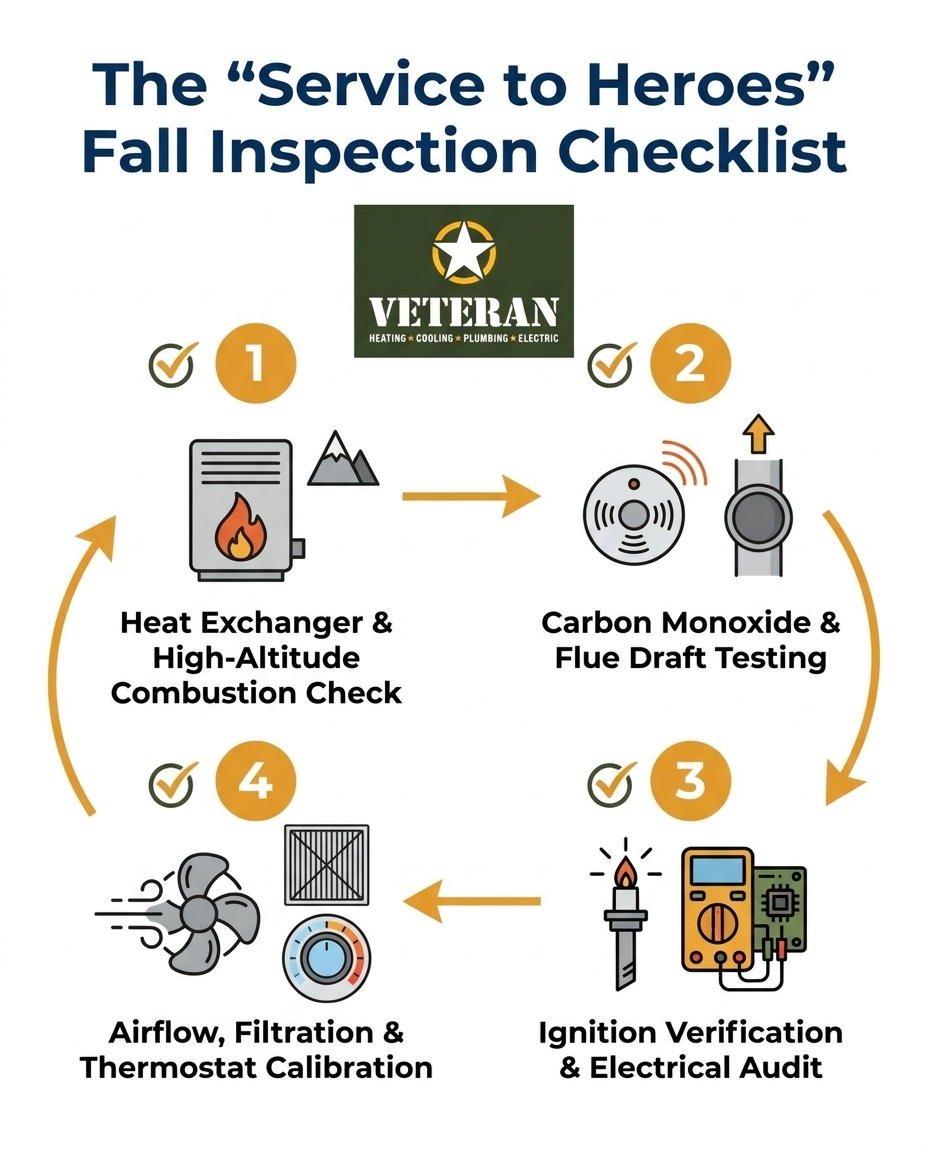
Phase 1: Heat Exchanger Integrity and High-Altitude Combustion
The heat exchanger is the most critical component for furnace safety. This metal shield separates the toxic exhaust gases created by burning fuel from the clean air that blows through your home's vents. During the September pre-heating transition, verifying the integrity of this component is our top priority. Our technicians use advanced visual and technical inspection methods, including high-resolution borescopes, to detect microscopic cracks or rust spots that could leak carbon monoxide.
Because the Denver metro area sits at a mile high, we frequently encounter furnaces running on standard sea-level combustion settings, which leads to inefficient and unsafe operation. A furnace shipped straight from the factory is typically calibrated for lower elevations. If left unadjusted, we've found the system will burn fuel poorly, creating excessive soot, stressing the heat exchanger, and dramatically increasing the risk of mechanical failure.
Why Altitude Impacts Furnace Performance
High-altitude conditions demand precise oxygen-to-fuel ratio adjustments for safe heating. At higher elevations, the air is thinner, meaning there is less oxygen available per cubic foot of air. Gas furnaces require a specific mixture of oxygen and natural gas to burn cleanly.
The high-altitude calibration process: Our technician carefully measures the gas pressure at the manifold and adjusts the burner settings to compensate for the lower oxygen density. This precise calibration ensures that the flame burns hot and clean, preventing the buildup of dangerous carbon monoxide and maximizing the heating output of the system. We consider this step non-negotiable for safe winter operation in this region.
Phase 2: Rigorous Carbon Monoxide Testing Protocols
Carbon monoxide testing addresses the most severe safety risk associated with dormant heating systems. According to data from the CDC and Energy Star, the peak risks of carbon monoxide poisoning occur during the transition to colder months, when homeowners first turn on their furnaces. Our 'Service to Heroes' program treats this threat with military-grade safety protocols, leaving absolutely nothing to chance.
Our testing process follows a strict, numbered sequence to ensure every potential vulnerability is checked:
1. Ambient Baseline Testing: Before the furnace is even turned on, our technician measures the baseline carbon monoxide levels in the mechanical room to ensure no other appliances (like a gas water heater) are currently leaking.
2. Heat Exchanger Stress Test: As the furnace fires up and reaches its maximum operating temperature, the technician uses a sensitive combustion analyzer to detect trace amounts of CO leaking around the furnace casing and supply vents.
3. Flue Draft Verification: We inspect the flue pipe to ensure proper drafting. This step verifies that the hot exhaust gases are safely exiting the home through the roof or sidewall, rather than spilling back into the utility room due to a blockage or negative air pressure.
4. Living Space Monitor Audit: Finally, our technician inspects the ambient CO detectors installed in your home's hallways and bedrooms. We verify the expiration dates on the sensors and test the alarms to ensure this secondary safety measure is fully operational.
These rigorous carbon monoxide testing protocols are a mandatory part of our September pre-heating transition. By verifying that the exhaust system is completely sealed and drafting correctly, our inspection process guarantees that your indoor air remains safe throughout the heavy winter usage.
Phase 3: Mechanical and Electrical System Audits
Once the combustion and exhaust systems are cleared, our inspection moves to the mechanical and electrical components. A furnace relies on a complex sequence of electrical signals and moving parts to distribute heat. We begin by checking and cleaning the blower motor to ensure proper air distribution. A dirty blower wheel can reduce airflow by up to 20%, forcing the furnace to run longer and hotter than designed, which we often see drastically shorten its lifespan.
Next is ignition verification. Our technician observes the burners as the system calls for heat, ensuring the system lights smoothly without delay or rollout. A delayed ignition—often recognized by a small "boom" sound when the furnace starts—indicates that gas is pooling before sparking, which is a significant safety hazard that must be corrected immediately.
The electrical audit includes tightening all wire connections, inspecting the control board for burn marks, and measuring the amp draws on the inducer and blower motors. Motors that draw too many amps are working too hard, signaling an impending failure.
Verifying System Communication
A modern HVAC system relies on constant communication between its components. Our technicians trace the electrical pathways to verify the connection between your indoor and outdoor units, ensuring that safety switches and control boards sequence properly. When the thermostat signals the control board for heat, a specific chain of events must occur in exact order: the inducer motor starts, the pressure switch closes, the igniter glows, and the gas valve opens. If any part of this electrical pathway is compromised, the safety mechanisms will shut the system down. Verifying this communication in the Denver metro area ensures your system won't lock out on the coldest night of the year.
Phase 4: Airflow, Filtration, and Final Calibration
The final phase of our inspection focuses on the efficiency adjustments that ensure the system is ready for winter. Proper airflow is the lifeblood of any HVAC system. If the furnace cannot move air efficiently through the ductwork, the heat exchanger will overheat, triggering the high-limit safety switch and causing the system to short-cycle.
Our final calibration checklist includes:
• Filtration assessment: Our technician explains the critical role of clean air filters in preventing system overheating and restricted airflow, replacing heavily soiled filters that choke the blower motor.
• Static pressure measurement: By measuring the air pressure inside the supply and return ducts, we ensure the ductwork is not impeding performance or forcing the motor to overwork.
• Thermostat calibration: We check the wall thermostat to ensure it accurately matches the actual room temperature, preventing the system from over-heating or under-heating the space.
• Complete cycle observation: The final test cycle involves our technician observing the furnace running through a complete heating phase, from the initial call for heat to the final blower cool-down sequence.
This final test cycle during the September pre-heating transition guarantees that every adjustment made during the previous phases works together harmoniously.
Beyond the Tune-Up: A Lasting Commitment to the Community
Our meticulous inspection process provides tangible peace of mind, knowing that your home's heating system has been evaluated with military discipline. But our 'Service to Heroes' program extends far beyond a single technical tune-up. It is about building long-term relationships based on trust, respect, and shared values within the Denver metro area.
This lasting commitment is evident in our broader engagement with the community at local events. For example, at a fall community event like the Denver Oktoberfest, one local resident was struck by the enthusiastic engagement of our outreach team. Meeting face-to-face in a relaxed, community setting reinforces the fact that our team is part of the local fabric, not just a faceless service provider.
When our technicians treat every home with the same level of professionalism and quality, it fosters a deep sense of reliability. A thorough, transparent walkthrough of the specific safety checks and maintenance steps performed during this program's tune-up demonstrates our true commitment to veteran safety, ensuring you stay warm and secure all winter long.
Frequently Asked Questions
What is checked during a fall furnace inspection?
A fall furnace inspection includes a comprehensive audit of the system's mechanical, electrical, and combustion components. Our technicians verify the integrity of the heat exchanger, test for carbon monoxide leaks, clean the ignition assembly, and measure motor amp draws. They also map the static pressure to ensure proper airflow and calibrate the thermostat for accurate heating.
Why is carbon monoxide testing important for furnaces?
Carbon monoxide testing is critical because CO is a colorless, odorless gas that can be fatal if it leaks into your living space. Furnaces produce this gas naturally during the combustion process, and a cracked heat exchanger or blocked flue pipe can allow it to escape. Rigorous testing ensures that all exhaust gases are safely drafted out of the home.
How often should a dormant heating system be inspected?
We recommend a dormant heating system be inspected annually, ideally in the early fall before the first freeze. Sitting unused for months allows dust to settle on moving parts and insects to nest in burner tubes, which can cause mechanical failures or delayed ignition. An annual pre-season check ensures the system is clean, safe, and ready for heavy winter use.
What happens during an HVAC safety inspection?
During an HVAC safety inspection, a technician uses specialized diagnostic tools to test the system's safety switches, electrical pathways, and combustion efficiency. They observe a complete heating cycle to ensure the system sequences correctly without gas rollout or electrical shorts. The goal is to identify and resolve microscopic wear and tear before it becomes a hazardous failure.
Why does high altitude affect my gas furnace?
High altitude affects a gas furnace because the air is thinner and contains less oxygen per cubic foot than at sea level. Gas furnaces require a precise mixture of oxygen and fuel to burn cleanly and safely. Without specific high-altitude combustion calibration, which we frequently perform in Denver, the furnace will burn inefficiently, creating excess soot and increasing the risk of overheating the heat exchanger.
What makes the 'Service to Heroes' inspection process unique?
The 'Service to Heroes' inspection process is unique because it applies military-grade discipline and rigorous safety protocols to standard HVAC maintenance. Run by a veteran-owned and operated team, our program focuses heavily on objective, technical audits rather than quick visual sweeps. It also integrates direct community outreach, ensuring local veterans receive transparent, trustworthy service.
ABOUT Veteran Heating, Cooling, Plumbing & Electric
Veteran Heating, Cooling, Plumbing & Electric was founded on the belief that service should be personal, honest, and community-focused. Our team is built around integrity, professionalism, and a true commitment to your home’s comfort and safety.
Led by a U.S. Army veteran with over 30 years of industry experience, we’re proud to remain locally owned and operated. Every technician, plumber, and electrician is EPA-certified, background checked, and driven to exceed expectations.
- 24/7 ServiceWe offer weekend & 24/7 emergency service. We’re here whenever you need us—day, night, or weekend, no exceptions.
- $0 Trip FeesNo dispatch or trip fees. You’ll never pay just for us to show up—service starts when the work does.
OUR SERVICES
AIR CONDITIONING
.jpg)
We offer specialty and seasonal services like indoor air quality upgrades, pre-winter furnace checks, and summer AC tune-ups to keep your home prepared year-round.
Our Primary Air Conditioning Services Include:
Don't see the service you need? Call our Team today!
PLUMBING
From leaks to full system installs, our plumbing services cover everything you need for a safe, reliable home water system, 24/7.
Our Primary Plumbing Include:
- Water Heater Replacement
- Water Heater Repair
- Trenchless Sewer Line
- Water Filtration
- Slab Leak
- Sewer Line Repair
Don't see the service you need? Call our Team today!
ELECTRICAL

Our electrical services ensure your home stays safe and powered, from routine fixes to complete system upgrades.
Our Primary Electrical Services Include:
- House Rewiring
- Electrician
- Electric Panel Upgrade
- Electric Panel Replacement
- EV Chargers
- Whole House Generator
Don't see the service you need? Call our Team today!
HEATING
.jpg)
We install, repair, and maintain heating & furnace systems with expert care to keep your Colorado home comfortable and energy-efficient year-round.
Our Primary Heating Services Include:
- Heating Installation
- Heating Replacement
- Heating Maintenance
- Heating Repair
- Heating Service
- Heating Tune-Up
Don't see the service you need? Call our Team today!