When Late-Summer Conservation Meets Home Plumbing Mechanics
You turn on the kitchen tap to rinse a plate, and instead of a strong stream, you get a sputtering, weak trickle. Navigating Littleton's late-summer water restrictions and what they mean for your plumbing fixtures can be incredibly frustrating when you just want to take a normal shower or wash your dishes. By late August, when drought conditions peak across the region, many homeowners automatically blame the city for every drop in water pressure. While municipal conservation efforts definitely alter system dynamics, assuming all flow issues are city-mandated is a common mistake that can cost you later.
The real challenge is determining if the pressure drop is solely due to local water restrictions or if those restrictions are actually masking an underlying plumbing failure. When city pressure drops slightly, a failing valve or clogged pipe in your home suddenly becomes obvious. Accurate isolation of the problem saves you time, prevents unnecessary wear on your home fixtures, and keeps you from ignoring a failing component until it completely breaks down. Let's look at exactly what happens when municipal conservation meets your home's internal plumbing mechanics, and how you can tell the difference between a city issue and a house issue.
Understanding Littleton's Water Supply Dynamics During Drought
To understand why your faucets are struggling, you first need to understand how municipal water systems manage supply and demand during peak drought periods. When water levels drop and conservation measures are enacted, the entire distribution grid experiences changes. While outdoor irrigation schedules are the most visible sign of these restrictions, overall municipal system pressure can and does fluctuate based on community usage and supply management.
The EPA WaterSense program outlines standard baselines for residential water pressure, typically recommending a range between 40 and 80 pounds per square inch (psi) for optimal home function. When municipal systems adjust their output to conserve water, the baseline pressure delivered to your street may hover closer to the lower end of that spectrum. A slight, uniform drop in pressure across your entire home might be a normal response to these municipal changes. However, severe or isolated drops usually point to internal issues. If your pressure drops below 40 psi, your appliances and fixtures will struggle to operate correctly.
How System-Wide Conservation Affects the Grid
The physical realities of municipal water distribution mean that not every home experiences conservation efforts the exact same way. When overall volume usage drops across the city, the dynamics of the water grid shift.
Homes at different elevations or varying distances from municipal pumping stations experience these fluctuations differently. If your home sits at a higher elevation in Littleton, you are naturally fighting gravity, which means you might notice municipal pressure drops more acutely than a home sitting in a valley.
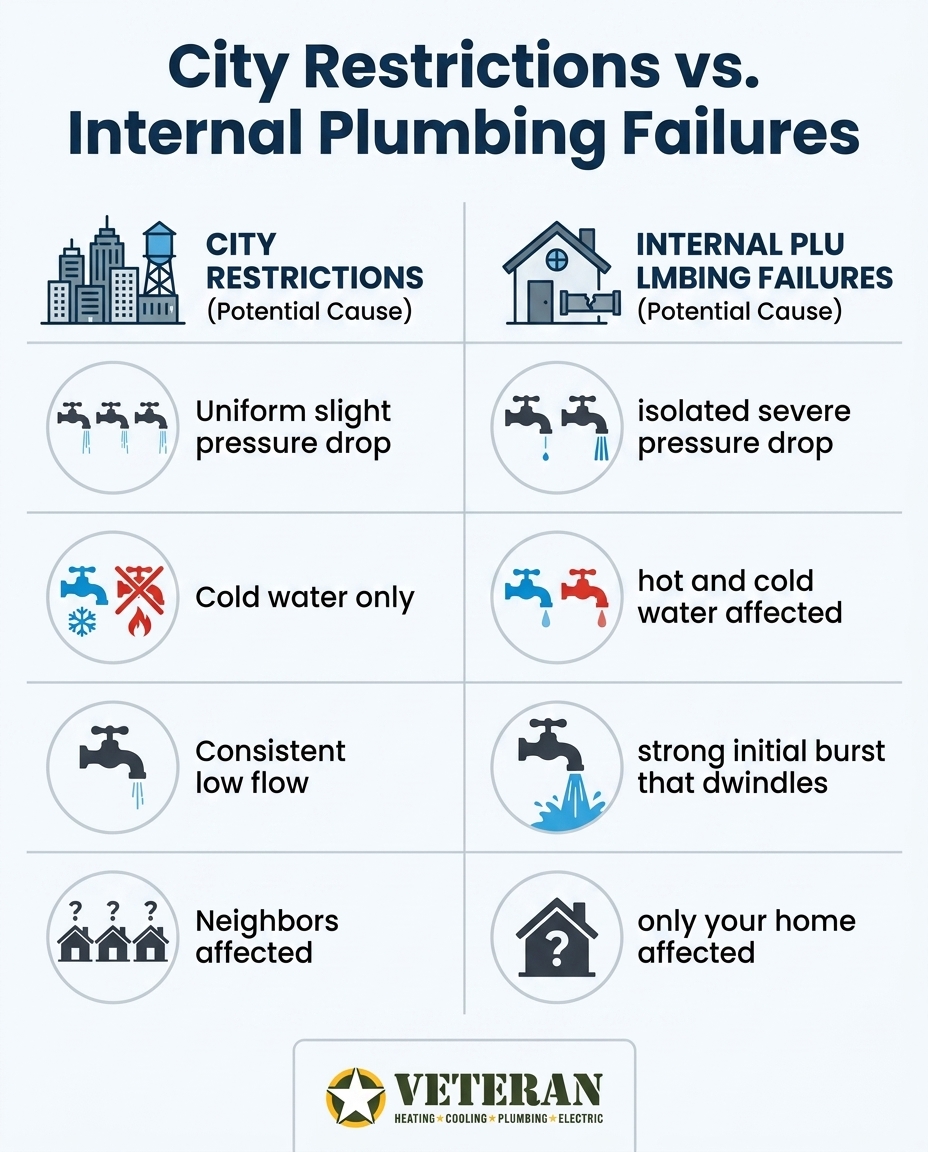
• Pressure Drop Scope — Likely Municipal Fluctuation: Uniform across the whole house — Likely Internal Plumbing Failure: Isolated to one room or fixture
• Severity — Likely Municipal Fluctuation: Slight decrease in flow — Likely Internal Plumbing Failure: Severe drop to a trickle
• Temperature — Likely Municipal Fluctuation: Both hot and cold affected equally — Likely Internal Plumbing Failure: Only hot or only cold affected
• Timing — Likely Municipal Fluctuation: Consistent during peak neighborhood usage — Likely Internal Plumbing Failure: Constant issue regardless of time of day
Understanding these grid dynamics helps you set a baseline for what is normal during late August conservation efforts, making it easier to spot when something is actually mechanically wrong inside your home.
The Hidden Impact on Pressure Reducing Valves (PRVs)
One of the most common internal failures masked by municipal restrictions involves your home's Pressure Reducing Valve (PRV). A PRV is a bell-shaped device usually installed on your main water line right where it enters the house. Its job is to regulate the high-pressure municipal water coming from the street, reducing it to a safe, consistent pressure before it enters your home's interior pipes. Without a PRV, high city pressure could blow out your pipe joints, damage your water heater, and ruin your appliance hoses.
Here is the catch: PRVs typically have a functional lifespan of 10 to 15 years, and they frequently fail in a way that severely restricts water flow. Inside the valve, a heavy-duty spring and a rubber diaphragm work constantly to balance the pressure. Over time, that rubber diaphragm degrades, stiffens, or tears, and the internal screen gets clogged with debris. When a PRV begins to fail, it stops allowing adequate water volume into your home.
A failing PRV perfectly mimics a municipal pressure drop. Because the symptoms look identical—lower water pressure across the house—homeowners often ignore this mechanical failure, assuming the city is just restricting water. Variations in city supply pressure during drought conditions can actually be the final trigger that causes an aging PRV to noticeably fail. When the city pressure drops slightly, a sticky, failing PRV that was barely pushing enough water through suddenly cannot push enough volume to run your shower, revealing the hidden failure.
Colorado's Hard Water: How Low Flow Exacerbates Sediment Buildup
The hot, dry Front Range climate not only triggers municipal water restrictions but also concentrates the effects of hard water when system flow is reduced. The region's water supply contains high levels of dissolved minerals, primarily calcium and magnesium. Under normal, high-pressure conditions, the sheer velocity of the water rushing through your pipes keeps a lot of these minerals suspended in the water column, flushing them right out of your taps.
When water flow rates decrease—whether due to city conservation or a failing PRV—the mechanical process inside your pipes changes. Slower-moving water gives suspended minerals and sediment more time to settle out of the water column and stick to the interior walls of your plumbing. This sediment accumulates rapidly in the tiny screens of your faucet aerators, inside your showerheads, and within your sink supply lines, causing severe, localized pressure drops.
At Veteran Heating, Cooling, Plumbing & Electric, our plumbers see this pattern constantly across the Denver metro area. For instance, just as families were gearing up for the back-to-school transition late last summer, our team addressed a kitchen sink issue for a Littleton homeowner where the flow had almost completely stopped. The homeowner assumed the city's restrictions were to blame, but sediment had heavily compromised the fixture. By correctly diagnosing the localized buildup, our technician picked up a specific replacement part and thoroughly resolved the issue. Resolving these localized issues requires specific attention to the affected fixtures, cleaning or replacing the clogged components, rather than attempting whole-house pressure adjustments.
Signs Your Low Water Pressure Is an Internal Plumbing Failure
Distinguishing between city-wide water restrictions and an internal mechanical failure doesn't have to be a guessing game. If you pay close attention to how and where the pressure drops in your home, your plumbing will usually give you clear signs that a component is failing.
• Isolated pressure drops: If the pressure drop is isolated to a single fixture or room—such as only the kitchen sink or just the master shower—the issue is internal. Municipal restrictions affect the entire house equally.
• Temperature discrepancies: If your hot water pressure is significantly lower than your cold water pressure, you are likely dealing with severe sediment buildup inside your water heater, not a city-wide drought issue.
• The initial burst: If you turn on a tap and the water pressure starts strong for a split second before immediately dropping to a weak trickle, this is a classic sign of a failing PRV or a severe restriction in your main line. The pipe builds up pressure while closed, but cannot sustain the volume once opened.
• Unaffected neighbors: If your neighbors on the same municipal supply line are not experiencing similar indoor pressure issues, the restriction is isolated to your property's plumbing system.
• Strange pipe noises: Banging, humming, or whistling noises in the pipes when water is running strongly indicate a valve failure. A failing PRV often hums or vibrates loudly as water struggles to push past a broken internal diaphragm.
Strategic Solutions for Restoring Optimal Flow
When you determine that your low flow is an internal mechanical problem rather than a municipal restriction, correcting the underlying plumbing issues requires specific professional methods. This is not a situation where turning a random bolt on your main line will safely solve the problem. In fact, adjusting a failing PRV incorrectly can flood your home with dangerously high pressure, blowing out supply lines and destroying appliances.
The professional process begins with testing both static and dynamic water pressure using calibrated gauges. Static pressure measures the force of the water when nothing is running in the house, while dynamic pressure measures the flow while multiple fixtures are open. By comparing these two numbers, experts evaluate the integrity of the main supply line and the PRV before recommending any replacements. If the dynamic pressure drops drastically while the static pressure remains normal, the PRV is almost certainly bottlenecking the system.
Addressing severe sediment buildup or compromised lines may require targeted, professional pipe repair methods to fully restore volume and pressure to your fixtures. If mineral scaling has permanently narrowed the interior of older pipes, localized replacement of those pipe sections is often the only way to return the flow to normal. Because adjusting municipal water entry points involves local building codes and significant flood risks, having a licensed professional handle PRV adjustments or replacements ensures your system remains compliant and safe.
The Importance of Precision in Plumbing Diagnostics
Guessing at the cause of low water pressure usually leads to wasted money and continued frustration. The risk of misdiagnosis is high: assuming a municipal issue means ignoring a failing PRV until it ruptures, while assuming a pipe failure when the city is simply flushing lines temporarily could lead to unnecessary service calls. This is why a methodical, step-by-step diagnostic approach is absolutely essential to isolate the exact point of pressure loss.
When you work with Veteran Heating, Cooling, Plumbing & Electric, you get the benefit of military precision, unyielding integrity, and top-tier workmanship in diagnosing complex pressure issues. You deserve the truth about your plumbing system, not a sales pitch. We believe in providing factual data about your plumbing system's health based on actual gauge readings and physical inspections.
When you call for help, you deserve a team that arrives promptly, introduces themselves, and gets straight to work. Our technicians recently helped a local Denver homeowner who was dealing with frustrating home service issues right at the end of the cooling season, and by applying our rigorous diagnostic approach, we provided honest answers that resolved the problem efficiently. Accurate diagnostics protect your property and your budget over the long term, ensuring you only fix what is actually broken.
Protecting Your Home's Plumbing Through the Late-Summer Drought
While municipal conservation is a necessary reality during a late August drought in Littleton, living with inadequate indoor water pressure shouldn't be. As you wrap up your end-of-season cooling needs and transition into the busy back-to-school routine, you rely on your plumbing system every single day, and a trickle at the kitchen sink or a weak shower disrupts everything. Understanding how city restrictions interact with your home's mechanics is the first step in taking control of your comfort.
It is vital to identify masked failures like aging PRVs or sediment-clogged aerators before they escalate into larger plumbing emergencies. Don't simply accept poor water pressure as an unavoidable part of late-summer living. If your fixtures are struggling to keep up, seek a professional assessment to ensure your plumbing system is operating exactly as designed. A quick, precise diagnostic check can restore your flow and give you total confidence in your home's plumbing.
Frequently Asked Questions
Why is my indoor water pressure low during summer restrictions?
During peak summer drought periods, municipalities may lower system pressure to conserve water and manage high community demand. While a slight decrease is normal, a severe drop usually indicates that the slightly lower city pressure has exposed a pre-existing mechanical issue in your home, like a failing pressure reducing valve.
How can I tell if low water pressure is the city's fault or my plumbing?
Check multiple fixtures and ask your neighbors. If the low pressure is isolated to one sink, only affects hot water, or if your neighbors have normal pressure, the issue is internal to your plumbing system. City-wide restrictions will cause a uniform, mild pressure drop across your entire house and neighborhood.
What are the signs of a failing pressure reducing valve?
A failing PRV often causes a sudden drop in water volume, whistling or humming noises in the pipes, or a situation where water starts strong for a second and then drops to a trickle. Because PRVs typically last 10 to 15 years, an older valve combined with these symptoms strongly points to failure.
What causes sudden low water pressure in one fixture?
Isolated low pressure is almost always caused by sediment buildup or a failing localized part. Hard water minerals can quickly clog the tiny screens inside faucet aerators or showerheads, restricting flow entirely in just one specific room while the rest of the house functions normally.
Do municipal water restrictions directly affect indoor water pressure?
Yes, municipal restrictions can lower the baseline pressure delivered to your street, which translates to slightly lower pressure inside your home. However, municipal systems are required to maintain a safe baseline, so if your indoor pressure drops to an unusable trickle, an internal plumbing component is likely failing.
Can hard water sediment mimic a drop in municipal water pressure?
Absolutely. When hard water sediment builds up in pipes or clogs a main valve, it chokes off the water supply entering your home. This creates a severe drop in pressure that homeowners often mistake for municipal water restrictions, especially during the late-summer drought season.
ABOUT Veteran Heating, Cooling, Plumbing & Electric
Veteran Heating, Cooling, Plumbing & Electric was founded on the belief that service should be personal, honest, and community-focused. Our team is built around integrity, professionalism, and a true commitment to your home’s comfort and safety.
Led by a U.S. Army veteran with over 30 years of industry experience, we’re proud to remain locally owned and operated. Every technician, plumber, and electrician is EPA-certified, background checked, and driven to exceed expectations.
- 24/7 ServiceWe offer weekend & 24/7 emergency service. We’re here whenever you need us—day, night, or weekend, no exceptions.
- $0 Trip FeesNo dispatch or trip fees. You’ll never pay just for us to show up—service starts when the work does.
OUR SERVICES
AIR CONDITIONING
.jpg)
We offer specialty and seasonal services like indoor air quality upgrades, pre-winter furnace checks, and summer AC tune-ups to keep your home prepared year-round.
Our Primary Air Conditioning Services Include:
Don't see the service you need? Call our Team today!
PLUMBING
From leaks to full system installs, our plumbing services cover everything you need for a safe, reliable home water system, 24/7.
Our Primary Plumbing Include:
- Water Heater Replacement
- Water Heater Repair
- Trenchless Sewer Line
- Water Filtration
- Slab Leak
- Sewer Line Repair
Don't see the service you need? Call our Team today!
ELECTRICAL

Our electrical services ensure your home stays safe and powered, from routine fixes to complete system upgrades.
Our Primary Electrical Services Include:
- House Rewiring
- Electrician
- Electric Panel Upgrade
- Electric Panel Replacement
- EV Chargers
- Whole House Generator
Don't see the service you need? Call our Team today!
HEATING
.jpg)
We install, repair, and maintain heating & furnace systems with expert care to keep your Colorado home comfortable and energy-efficient year-round.
Our Primary Heating Services Include:
- Heating Installation
- Heating Replacement
- Heating Maintenance
- Heating Repair
- Heating Service
- Heating Tune-Up
Don't see the service you need? Call our Team today!