Which Mini Split Setup Is Right for Your Denver Home?
A single zone vs multi zone mini split comparison comes down to one essential question: how many separate areas of your home need independent temperature control? Here is a quick breakdown to help you decide fast:
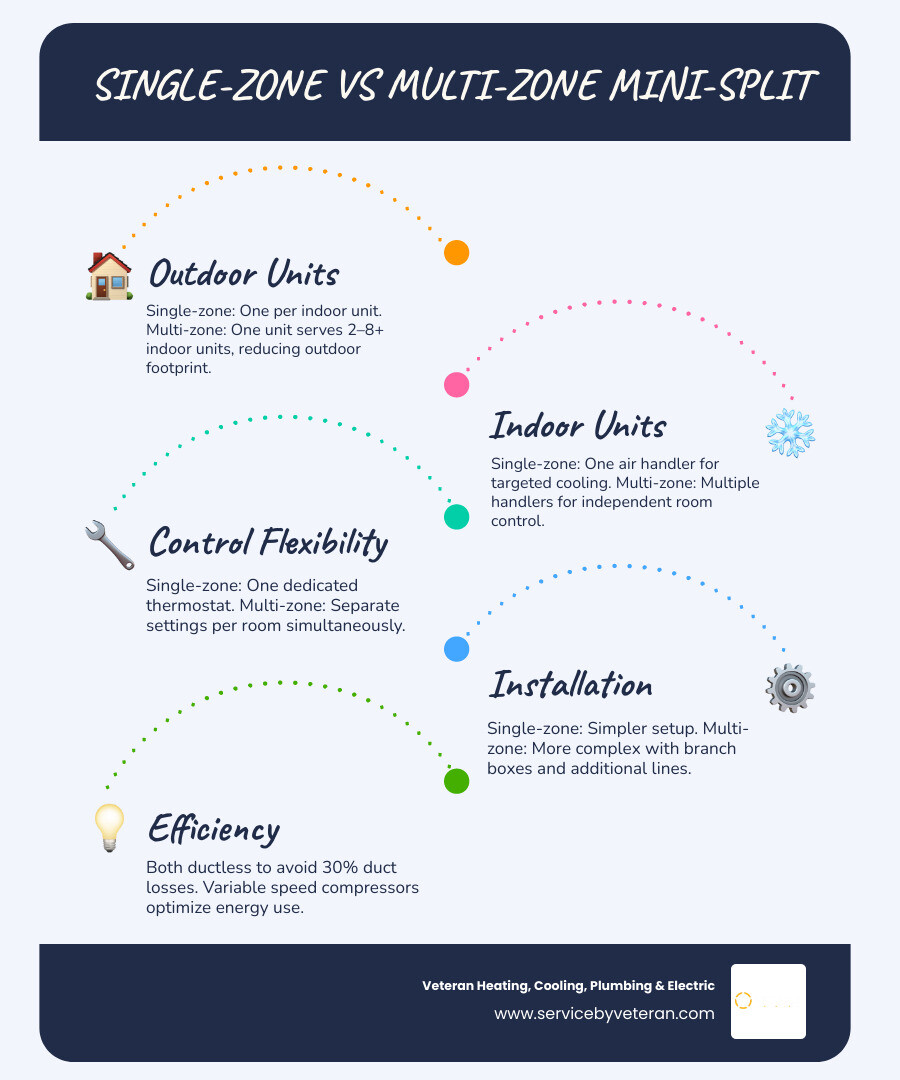
• Outdoor units — Single-Zone: One per indoor unit — Multi-Zone: One for 2–8+ indoor units
• Indoor units — Single-Zone: One — Multi-Zone: Two or more
• Independent control — Single-Zone: One space — Multi-Zone: Multiple spaces simultaneously
• Installation complexity — Single-Zone: Simpler — Multi-Zone: More involved
• Best for — Single-Zone: One room, garage, addition — Multi-Zone: Whole home, multi-story, varied preferences
• Outdoor unit footprint — Single-Zone: Larger (multiple units) — Multi-Zone: Smaller (one unit)
• Efficiency potential — Single-Zone: Highest for single space — Multi-Zone: Best for homes with multiple occupied zones
A single-zone system pairs one outdoor condenser with one indoor air handler — ideal for targeting a specific problem space. A multi-zone system connects one outdoor unit to multiple indoor handlers, giving each room its own comfort settings without the clutter of multiple outdoor units.
Both systems are ductless, meaning they sidestep the up to 30% energy loss that traditional ducted HVAC systems can waste through leaky ductwork. The right choice depends on your home's layout, how many rooms need coverage, and your long-term comfort goals.
I'm Mike Townsend, a U.S. Army veteran whose background includes managing precision cooling systems for heat-seeking missile technology — experience that sharpened my understanding of exactly how critical proper system sizing and zone control are in any climate, including Denver's. That same precision shapes how I approach every single zone vs multi zone mini split comparison for homeowners across the Denver Metro area. Let's dig into the details so you can make a confident, informed choice.
Defining the Core Components: Single-Zone vs. Multi-Zone
Before we dive into the "war" between these two configurations, we need to understand the hardware. Whether you live in a historic home in Golden or a modern build in Aurora, the basic anatomy of a mini-split remains the same. It is a "split" system because the components are divided between the inside and outside of your home.
The outdoor condenser (or heat pump) is the powerhouse. It houses the compressor and the fan. Its job is to move heat—pulling it out of your home in the summer and squeezing it from the outdoor air to bring inside during our chilly Denver winters.
The indoor air handler is the part you see on your wall, floor, or ceiling. It contains the evaporator coil and a quiet fan that circulates conditioned air directly into the room. These two halves are connected by refrigerant lines, power cables, and a condensate drain line, all of which typically pass through a small, three-inch hole in your exterior wall.
When we talk about mini-split installation, we are looking at how these indoor and outdoor pieces are paired to meet your specific comfort needs.
How Single-Zone Systems Operate
A single-zone system is a "one-to-one" pairing. You have one outdoor unit dedicated entirely to one indoor unit. This setup is the ultimate "precision tool" for climate control. Because the outdoor compressor only has to worry about one room, it can modulate its speed with incredible accuracy to maintain the exact temperature you set on your dedicated thermostat or remote.
If you have a sunroom in Lakewood that feels like an oven in July, a single-zone system focuses all its cooling power right there. It doesn’t have to share refrigerant or "think" about what’s happening in the rest of the house.
How Multi-Zone Systems Operate
Multi-zone systems are the "multi-taskers" of the HVAC world. Here, a single condenser sits outside but is engineered with enough capacity to support multiple indoor handlers—anywhere from two up to eight or even ten units in some advanced systems.
In many multi-zone setups, especially those with four or more heads, we might use branch boxes. These act like a traffic controller, directing the flow of refrigerant to the specific indoor units that are calling for air. The beauty of this is independent control. Your teenager can keep their bedroom at a brisk 68 degrees in Highlands Ranch while you keep the master suite at a cozy 72 degrees.
A Detailed Single Zone vs Multi Zone Mini Split Comparison
When we sit down with homeowners in Centennial or Littleton for a single zone vs multi zone mini split comparison, we look at more than just the number of boxes. We look at the technical ratings that determine your comfort and your utility bills.
• SEER2 Ratings — Single-Zone Performance: Can reach up to 40+ SEER2 — Multi-Zone Performance: Typically ranges from 16 to 25 SEER2
• HSPF2 (Heating) — Single-Zone Performance: Extremely high (up to 15+) — Multi-Zone Performance: High, but slightly lower than 1:1 units
• Inverter Technology — Single-Zone Performance: Optimized for a single load — Multi-Zone Performance: Modulates across multiple loads
• Redundancy — Single-Zone Performance: If it fails, one room is affected — Multi-Zone Performance: If the condenser fails, all zones go down
• Installation — Single-Zone Performance: Quick, minimal line-set runs — Multi-Zone Performance: Complex routing and electrical needs
One of the most important things to remember in this mini-split comparison is inverter technology. Unlike old-school ACs that are either "all on" or "all off," mini-splits use variable-speed compressors. They act like a dimmer switch for your cooling, slowing down or speeding up to match the demand perfectly.
Sizing Factors in a Single Zone vs Multi Zone Mini Split Comparison
Getting the BTU capacity right is where our military-grade precision comes in. If a system is oversized, it will "short cycle," turning on and off too quickly. This leads to poor dehumidification and extra wear on the parts. If it’s undersized, it will run constantly and never quite get you comfortable.
In the Denver Metro area, we have to account for:
• Square Footage: The baseline for any load calculation.
• Insulation Quality: Older homes in areas like Arvada often need more BTUs per square foot than new builds in Broomfield.
• Sun Exposure: South-facing rooms with large windows (common in our 300 days of sunshine) require significantly more cooling power.
• Denver Climate: We need systems that can handle 95-degree summer days and sub-zero winter nights.
Energy Efficiency in a Single Zone vs Multi Zone Mini Split Comparison
Efficiency is the primary reason homeowners switch to ductless. Traditional forced-air systems lose up to 30% of their energy through leaky, uninsulated ductwork in attics or crawlspaces. By going ductless, you instantly reclaim that lost energy.
Single-zone systems often boast higher individual SEER2 ratings because the compressor is perfectly matched to one indoor unit. However, a multi-zone system can be more efficient for a whole home because you aren't cooling the guest room or the formal dining room when nobody is using them. You only "pay" to condition the air in the rooms you are actually in.
Strategic Use Cases for Single and Multi-Zone Systems
Choosing between these systems isn't just about the tech—it's about how you live in your home. We see a wide variety of "strategic" applications across the Denver Metro.
When to Choose a Single-Zone Setup
We often recommend a single-zone setup for "problem rooms." These are areas where your central HVAC just can't keep up.
• Home Additions: If you’ve added a new bedroom or office, it’s often cheaper and more efficient to install a single-zone mini-split than to resize your entire central furnace and AC.
• Garage Conversions: Turning a garage into a workshop or gym? A single-zone unit is the perfect solution.
• Attic Suites: Heat rises, making attics notoriously difficult to cool. A dedicated single-zone unit handles that localized heat load perfectly.
• Small Apartments or Studios: In a compact living space, one well-placed indoor head can often handle the entire footprint.
When to Choose a Multi-Zone Setup
Multi-zone systems are the gold standard for whole-home comfort.
• Multi-Story Homes: In places like Castle Rock, where homes often have three levels, a multi-zone system allows you to balance the temperature between the basement and the top floor.
• Diverse Preferences: If one person likes it cold and another likes it warm, multi-zone is the "peacekeeper" of the household.
• Landscaping Aesthetics: If you want to cool four rooms but don't want four separate metal boxes sitting in your yard, one multi-zone condenser keeps your outdoor space looking clean.
• Future Expansion: Some multi-zone condensers allow you to install two heads now and add a third or fourth later as you finish your basement or renovate.
Installation and Maintenance: What Homeowners Need to Know
A mini-split is only as good as its installation. Because these systems rely on pressurized refrigerant and complex electronics, this is not a weekend DIY project.
When we handle a mini-split installation, we carefully plan the line-set routing. We want the shortest, most efficient path between the indoor and outdoor units to minimize energy loss. We also have to ensure your home's electrical capacity can handle the new load. While mini-splits are efficient (often running on only 3-12 amps compared to 25 amps for central units), they still require a dedicated circuit.
Professional Installation Considerations
In the Denver Metro area, local codes and safety are paramount. Our team consists of EPA-certified and background-checked technicians who understand the specific requirements for Arvada, Lakewood, and beyond.
• Proper Drainage: If the condensate line isn't pitched correctly, water will back up and leak down your interior wall.
• Vacuum Testing: We use specialized pumps to remove all air and moisture from the lines before charging them with refrigerant. This is critical for the long-term health of the compressor.
• Mounting: Outdoor units must be mounted on a sturdy pad or wall bracket, elevated above the snow line to ensure they can "breathe" during a Denver blizzard.
Long-Term Maintenance and Reliability
One of the "pros" of a single-zone system is simplicity. With fewer parts, there is less to go wrong. However, if you have multiple single-zone units, you have more filters to clean and more outdoor coils to spray down.
For both systems, filter cleaning is the most important task for a homeowner. Most mini-split filters are reusable—you just pop them out, rinse them in the sink, and put them back. We recommend doing this every 4-6 weeks, especially if you have pets.
At Veteran Heating, Cooling, Plumbing & Electric, we stand behind our work with a lifetime warranty on parts and labor. We also offer a maintenance plan for $9.99/month that includes priority scheduling, which is a lifesaver when everyone in Denver turns on their AC for the first time in June.
Frequently Asked Questions about Mini-Split Zones
Can a single-zone mini-split effectively cool multiple rooms?
Technically, if you leave the doors open, the cool air will eventually migrate to adjacent rooms. However, this is rarely efficient. You will end up with a "frozen" main room and "warm" bedrooms. A single-zone unit is designed to sense the temperature in the room where it is installed. Using fans to push air around can help slightly, but for true comfort across multiple rooms, a multi-zone system is always the better choice.
Do all indoor units in a multi-zone system have to operate in the same mode?
Yes. This is a common point of confusion. Because all the indoor units share a single compressor, they must all be in either "Heating" mode or "Cooling" mode. You cannot have the living room cooling while the bedroom is heating. However, you can have some units turned off while others are running, or have them set to different temperatures within the same mode.
Can I mix different types of indoor units on a multi-zone system?
Absolutely! This is one of the coolest features of multi-zone technology. You can have a standard wall-mounted unit in the bedroom, a ceiling cassette (which sits flush with the ceiling) in the kitchen, and a floor console in a room with low windows or slanted ceilings. You can even use concealed duct units for a completely "invisible" look in certain areas.
Conclusion
When the "Zone War" ends, the winner is whoever is most comfortable in their own home. Whether you need a single-zone unit to reclaim your garage or a multi-zone system to provide whole-home comfort in Centennial, we are here to help you navigate the choice.
At Veteran Heating, Cooling, Plumbing & Electric, we bring military values—integrity, service, and precision—to every home we visit. We are locally owned, veteran-led, and deeply committed to our Denver Metro community. We offer 24/7 emergency service, no dispatch or trip fees, and a 10% discount for veterans, seniors, and first responders.
If you're ready to see how a ductless system can transform your home's comfort and slash your energy bills, don't leave it to chance. Schedule your mini-split installation today and experience the peace of mind that comes with a lifetime warranty and a team that truly cares about your comfort.
ABOUT Veteran Heating, Cooling, Plumbing & Electric
Veteran Heating, Cooling, Plumbing & Electric was founded on the belief that service should be personal, honest, and community-focused. Our team is built around integrity, professionalism, and a true commitment to your home’s comfort and safety.
Led by a U.S. Army veteran with over 30 years of industry experience, we’re proud to remain locally owned and operated. Every technician, plumber, and electrician is EPA-certified, background checked, and driven to exceed expectations.
- 24/7 ServiceWe offer weekend & 24/7 emergency service. We’re here whenever you need us—day, night, or weekend, no exceptions.
- $0 Trip FeesNo dispatch or trip fees. You’ll never pay just for us to show up—service starts when the work does.
OUR SERVICES
AIR CONDITIONING
.jpg)
We offer specialty and seasonal services like indoor air quality upgrades, pre-winter furnace checks, and summer AC tune-ups to keep your home prepared year-round.
Our Primary Air Conditioning Services Include:
Don't see the service you need? Call our Team today!
PLUMBING

From leaks to full system installs, our plumbing services cover everything you need for a safe, reliable home water system, 24/7.
Our Primary Plumbing Include:
- Water Heater Replacement
- Water Heater Repair
- Trenchless Sewer Line
- Water Filtration
- Slab Leak
- Sewer Line Repair
Don't see the service you need? Call our Team today!
ELECTRICAL

Our electrical services ensure your home stays safe and powered, from routine fixes to complete system upgrades.
Our Primary Electrical Services Include:
- House Rewiring
- Electrician
- Electric Panel Upgrade
- Electric Panel Replacement
- EV Chargers
- Whole House Generator
Don't see the service you need? Call our Team today!
HEATING
.jpg)
We install, repair, and maintain heating & furnace systems with expert care to keep your Colorado home comfortable and energy-efficient year-round.
Our Primary Heating Services Include:
- Heating Installation
- Heating Replacement
- Heating Maintenance
- Heating Repair
- Heating Service
- Heating Tune-Up
Don't see the service you need? Call our Team today!