Understanding Water Heater Efficiency Options Explained for Denver Homeowners
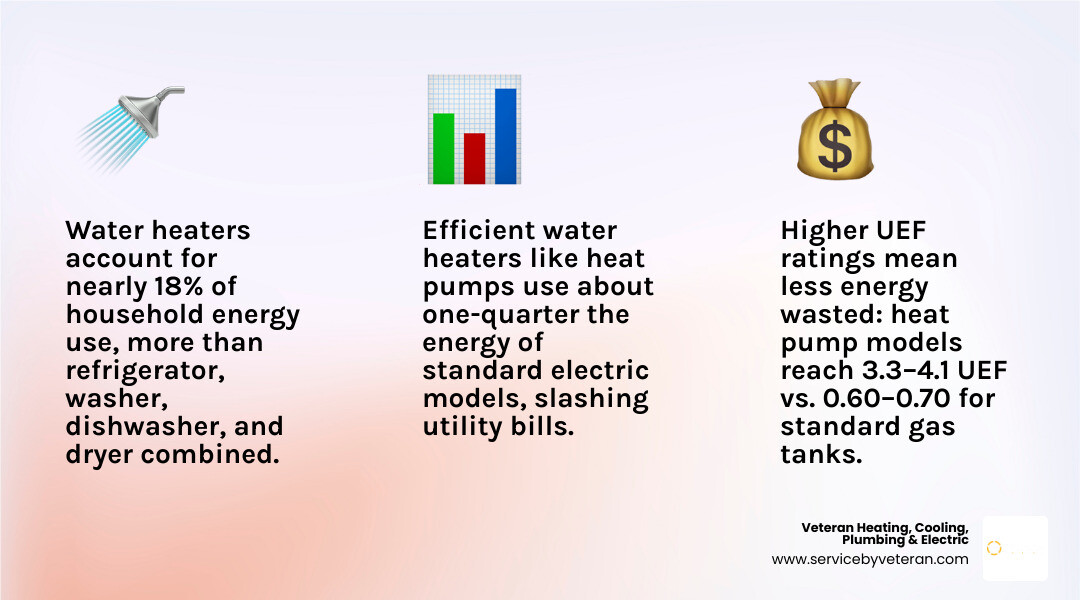
Water heater efficiency options explained comes down to understanding a few key factors: the type of water heater, its Uniform Energy Factor (UEF) rating, and how well it matches your household's hot water demand. Here's a quick breakdown:
• Standard gas storage tank — UEF Rating: 0.60–0.70 — Efficiency Level: Baseline
• Standard electric storage tank — UEF Rating: 0.90–0.95 — Efficiency Level: Moderate
• Tankless gas (condensing) — UEF Rating: 0.90–0.97 — Efficiency Level: Good
• Heat pump (hybrid) — UEF Rating: 3.3–4.1 — Efficiency Level: Excellent
• Solar thermal — UEF Rating: Varies — Efficiency Level: High (climate-dependent)
Higher UEF means less energy wasted. Heat pump water heaters are the clear efficiency leaders, using roughly one-quarter the energy of a standard electric model.
Your water heater is quietly one of the biggest energy consumers in your home — accounting for nearly 18% of your household's total energy use. That means it uses more energy than your refrigerator, clothes washer, dishwasher, and dryer combined. Yet most homeowners don't think about it until cold water starts coming out of the tap.
In April 2026, with energy costs continuing to climb and newer federal efficiency standards reshaping what's available on the market, understanding your water heater options has never mattered more. Whether you're replacing an aging unit or planning ahead, choosing the right efficient model can translate into hundreds of dollars saved every year — and thousands over the life of the appliance.
I'm Mike Townsend, a U.S. Army veteran and founder of Veteran Heating, Cooling, Plumbing & Electric, and my background — from managing precision cooling systems in the military to leading a full-service home systems company in the Denver Metro area — gives me a grounded, practical perspective on water heater efficiency options explained for real homeowners. In the sections ahead, I'll walk you through everything you need to make a confident, informed decision.
When we talk about efficiency in the Denver Metro area — from the historic homes in Golden to the newer builds in Centennial — we are looking at how much of the energy you pay for actually ends up heating your water versus being wasted.
Every new residential water heater is required by law to have a yellow EnergyGuide label. This label is your best friend when shopping. It displays the estimated yearly operating cost based on national average fuel prices and, most importantly, the Uniform Energy Factor (UEF).
Comparing UEF and EF Ratings in 2026
If you haven't shopped for a water heater since before 2017, you might remember "Energy Factor" (EF). The Department of Energy (DOE) replaced EF with the Uniform Energy Factor (UEF) to create a more consistent, "apples-to-apples" comparison.
The UEF system places water heaters into "usage bins" based on how much hot water they can provide. For example, a small household with low demand is in a different bin than a large family in Aurora with high demand. You should only compare UEF ratings between units in the same bin. Furthermore, manufacturers must now disclose both the "nominal capacity" (like 50 gallons) and the "actual storage capacity" (which might be 46 or 47 gallons), giving you a clearer picture of what you're actually buying.
Why Water Heater Efficiency Options Explained Matter for Your Utility Bills
In Colorado, heating water typically accounts for 12% to 18% of your total energy bill. It is usually the second-largest expense after space heating and cooling. Choosing a high-efficiency model isn't just about being "green"; it's about keeping more of your hard-earned money in your pocket.
An ENERGY STAR certified model meets strict efficiency guidelines. For a household of four, switching from a standard electric tank to an ENERGY STAR heat pump model can save approximately $600 per year. Over the lifetime of the unit, those savings can exceed $4,500. If you are ready to make the switch, our team specializes in Water Heater Installation Lakewood CO and throughout the surrounding areas to ensure your new system is set up for maximum savings.
Top Energy-Efficient Water Heater Types for Colorado Homes
In the Denver Metro area, we have several great options for high-efficiency water heating. Each has its own set of requirements and benefits.
• Upfront Cost — Storage Tank (Gas/Elec): Lower — Tankless (Demand): Moderate to High — Heat Pump (Hybrid): High
• Energy Savings — Storage Tank (Gas/Elec): Baseline — Tankless (Demand): 24%–34% higher — Heat Pump (Hybrid): 70%+ higher
• Lifespan — Storage Tank (Gas/Elec): 10–15 years — Tankless (Demand): 20+ years — Heat Pump (Hybrid): 10–15 years
• Space Needs — Storage Tank (Gas/Elec): Standard — Tankless (Demand): Minimal (Wall-mount) — Heat Pump (Hybrid): Large (Airflow needed)
Whether you are looking for a Tankless Water Heater Installation Complete Guide or want to explore hybrid options, understanding these types is the first step.
Heat Pump Water Heaters (HPWH)
These are the "super-efficient" options of 2026. Instead of generating heat through a flame or an electric resistance coil, they move heat from the surrounding air into the water — much like a refrigerator works in reverse.
Because they move heat rather than create it, they can achieve UEF ratings between 3.3 and 4.1. This makes them two to four times more efficient than conventional electric models. They do require about 700 cubic feet of air space to "breathe" and a way to drain the condensate water they produce. For homeowners in Centennial, we often recommend these for basements where there is plenty of room and ambient heat. Learn more about our Water Heater Installation Centennial CO services to see if this fits your home.
Tankless and Demand-Type Systems
Tankless water heaters only heat water when you turn on a hot water tap. This eliminates "standby loss" — the energy wasted keeping 50 gallons of water hot when no one is using it.
These systems are rated by Gallons Per Minute (GPM). A "condensing" tankless gas model is particularly efficient because it uses a second heat exchanger to capture heat from exhaust gases that would otherwise go out the vent. They are excellent for smaller homes or high-demand households that want "endless" hot water. If you're in the Aurora area, we can help you determine if this is the right fit with our Tankless Water Heater Aurora CO expertise.
How to Choose and Size Your Efficient Water Heater
Sizing is critical. If a unit is too small, you'll run out of hot water mid-shower. If it's too large, you're paying to heat water you don't need.
When sizing a tank-style heater, look at the First-Hour Rating (FHR). This tells you how many gallons of hot water the heater can supply in its first hour of operation starting with a full tank. For tankless heaters, you look at the GPM rating based on how many fixtures you might run at once (like a shower and a dishwasher).
Sizing for Denver Metro Households
A typical household of four usually needs a 40- to 50-gallon standard tank. However, if you are switching to a heat pump water heater, we often recommend upsizing to a 65- or 80-gallon tank. This allows the heat pump to do more of the work in its most efficient mode without relying as much on the "backup" electric heating elements during peak times.
In places like Arvada, where many homes have multiple bathrooms, getting the flow rate right for a tankless system is key. We provide a Best Water Heater Replacement Guide Denver CO to help you navigate these choices, or you can reach out for Water Heater Installation Arvada CO for a professional load calculation.
Installation and Maintenance for Long-Term Efficiency
An efficient water heater only stays efficient if it's installed and maintained correctly.
High-efficiency gas models often require "sealed combustion," meaning they pull air for the burner from outside the home through a PVC pipe. This is much safer because it prevents "backdrafting," where dangerous carbon monoxide could enter your living space.
Proper venting and drainage (for condensing and heat pump models) are non-negotiable for both safety and performance. If you're experiencing issues with an existing unit, our Water Heater Repair Lakewood CO team can diagnose if a repair or an efficiency upgrade is your best path forward.
Maintaining Your Water Heater Efficiency Options Explained
To keep your UEF rating as high as possible for the life of the unit, you must stay on top of maintenance:
1. Sediment Flushing: In the Denver area, minerals can settle at the bottom of a tank, creating a layer of "insulation" between the burner and the water. Flushing the tank annually keeps it heating efficiently.
2. Anode Rod Inspection: This rod "sacrifices" itself to prevent the tank from rusting. Checking it every 2-3 years can double the life of your tank.
3. Descaling Tankless Units: If you have hard water, tankless units need to be descaled annually to prevent mineral buildup on the heating elements.
4. Pressure Relief Valve: Test this once a year to ensure your tank stays within safe pressure limits.
For any of these tasks, professional Water Heater Repair services are the safest way to ensure the job is done right.
Frequently Asked Questions about Efficient Water Heaters
What is the most efficient water heater for a home in Aurora?
Heat pump water heaters (HPWH) are the efficiency leaders in 2026. They move heat rather than generating it, which allows them to use about one-quarter of the energy required by standard electric models. For gas users, a condensing tankless system is the most efficient alternative.
How long do high-efficiency water heaters last?
High-efficiency storage tanks (including heat pumps) typically last 10 to 15 years. Tankless models are much more durable, often lasting 20 years or more because they don't have a tank that can rust out.
Are there tax credits for upgrading my water heater in 2026?
Yes! Under current federal guidelines, many ENERGY STAR certified heat pump water heaters qualify for a tax credit of 30% of the project cost, up to $2,000. Additionally, local utilities like Xcel Energy often provide rebates for high-efficiency models. We recommend checking the ENERGY STAR rebate finder for the most current incentives in your specific zip code.
Conclusion
Choosing the right water heater is a major decision that impacts your home's comfort and your wallet for the next decade or more. By focusing on water heater efficiency options explained — specifically looking for high UEF ratings and ENERGY STAR certification — you can turn one of your home's biggest expenses into a source of long-term savings.
At Veteran Heating, Cooling, Plumbing & Electric, we bring military-grade integrity and over 30 years of experience to every home in the Denver Metro area. Whether you are in Littleton, Broomfield, or anywhere in between, we offer a lifetime warranty on parts and labor and a money-back guarantee to ensure you are 100% satisfied.
Don't wait for your old heater to flood your basement. Contact our expert plumbers for an efficiency upgrade today and start saving on your utility bills.
ABOUT Veteran Heating, Cooling, Plumbing & Electric
Veteran Heating, Cooling, Plumbing & Electric was founded on the belief that service should be personal, honest, and community-focused. Our team is built around integrity, professionalism, and a true commitment to your home’s comfort and safety.
Led by a U.S. Army veteran with over 30 years of industry experience, we’re proud to remain locally owned and operated. Every technician, plumber, and electrician is EPA-certified, background checked, and driven to exceed expectations.
- 24/7 ServiceWe offer weekend & 24/7 emergency service. We’re here whenever you need us—day, night, or weekend, no exceptions.
- $0 Trip FeesNo dispatch or trip fees. You’ll never pay just for us to show up—service starts when the work does.
OUR SERVICES
AIR CONDITIONING
.jpg)
We offer specialty and seasonal services like indoor air quality upgrades, pre-winter furnace checks, and summer AC tune-ups to keep your home prepared year-round.
Our Primary Air Conditioning Services Include:
Don't see the service you need? Call our Team today!
PLUMBING
From leaks to full system installs, our plumbing services cover everything you need for a safe, reliable home water system, 24/7.
Our Primary Plumbing Include:
- Water Heater Replacement
- Water Heater Repair
- Trenchless Sewer Line
- Water Filtration
- Slab Leak
- Sewer Line Repair
Don't see the service you need? Call our Team today!
ELECTRICAL

Our electrical services ensure your home stays safe and powered, from routine fixes to complete system upgrades.
Our Primary Electrical Services Include:
- House Rewiring
- Electrician
- Electric Panel Upgrade
- Electric Panel Replacement
- EV Chargers
- Whole House Generator
Don't see the service you need? Call our Team today!
HEATING
.jpg)
We install, repair, and maintain heating & furnace systems with expert care to keep your Colorado home comfortable and energy-efficient year-round.
Our Primary Heating Services Include:
- Heating Installation
- Heating Replacement
- Heating Maintenance
- Heating Repair
- Heating Service
- Heating Tune-Up
Don't see the service you need? Call our Team today!