Your Guide to On-Demand Hot Water in the Mile High City
Tankless water heater denver co systems are becoming an increasingly popular choice for homeowners looking to upgrade their aging tank models. Whether you're experiencing inconsistent hot water, high energy bills, or simply running out of hot water during peak usage times, a tankless system might be the solution you need.
Quick Answer: Key Factors for Denver Homeowners
• Energy Savings: Up to 30% reduction in electricity usage compared to traditional tanks
• Lifespan: 20 years with proper maintenance vs. 10-12 years for tank heaters
• Space: Wall-mounted design frees up valuable floor space
• Hot Water Supply: Continuous on-demand hot water without running out
• Denver Considerations: Cold groundwater temperatures require proper sizing; hard water may need regular descaling
Traditional tank water heaters store and constantly reheat 30 to 60 gallons of water, whether you need it or not. This leads to standby energy loss and eventual depletion during high-demand periods. Tankless systems heat water only when you turn on the tap, eliminating waste and providing an endless supply.
For Denver homes, the decision involves more than just efficiency. Our cold groundwater temperatures mean your tankless unit needs proper sizing to achieve the temperature rise you expect. Hard water conditions common in the area can also lead to mineral buildup if maintenance is neglected.
Many homeowners wonder if the higher upfront investment makes sense. The answer depends on your household's hot water usage patterns, your current system's age, and your long-term plans for your home. With proper installation and maintenance, tankless water heaters can deliver significant savings and reliability over their extended lifespan.
I'm Mike Townsend, and my experience managing precision cooling systems during my eight years in the U.S. Army taught me that proper installation and maintenance are everything. At Veteran Heating, Cooling, Plumbing & Electric, we help Denver homeowners evaluate whether a tankless water heater denver co system is the right fit for their specific needs and home conditions.
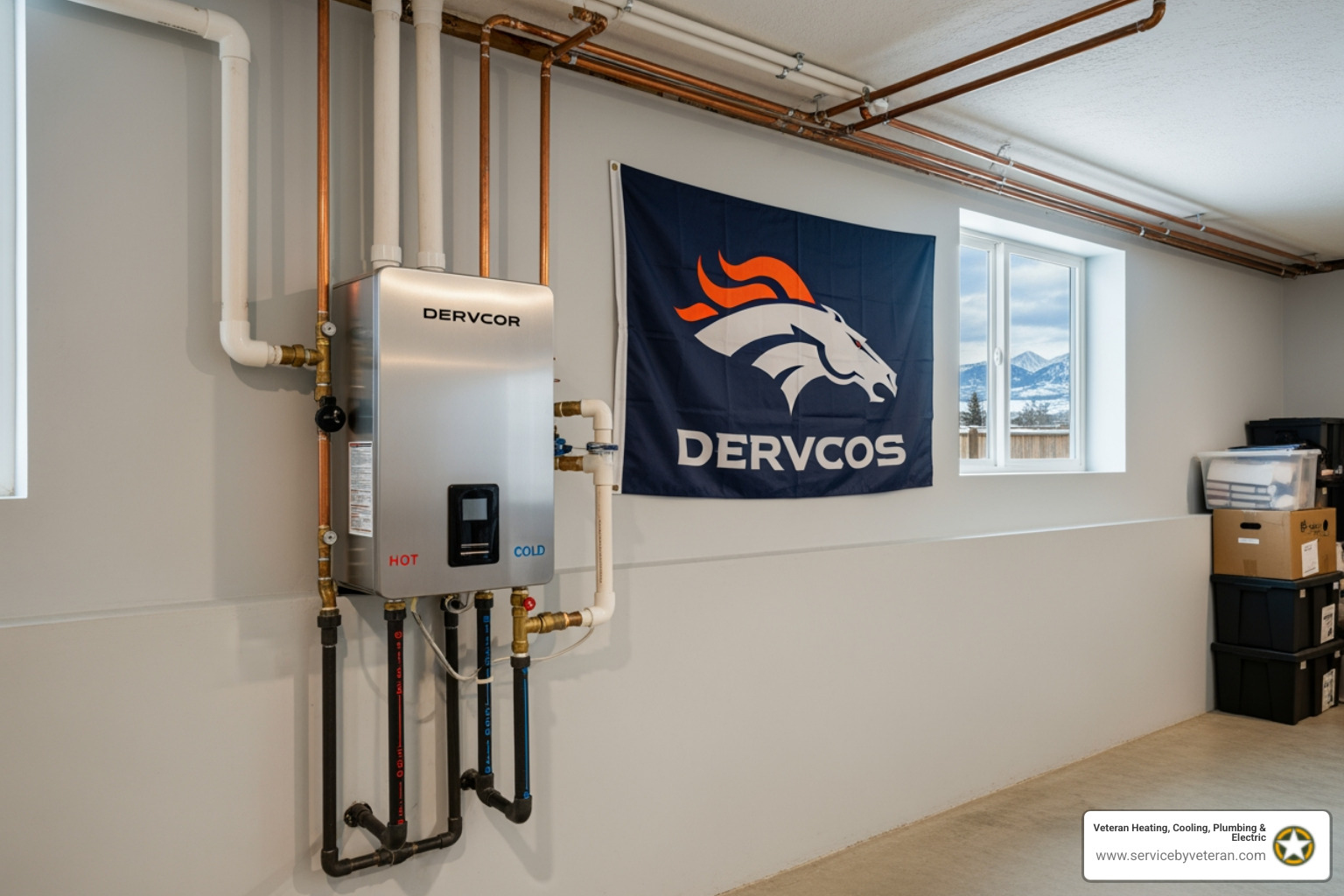
This infographic illustrates the key differences between traditional tank heaters and tankless systems, highlighting how on-demand heating can improve efficiency and comfort in Denver homes.
How Tankless Water Heaters Work vs. Traditional Tanks
Understanding the fundamental difference between tankless and traditional water heaters is the first step in deciding which is best for your Denver home. It's like comparing a made-to-order meal with a buffet - both get the job done, but one is prepared fresh when you need it, and the other keeps a large quantity warm just in case.
The On-Demand Difference
Imagine turning on your hot water tap and having hot water instantly, for as long as you need it. That's the magic of a tankless water heater. These ingenious devices, sometimes called on-demand or instant water heaters, rapidly heat water directly as it flows through them. There's no bulky storage tank. Instead, when you open a hot water faucet, cold water travels through a pipe into the unit. A flow sensor detects the demand, and a powerful heating element (either gas or electric) quickly heats the water as it passes through a heat exchanger.
This "on-demand" approach means several things for your home. Firstly, you get a continuous supply of hot water. No more running out of hot water halfway through a shower or while filling a large tub. Secondly, it's incredibly energy-efficient. Traditional tank heaters constantly keep a large volume of water hot, even when no one is home, leading to significant standby energy loss. Tankless units, however, only use energy when hot water is actually needed. This can lead to substantial energy savings, with some homeowners experiencing up to a 30% reduction in electricity usage. This efficiency also contributes to water conservation, as you're not waiting for water to heat up or wasting water that's been sitting in a tank. The heating stops the moment you turn off the tap, making it a smart choice for both your wallet and the environment.
Traditional Tank Heaters: The Old Standard
For decades, the traditional tank water heater has been the standard in most homes, including many here in Denver, Greenwood Village, and our surrounding communities. These units feature a large insulated tank, typically holding between 30 and 60 gallons of water, which is heated and stored until needed.
The main principle is simple: a heating element (gas burner or electric coils) warms the water inside the tank to a set temperature. Once the water reaches this temperature, the heater cycles on and off periodically to maintain it, regardless of whether anyone is using hot water. This constant reheating is the primary source of energy consumption for a traditional tank heater, accounting for almost a third of your home's energy use for hot water. It's like keeping a pot of water boiling on the stove all day, just in case you want a cup of tea.
While dependable, this system has its limitations. The hot water supply is finite; once the tank is depleted, you have to wait for it to refill and reheat, which can take a while. This often leads to frustrating cold showers if multiple family members use hot water consecutively. Furthermore, these large tanks take up considerable floor space, often relegated to basements or utility closets, which could be used for other purposes. The continuous heating also means they are less energy-efficient than their tankless counterparts, as they constantly combat heat loss through the tank walls.
Why Choose a Tankless Water Heater in Denver, CO?
When considering a water heater upgrade for your home in Denver or nearby areas like Arvada, Aurora, Broomfield, or Littleton, the benefits of a tankless system often stand out. We believe in providing solutions that improve your comfort, save you money, and contribute to a more sustainable home.
• Lifespan — Traditional Tank Water Heater: 10-12 years — Tankless Water Heater: Up to 20 years with proper maintenance
• Energy Efficiency — Traditional Tank Water Heater: Lower (constant reheating) — Tankless Water Heater: Higher (on-demand heating, up to 30% savings)
• Hot Water Supply — Traditional Tank Water Heater: Limited (can run out) — Tankless Water Heater: Continuous (endless hot water)
• Space — Traditional Tank Water Heater: Large, bulky tank — Tankless Water Heater: Compact, wall-mounted
• Maintenance — Traditional Tank Water Heater: Less frequent, but crucial — Tankless Water Heater: Annual descaling and filter checks
Key Advantages for Your Home
Making the switch to a tankless water heater offers a multitude of advantages that resonate with the modern homeowner.
• Endless Hot Water: This is often the most celebrated benefit. With a tankless system, you'll never again have to worry about running out of hot water, no matter how many showers are taken, dishes are washed, or loads of laundry are done simultaneously. The water is heated on demand, providing a continuous supply that truly transforms your daily routines.
• Reduced Utility Bills: Because tankless water heaters only heat water when you need it, they eliminate the energy waste associated with keeping a large tank of water constantly hot. This efficiency translates directly into savings on your monthly energy bills. Our research shows that tankless units can save as much as 30% on electricity and several hundred gallons of water annually. Imagine what those savings could mean for your household budget!
• Longevity Up to 20 Years: We love products that last, and tankless water heaters are built for the long haul. With proper maintenance, these units can last up to 20 years, almost double the lifespan of a traditional tank heater, which typically lasts 10-12 years. This extended lifespan means fewer replacements over time, offering excellent long-term value for your investment. For those in Highlands Ranch considering a long-term solution, a tankless water heater is a fantastic choice.
• Compact Size, More Space: Traditional water heater tanks are bulky and demand significant floor space. Tankless models are much smaller and can be mounted on a wall, freeing up valuable floor space in your utility closet, basement, or garage. This is a huge advantage for homes where space is at a premium, allowing you to reclaim areas for storage or other uses. If you're in Littleton and looking to optimize your home's layout, a tankless water heater could be the answer.
• Lower CO2 Emissions: Beyond personal savings, tankless water heaters are also an environmentally friendlier option. Their energy efficiency translates to lower CO2 emissions, reducing your home's carbon footprint. It's a fabulous way of supplying hot water to your home in a very eco-friendly way, preventing water and energy loss.
Special Considerations for a tankless water heater denver co
While the benefits are clear, we also want to ensure you're aware of specific considerations when choosing a tankless water heater denver co. Our unique climate and water conditions mean that a "one-size-fits-all" approach simply won't do.
• Denver's Cold Groundwater: One of the primary factors we consider for homes in Denver, Golden, and Castle Rock is the temperature of the incoming groundwater. In colder months, the water entering your home can be quite chilly. Tankless water heaters heat water to a specific temperature rise. Colder incoming water means the unit has to work harder to achieve your desired hot water temperature. This directly impacts the sizing of your unit; a larger or more powerful unit might be necessary to adequately heat the colder water, especially if you have high demand.
• Sizing for Temperature Rise and Demand: Proper sizing is crucial. If you typically use two or more hot water appliances simultaneously—say, someone is showering while the dishwasher is running—a single tankless unit might struggle to meet that demand if not sized correctly. If your household needs to use more than 6 GPM (gallons per minute) at any one time, we'll guide you on whether a single powerful unit, or even multiple smaller point-of-use (POU) units, would be the best solution for continuous hot water without sacrificing comfort. For homes in Arvada, ensuring proper sizing for a tankless water heater is key to maximizing its benefits.
• Hard Water Impact & Mineral Buildup: Denver and the surrounding areas often have hard water, meaning it contains higher levels of minerals like calcium and magnesium. While generally safe to drink, these minerals can accumulate inside your tankless water heater's heat exchanger over time, forming scale. This mineral buildup can reduce efficiency, restrict water flow, and ultimately shorten the lifespan of your unit if not addressed. Regular descaling and maintenance are essential to combat this, a topic we'll dig into further.
• Gas Line and Electrical Requirements: For gas tankless water heaters, you might need an upgrade to your existing gas line to accommodate the higher BTU (British Thermal Unit) input required by these powerful units. Similarly, electric tankless units require substantial electrical capacity, potentially necessitating an electrical panel upgrade. We'll assess your home's current infrastructure to determine any necessary modifications during our consultation.
Installation, Maintenance, and Lifespan
Choosing a tankless water heater is a significant investment in your home's comfort and efficiency. To truly open up its full potential and ensure its longevity, proper installation and consistent maintenance are non-negotiable.
Professional Installation of a tankless water heater denver co
Installing a tankless water heater denver co is not a DIY project. It's a complex task that requires specialized knowledge and adherence to local codes and safety standards. Our team of certified and experienced professionals ensures your installation is seamless and safe.
• Proper Sizing and Placement: As we discussed, sizing is critical, especially with Denver's cold groundwater. We'll perform a detailed assessment of your household's hot water demand, considering factors like the number of bathrooms, appliances, and peak usage times, to recommend the appropriately sized unit. We'll also help you determine the optimal installation location, whether it's indoors or outdoors, keeping in mind venting requirements and accessibility.
• Gas and Water Line Connections: For gas tankless units, proper gas line sizing and connections are paramount for both performance and safety. We ensure that the gas supply meets the unit's BTU requirements. Similarly, water line connections must be correctly installed to prevent leaks and ensure efficient water flow.
• Electrical Requirements: Even gas tankless units require an electrical connection to power their igniters and control boards. Electric tankless units, however, demand a much higher electrical load. We'll verify that your home's electrical system is adequately equipped and perform any necessary upgrades to ensure safe and reliable operation.
• Safety Codes and Venting: All installations must comply with local plumbing and building codes. This includes proper venting for gas units to safely expel combustion byproducts. Incorrect venting can pose serious health risks, which is why professional installation is so crucial. Our team is well-versed in all applicable codes for Denver, Centennial, and our service areas, ensuring your new tankless water heater is installed safely and legally.
• Expansion Tanks: With tankless water heaters, we often recommend installing an expansion tank. This manages pressure changes in your plumbing system, protecting your pipes and the water heater itself from potential damage due to thermal expansion.
Extending the Life of Your Unit
One of the significant advantages of tankless water heaters is their impressive lifespan - up to 20 years with proper care. To achieve this longevity and maintain peak efficiency, regular maintenance is key. Think of it like taking care of your car; routine check-ups prevent major breakdowns.
• Annual Flushing and Descaling: This is arguably the most critical maintenance task, especially in areas with hard water like Denver, Broomfield, and Aurora. Mineral buildup (scale) can accumulate in the heat exchanger, reducing efficiency and potentially causing damage. We recommend an annual professional flushing and descaling service to remove these mineral deposits. This process involves circulating a descaling solution through the unit, cleaning out any calcification.
• Filter Checks and Cleaning: Many tankless units have an inlet water filter that prevents sediment from entering the system. Regularly checking and cleaning this filter ensures optimal water flow and prevents blockages.
• Professional Tune-Ups: Beyond flushing, a professional tune-up involves inspecting various components: the heat exchanger for wear and tear, the ignition system, the venting system for blockages, and checking for any gas or water leaks. These comprehensive checks help identify potential issues before they become costly repairs. For homeowners in Broomfield, ensuring your tankless water heater receives regular professional attention will ensure it continues to operate efficiently for years to come.
• Lifespan Comparison: While traditional tank heaters typically last 10-12 years, a well-maintained tankless unit can last up to 20 years. This nearly doubles the operational life, providing greater return on your initial investment and reducing the frequency of costly replacements. Our lifetime warranty on parts and labor further reinforces our commitment to the longevity and performance of your system. For those in Golden, opting for a tankless water heater with diligent maintenance is a smart financial move.
Is It Time to Upgrade Your Water Heater?
Sometimes, the decision to switch to a tankless water heater is prompted by the undeniable signs that your current unit is on its last legs. Ignoring these warnings can lead to inconvenience, costly repairs, or even water damage.
Signs Your Current Water Heater is Failing
If your current water heater is exhibiting any of these symptoms, it might be time to consider an upgrade to a more reliable and efficient tankless system:
• Age of the Unit: Traditional tank water heaters generally last 10-12 years. If your unit is approaching or has exceeded this age, its efficiency is likely declining, and the risk of failure increases significantly. It's often more cost-effective to replace an aging unit proactively rather than waiting for it to break down completely.
• Inconsistent or Lack of Hot Water: Are you experiencing lukewarm showers, or does the hot water run out much faster than it used to? This is a clear sign that your traditional tank heater is struggling to keep up with demand or that its heating elements are failing. A tankless system, with its continuous hot water supply, would solve this problem immediately.
• Leaks or Rust: Any visible signs of water pooling around the base of your tank, or rust on the tank itself or in your hot water, are serious red flags. Leaks indicate a compromised tank, which can lead to significant water damage and means the unit is at risk of catastrophic failure. Rust in your hot water can also indicate internal corrosion.
• Strange Noises: Rumbling, popping, or banging noises coming from your water heater often indicate sediment buildup inside the tank. This sediment not only reduces efficiency but can also damage the tank's lining, leading to premature failure.
• Rising Energy Bills: If you've noticed an unexplained increase in your energy bills, especially those related to heating, your old water heater could be the culprit. As units age, they become less efficient, working harder and consuming more energy to heat water.
• Discolored Water: Rusty or discolored hot water coming from your taps is a strong indicator of internal corrosion within your water heater tank. This means the tank's protective lining has likely deteriorated, and replacement is imminent.
For homeowners in Greenwood Village, if your existing water heater is showing these signs, it's a good time to explore the benefits of a tankless water heater with our expert team. Don't wait for a complete breakdown; proactive replacement can save you stress, money, and potential water damage.
Make the Right Choice for Your Denver Home
Deciding on the right water heater for your home in Denver, Aurora, Columbine, or Lakewood is a decision that impacts your daily comfort, monthly expenses, and long-term peace of mind. We've explored how tankless water heaters work, their significant advantages, and the specific considerations for our Colorado climate and water conditions. From endless hot water and considerable energy savings to a longer lifespan and space-saving design, the benefits of a tankless system are compelling.
At Veteran Heating, Cooling, Plumbing & Electric, we pride ourselves on being your trusted, veteran-led, locally owned home services company. We understand that making an informed decision is paramount, and we're here to provide the expert advice and reliable service you deserve. Our commitment to personal, honest, and community-focused service means we'll help you assess your unique hot water needs, evaluate your existing home infrastructure, and determine if a tankless water heater denver co is the ideal solution for you. We stand by our work with a lifetime warranty on parts and labor and a money-back guarantee, ensuring your complete satisfaction.
Don't let an old, inefficient water heater dictate your comfort or inflate your utility bills. Take the first step towards a more efficient, comfortable, and sustainable home.
Ready to explore the long-term value and comfort a tankless water heater can bring to your Denver home? Connect with us today to discuss your options and find how we can help you make the right choice. tankless water heater denver co
ABOUT Veteran Heating, Cooling, Plumbing & Electric
Veteran Heating, Cooling, Plumbing & Electric was founded on the belief that service should be personal, honest, and community-focused. Our team is built around integrity, professionalism, and a true commitment to your home’s comfort and safety.
Led by a U.S. Army veteran with over 30 years of industry experience, we’re proud to remain locally owned and operated. Every technician, plumber, and electrician is EPA-certified, background checked, and driven to exceed expectations.
- 24/7 ServiceWe offer weekend & 24/7 emergency service. We’re here whenever you need us—day, night, or weekend, no exceptions.
- $0 Trip FeesNo dispatch or trip fees. You’ll never pay just for us to show up—service starts when the work does.
OUR SERVICES
AIR CONDITIONING
.jpg)
We offer specialty and seasonal services like indoor air quality upgrades, pre-winter furnace checks, and summer AC tune-ups to keep your home prepared year-round.
Our Primary Air Conditioning Services Include:
Don't see the service you need? Call our Team today!
PLUMBING
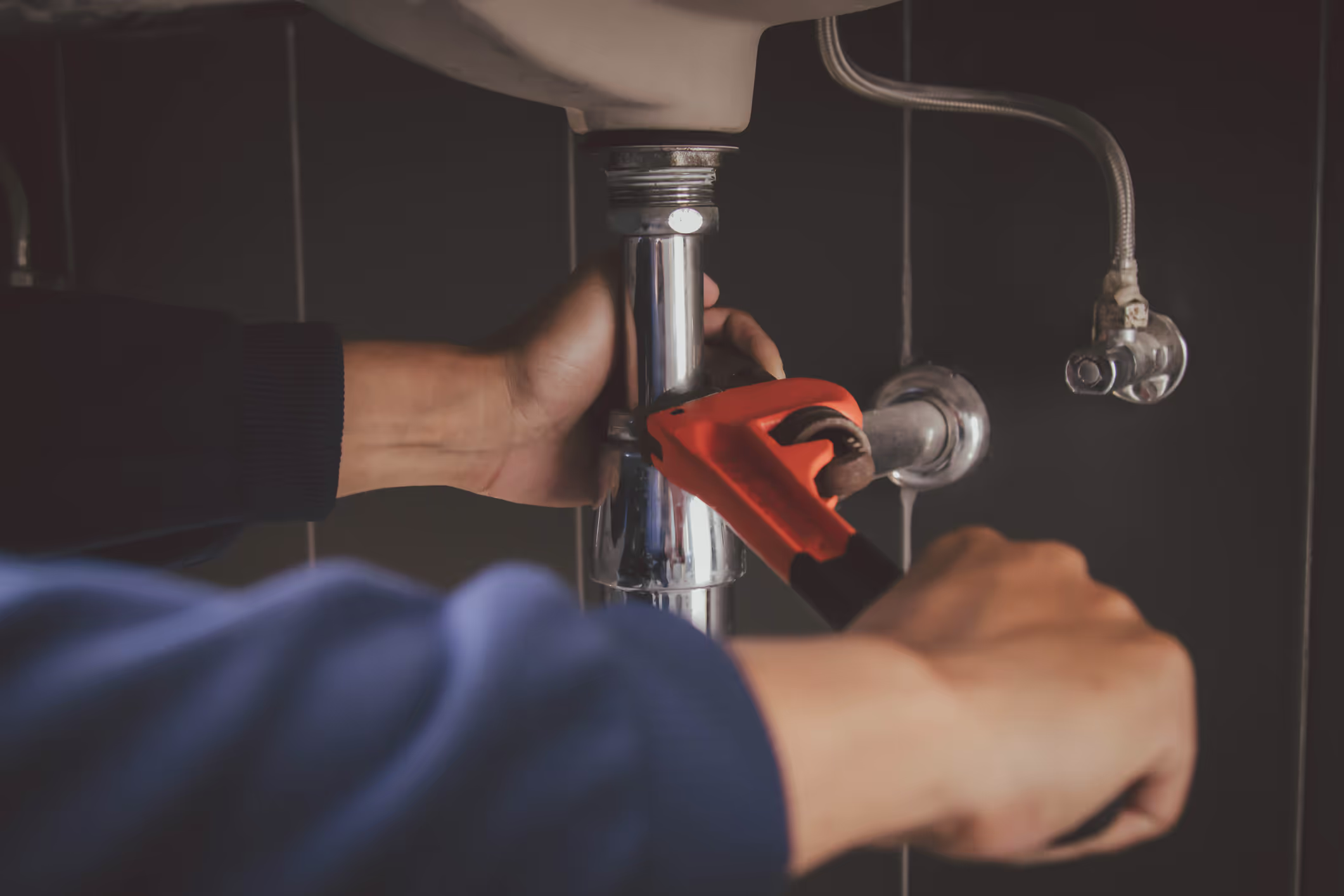
From leaks to full system installs, our plumbing services cover everything you need for a safe, reliable home water system, 24/7.
Our Primary Plumbing Include:
- Water Heater Replacement
- Water Heater Repair
- Trenchless Sewer Line
- Water Filtration
- Slab Leak
- Sewer Line Repair
Don't see the service you need? Call our Team today!
ELECTRICAL

Our electrical services ensure your home stays safe and powered, from routine fixes to complete system upgrades.
Our Primary Electrical Services Include:
- House Rewiring
- Electrician
- Electric Panel Upgrade
- Electric Panel Replacement
- EV Chargers
- Whole House Generator
Don't see the service you need? Call our Team today!
HEATING
.jpg)
We install, repair, and maintain heating & furnace systems with expert care to keep your Colorado home comfortable and energy-efficient year-round.
Our Primary Heating Services Include:
- Heating Installation
- Heating Replacement
- Heating Maintenance
- Heating Repair
- Heating Service
- Heating Tune-Up
Don't see the service you need? Call our Team today!