Your Guide to Water Heaters in the Mile High City
Water heater installation in Denver, CO requires careful consideration of local conditions, from high altitude performance to cold groundwater temperatures. Whether you're replacing a failing unit or upgrading to a more efficient model, professional installation ensures safety, code compliance, and reliable hot water for years to come.
Quick Overview: What You Need to Know
• Average Lifespan: 10-15 years for tank models, longer for tankless
• Installation Time: 2-4 hours for standard replacements
• Permit Required: Yes, in most Denver-area municipalities
• Professional vs. DIY: Professional installation ensures safety, warranty protection, and code compliance
• Types Available: Traditional tank, tankless, gas, electric, and hybrid models
For expert guidance on all your plumbing needs, visit our comprehensive plumbing services page, or schedule your water heater installation consultation today.
Denver homeowners face unique challenges when it comes to water heating. Our high altitude affects appliance performance, cold groundwater temperatures increase heating demands, and local building codes require specific safety measures like expansion tanks and proper venting. Choosing the wrong size, type, or installer can lead to insufficient hot water, higher energy consumption, premature equipment failure, or even dangerous situations involving gas leaks or carbon monoxide.
A properly installed water heater provides consistent hot water for showers, laundry, dishes, and all your daily needs. Modern energy-efficient models can significantly reduce energy consumption while ensuring your family never runs out of hot water at the worst possible moment. Professional installation also protects your investment through proper warranty coverage and ensures your system meets all local safety requirements.
I'm Mike Townsend, and my background includes eight years in the U.S. Army managing precision cooling systems, which taught me the importance of technical accuracy and attention to detail in every installation. Today, I lead our veteran-owned company in providing reliable water heater installation in Denver, CO, bringing that same military precision to every home we serve.
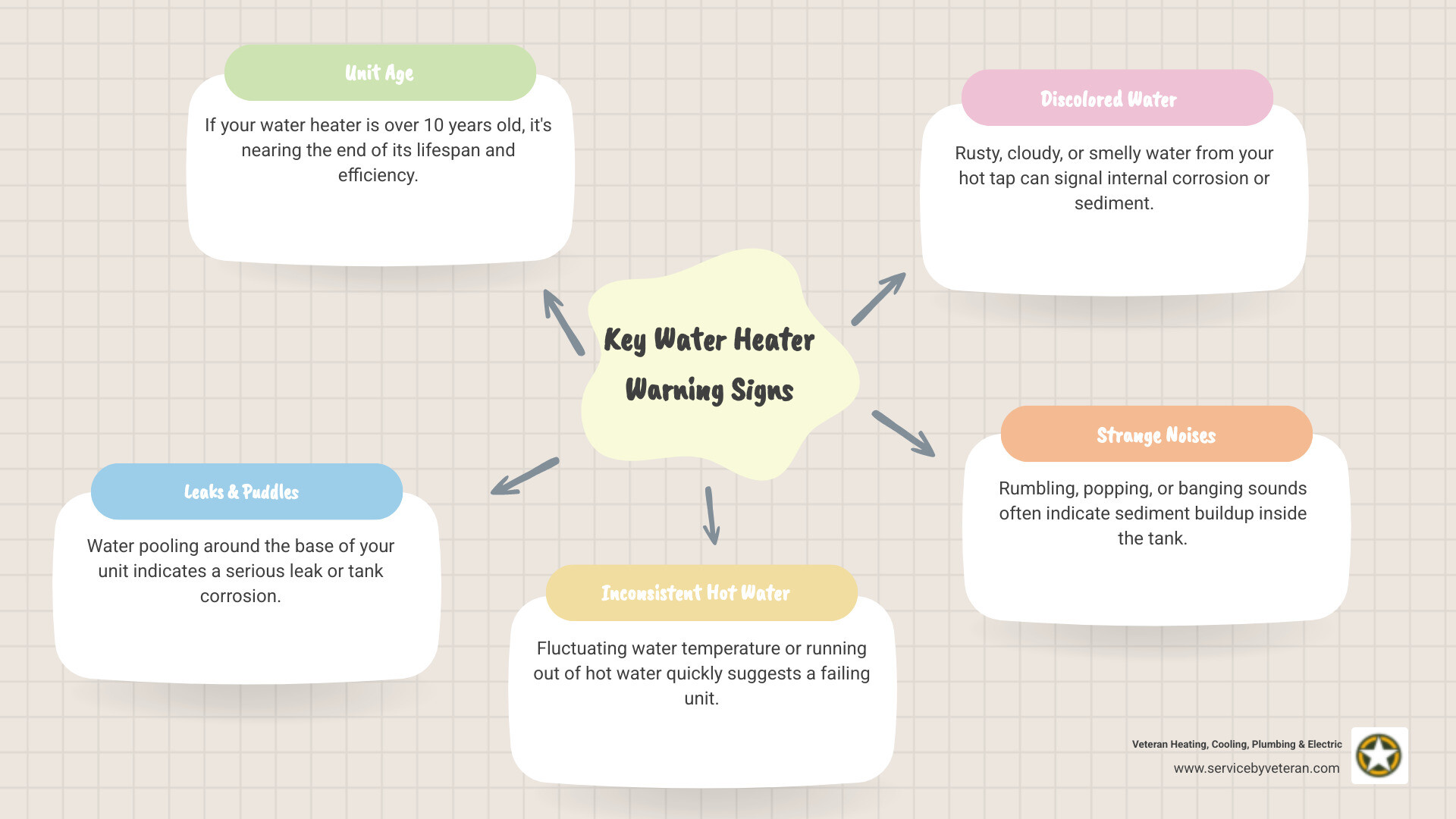
Is It Time for a New Water Heater? Key Warning Signs
Nobody wants to find themselves in a cold shower, especially on a chilly Denver morning. Your water heater works hard behind the scenes, but like any appliance, it gives off signals when it's nearing the end of its service. Paying attention to these signs can help you avoid an emergency and plan for a timely water heater installation in Denver, CO.
Here are the key warning signs that your current water heater might need repair or replacement:
• Leaks and puddles: This is often the most obvious and urgent sign. If you notice water around the base of your water heater, it could indicate a leak in the tank. Older homes, common in many Denver neighborhoods, are particularly susceptible to leaks related to aging water heaters. While some minor leaks might be repairable, a leaking tank often signals the need for replacement.
• Inconsistent water temperature: Are your showers starting hot and ending cold? Or is the water lukewarm at best? This could point to issues with the heating elements, thermostat, or sediment buildup inside the tank, preventing efficient heat transfer.
• Discolored or smelly water: Rusty or discolored hot water coming from your taps often indicates corrosion inside your water heater's tank. Unpleasant smells, like rotten eggs, can suggest bacterial growth within the tank, a common issue that requires professional attention.
• Strange noises: Rattling, rumbling, or clanging sounds coming from your water heater are typically caused by sediment buildup at the bottom of the tank. As water heats, these mineral deposits harden and cause noise. This buildup reduces efficiency and can damage the tank over time.
• Unit age over 10 years: The projected average life of a home water heater is about 10 years, though some can last up to 15 years. If your unit is approaching or past this age and you're experiencing any of the other symptoms, replacement is often the most practical long-term solution.
• Increased energy use: A water heater that's struggling to do its job will consume more energy. If you notice an unexplained increase in your energy consumption, your water heater's efficiency might be declining.
• Frequent repairs: If your water heater constantly needs repairs, it's likely on its last legs. While minor repairs are sometimes possible, needing multiple repairs within a short period, especially if the unit is old, suggests that replacing it would be a more reliable solution for the long run.
Our expert technicians are skilled in diagnosing these issues and can provide clear recommendations on whether repair or a new water heater installation in Denver, CO, is the best path forward for your home.
Common Issues Requiring Professional Attention
While some issues might seem minor, many water heater problems require the expertise of a professional plumber to ensure safety and proper function. Our team is equipped to handle a wide range of common water heater issues that homeowners in Denver and surrounding areas like Lakewood, Arvada, and Littleton face:
• Sediment buildup: As mentioned, mineral deposits accumulate at the bottom of the tank. This not only causes noise but also acts as an insulator, making the water heater work harder and less efficiently. Professional flushing can help, but severe buildup may warrant replacement.
• Faulty heating elements: For electric water heaters, a broken heating element means no hot water. This requires replacement of the element, a task best left to trained professionals due to electrical safety concerns.
• Thermostat problems: An inaccurate or malfunctioning thermostat can lead to water that's either too hot or not hot enough. Maintaining the correct temperature, ideally not exceeding 125°F to prevent scalding, is crucial.
• Pressure relief valve issues: The temperature and pressure (T&P) relief valve is a critical safety device that prevents the water heater from exploding due to excessive pressure or temperature. If it's leaking or not functioning correctly, it needs immediate professional attention.
• Anode rod corrosion: The anode rod is a sacrificial metal rod inside the tank designed to corrode before the tank itself. When it's fully consumed, the tank becomes vulnerable to rust. Regular inspection and replacement of the anode rod can significantly extend your water heater's life.
• Gas line problems: For gas water heaters, any issue with the gas line or burner assembly is a serious safety concern, potentially leading to gas leaks or carbon monoxide poisoning. These problems absolutely require a licensed professional for diagnosis and repair.
Addressing these issues promptly with professional help ensures your water heater operates safely and efficiently.
Choosing the Right Water Heater for Your Denver Home
Selecting the ideal water heater for your home in Denver, CO, involves more than just picking the first model you see. It's about finding the perfect balance between your household's needs, energy efficiency goals, and the specific demands of our local climate. Our experts will guide you through the process, considering:
• Household size: The number of people in your home directly impacts your hot water demand. A single person's needs differ greatly from a large family's.
• Hot water usage habits: Do you often run the dishwasher, washing machine, and take showers simultaneously? Do you have a hot tub? Your peak hot water demand will influence the type and size of unit you need.
• Fuel type availability: Do you have natural gas lines available, or is electric your only option? This often plays a significant role in the initial decision.
• Energy efficiency goals: Are you looking to minimize your carbon footprint and reduce energy use? Modern energy-efficient models offer substantial long-term benefits.
Tank vs. Tankless: Which is Best for You?
The choice between traditional tank and tankless water heaters is one of the most significant decisions for your water heater installation in Denver, CO. Each offers distinct advantages, and our team can help you weigh them against your specific circumstances.
• Hot Water Supply — Traditional Tank Water Heaters: Stores and heats a fixed volume of water — Tankless Water Heaters: Heats water on-demand as it flows through the unit
• Availability — Traditional Tank Water Heaters: Ready supply until tank is depleted — Tankless Water Heaters: Endless hot water, as long as it's needed
• Energy Efficiency — Traditional Tank Water Heaters: Heats water continuously, even when not in use — Tankless Water Heaters: Heats only when hot water is requested, saving energy
• Lifespan — Traditional Tank Water Heaters: Average 10-15 years — Tankless Water Heaters: Average 20+ years
• Space Required — Traditional Tank Water Heaters: Large, cylindrical tank — Tankless Water Heaters: Compact, wall-mounted unit
• Installation — Traditional Tank Water Heaters: Generally simpler — Tankless Water Heaters: More complex, may require gas line or electrical upgrades
• Water Heating — Traditional Tank Water Heaters: Water heating technology has evolved for both types.
Traditional Tank Water Heaters store gallons of water, keeping it heated and ready for use. They are generally easier to install, making them a popular choice for many Denver homes. However, once the stored hot water is depleted, you'll need to wait for the tank to refill and reheat.
Tankless Water Heaters, on the other hand, provide on-demand hot water. This means they only heat water when you turn on a hot water tap, leading to significant energy savings over time. While the installation can be more complex (often requiring gas line or electrical upgrades), their longer lifespan and continuous hot water supply make them an attractive option for many homeowners seeking a modern, efficient solution.
Gas vs. Electric Water Heaters
Another critical decision for your water heater installation in Denver, CO, is the fuel source. The choice between gas and electric water heaters depends heavily on factors such as fuel availability and installation requirements.
• Operating efficiency: While both types have become more efficient, their performance can vary. Gas water heaters often heat water faster than electric models.
• Local utility availability: The availability of natural gas versus electricity in your specific Denver neighborhood will impact your options. Our team can help you understand the performance differences between the two fuel types in your area.
• Installation requirements: Gas water heaters require a gas line and proper venting to safely expel combustion byproducts. Electric water heaters need dedicated high-voltage electrical circuits. If your home in Arvada, Aurora, or Lakewood doesn't have the necessary connections, upgrading them will add to the installation complexity.
• Venting needs: Gas water heaters produce exhaust gases that must be vented outside, often requiring a chimney or power vent system. Electric units do not require venting, which can simplify installation in some spaces.
• Denver climate considerations: Given Denver's cold climate, both types need to be robust enough to handle cold incoming groundwater. Natural gas may offer quicker recovery rates, which can be beneficial during periods of high demand.
Sizing and Other Factors for Your Water Heater Installation in Denver, CO
Proper sizing is paramount for a successful water heater installation. An undersized unit will leave you with cold water, while an oversized one will waste energy. Our technicians consider several factors specific to Denver homes:
• First Hour Rating (FHR): For tank water heaters, the FHR indicates how many gallons of hot water the unit can deliver in the first hour of use, accounting for the tank's capacity and recovery rate. This is crucial for matching the unit to your household's peak demand.
• Gallon capacity: Traditional tank-style water heaters commonly range from 20- to 80-gallon tanks, with 40-gallon units being a very common choice for many households.
• Flow rate (GPM): For tankless water heaters, we focus on the gallons per minute (GPM) rating, which indicates how much hot water the unit can produce continuously. This needs to match the combined GPM of all hot water fixtures you might use simultaneously.
• Denver's cold groundwater: Our region's cold incoming groundwater means water heaters have to work harder to raise the temperature to your desired setting. We account for this "temperature rise" when recommending unit sizes.
• High altitude performance: The higher altitude in Denver and surrounding areas like Castle Rock and Highlands Ranch can affect the performance of gas-fired appliances. Our team ensures the chosen unit is properly configured and installed to operate efficiently at our elevation.
• High-Quality Brands: We install high-quality water heaters from trusted brands known for their reliability and performance in various conditions.
Energy-Efficient Models
Investing in an energy-efficient water heater for your water heater installation in Denver, CO, can reduce your energy consumption and environmental impact. We can help you explore:
• ENERGY STAR® certified models: These units meet strict energy efficiency guidelines set by the EPA and Department of Energy.
• Heat pump (hybrid) water heaters: These innovative units use heat pump technology to extract heat from the surrounding air to warm the water, making them significantly more efficient than conventional electric models.
• High-efficiency gas units: Modern gas water heaters, especially condensing models, achieve much higher efficiency ratings than older conventional units, leading to lower energy use.
• Reduced Energy Consumption: Choosing an energy-efficient model means you are opting for a system designed for lower energy consumption throughout its lifespan.
The Professional Water Heater Installation Process in Denver, CO
When it comes to water heater installation in Denver, CO, choosing professionals like us ensures not just hot water, but also safety, code compliance, and system longevity. We believe in getting the job done right the first time, every time.
What to Expect During Your Installation
Our comprehensive approach to water heater installation in Denver, CO, means you'll know exactly what to expect from start to finish:
1. Initial consultation: We begin with a thorough assessment of your current system, hot water needs, and home's specific requirements. We'll discuss options, answer your questions, and help you choose the best water heater for your situation.
2. Old unit disconnection and removal: Our team will safely disconnect your old water heater, drain it completely, and responsibly remove it from your property for proper disposal.
3. Site preparation: We prepare the installation site, ensuring proper clearances, ventilation (for gas units), and any necessary upgrades to water lines, gas lines, or electrical connections.
4. New unit placement and connection: Your new water heater will be carefully positioned and expertly connected to your home's water supply, gas line (if applicable), and electrical system. This includes installing crucial components like expansion tanks and drip pans as required by local codes.
5. System testing and verification: Once installed, we thoroughly test the new unit to ensure it's operating correctly, efficiently, and safely. This includes checking for leaks, proper water temperature, and verifying all safety mechanisms are functioning.
6. Homeowner walkthrough: Before we leave, we'll walk you through the operation of your new water heater, explain any unique features, and provide essential maintenance tips to help you maximize its performance and lifespan.
Denver Permits and Regulations
Water heater installation in Denver, CO, and its surrounding communities like Greenwood Village, Centennial, and Golden, is not just a matter of swapping out an old unit for a new one. It involves adhering to specific local building codes and regulations designed to ensure safety and proper function.
• Local building codes: These codes dictate various aspects of the installation, including sizing, venting, pressure relief, and proper connections. Our technicians are well-versed in the specific requirements for each of the communities we serve.
• Permit requirements: In most cities and towns across the Denver metro area, a permit is typically required for water heater installations. We handle the permit acquisition process for you, ensuring all necessary paperwork is filed correctly to avoid delays or compliance issues.
• Safety inspections: After installation, a city inspector may conduct a safety inspection to verify that the installation complies with all local codes. We ensure our work passes these inspections with flying colors.
• Carbon monoxide safety: For gas water heaters, proper venting is paramount to prevent the buildup of carbon monoxide, a colorless, odorless, and highly toxic gas. We ensure all gas units are correctly vented.
• Expansion tanks: Many Denver-area codes require the installation of an expansion tank, which absorbs excess pressure from the heating water, protecting your plumbing system and water heater from damage.
• CDLE safety standards: We adhere to all relevant CDLE safety standards to ensure every installation is performed safely for both our team and your home.
Why Professional Water Heater Installation in Denver, CO is Essential
While some homeowners might consider a DIY approach, the complexities and potential dangers of water heater installation make professional service not just beneficial, but essential.
• DIY risks: Attempting a water heater installation in Denver, CO, without the necessary expertise can lead to serious hazards, including gas leaks, electrical shocks, water damage, and even explosions. Improper installation can also void your unit's warranty.
• Gas and electrical safety: Working with gas lines and high-voltage electrical circuits demands specialized knowledge and tools. Professionals ensure all connections are secure, leak-free, and up to code, preventing dangerous situations.
• Proper venting: For gas water heaters, correct venting is crucial to safely remove combustion byproducts like carbon monoxide. Incorrect venting can lead to toxic gas buildup in your home.
• Water damage prevention: Improperly connected water lines can lead to leaks and significant water damage. Our plumbers ensure all plumbing connections are tight and secure.
• Maximizing efficiency: A professionally installed water heater operates at peak efficiency, providing consistent hot water while minimizing energy consumption. Incorrect installation can drastically reduce efficiency and lead to higher energy use.
• Warranty protection: Most manufacturers' warranties require professional installation to remain valid. DIY installation or installation by an unlicensed individual can void your warranty, leaving you without coverage for future repairs.
Our team has decades of combined experience, and we are committed to providing safe, reliable, and code-compliant water heater installation in Denver, CO, for every home we serve.
Maximizing Your Water Heater's Performance and Lifespan
Once your new water heater is professionally installed, the journey to reliable hot water doesn't end there. Proactive care is key to preventing breakdowns, ensuring efficiency, and extending the life of your unit.
The Importance of Regular Maintenance
Regular maintenance is crucial for keeping your water heater running smoothly and efficiently for years to come. Just like changing the oil in your car, a little preventive care goes a long way. Our maintenance services for water heater installation in Denver, CO, include:
• Flushing the tank: Annually flushing the tank removes sediment buildup, which improves efficiency, reduces noise, and prevents corrosion. This is a critical step in extending the unit's lifespan.
• Checking the anode rod: This "sacrificial" rod attracts corrosive elements in the water, protecting the tank lining. We inspect its condition and recommend replacement if it's significantly corroded, typically every 3-5 years.
• Testing the T&P valve: The temperature and pressure relief valve is a vital safety device. We test it to ensure it's functioning properly, preventing dangerous pressure buildup.
• Inspecting for leaks: We carefully check all connections, pipes, and the tank itself for any signs of leaks, catching potential problems before they become major issues.
• Extending unit lifespan: Regular maintenance can help your water heater last closer to the upper end of its projected 10-15 year lifespan, helping you avoid premature replacement.
Understanding Your Warranty and Guarantees
When you invest in a new water heater installation in Denver, CO, understanding the warranty and guarantees offered is crucial for your peace of mind.
• Manufacturer warranty: This covers defects in the water heater unit itself, typically for a period of 6 to 12 years, depending on the model and brand.
• Labor warranty: This covers the quality of the installation work performed by our technicians. We stand behind our craftsmanship.
• Parts coverage: Beyond the unit itself, individual components like heating elements or thermostats may have separate parts warranties.
• Peace of mind: A comprehensive warranty package ensures that if any issues arise, you're covered for repairs and replacements.
• Lifetime warranty benefits: As a veteran-led, locally owned company, we offer a lifetime warranty on parts and labor for many of our services, along with a money-back guarantee. This commitment to quality and customer satisfaction provides unparalleled peace of mind for your water heater installation in Denver, CO.
Your Partner for Reliable Hot Water in Denver
At Veteran Heating, Cooling, Plumbing & Electric, we're more than just service providers; we're your neighbors, committed to ensuring your home in Denver, Arvada, Aurora, Broomfield, Centennial, or Littleton has reliable hot water. Our expert guidance, quality workmanship, and community-focused service mean you can trust us with your home comfort.
We understand the unique demands of our Mile High City climate and are dedicated to providing personalized, honest solutions for every water heater installation in Denver, CO. From helping you choose the right type and size to ensuring a safe, code-compliant installation and offering robust warranties, we're with you every step of the way.
Experience the difference that military precision and local commitment can make.
Contact us for your water heater installation in Denver, CO today!
ABOUT Veteran Heating, Cooling, Plumbing & Electric
Veteran Heating, Cooling, Plumbing & Electric was founded on the belief that service should be personal, honest, and community-focused. Our team is built around integrity, professionalism, and a true commitment to your home’s comfort and safety.
Led by a U.S. Army veteran with over 30 years of industry experience, we’re proud to remain locally owned and operated. Every technician, plumber, and electrician is EPA-certified, background checked, and driven to exceed expectations.
- 24/7 ServiceWe offer weekend & 24/7 emergency service. We’re here whenever you need us—day, night, or weekend, no exceptions.
- $0 Trip FeesNo dispatch or trip fees. You’ll never pay just for us to show up—service starts when the work does.
OUR SERVICES
AIR CONDITIONING
.jpg)
We offer specialty and seasonal services like indoor air quality upgrades, pre-winter furnace checks, and summer AC tune-ups to keep your home prepared year-round.
Our Primary Air Conditioning Services Include:
Don't see the service you need? Call our Team today!
PLUMBING
From leaks to full system installs, our plumbing services cover everything you need for a safe, reliable home water system, 24/7.
Our Primary Plumbing Include:
- Water Heater Replacement
- Water Heater Repair
- Trenchless Sewer Line
- Water Filtration
- Slab Leak
- Sewer Line Repair
Don't see the service you need? Call our Team today!
ELECTRICAL

Our electrical services ensure your home stays safe and powered, from routine fixes to complete system upgrades.
Our Primary Electrical Services Include:
- House Rewiring
- Electrician
- Electric Panel Upgrade
- Electric Panel Replacement
- EV Chargers
- Whole House Generator
Don't see the service you need? Call our Team today!
HEATING
.jpg)
We install, repair, and maintain heating & furnace systems with expert care to keep your Colorado home comfortable and energy-efficient year-round.
Our Primary Heating Services Include:
- Heating Installation
- Heating Replacement
- Heating Maintenance
- Heating Repair
- Heating Service
- Heating Tune-Up
Don't see the service you need? Call our Team today!