Your Guide to Hot Water in the Mile High City
Water heater replacement in denver, co is one of those home projects most people don't think about until they're standing in a cold shower or noticing a puddle forming around their basement tank. Whether your current unit is showing its age, costing too much to run, or simply not keeping up with your family's hot water needs, understanding your options makes the replacement process much less stressful.
If you're searching for water heater replacement services in Denver, here's what you need to know:
• Average lifespan: Most water heaters last 10-15 years before needing replacement
• Common signs of failure: Inconsistent temperatures, rusty water, strange noises, leaks, or rising energy bills
• Your main options: Traditional tank (most common, 40-80 gallons), tankless (on-demand, energy-efficient), or hybrid electric (combines both technologies)
• Typical installation time: 2-4 hours for standard replacements
• Professional installation: Required for safety, code compliance, and warranty protection
• Cost factors: Type of unit, fuel source (gas vs. electric), size, labor, and any additional components like expansion tanks or upgraded venting
For comprehensive plumbing services beyond water heaters, explore our full range of plumbing solutions, or if you're ready to move forward, schedule your water heater replacement consultation today.
Denver's unique climate—with freezing winters and mineral-rich water—puts extra demands on your water heater. A properly sized and professionally installed unit not only ensures your family never runs out of hot water, but also saves money on energy bills and prevents the kind of water damage that can come from an aging, leaking tank.
I'm Mike Townsend, and my eight years in the U.S. Army included managing precision cooling systems for heat-seeking missile technology—work that demanded absolute attention to detail and technical expertise. That same discipline now guides how we approach water heater replacement in denver, co, ensuring every installation meets the highest standards of safety and performance for the families we serve.
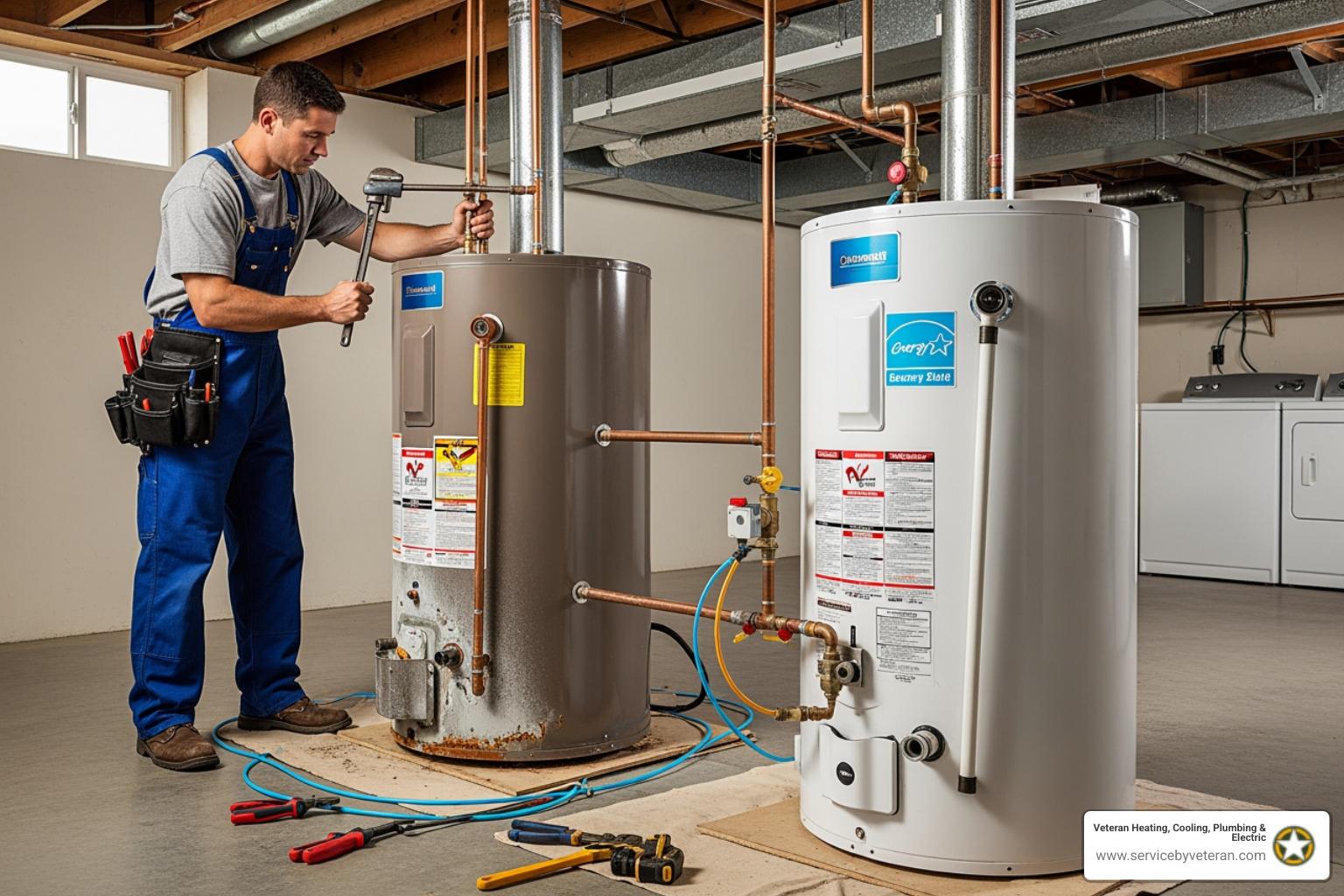
Is It Time for an Upgrade? Telltale Signs Your Water Heater is Failing
Few things disrupt a household faster than a malfunctioning water heater. The average lifespan of a water heater is typically 10-15 years, with many sources indicating an average closer to 10-12 years. If your unit is approaching or has exceeded this age, it's wise to start paying closer attention to its performance. Even with diligent maintenance, all water heaters will eventually reach the end of their functional life.
There are several key indicators that your water heater is struggling and may be nearing the point of needing a water heater replacement in denver, co. These signs can range from subtle inconveniences to more urgent problems.
One of the most common complaints we hear is inconsistent water temperature. Are your showers starting hot but quickly turning cold? Is the hot water supply simply not lasting as long as it used to? This often points to a failing heating element or an accumulation of sediment within the tank, reducing its efficiency and capacity.
Another telltale sign is strange noises emanating from your water heater. Rumbling, banging, popping, or hissing sounds are usually indications of sediment buildup at the bottom of the tank. As water heats, this sediment hardens, and the trapped air bubbles trying to escape cause these unsettling noises. While sometimes manageable with flushing, severe sediment buildup can lead to premature tank failure.
Have you noticed your hot water appearing discolored or rusty? This could be a sign of corrosion inside your water heater tank. While rusty water can sometimes come from your pipes, if it's only present when you're drawing hot water, your water heater is the likely culprit. A corroded tank is a serious issue that often necessitates immediate replacement to prevent leaks.
Finally, a rising energy bill without a corresponding increase in usage can be a strong indicator that your water heater is losing efficiency. An aging unit has to work harder and longer to heat water, consuming more energy in the process. This increased energy consumption can negate any perceived savings from delaying a replacement.
Key Signs You Need a Water Heater Replacement in Denver, CO
When considering a water heater replacement in denver, co, it's crucial to recognize the specific signs that point towards the need for a new unit rather than a repair.
• Age over a decade: As mentioned, the average lifespan is around 10-15 years. If your water heater is 10 years old or older, and you're experiencing any other issues, replacement is often the most cost-effective and reliable long-term solution.
• Visible leaks or moisture around the tank: Any water pooling around the base of your water heater, dripping from connections, or showing signs of corrosion on the tank exterior is a critical red flag. Leaks can quickly lead to significant water damage in your home.
• Lack of hot water: If your water heater consistently fails to provide enough hot water for your household's needs, or if you're frequently running out, it's a clear indication that it's no longer performing adequately. This could be due to a heating element failure or, again, excessive sediment buildup reducing the tank's effective capacity.
If you find a leak, the first step is to turn off the water supply to the heater and, if it's a gas unit, turn off the gas supply. Then, contact us immediately. A leaking water heater can cause extensive damage to your home, and addressing it promptly is essential. For urgent situations, our team is ready to assist with Emergency Plumbing Denver CO.
Common Problems That May Signal Replacement
Beyond the general signs, specific issues often indicate that a water heater is beyond simple repair and requires replacement.
• Sediment buildup: This is a pervasive issue, especially in areas like Denver with hard water. Minerals in the water settle at the bottom of the tank, forming a hard layer. This layer acts as an insulator, forcing the heating element to work harder, leading to inefficiency, reduced hot water capacity, and the rumbling noises we discussed. While regular flushing can mitigate this, severe, long-standing sediment buildup can permanently damage the tank.
• Faulty heating elements: For electric water heaters, a broken or failing heating element will directly impact the unit's ability to produce hot water. For gas units, issues with the burner or pilot light can cause similar problems.
• Corroded tank: Internal corrosion is an invisible enemy. Once the protective lining inside the tank degrades, the metal is exposed to water, leading to rust. This can manifest as discolored water or, eventually, small pinhole leaks that are impossible to repair.
• Frequent need for repairs: If your water heater requires repairs multiple times a year, the cost of these ongoing fixes can quickly surpass the investment in a new, more efficient unit. It becomes a money pit, and at some point, it's more economical to replace it.
When these issues arise, our team can help diagnose the problem and provide expert guidance on whether repair or a full Water Heater Repair Denver CO is the best course of action.
Choosing Your New Water Heater: A Denver Homeowner's Guide
Deciding on a new water heater involves more than just picking a size. It's an opportunity to improve your home's energy efficiency and potentially lower your utility bills. We understand that this is a significant investment for your home, and we're here to help you make an informed decision.
Modern water heaters, especially energy-efficient models, can significantly reduce your household's energy consumption. For example, tankless water heaters can use up to 50% less energy than conventional tanks, potentially saving hundreds of dollars a year on utility bills. This focus on energy savings isn't just good for your wallet; it's also beneficial for the environment.
To further encourage energy-efficient upgrades, federal and local programs often offer incentives. Homeowners may be able to explore potential savings and eligibility for federal tax credits on certain high-efficiency water heaters. Additionally, local utility providers like Xcel Energy in Colorado offer Water Heater Rebates - Rebates for qualifying energy-efficient water heaters, such as heat pump or natural gas tankless models. These rebates can help offset the initial investment, making the upgrade even more attractive.
Tank vs. Tankless: Which is Right for You?
The first major decision you'll face is between a traditional storage tank water heater and a tankless (on-demand) model. Both have distinct advantages and disadvantages.
Traditional Storage Tank Water Heaters:These are the most common type, storing and heating a large volume of water in a tank (typically 20 to 80 gallons, with 40-gallon tanks being the most common for residential use).
• Pros: Lower upfront cost, simpler installation, reliable supply of hot water until the tank is depleted, can operate during power outages if gas-fired.
• Cons: Less energy efficient due to standby heat loss, takes up significant space, limited hot water supply (can run out during peak usage), shorter lifespan compared to tankless.
Tankless Water Heaters:These units heat water only when you need it, providing a continuous supply of hot water. When a hot water tap is opened, cold water travels through a pipe into the unit, and a gas burner or electric element heats the water as it passes through.
• Pros: Highly energy efficient (up to 50% less energy consumption), continuous hot water supply, compact size (saves space), longer lifespan (up to 20 years), reduces water waste.
• Cons: Higher upfront cost, more complex installation (may require upgrades to gas lines or electrical systems), can be overwhelmed by multiple simultaneous hot water demands (e.g., two showers running at once), limited by flow rate.
The choice between the two often comes down to your budget, hot water demands, and energy efficiency goals. For many Denver homeowners, the long-term savings and convenience of tankless systems make them an attractive option for a Tankless Water Heater Denver CO.
Gas vs. Electric: Fueling Your Decision
Another critical factor is the fuel source for your new water heater: gas or electric. The best choice for your home often depends on existing utility connections, local energy costs, and personal preferences.
• Energy Source — Gas Water Heater: Natural gas or propane — Electric Water Heater: Electricity
• Efficiency — Gas Water Heater: Generally less energy-efficient than electric — Electric Water Heater: Generally more energy-efficient than gas
• Operating Cost — Gas Water Heater: Can be less expensive to run depending on local gas prices — Electric Water Heater: Can be more expensive to run depending on local electricity prices
• Upfront Cost — Gas Water Heater: Often slightly more expensive than electric, especially with venting requirements — Electric Water Heater: Often less expensive upfront
• Installation — Gas Water Heater: Requires gas line, ventilation (flue pipe) — Electric Water Heater: Requires dedicated electrical circuit
• Recovery Rate — Gas Water Heater: Faster recovery rate (heats water quicker) — Electric Water Heater: Slower recovery rate
• Environmental — Gas Water Heater: Emits greenhouse gases — Electric Water Heater: Can be zero-emission if electricity comes from renewable sources
While electric water heaters are generally considered more energy-efficient, the actual operating cost can make gas water heaters less expensive to run, depending on the current rates for natural gas and electricity in the Denver area. Gas water heaters also tend to have a faster recovery rate, meaning they can heat a new tank of cold water more quickly than electric models, which can be beneficial for larger households with high hot water demand.
However, electric models are often simpler and cheaper to install upfront, especially if your home doesn't have an existing gas line or proper ventilation. Your home's existing infrastructure and local utility costs will be significant factors in this decision.
Choosing the Right Size for Your Denver Home
Selecting the correct size for your new water heater is essential to ensure you always have enough hot water without wasting energy. An undersized unit will leave you with cold showers, while an oversized one will heat more water than you need, leading to higher energy bills.
For traditional tank water heaters, sizing is primarily determined by the "First Hour Rating" (FHR). This indicates how much hot water the heater can supply in one hour, starting with a full tank of hot water. To determine your FHR needs, consider:
• Household size: A typical family of four uses approximately 2,000 gallons of hot water each month.
• Peak hot water usage: When do you use the most hot water? Mornings, evenings? How many showers, laundry loads, or dishwasher cycles run simultaneously?
• Number of bathrooms and hot water appliances.
For tankless water heaters, sizing is based on "Gallons Per Minute" (GPM). This measures how much hot water the unit can produce per minute at a specific temperature rise. To size a tankless unit, you'll need to:
• Identify the total GPM needed for all hot water appliances that might run simultaneously during peak usage.
• Consider the incoming water temperature, which can be quite cold in Denver during winter months, requiring a higher temperature rise from the heater.
We can help you calculate your household's specific needs to ensure you choose the perfectly sized unit for your Plumbing system.
The Professional Water Heater Replacement in Denver, CO Process
When it's time for a water heater replacement in denver, co, entrusting the job to professionals ensures a smooth, safe, and code-compliant installation. We pride ourselves on our meticulous approach, ensuring every step is handled with precision and care.
Here's a general overview of what you can expect during the installation process:
1. Assessment and Recommendation: We'll first assess your current system and hot water needs, helping you choose the best type and size of water heater for your home.
2. Permit Acquisition: In many parts of Denver and surrounding areas, a permit is required for water heater installations. We handle the necessary paperwork to ensure your installation meets all local regulations.
3. Preparation: We'll prepare the installation area, ensuring proper drainage and safety. This includes turning off the water, gas (if applicable), and electricity to the old unit.
4. Removal of Old Unit: Your old water heater will be carefully drained and removed from your property. We ensure responsible disposal.
5. New Unit Installation: The new water heater is then positioned and connected to your home's water lines, gas lines (if applicable), and electrical system. This step is critical for safety and efficiency.
6. Venting (for gas units): Proper venting is installed or checked to ensure safe expulsion of combustion gases, like carbon monoxide.
7. Safety Features: We install or check safety features such as a temperature and pressure relief (T&P) valve and, if necessary, an expansion tank.
8. Testing and Calibration: Once installed, the unit is filled, tested for leaks, and calibrated to ensure optimal performance and safe operation. We'll also walk you through its basic functions.
A typical water heater installation usually takes between 2 to 4 hours, depending on the complexity of the job, such as switching fuel types or upgrading from a tank to a tankless system. Our technicians are NATE certified and bring decades of combined experience to every job, ensuring top-notch service.
Why Professional Installation is Crucial
While some homeowners might consider a DIY approach, the risks associated with water heater installation far outweigh the potential savings. Professional installation is crucial for several reasons:
• Safety: Water heaters involve high-pressure water, electricity, and potentially combustible gas. Improper installation can lead to leaks, electrical hazards, gas leaks, or even explosions. Our technicians are trained to handle these complexities safely.
• Adherence to Denver Codes and Permits: Local building codes dictate specific requirements for water heater installation, including proper venting, seismic strapping, and drainage. Most cities and towns in our service areas, including Denver, require a permit for water heater installations. We ensure all installations adhere to these codes and handle the necessary permits, protecting you from potential fines or future issues with home inspections.
• Proper Connections: Ensuring safe and correct electrical and plumbing connections is vital for the unit's efficiency and longevity, as well as the safety of your home. Gas models, in particular, require meticulous attention to gas line connections and proper venting for carbon monoxide.
• Efficiency and Longevity: A professionally installed water heater will operate at peak efficiency, saving you money on energy bills and extending its lifespan. Incorrect installation can lead to premature failure and costly repairs down the line.
Choosing a certified Plumber Denver CO like us means you're investing in peace of mind, knowing the job is done right the first time.
Understanding Warranties and Guarantees
When you invest in a new water heater, understanding the warranties and guarantees that come with it is important.
• Manufacturer's Warranty on the Unit: Most new water heaters come with a manufacturer's warranty that covers the tank and parts for a certain period, often 6 to 10 years, with some premium models offering longer coverage. This warranty protects you against defects in materials or manufacturing.
• Workmanship or Labor Guarantees: Beyond the manufacturer's warranty, a reputable plumbing company like ours will offer a guarantee on the installation itself. We are proud to offer a lifetime warranty on parts and labor for installations performed by our team, along with a money-back guarantee. This commitment reflects our confidence in our technicians' expertise and the quality of our work, providing you with long-term peace of mind.
These guarantees ensure that if any issues arise due to the installation, we will address them promptly and professionally, at no additional cost to you.
Maximizing Longevity: Post-Installation Care and Maintenance
Once your new water heater is installed, its longevity and efficiency largely depend on proper care and maintenance. Just like any other major appliance, a water heater benefits from routine attention.
We recommend annual maintenance to keep your unit running smoothly. This proactive approach can significantly extend its lifespan, maintain optimal energy efficiency, and prevent unexpected breakdowns.
Key maintenance tasks include:
• Flushing the tank to remove sediment: This is especially important in Denver due to our hard water. Flushing the tank regularly helps remove mineral deposits that can accumulate at the bottom, which cause those rumbling noises and reduce efficiency.
• Checking the anode rod: Often called the "sacrificial rod," the anode rod corrodes over time to protect the steel tank from rust. Inspecting and replacing it every few years can dramatically extend the life of your water heater.
• Testing the pressure relief valve: The temperature and pressure relief (T&P) valve is a crucial safety device designed to open if the temperature or pressure inside the tank exceeds safe limits. Testing it annually ensures it's functioning correctly.
Regular maintenance is not just for water heaters; it's a best practice for all your home's systems. For example, comprehensive checks on your boiler system can also contribute to overall home heating efficiency. Learn more about our Boiler Service Denver CO offerings.
How Denver's Climate and Water Quality Affect Your Heater
Denver's unique environmental conditions play a significant role in the performance and lifespan of your water heater. Understanding these factors can help you better maintain your unit.
• Impact of Hard Water and Mineral Buildup: The water in Denver and many surrounding areas is known to be moderately hard. This means it contains higher levels of dissolved minerals like calcium and magnesium. While generally safe to drink, these minerals can lead to scale buildup inside your water heater tank and on heating elements. As discussed, this buildup reduces efficiency, causes noise, and can shorten the unit's life. Regular sediment flushing is your best defense against this.
• Protecting Pipes from Freezing Temperatures: Denver experiences cold winters with freezing temperatures. While your water heater itself is typically indoors, the plumbing lines leading to and from it, as well as throughout your home, are susceptible to freezing. Frozen pipes can burst, leading to significant water damage. Proper insulation of exposed pipes and maintaining adequate indoor temperatures are crucial preventative measures. A neglected plumbing system can lead to costly and inconvenient issues, such as a Slab Leak Denver CO, which can be particularly damaging and difficult to repair.
By being aware of these local factors and taking proactive maintenance steps, you can ensure your water heater performs optimally for years to come.
Conclusion: Secure Your Home's Comfort with a Reliable Water Heater
A reliable source of hot water is more than just a convenience; it's a fundamental aspect of your home's comfort and functionality, especially in the Mile High City. Understanding the signs of a failing unit, exploring the various types of water heaters available, and recognizing the importance of professional installation are all critical steps in ensuring your household's continued comfort.
Investing in a new water heater replacement in denver, co offers numerous benefits, including:
• Improved energy efficiency: Modern units are designed to use less energy, translating to significant savings on your utility bills over time.
• Consistent hot water supply: Say goodbye to cold showers and waiting for water to heat up. A new, properly sized unit provides the hot water your family needs, when they need it.
• Increased home value: A new, efficient water heater is an attractive feature for potential homebuyers and contributes to the overall reliability of your home's infrastructure.
• Peace of mind: With a professional installation and a solid warranty, you can rest easy knowing your hot water system is safe, efficient, and dependable.
For expert guidance and professional installation, trust the team at Veteran Heating, Cooling, Plumbing & Electric. We bring military precision and a commitment to honest, community-focused service to every job, backed by a lifetime warranty on parts and labor and a money-back guarantee. We're dedicated to ensuring your home has the dependable, energy-efficient hot water supply it deserves.
Contact our team for your water heater replacement in Denver, CO and let us help you find the perfect solution for your home.
ABOUT Veteran Heating, Cooling, Plumbing & Electric
Veteran Heating, Cooling, Plumbing & Electric was founded on the belief that service should be personal, honest, and community-focused. Our team is built around integrity, professionalism, and a true commitment to your home’s comfort and safety.
Led by a U.S. Army veteran with over 30 years of industry experience, we’re proud to remain locally owned and operated. Every technician, plumber, and electrician is EPA-certified, background checked, and driven to exceed expectations.
- 24/7 ServiceWe offer weekend & 24/7 emergency service. We’re here whenever you need us—day, night, or weekend, no exceptions.
- $0 Trip FeesNo dispatch or trip fees. You’ll never pay just for us to show up—service starts when the work does.
OUR SERVICES
AIR CONDITIONING
.jpg)
We offer specialty and seasonal services like indoor air quality upgrades, pre-winter furnace checks, and summer AC tune-ups to keep your home prepared year-round.
Our Primary Air Conditioning Services Include:
Don't see the service you need? Call our Team today!
PLUMBING
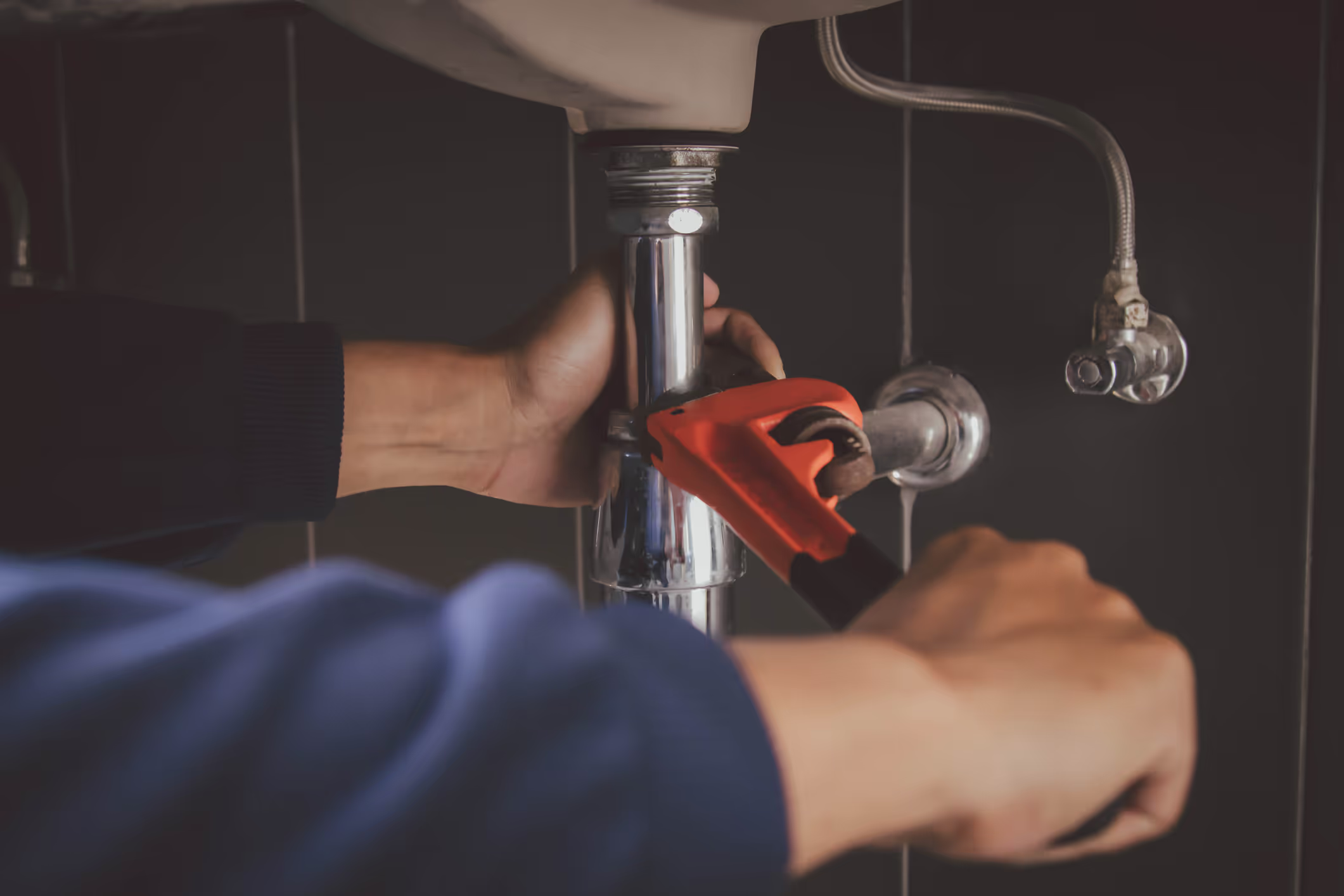
From leaks to full system installs, our plumbing services cover everything you need for a safe, reliable home water system, 24/7.
Our Primary Plumbing Include:
- Water Heater Replacement
- Water Heater Repair
- Trenchless Sewer Line
- Water Filtration
- Slab Leak
- Sewer Line Repair
Don't see the service you need? Call our Team today!
ELECTRICAL

Our electrical services ensure your home stays safe and powered, from routine fixes to complete system upgrades.
Our Primary Electrical Services Include:
- House Rewiring
- Electrician
- Electric Panel Upgrade
- Electric Panel Replacement
- EV Chargers
- Whole House Generator
Don't see the service you need? Call our Team today!
HEATING
.jpg)
We install, repair, and maintain heating & furnace systems with expert care to keep your Colorado home comfortable and energy-efficient year-round.
Our Primary Heating Services Include:
- Heating Installation
- Heating Replacement
- Heating Maintenance
- Heating Repair
- Heating Service
- Heating Tune-Up
Don't see the service you need? Call our Team today!