Why the September Shoulder Season Wreaks Havoc on Indoor Comfort
If you have ever wondered why September's fluctuating temperatures make it the hardest month to balance your home's humidity, you are already feeling the effects of the early fall transition. The shift from late summer heat to brisk autumn evenings creates a chaotic environment for your indoor air quality. Before the consistent freezing temperatures of winter set in, your home's climate control systems are forced to navigate wildly unpredictable weather patterns.
During the September shoulder season, the air outside is constantly expanding and contracting as the sun rises and sets. This rapid shift creates a unique challenge for automated whole-home humidifiers. These systems are generally designed for steady, predictable climates. When weather patterns become erratic, automated sensors often get confused, leading to severe over-humidification or uncomfortable under-humidification.
The Reality of Fall Climate Control
Many homeowners assume their heating and cooling equipment will seamlessly handle the seasonal transition. However, the reality is that the weeks leading up to winter require a completely different approach to indoor air management. Relying solely on automation during this time often leads to damp windows, dry throats, and a home that never quite feels comfortable.
The decision point is clear: you must actively manage your humidistat and thermostat settings to maintain comfort. Passive trust in legacy sensors will leave your indoor environment unbalanced. By understanding the mechanics of your system and applying clear, safe, homeowner-level instructions on adjusting your dials, you can conquer the transitional weather and keep your living space perfectly conditioned.
The Physics of 80-Degree Afternoons and 40-Degree Nights
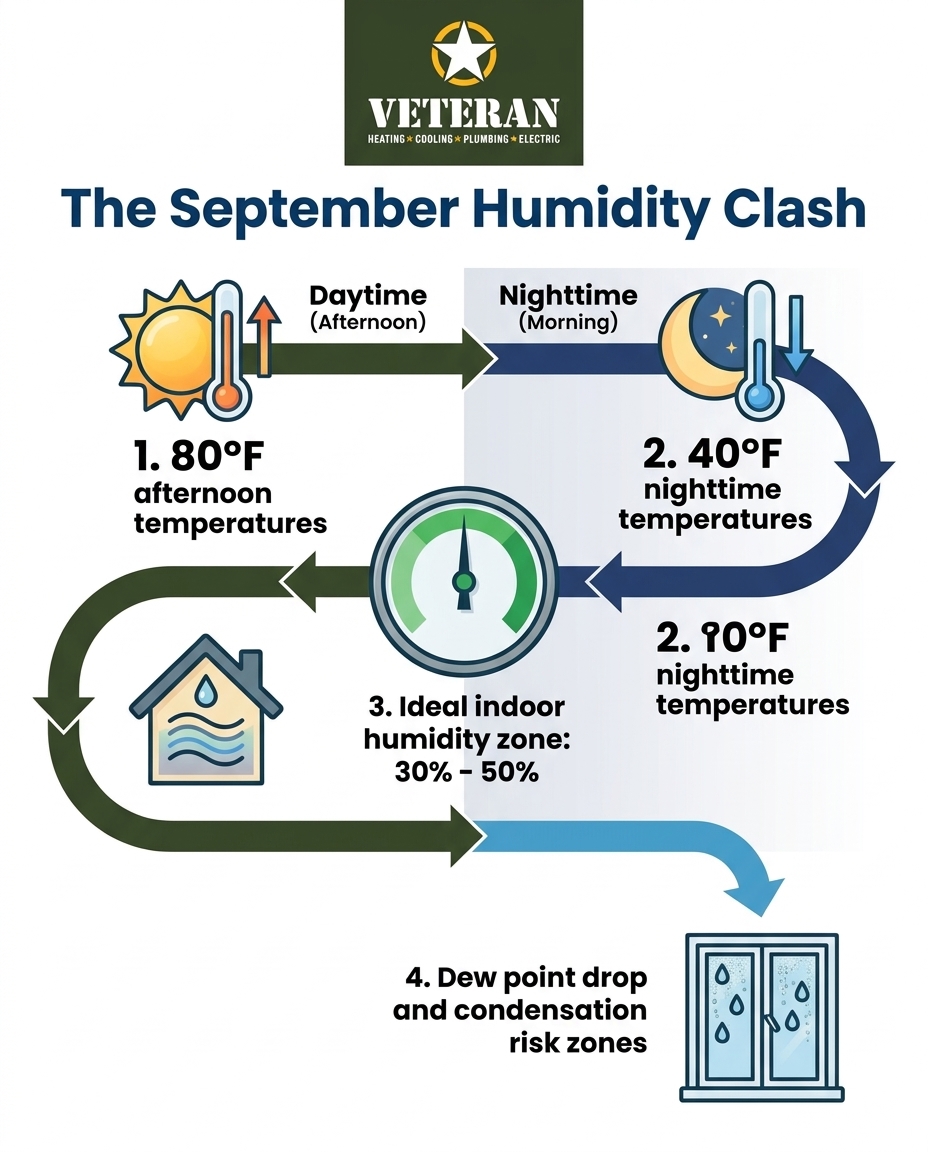
To truly understand indoor air quality during the fall, you have to look at the thermodynamics of air. The core rule of humidity is simple: cold air holds significantly less moisture than warm air. When you experience 80-degree afternoons to 40-degree nights, the physical capacity of the air to hold water vapor changes drastically within a matter of hours.
In a high-altitude, semi-arid climate like Denver's, this dynamic is amplified. The baseline outdoor humidity might be low, but the rapid nighttime cooling drastically lowers the dew point. During a hot afternoon, the air inside your home acts like a large, dry sponge, easily absorbing any moisture your humidifier adds. But as the sun goes down and temperatures plummet, that "sponge" shrinks rapidly.
If the moisture levels inside your home remain constant while the temperature drops, the relative humidity spikes. The air simply cannot hold the water vapor anymore, forcing it to look for a place to condense. This extreme diurnal swing—the rapid shift from daytime highs to nighttime lows—is the primary culprit for indoor air quality imbalances during the early fall.
• Afternoon — Temperature Profile: High (Near 80°F) — Air Moisture Capacity: High (Air expands and absorbs water) — Indoor Humidity Risk: Dry air if humidifier is set too low.
• Evening — Temperature Profile: Dropping (60°F - 50°F) — Air Moisture Capacity: Decreasing (Air begins to contract) — Indoor Humidity Risk: Moisture starts approaching the dew point.
• Late Night — Temperature Profile: Low (Near 40°F) — Air Moisture Capacity: Low (Air cannot hold excess water) — Indoor Humidity Risk: High risk of sudden condensation and over-humidification.
The dew point danger: When indoor air hits the dew point, water vapor turns back into liquid. Because your windows are the primary barrier between the warm indoors and the freezing outdoors, they become the first surface where this physical reaction takes place.
Why 'Set It and Forget It' Fails High-Altitude Homes
For decades, standard manufacturer advice has been to find a comfortable setting on your humidistat and leave it alone. That advice assumes a gradual, predictable climate transition where the weather slowly cools over several months. In Denver, CO, where the weather can change violently from lunch to dinner, "set it and forget it" is a recipe for an uncomfortable home.
Typical automated humidifier sensors read daytime temperatures and inject moisture accordingly. If your thermostat registers 72°F indoors while it is 80°F outside, the humidifier pumps water vapor into your ductwork to reach the target percentage. The failure point happens when the sun sets. As temperatures plummet outside, the system cannot extract the excess moisture fast enough to account for the shrinking capacity of the air.
Active observation is an absolute necessity. Relying on passive trust in legacy sensors means you are always one step behind the weather. You have to anticipate the drop rather than waiting for the system to react to it.
The Sensor Lag Effect
The disconnect between your equipment and the actual weather is driven by a mechanical delay known as the sensor lag effect. Here is exactly how this delay disrupts your indoor comfort:
1. Ambient reading delay: Indoor thermostats read ambient indoor heat, not the actual outdoor temperature drops. Your house retains heat well into the evening, tricking the sensor into thinking it is still warm.
2. Continued moisture injection: Because the sensor believes the house is still warm, it allows the whole-home humidifier to keep running, adding water vapor to air that is about to cool rapidly.
3. The thermal crash: The outdoor cold finally penetrates the exterior walls and windows. The indoor air cools, its moisture capacity shrinks, and the relative humidity skyrockets instantly.
4. HVAC response delay: There is a significant delay between the outdoor cooling and the indoor HVAC response. By the time the system realizes the environment has changed, the excess moisture is already trapped inside.
This mechanical delay is very similar to understanding how a heat pump works in a four-season climate—the equipment needs time to adjust to external thermal shifts, and during wild temperature swings, that time is something you do not have.
Decoding Morning Window Condensation and Dry Air
When the physics of the air and the mechanics of your sensors clash, the results show up physically in your living space. Recognizing these symptoms early allows you to adjust your dials before minor annoyances turn into long-term damage.
Morning window condensation is the most visible warning sign of over-humidification. When the warm, moist air inside your home touches the cold glass of your windows, it hits the dew point instantly. The air cools, contracts, and deposits liquid water directly onto the pane. If left unchecked, this localized indoor condensation pools on window sills, damages wood finishes, and creates an ideal environment for mold growth.
Conversely, waking up with a scratchy, dry throat indicates that the system over-corrected or failed to run altogether. If you dialed the humidifier back too far in fear of condensation, the morning air will lack the necessary moisture to keep your respiratory system comfortable. The ideal indoor relative humidity range is between 30% and 50%—this sweet spot prevents mold while maintaining optimal comfort for your family.
During the September shoulder season last year, one local homeowner called us in when their furnace was acting up and their home felt incredibly unbalanced. Jeff, one of our technicians, arrived quickly and found the furnace problem that needed fixing. He was professional, efficient, and reliable, resolving the issue quickly and dependably so the system could properly distribute conditioned air. Without proper airflow from a functioning furnace, balancing humidity becomes nearly impossible.
• Water droplets on glass: A clear indicator that your humidistat was set too high for the overnight low temperature.
• Static electricity shocks: A sign that the air is severely under-humidified, usually dropping below 30% relative humidity.
• Peeling paint near windows: Long-term evidence of repeated condensation cycles damaging the drywall and trim.
• Dry sinuses and skin: Physical symptoms that your humidifier is not keeping up with the daytime heat expansion.
A Tactical Protocol for Manual Humidistat Management
Taking control of your indoor air quality requires a disciplined approach. At Veteran Heating, Cooling, Plumbing & Electric, we believe in applying a military precision and disciplined approach to home comfort. Managing your humidistat during wild weather swings is a tactical protocol—a set of clear, actionable steps you execute to protect your home environment.
These adjustments are strictly restricted to user-facing dials and thermostats. You do not need to open any equipment panels or perform unlicensed work to master your indoor humidity. By following a daily routine, you can preempt the 80-degree afternoons to 40-degree nights and maintain perfect balance.
Step 1: The Morning Forecast Briefing
Before you start your day, check the local weather forecast. Look specifically at the projected overnight low. The high temperature dictates your daytime comfort, but the overnight low dictates your condensation risk. If the temperature is expected to drop below 50°F, you need to prepare for a manual adjustment.
Step 2: Establishing the Daytime Baseline
During warm afternoons, set your humidistat to maintain around 40% to 45% relative humidity. This provides enough moisture to keep your skin and sinuses comfortable while the air is expanded and capable of holding the water vapor.
Step 3: The Evening Dial-Back
This is the most critical tactical step. As the sun goes down and before the outdoor temperature plummets, manually dial your humidistat back to 30% or 35%. By reducing the moisture output before the cold sets in, you prevent the system from overloading the air, entirely eliminating the risk of morning window condensation.
Step 4: Verification via Hygrometer
Do not rely solely on how the air feels. Advise placing a standalone indoor humidity monitor (hygrometer) in your primary living space. These inexpensive digital displays verify that your manual dial adjustments are actually working, giving you real-time data on your home's relative humidity.
Preparing Your Complete HVAC Profile for Winter
While homeowners can effectively manage the user-facing dials, the mechanical components of your system require professional verification. Your furnace and your whole-home humidifier are deeply interconnected. The humidifier relies entirely on the furnace's blower motor to distribute moisture throughout the ductwork. If your furnace has a clogged filter, restricted airflow, or a failing motor, your humidity levels will suffer regardless of how perfectly you manage the humidistat.
A fall tune-up is a critical preventative measure against mid-winter breakdowns. During a professional inspection, technicians evaluate the humidifier's water panel (which often scales up with hard water minerals over the summer) and ensure the bypass damper is set to the correct seasonal position. Having a professional verify these mechanical functions ensures your manual dial adjustments actually translate into whole-home comfort.
This past summer, another Denver, CO customer reached out for HVAC service and system maintenance to get ahead of the changing weather. Our team provided punctual, knowledgeable service, took the time to explain the entire HVAC process, and answered every question. The result was honest advice and top-tier workmanship that left their system fully prepared for the upcoming seasonal shift. That level of professional oversight is what guarantees your equipment will perform when the extreme cold finally arrives.
Take Command of Your Fall Home Comfort
Active management is the undeniable key to conquering September's erratic weather. The extreme swings of the early fall will quickly overwhelm an automated system, but by taking control of your humidistat, you can maintain a perfectly balanced environment. Clear, safe, homeowner-level instructions on how to turn the dials are just the first step in protecting your home from condensation and dry air.
Now is the time to ensure your equipment is mechanically sound. Schedule a seasonal inspection to ensure your whole-home humidifier and furnace are operating with absolute precision. Our technicians are ready to evaluate your system, replace scaled water panels, and optimize your airflow for the months ahead. Why September's fluctuating temperatures make it the hardest month to balance your home's humidity is no longer a mystery—it is a tactical challenge you are now fully equipped to handle.
Frequently Asked Questions
What should I set my humidifier to in the fall?
During the early fall, aim for a baseline setting of 35% to 45% relative humidity on warm days. You must actively dial this setting back closer to 30% when the forecast calls for cold overnight temperatures. Adjusting the dial based on the outdoor weather prevents the system from overloading your indoor air with moisture.
Why is there condensation on my windows in September?
Condensation forms because the warm, moist air inside your home hits the cold glass of your windows and reaches its dew point. This is a direct result of your whole-home humidifier running at daytime settings while the outdoor temperatures plummet at night. Manually lowering your humidistat in the evening will clear up this issue.
How do you balance indoor humidity when temperatures fluctuate?
The most effective way to balance humidity during extreme temperature swings is through proactive manual management. Check the evening forecast daily and lower your humidistat dial before the cold weather hits. Using a standalone digital hygrometer will help you verify that your indoor humidity stays safely between 30% and 50%.
Should I run my whole-home humidifier in the early fall?
Yes, you should run your humidifier in the early fall to prevent dry skin, scratchy throats, and damage to wood furniture. However, you cannot treat it as a "set it and forget it" device during this transition period. It requires daily observation and minor dial adjustments to match the erratic outdoor temperatures.
Can a high-altitude climate damage my whole-home humidifier?
The climate itself will not mechanically damage the unit, but high-altitude, semi-arid environments demand more precise control to prevent secondary damage to your home. Rapid high-altitude cooling drastically lowers the dew point, which can cause severe condensation and potential mold growth if the humidifier is left running on high overnight.
How often should I manually adjust my humidistat during shoulder seasons?
During the chaotic shoulder season, you should check and potentially adjust your humidistat daily. Make it a habit to check the evening weather forecast every morning; if a major temperature drop is predicted, adjust the dial down before you go to sleep to protect your windows and indoor air quality.
ABOUT Veteran Heating, Cooling, Plumbing & Electric
Veteran Heating, Cooling, Plumbing & Electric was founded on the belief that service should be personal, honest, and community-focused. Our team is built around integrity, professionalism, and a true commitment to your home’s comfort and safety.
Led by a U.S. Army veteran with over 30 years of industry experience, we’re proud to remain locally owned and operated. Every technician, plumber, and electrician is EPA-certified, background checked, and driven to exceed expectations.
- 24/7 ServiceWe offer weekend & 24/7 emergency service. We’re here whenever you need us—day, night, or weekend, no exceptions.
- $0 Trip FeesNo dispatch or trip fees. You’ll never pay just for us to show up—service starts when the work does.
OUR SERVICES
AIR CONDITIONING
.jpg)
We offer specialty and seasonal services like indoor air quality upgrades, pre-winter furnace checks, and summer AC tune-ups to keep your home prepared year-round.
Our Primary Air Conditioning Services Include:
Don't see the service you need? Call our Team today!
PLUMBING
From leaks to full system installs, our plumbing services cover everything you need for a safe, reliable home water system, 24/7.
Our Primary Plumbing Include:
- Water Heater Replacement
- Water Heater Repair
- Trenchless Sewer Line
- Water Filtration
- Slab Leak
- Sewer Line Repair
Don't see the service you need? Call our Team today!
ELECTRICAL

Our electrical services ensure your home stays safe and powered, from routine fixes to complete system upgrades.
Our Primary Electrical Services Include:
- House Rewiring
- Electrician
- Electric Panel Upgrade
- Electric Panel Replacement
- EV Chargers
- Whole House Generator
Don't see the service you need? Call our Team today!
HEATING
.jpg)
We install, repair, and maintain heating & furnace systems with expert care to keep your Colorado home comfortable and energy-efficient year-round.
Our Primary Heating Services Include:
- Heating Installation
- Heating Replacement
- Heating Maintenance
- Heating Repair
- Heating Service
- Heating Tune-Up
Don't see the service you need? Call our Team today!