Decoding the Fall Freeze: Why Timing Your Heating Prep Matters
At Veteran Heating, Cooling, Plumbing & Electric, we see it happen every single year: when the temperature plummets 30 degrees overnight, pinpointing The Exact Moment Denver Homeowners Should Schedule Their Fall Furnace Tune-Up to Avoid the October Rush becomes the most critical decision of the season. Thousands of residents wait until that very first freezing night to finally switch their thermostats to "heat," only to discover their system is completely unresponsive. By the time they scramble to call for help, the local industry is already bottlenecked with emergency requests. Establishing a routine HVAC service schedule is the foundation of winter reliability, ensuring your system is tested and ready before the weather turns. Booking professional furnace maintenance early guarantees your home stays warm while everyone else is stuck waiting for a technician.
The Reality of Sudden Temperature Drops
As locals know, the transition from late summer to fall in Colorado is rarely a gentle slope. In our years of servicing Denver homes, we've seen firsthand how our local climate's abrupt, dramatic shifts mean you might be running the air conditioner on a Tuesday afternoon and scraping frost off your windshield by Wednesday morning. This rapid change leaves zero margin for error when it comes to home heating. If your furnace has been sitting idle for six months, asking it to suddenly perform at peak capacity during a steep temperature drop is a recipe for mechanical failure.
Homeowners who wait for the cold to arrive before testing their equipment are playing a risky game of seasonal roulette. The concrete problem isn't just that the furnace might not turn on; it's that when it fails, it fails at the exact same time as hundreds of other units across the region. Pinpointing the operational window to get service before the local industry bottlenecks is the only way to avoid the chaos. Taking action while the weather is still mild is a strategic move that separates proactive homeowners from those caught in the emergency queue.
The Anatomy of Denver's Notorious October Rush
The "October Rush" is not just a catchy marketing phrase used to book appointments; it is a verifiable, industry-wide logistical bottleneck that impacts the entire Denver metro area every single year. Understanding the anatomy of this phenomenon requires looking at historical climate data and how human behavior reacts to sudden weather changes.
The October 7th Tipping Point
Based on historical weather patterns and our own dispatch experience across the Denver metro area, the average first freeze typically occurs around October 7th. Leading up to this date, the days are often warm and pleasant, lulling residents into a false sense of security. Because the daytime highs remain comfortable, furnaces remain an afterthought. However, when that first true cold snap hits, the physical toll it takes on an untested heating system is immense. Dust has settled on the burners, flame sensors have oxidized, and blower motors have sat stagnant. Forcing the system to fire up instantly under these conditions frequently triggers safety switches or exposes underlying mechanical faults that developed over the summer.
The Domino Effect on Local Service Boards
When that first freezing night arrives, a massive domino effect begins. Between 6:00 AM and 8:00 AM, thousands of residents wake up to chilly houses and simultaneously turn up their thermostats. Within hours, local HVAC dispatch boards are instantly overwhelmed with calls. What starts as a quiet morning quickly transforms into a logistical nightmare for service companies across the city.
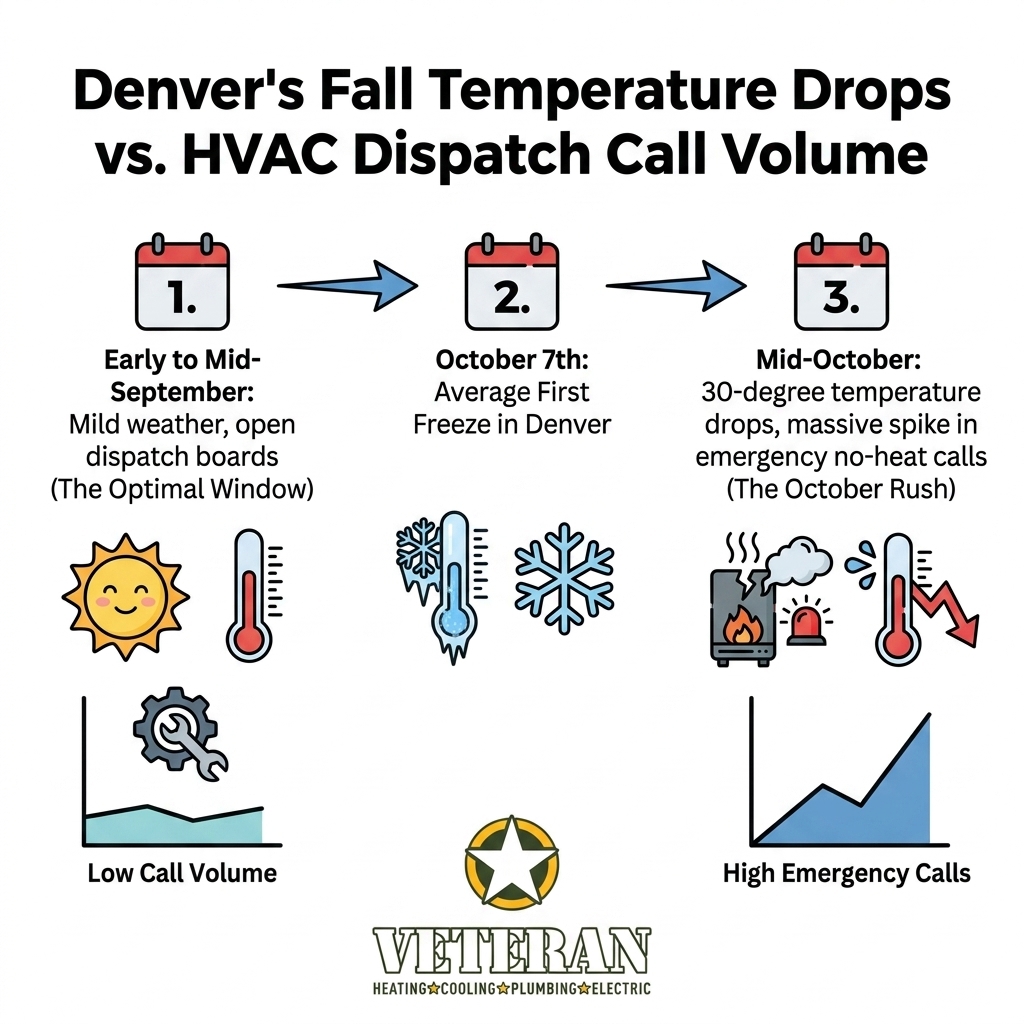
This sudden surge in demand fundamentally changes the operational landscape. A single severe cold snap translates into days—and sometimes weeks—of waiting for an available technician. Contrast this reactive waiting game with proactive scheduling, and the value of early action becomes incredibly clear. To illustrate how quickly the situation escalates, consider the typical timeline of the October Rush:
• Early to Mid-September — Weather Conditions: Mild days, cool nights — HVAC Industry Status: Normal capacity, open schedules — Homeowner Action Required: Optimal time to book maintenance
• Late September — Weather Conditions: Noticeably cooler, frost risk — HVAC Industry Status: Schedules filling up rapidly — Homeowner Action Required: Last chance for flexible booking
• Around October 7th — Weather Conditions: First official overnight freeze — HVAC Industry Status: Dispatch boards overwhelmed — Homeowner Action Required: Emergency response mode begins
• Mid-October — Weather Conditions: Consistent freezing nights — HVAC Industry Status: Days or weeks of wait time — Homeowner Action Required: Expect delays for all non-emergencies
What Our Dispatch Logs Reveal About Heating Emergencies
Looking directly at our Veteran Heating, Cooling, Plumbing & Electric dispatch logs over previous fall seasons provides a clear, undeniable picture of exactly when the local industry bottlenecks. The data doesn't lie: there is a massive, immediate spike in October emergency no-heat calls the morning after the first freezing night. This isn't a gradual increase; it is an overnight explosion of service requests that strains logistical planning to its absolute limits.
The Morning After the First Freeze
If you were to look at our dispatch board at 7:00 AM after a 30-degree overnight temperature drop, you would see a screen glowing with urgent requests. Technicians who were scheduled for routine checks are suddenly forced to triage back-to-back emergency repairs. This logistical strain means that even well-staffed companies must prioritize households without any heat, pushing routine maintenance further down the calendar.
The most frustrating aspect for our veteran-led team when reviewing these logs is realizing that the vast majority of these failures were entirely preventable. When our Denver-based technicians arrive at these emergency calls, they rarely find catastrophic, unpredictable failures. Instead, they find avoidable breakdowns. The most common culprits include:
• Dirty flame sensors: A microscopic layer of dust prevents the sensor from reading the flame, causing the furnace to shut down for safety.
• Clogged air filters: Months of accumulated summer dust restrict airflow, causing the heat exchanger to overheat and trip the high-limit switch.
• Stuck inducer motors: Motors that haven't spun in months seize up, preventing the furnace from exhausting harmful gases safely.
• Thermostat communication errors: Weak batteries or loose wiring connections that fail when the system is finally called to action.
By analyzing this data, we apply our core operational discipline to help you avoid becoming just another statistic on a crowded dispatch board. Knowing exactly when the rush hits allows you to maneuver around it entirely.
Hitting the Target: The Mid-September Pre-Heating Window
Based on our operational data at Veteran Heating, Cooling, Plumbing & Electric, the definitive deadline for homeowners to act is clear. The mid-September pre-heating window is the strategic sweet spot for maintenance. This specific 2-to-3 week period offers the perfect balance of conditions to ensure your system is prepped, tested, and ready to perform flawlessly.
Why Mid-September is the Strategic Sweet Spot
Targeting mid-September allows you to beat the October 7th average freeze by a safe, comfortable three-week margin. During this window, the weather is still mild enough that technicians aren't rushed from one emergency to the next. They have the time to be meticulous, and your schedule is accommodated with flexibility because dispatch boards are still operating at normal capacity. Furthermore, the temperatures in mid-September are just cool enough in the early mornings to allow for accurate system testing without turning your house into a sauna.
Securing your tune-up during this mid-September pre-heating window provides profound peace of mind. You gain the confidence of knowing your system is fully operational weeks before it is actually needed. To ensure you hit this target, follow this early September readiness checklist:
1. Check the filter: Inspect your current air filter and replace it if it is clogged with summer dust and allergens.
2. Clear the perimeter: Ensure all vents and returns inside the home are unblocked by furniture or rugs, and clear any debris away from outdoor exhaust pipes.
3. Test the thermostat: Switch the thermostat to "heat" on a cool morning just to verify that the furnace receives the signal and ignites.
4. Listen for odd noises: Pay attention to any grinding, squealing, or rattling sounds during that initial test run.
5. Book the tune-up: Call to schedule your professional maintenance before the third week of September concludes.
What a Military-Grade Furnace Tune-Up Actually Entails
Not all maintenance visits are created equal. At Veteran Heating, Cooling, Plumbing & Electric, executing a maintenance checklist with military-style precision and uncompromised integrity is what separates a cursory glance from a true, deep-dive tune-up. Our veteran-led approach means our technicians don't just wipe down the cabinet; we systematically inspect, test, and calibrate every critical component of your heating system.
Comprehensive Safety and Efficiency Checks
The core of a military-grade tune-up is safety. Our comprehensive safety checks begin with rigorous carbon monoxide testing and a meticulous inspection of the heat exchanger. Even a microscopic crack in the heat exchanger can allow dangerous combustion gases to leak into your living space. We also detail the inspection of the ignition system, the blower motor, and the venting to ensure everything operates within strict manufacturer tolerances.
Efficiency is the next priority. Calibration is vital ahead of the heavy usage months. We adjust the gas pressure and clean the burners to ensure optimal fuel combustion, which maximizes heat output while minimizing energy waste. Thorough cleaning of the internal components prevents the most common mid-winter failures we discussed earlier. Furthermore, our technicians evaluate how your indoor and outdoor units work together to ensure a seamless, efficient transition from the cooling season to the heating season.
The standard of service: During a recent summer service call, our team was dispatched for routine HVAC maintenance. The homeowner noted that the technicians provided punctual, knowledgeable service, taking the time to explain the entire HVAC process and how maintenance affects long-term performance. That commitment to integrity and honesty—delivering top-tier service on all fronts without pushing unnecessary upgrades—is exactly what we bring to every fall tune-up. We focus on honest advice, ensuring your system is safe and efficient, rather than looking for a quick upsell.
The Hidden Costs of Procrastinating on Fall Maintenance
Ignoring the mid-September deadline carries significant risks. Procrastinating on fall maintenance isn't just about the inconvenience of a chilly house; it involves real safety hazards, financial impacts, and the potential for immense stress when things go wrong.
When Maintenance Turns Into Replacement
The most immediate hidden cost is safety. Operating an untested furnace, particularly an older gas model, introduces the risk of gas leaks or carbon monoxide exposure. Without a professional verifying that the venting is clear and the heat exchanger is intact, you are putting your household at risk during that first major cold snap.
Beyond safety, there is the financial impact of running an uncalibrated, inefficient system. A furnace struggling against a clogged filter or a dirty blower motor has to run longer and burn more fuel to reach the set temperature. This inefficiency drives up your utility bills right from the start of the season. Ignoring minor wear and tear in September directly leads to major component failure in October.
The worst-case scenario is discovering a catastrophic failure during the October rush. When a furnace is deemed unsafe to operate, finding immediate furnace installation options is incredibly difficult because installation crews are booked solid. While generic energy rebates and federal tax credits may apply to qualifying high-efficiency upgrades, rushing a replacement due to a sudden breakdown limits your ability to research these options. You lose the luxury of time to properly evaluate systems, compare features, and ensure you are maximizing available utility incentives. You are forced to take whatever equipment is available immediately, which is rarely the best long-term strategy for your home.
Executing Your Seasonal Readiness Plan with Precision
Avoiding the October rush requires action while the weather is still comfortable. Proactive, data-driven scheduling is the ultimate defense against the chaos of the first freeze. By recognizing the mid-September window and understanding the logistical realities of the local industry, you can secure your comfort on your own terms.
When a system goes down, time is of the essence. Last fall, a Denver homeowner experienced a sudden furnace problem right as the weather turned. Our Veteran Heating, Cooling, Plumbing & Electric team responded, relying on our military-grade operational discipline to efficiently fix the issue and restore heat quickly. Providing that fast, dependable service is our mission, but avoiding the breakdown entirely through early intervention is the ultimate goal.
We encourage homeowners to view their HVAC maintenance not as a chore, but as a critical readiness protocol for their home. Applying veteran-led logistical discipline to your household maintenance ensures you are never caught off guard. You gain the value of having a highly trained, disciplined professional efficiently fix, clean, and tune the system quickly and dependably, long before the snow starts to fall.
Frequently Asked Questions About Fall Furnace Preparation
When is the exact best time to schedule a furnace tune up in Colorado?
The exact best time to schedule your tune-up is during the mid-September pre-heating window. This specific timeframe allows you to beat the typical October 7th first freeze by a few weeks. Scheduling in mid-September ensures dispatch boards are still open, and technicians have the time to perform thorough calibrations before the emergency calls begin.
Why do local HVAC companies get so busy in October?
Local HVAC companies experience a massive surge in October because thousands of homeowners turn on their heating systems for the first time on the exact same freezing night. This simultaneous demand instantly floods dispatch boards with emergency no-heat calls. The sudden transition from mild fall weather to freezing temperatures exposes underlying mechanical issues that developed over the summer.
What specific safety checks happen during a fall furnace tune up?
A comprehensive tune-up includes rigorous carbon monoxide testing and a detailed visual inspection of the heat exchanger for cracks. Technicians also verify that the venting system is clear of obstructions to ensure dangerous gases exhaust properly outdoors. Additionally, all electrical connections, safety limit switches, and the ignition assembly are tested to guarantee safe operation.
How often should you get your furnace serviced if it's less than five years old?
Even newer furnaces require professional maintenance once every single year, ideally in the fall. Annual servicing keeps the system running at peak energy efficiency and prevents minor dust buildup from causing major sensor failures. Furthermore, nearly all manufacturers require proof of annual professional maintenance to keep the equipment warranty valid.
What temperature should I test my furnace at before the real cold hits?
You should test your furnace early on a cool September morning when the indoor temperature is naturally lower. Set the thermostat three to five degrees above the current room temperature and listen for the system to ignite smoothly. Let it run for at least ten minutes to ensure warm air is flowing from the vents without any burning smells or unusual grinding noises.
Can skipping fall maintenance cause my furnace to fail during a sudden cold snap?
Yes, skipping maintenance is the leading cause of sudden failures during the first major cold snap. Dust accumulation on the flame sensor or a clogged air filter will cause the furnace to overheat and shut itself down as a safety precaution. Routine maintenance addresses these minor issues before they compound into a complete system shutdown when you need heat the most.
Secure Your Spot Before the October Freeze
The mid-September pre-heating window is closing quickly, and the inevitable October rush is just around the corner. Do not wait for the first freezing night to discover your heating system needs help. Booking your professional furnace maintenance now guarantees a warm, safe home and keeps you off the emergency waitlist. Take control of your seasonal readiness today by contacting our dispatch team at Veteran Heating, Cooling, Plumbing & Electric to secure your appointment before the weather turns.
ABOUT Veteran Heating, Cooling, Plumbing & Electric
Veteran Heating, Cooling, Plumbing & Electric was founded on the belief that service should be personal, honest, and community-focused. Our team is built around integrity, professionalism, and a true commitment to your home’s comfort and safety.
Led by a U.S. Army veteran with over 30 years of industry experience, we’re proud to remain locally owned and operated. Every technician, plumber, and electrician is EPA-certified, background checked, and driven to exceed expectations.
- 24/7 ServiceWe offer weekend & 24/7 emergency service. We’re here whenever you need us—day, night, or weekend, no exceptions.
- $0 Trip FeesNo dispatch or trip fees. You’ll never pay just for us to show up—service starts when the work does.
OUR SERVICES
AIR CONDITIONING
.jpg)
We offer specialty and seasonal services like indoor air quality upgrades, pre-winter furnace checks, and summer AC tune-ups to keep your home prepared year-round.
Our Primary Air Conditioning Services Include:
Don't see the service you need? Call our Team today!
PLUMBING
From leaks to full system installs, our plumbing services cover everything you need for a safe, reliable home water system, 24/7.
Our Primary Plumbing Include:
- Water Heater Replacement
- Water Heater Repair
- Trenchless Sewer Line
- Water Filtration
- Slab Leak
- Sewer Line Repair
Don't see the service you need? Call our Team today!
ELECTRICAL

Our electrical services ensure your home stays safe and powered, from routine fixes to complete system upgrades.
Our Primary Electrical Services Include:
- House Rewiring
- Electrician
- Electric Panel Upgrade
- Electric Panel Replacement
- EV Chargers
- Whole House Generator
Don't see the service you need? Call our Team today!
HEATING
.jpg)
We install, repair, and maintain heating & furnace systems with expert care to keep your Colorado home comfortable and energy-efficient year-round.
Our Primary Heating Services Include:
- Heating Installation
- Heating Replacement
- Heating Maintenance
- Heating Repair
- Heating Service
- Heating Tune-Up
Don't see the service you need? Call our Team today!