Facing the First October Freeze: Boiler and Radiant Heat Startup Realities
Navigating home maintenance tips and troubleshooting is never more critical than during that initial fall startup. The first cold nights of October have arrived, but when you turn on your heating system after months of summer dormancy, the house still feels unevenly warm, and strange noises are echoing from the utility room. Denver homeowners face a very specific dilemma during this October pre-winter startup: deciding whether those early gurgles and cold spots in the radiant heat are harmless quirks of waking a dormant system, or early warning signs of a mechanical failure.
With early October cold snaps being a stark reality in the region, waiting until deep winter to fully test your boiler is a massive risk. In our experience servicing local heating systems, catching these symptoms now is the difference between a simple adjustment and a mid-winter breakdown. If you are evaluating your home's seasonal readiness, understanding high elevation heating and cooling and weighing furnace repair vs replacement can help you make the right call before the first hard freeze.
Normal vs. Abnormal: Decoding Boiler Noises and Pressure Changes
As radiant heat and boiler specialists, one thing we see often is homeowners panicking over perfectly normal startup sounds. However, distinguishing between harmless operations and mechanical distress is vital for the longevity of your equipment. Here is how to decode what your boiler is telling you during its first firing sequence of the season.
Harmless Gurgling vs. Trapped Air
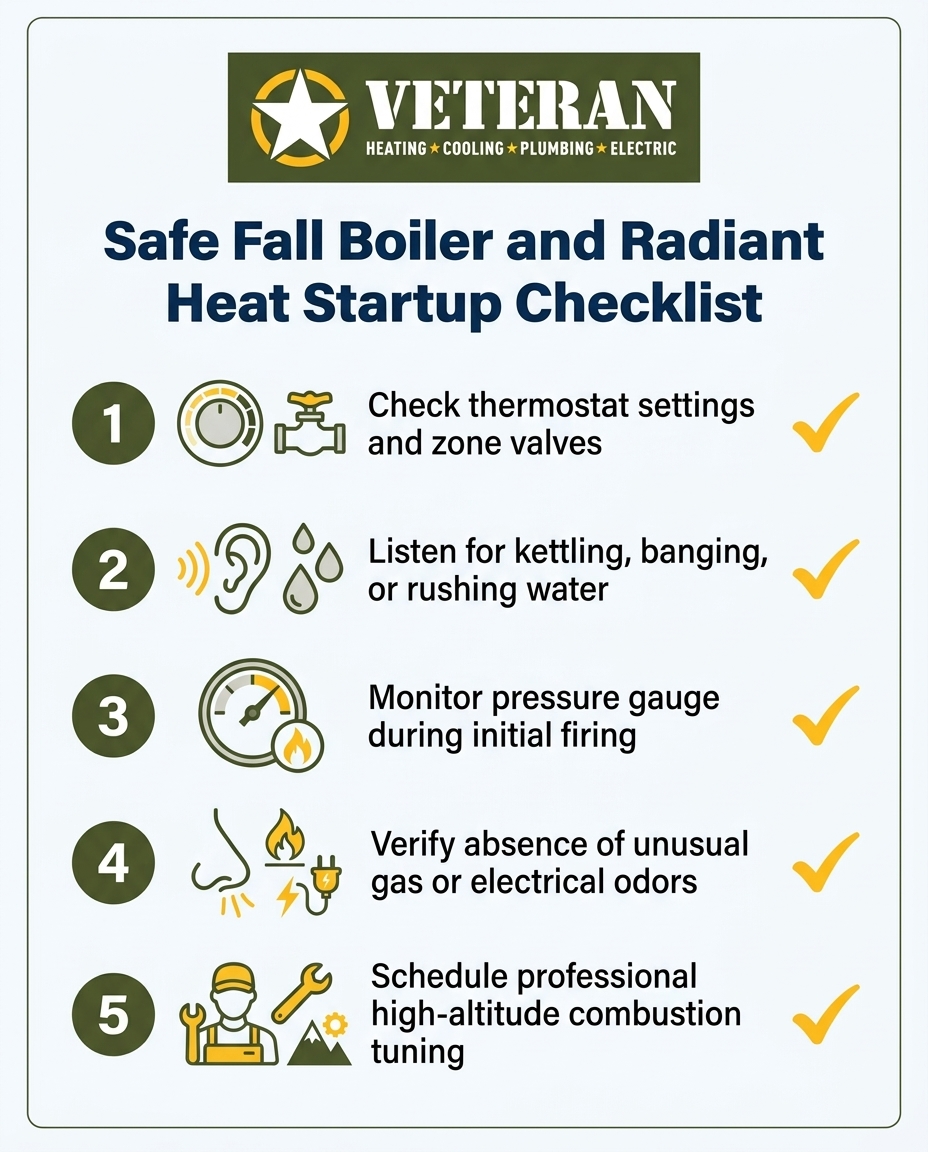
The problem: You hear a rushing water sound or light gurgling when the system first kicks on.
The cause: After sitting idle all summer, the water inside the closed loop settles, and small amounts of air can accumulate at the highest points of the system. This is a natural byproduct of temperature fluctuations during the off-season.
The solution: Minor gurgling that dissipates quickly is usually harmless. However, persistent rushing sounds indicate significant trapped air, which acts as an insulator and prevents hot water from circulating effectively through your baseboards or radiant loops. The professional solution is to bleed the system safely, removing the air locks without compromising the base water pressure.
Kettling and Banging: Signs of Scale Buildup
The problem: A deep rumbling or whistling noise that sounds exactly like a boiling teapot (kettling), or loud, abrupt banging sounds from the pipes.
The cause: Over time, hard water mineral deposits settle at the bottom of the boiler's heat exchanger. When the burner fires, water trapped under this scale boils rapidly, turning to steam and expanding violently. This rapid expansion creates the banging and whistling noises.
The solution: This is not a harmless startup noise. Kettling restricts water flow, drastically reduces heating efficiency, and can eventually crack the heat exchanger due to localized overheating. Professional flushing and descaling are required to clear these deposits and restore safe, quiet operation.
Pressure Gauge Fluctuations on Initial Firing
The problem: The pressure gauge reading spikes dangerously high or drops near zero when the boiler turns on.
The cause: A healthy residential boiler typically sits around 12 to 15 PSI when cold, rising slightly to about 20 PSI when fully heated. If the pressure spikes rapidly toward 30 PSI (the typical threshold for the pressure relief valve to discharge water), the expansion tank has likely failed, become waterlogged, or lost its internal air charge.
The solution: Never attempt DIY tinkering with pressure relief valves or water feed regulators. If your gauge shows consistently erratic readings during the initial startup, shut the system down. You need a professional to assess the expansion tank and recalibrate the water feed valve to prevent a dangerous over-pressurization event.
Radiant Floor Heating Troubleshooting: Solving Uneven Warmth
Radiant floor heating provides unparalleled comfort, but its hidden nature makes diagnosing issues tricky. When a homeowner turns on their system and discovers freezing cold spots in the bathroom while the living room is sweltering, panic often sets in. As radiant heat and boiler specialists, we follow a specific diagnostic path to solve uneven warmth.
Addressing Cold Spots and Uneven Zones
Radiant systems are divided into zones, with individual loops of PEX tubing serving different rooms. Diagnosing a cold spot requires isolating the specific loop that is failing to deliver heat.
1. Check the manifold actuators: Each loop connects to a central manifold equipped with motorized actuators (also known as zone valves). If a single actuator fails to open when the thermostat calls for heat, that specific room will remain freezing while the rest of the house warms up.
2. Identify air locks: If the actuator is functioning properly but the floor is still cold, an air lock within that specific loop is the most likely culprit. Air trapped in the tubing completely halts the flow of heated water, creating a hard blockage.
3. Assess the circulation pump: If multiple zones or the entire floor is struggling to heat up, the primary circulation pump may be seized from months of summer inactivity, or it may have suffered an electrical failure.
While checking the thermostat is a safe homeowner task, diagnosing manifold actuators or isolating a cold loop requires professional tools to prevent water damage or accidental system depressurization.
Thermostat Calibration for Radiant Systems
Radiant heat thermostats operate entirely differently than traditional forced-air systems. Because heating a concrete slab or subfloor involves immense thermal mass, radiant systems have a notoriously slow response time.
• Managing thermal lag: It can take several hours for a cold floor to reach the desired temperature. Cranking the thermostat up to 85°F will not make the room heat faster; it will only cause massive overheating hours later once the floor finally catches up.
• Utilizing floor sensors: Many radiant thermostats rely on in-floor sensors rather than just ambient air temperature. If these sensors are miscalibrated, the system may short-cycle before the room actually feels warm.
• Setting early fall schedules: Set a consistent, moderate schedule during the early fall rather than turning the system on and off daily. This maintains the thermal mass and reduces the workload on the boiler.
Understanding the indoor and outdoor HVAC unit connection and how your home's specific heating zones communicate with the boiler is key to maximizing winter comfort.
How High Altitude Impacts Your Boiler's Performance
Living in the Denver metro area means dealing with unique physical realities that directly affect mechanical systems. The 5,280-foot elevation is not just a geographical trivia fact; it fundamentally alters the physics of how your boiler operates. Out-of-the-box factory settings are designed for sea level, and running a boiler in this environment without specific high-altitude tuning is a recipe for inefficiency and premature breakdown.
The 5,280-Foot Difference in Boiling Points
At sea level, water boils at 212°F. However, in the lower atmospheric pressure of our region, water boils at approximately 202°F. This 10-degree difference completely changes the thermal dynamics of a residential boiler.
If a system is left at factory settings, it may attempt to heat the water past its local boiling point, causing the water to flash into steam within the pipes. This leads to severe kettling noises, rapid pressure spikes, and system short-cycling as the high-limit switch trips repeatedly. Professional calibration adjusts the aquastat (the boiler's internal thermostat) to respect the lower boiling point, ensuring smooth, consistent heat transfer without pushing the water into a gaseous state.
Combustion Air Requirements at High Elevation
Boilers require a precise mixture of oxygen and natural gas to burn cleanly. The thinner air at high elevations contains significantly less oxygen per cubic foot than air at sea level.
If a gas burner is not properly derated (a process where the gas input is adjusted to match the lower oxygen levels), the result is a "rich" mixture. This incomplete combustion causes a host of dangerous problems. Unburned fuel leaves thick carbon deposits (soot) on the heat exchanger, acting as an insulator and destroying the system's efficiency. More importantly, incomplete combustion dramatically increases the production of carbon monoxide, a deadly, odorless gas. A fuel-heavy mixture can also cause the burner flame to roll out of the combustion chamber, damaging electrical components and creating a severe fire hazard. This is exactly why high-altitude combustion tuning is absolutely mandatory for any boiler operating in the region.
Identifying Genuine Heating Emergencies Before Winter Hits
During an October pre-winter startup, you might encounter issues that go beyond simple maintenance needs. Knowing the difference between a harmless quirk and a critical failure allows you to act before a minor issue becomes a midnight emergency. If you are experiencing heating emergencies and safe fall startups concerns, here is a checklist of definitive red flags that warrant an immediate service call.
Persistent Ignition Failures and Lockouts
Modern boilers are equipped with sophisticated safety mechanisms designed to shut the system down entirely if it detects a dangerous condition. This protective state is known as a "lockout."
• What a lockout means: If the boiler attempts to fire but fails to detect a stable flame, it will lock itself out to prevent raw natural gas from flooding the combustion chamber and the surrounding utility room.
• The danger of resetting: While it is generally safe to press the reset button once, repeatedly resetting the system without diagnosing the root cause is incredibly dangerous. It bypasses the safety controls and can lead to explosive ignition.
• Common culprits: Lockouts are frequently caused by dirty flame sensors, failing pilot assemblies, or obstructed venting. These require professional diagnostic tools to resolve safely.
Unusual Burning Smells That Don't Dissipate
It is perfectly normal to notice a faint "burning dust" smell for the first 15 to 30 minutes of operation after a long summer. Dust settles on the heat exchanger and burns off harmlessly. However, other odors signal immediate danger.
• Electrical odors: A sharp, acrid smell similar to burning plastic, ozone, or melting wire indicates an electrical short or a failing circulation pump motor. Shut the system down immediately at the breaker panel.
• Gas odors: If you smell rotten eggs or natural gas near the boiler, do not touch any electrical switches. Evacuate the area, shut off the main gas supply if you know how to do so safely, and call for emergency professional leak detection.
Running a compromised boiler during a deep freeze is a gamble you cannot afford to lose. Prioritize safety and expert intervention when these red flags appear.
Applying Military Precision to Heating Diagnostics
When dealing with complex mechanical systems like boilers and radiant heat networks, a quick glance and a filter change simply will not suffice. As a veteran-owned business, we believe that military precision and discipline translate directly into a highly structured, trustworthy diagnostic process that never cuts corners. We approach every service call with a commitment to doing the job right the first time.
A No-Stone-Unturned Inspection Protocol
In our experience servicing local heating systems, the difference between a mid-winter breakdown and a flawless season lies entirely in the thoroughness of the fall inspection. A standard "quick look" tune-up often misses the subtle signs of impending failure. Our diagnostic protocol involves a rigorous, systematic checklist that evaluates every critical function of your equipment.
• Water Pressure & Flow — Diagnostic Action: Test expansion tank charge and verify circulation pump amp draw. — Why It Matters: Prevents dangerous pressure spikes and ensures even heat distribution across all radiant zones.
• Gas & Combustion — Diagnostic Action: Analyze flue gases and verify high-altitude oxygen-fuel mixtures. — Why It Matters: Guarantees safe, efficient burning and eliminates the risk of carbon monoxide exposure.
• Electrical & Controls — Diagnostic Action: Inspect zone valve actuators, test aquastat limits, and clean flame sensors. — Why It Matters: Prevents unexpected system lockouts and ensures the thermostat communicates accurately with the boiler.
By applying this level of operational discipline, as radiant heat and boiler specialists, we provide homeowners with complete reporting transparency. You see exactly what we look for during an annual heating check, ensuring your system is ready for the harshest weather the season can deliver.
Protecting Your Manufacturer Warranty with Proactive Fall Checks
Beyond the immediate comfort and safety benefits, scheduling a pre-winter startup check is one of the most effective ways to protect your financial investment. Many homeowners do not realize that the fine print in modern boiler warranties specifically requires proof of annual professional maintenance.
Manufacturer Requirements for Annual Maintenance
Manufacturers build complex, expensive equipment, and they expect it to be maintained to their exact specifications. If a major component like a heat exchanger cracks prematurely, the very first thing the manufacturer will ask for when you file a claim is the service history. Neglecting routine care effectively voids coverage for these expensive component failures.
A valid annual heating check provides the professional documentation needed to keep your warranty intact. This is why enrolling in a routine maintenance plan is a smart, proactive strategy. Not only does it ensure the system is checked systematically every fall, but it also creates an undeniable paper trail of responsible ownership, protecting you from out-of-pocket expenses for covered parts.
The Value of Priority Scheduling
When the first major snowstorm hits the Denver metro, local contractors are instantly overwhelmed with emergency calls from homeowners whose neglected systems have failed. Wait times can stretch for days, leaving families in the cold.
For established maintenance plan members, this panic is entirely bypassed. Members receive priority scheduling, meaning they are moved to the front of the line ahead of non-members. Securing your fall furnace tune-up scheduling or boiler check early provides the ultimate peace of mind, knowing that if the unexpected happens, you have a dedicated team ready to respond immediately.
Frequently Asked Questions About Boiler and Radiant Heat Maintenance
Why is my radiant floor heating not getting hot?
Your radiant floor heating may not be getting hot due to an air lock in the PEX tubing, a failed zone valve actuator, or a seized circulation pump. Because radiant systems rely on the smooth, continuous flow of heated water, any interruption in that flow leaves the floor cold. As radiant heat and boiler specialists, we recommend checking your thermostat settings first, then calling a professional if the manifold or actuators require electrical testing.
What are normal boiler sounds when first turned on?
Normal boiler sounds during the first fall startup include light clicking from the gas valve, a quiet whoosh of the burners igniting, and a brief rushing water sound as the fluid begins to circulate. These noises should settle into a low, steady hum within a few minutes. If you hear loud banging, whistling, or deep kettling sounds, shut the system down immediately, as these indicate trapped air or severe scale buildup in the heat exchanger.
How do I prep my boiler for winter?
To prep your boiler for winter, start by clearing the area around the unit to ensure proper airflow and visually inspecting the exposed pipes for minor leaks. Next, turn the thermostat up to trigger a heating cycle and monitor the pressure gauge to ensure it stays within the normal 12 to 20 PSI range. Finally, the most crucial step is scheduling a professional high-altitude combustion tune-up to ensure safe, efficient, and reliable operation all season long.
Do boilers need annual maintenance?
Yes, boilers absolutely require annual maintenance to operate safely and efficiently. Routine checks prevent hard water scale buildup, ensure the expansion tank is properly charged, and verify that all internal safety limits are functioning correctly. Furthermore, almost all modern boiler manufacturers require documented annual maintenance by a licensed professional to keep the equipment warranty valid.
Why is my radiant heating heating unevenly?
Uneven radiant heating is typically caused by trapped air bubbles in specific heating loops, which block the hot water from circulating through that particular zone. It can also be the result of a malfunctioning zone valve that fails to open fully when the thermostat calls for heat. Bleeding the system to remove these air locks requires specialized equipment to maintain the proper boiler pressure and prevent further issues.
When should I call a professional for radiant heat issues?
You should call a professional for radiant heat issues if you experience persistent cold spots, notice unexplained pressure drops on your boiler gauge, or hear loud mechanical banging from the utility room. DIY repairs on closed-loop pressurized systems can lead to severe water damage or dangerous combustion issues. Always rely on certified technicians to handle manifold adjustments, actuator replacements, or comprehensive system bleeding.
Secure Your Comfort Before the Next Hard Freeze
The peace of mind that comes from a properly functioning boiler is invaluable as the temperatures begin to plummet. By following these essential home maintenance tips and troubleshooting strategies during your October pre-winter startup, you can identify minor quirks before they escalate into major winter emergencies. Knowing exactly what to look and listen for empowers you to act decisively. Secure your comfort and protect your equipment's warranty by scheduling a comprehensive, professional heating check today, providing you with clear, expert guidance and ensuring your home remains a warm, reliable sanctuary all season long.
ABOUT Veteran Heating, Cooling, Plumbing & Electric
Veteran Heating, Cooling, Plumbing & Electric was founded on the belief that service should be personal, honest, and community-focused. Our team is built around integrity, professionalism, and a true commitment to your home’s comfort and safety.
Led by a U.S. Army veteran with over 30 years of industry experience, we’re proud to remain locally owned and operated. Every technician, plumber, and electrician is EPA-certified, background checked, and driven to exceed expectations.
- 24/7 ServiceWe offer weekend & 24/7 emergency service. We’re here whenever you need us—day, night, or weekend, no exceptions.
- $0 Trip FeesNo dispatch or trip fees. You’ll never pay just for us to show up—service starts when the work does.
OUR SERVICES
AIR CONDITIONING
.jpg)
We offer specialty and seasonal services like indoor air quality upgrades, pre-winter furnace checks, and summer AC tune-ups to keep your home prepared year-round.
Our Primary Air Conditioning Services Include:
Don't see the service you need? Call our Team today!
PLUMBING
From leaks to full system installs, our plumbing services cover everything you need for a safe, reliable home water system, 24/7.
Our Primary Plumbing Include:
- Water Heater Replacement
- Water Heater Repair
- Trenchless Sewer Line
- Water Filtration
- Slab Leak
- Sewer Line Repair
Don't see the service you need? Call our Team today!
ELECTRICAL

Our electrical services ensure your home stays safe and powered, from routine fixes to complete system upgrades.
Our Primary Electrical Services Include:
- House Rewiring
- Electrician
- Electric Panel Upgrade
- Electric Panel Replacement
- EV Chargers
- Whole House Generator
Don't see the service you need? Call our Team today!
HEATING
.jpg)
We install, repair, and maintain heating & furnace systems with expert care to keep your Colorado home comfortable and energy-efficient year-round.
Our Primary Heating Services Include:
- Heating Installation
- Heating Replacement
- Heating Maintenance
- Heating Repair
- Heating Service
- Heating Tune-Up
Don't see the service you need? Call our Team today!