Surviving the First Fall Chill: Why a Silent Furnace Doesn't Always Mean Disaster
Before the autumn leaves even begin to peak, knowing the exact questions our dispatchers ask when you call with a dead furnace in late September can be the difference between a quick fix and a freezing night. Here in Colorado, autumn weather rarely arrives gradually. At Veteran Heating, Cooling, Plumbing & Electric, our team has helped countless Denver homeowners navigate these rapid temperature swings, where a 30-degree drop in a single day forces families to suddenly fire up dormant furnaces. When that thermostat clicks and nothing happens, panic is the natural first response.
That initial intake phone call is much more than a simple scheduling step—it is a critical triage moment. Many early-season heating failures are actually resolved without a professional repair bill. A silent heating system during that late-September first cold snap often points to a minor oversight rather than a catastrophic mechanical failure. Our front office uses a transparent checklist of questions designed to help you identify these simple fixes safely.
By understanding what we look for during that initial call, you can confidently check your own system before picking up the phone. If a simple reset or a fresh set of batteries gets your heat running again, you save time and keep your home comfortable.
Our Integrity-First Dispatch Process: Why We Try NOT to Send a Technician Immediately
Standard industry practice often dictates dispatching a technician immediately the moment a homeowner reports a dead furnace. For many companies, rolling a truck is the quickest way to collect a service fee, regardless of whether the issue required a licensed professional. We take a fundamentally different approach. As a veteran-led organization, our core values of integrity and military discipline extend directly to the front office. That discipline means actively trying to save you an unnecessary dispatch fee whenever possible.
Instead of immediately booking an appointment, our dispatchers are trained to walk homeowners through safe, basic troubleshooting over the phone. We want to ensure that if a Veteran Heating, Cooling, Plumbing & Electric technician arrives at your home in the Denver metro area, it is because you genuinely need professional expertise. One local homeowner reached out for general HVAC service last summer, and our team made sure to explain the entire service process, answer all questions, and provide honest advice alongside top-tier workmanship. That same transparency applies to emergency heating calls.
The Value of Honest Phone Triage
Taking a few minutes on the phone to troubleshoot can save a costly and unnecessary visit. We clearly define the boundary between safe homeowner checks and licensed professional work. We will never ask you to open the furnace cabinet or handle internal electrical components. The checks we guide you through are entirely external and risk-free.
• Protecting your wallet: Ruling out simple oversights keeps your maintenance budget intact for actual repairs.
• Prioritizing real emergencies: By solving minor issues over the phone, we keep our technicians available for neighbors facing dangerous no-heat situations.
• Empowering the homeowner: You learn exactly how your system operates, making you better prepared for future seasons.
Dispatcher Question #1: What is the Thermostat Currently Doing?
The very first suspect when a furnace refuses to ignite is the device telling it to turn on. The thermostat acts as the brain of your HVAC system, and if it sends the wrong signal—or no signal at all—the furnace will remain completely silent during that late-September first cold snap.
Verifying System Modes and Set Points
The transition from summer cooling to autumn heating is a prime time for thermostat confusion. In fact, our front office team typically sees a huge spike in calls during early September where a system is simply in the wrong mode.
1. Check the system mode: Verify that the switch or digital display is explicitly set to "Heat." If it was left on "Cool" or switched to "Off" at the end of summer, the furnace will not respond to a drop in room temperature.
2. Verify the set point: Ensure the target temperature is set at least three to five degrees higher than the current room temperature. A smaller margin might not trigger the heat call immediately.
3. Listen for the click: Once you raise the temperature, listen closely to the thermostat. You should hear a faint click indicating that the call for heat has been sent to the control board.
The Hidden Culprit: Dead Batteries
Even hardwired thermostats often rely on backup batteries to maintain settings and facilitate communication with the furnace control board. If the display is blank, fading, or showing a low-battery icon, replace the batteries immediately. This is a zero-risk first step that resolves a surprising number of early-season service calls.
• Blank digital screen — Potential Cause: Dead batteries or tripped breaker — Safe Homeowner Action: Replace batteries; check electrical panel
• Screen on, but no heat — Potential Cause: Wrong mode selected — Safe Homeowner Action: Switch from "Cool" or "Off" to "Heat"
• Room is cold, system silent — Potential Cause: Set point too low — Safe Homeowner Action: Raise target temp 5 degrees above room temp
Dispatcher Question #2: What Does the Electrical Panel Show?
Even if your furnace runs on natural gas, it requires a steady supply of electricity to operate the blower motor, the control board, and the electronic ignition system. If the power is cut, the gas will not flow, and the system will remain dormant.
Identifying the Furnace Breaker
When you call our team, we will ask you to check your electrical panel before firing up your furnace. Locating the correct switch in the electrical panel is a safe, straightforward process for any homeowner in the Denver metro area. Look for a breaker labeled "Furnace," "HVAC," or "Heating."
Visual cues of a tripped breaker: A tripped breaker rarely flips all the way to the "Off" position. Instead, it usually rests slightly out of line with the other switches, stuck in the middle. Sometimes, a small red indicator window becomes visible.
How to safely reset it:
• Firmly push the breaker switch entirely to the "Off" position until you feel it click.
• Wait a few seconds.
• Push the switch firmly back to the "On" position.
The critical warning: If the breaker trips again immediately after you reset it, or if it trips repeatedly over the next few hours, stop touching it. A repeatedly tripping breaker signals a serious electrical short or an overloaded blower motor. At this point, professional intervention is mandatory to prevent electrical hazards or fire risks.
Dispatcher Question #3: Is the Furnace Power Switch Flipped?
One of the most frequently overlooked components of a heating system is the dedicated power switch. Code requires furnaces to have a local disconnect switch, which typically looks exactly like a standard light switch mounted on the side of the furnace cabinet or on a nearby wall or ceiling joist.
During the summer months, this switch is easily bumped by accident. Homeowners storing holiday decorations in the basement, moving boxes in the utility closet, or performing routine summer cleaning often flip this switch without realizing it. When that late-September first cold snap hits, the furnace has absolutely no power to start the ignition sequence.
What to check:
• Locate the switch near the furnace unit.
• Verify it is flipped UP to the "On" position.
• If it was off, flip it on and wait three to five minutes. Modern furnaces go through a diagnostic sequence before attempting to ignite.
We always reiterate to our callers that verifying this switch is an external, completely safe check. It does not involve opening the furnace cabinet or exposing yourself to any moving parts or high voltage.
Dispatcher Question #4: What is the Condition of Your Air Filter?
A dirty air filter is not just an efficiency issue; it is a primary cause of complete system shutdowns. Over the summer, your air conditioning system uses the exact same blower motor and filter as your furnace. By the time autumn arrives, that filter is often heavily clogged with months of accumulated dust, pet dander, and debris.
The Role of the Limit Switch
Your furnace is designed with multiple safety mechanisms, the most important being the high-limit switch. This sensor monitors the internal temperature of the heat exchanger. Airflow is critical to safe operation because the blower motor pushes cool house air over the heat exchanger, absorbing the heat and carrying it into your ductwork.
If a clogged filter restricts that airflow, the heat cannot escape the furnace cabinet. The heat exchanger rapidly overheats, and the limit switch trips, shutting down the burners immediately to prevent a fire or a cracked heat exchanger. Our technicians routinely pull out heavily impacted filters on early fall service calls, as dust and dry air in the Denver metro area cause filters to clog much faster than many homeowners expect.
The quick fix: Pull the filter out and hold it up to a light bulb. If you cannot see light shining through the material, it is severely restricted. Replace it with a fresh filter, cycle the power to the furnace off and back on, and see if the system resets and runs normally. Regular filter maintenance is the single easiest way to prevent early-season breakdowns.
Dispatcher Question #5: For Older Models, Is the Pilot Light Lit?
While the vast majority of modern heating systems use electronic hot-surface igniters or spark igniters, some older homes still rely on conventional standing pilot lights. If you have an older system, the pilot light must remain lit continuously for the main burners to ignite.
During a late-September first cold snap, you might discover that a strong draft, a brief gas interruption, or a dirty pilot orifice extinguished the small flame over the summer. We ask this question to differentiate between older furnaces and modern systems, but we handle the advice with strict safety protocols.
Safe visual verification:
• Look through the small viewing port at the bottom of the furnace cabinet.
• Check for a small, steady blue flame.
• If you do not see a flame, the pilot is out.
We advise homeowners that if they are unsure how to relight it, or if they smell even a faint odor of natural gas or sulfur, they should immediately stop, leave the area, and wait for a professional. Internal gas components should only be handled by certified technicians. We never encourage dangerous DIY relighting if you are uncomfortable with the process.
When Safe Checks Aren't Enough: Moving from Triage to Professional Repair
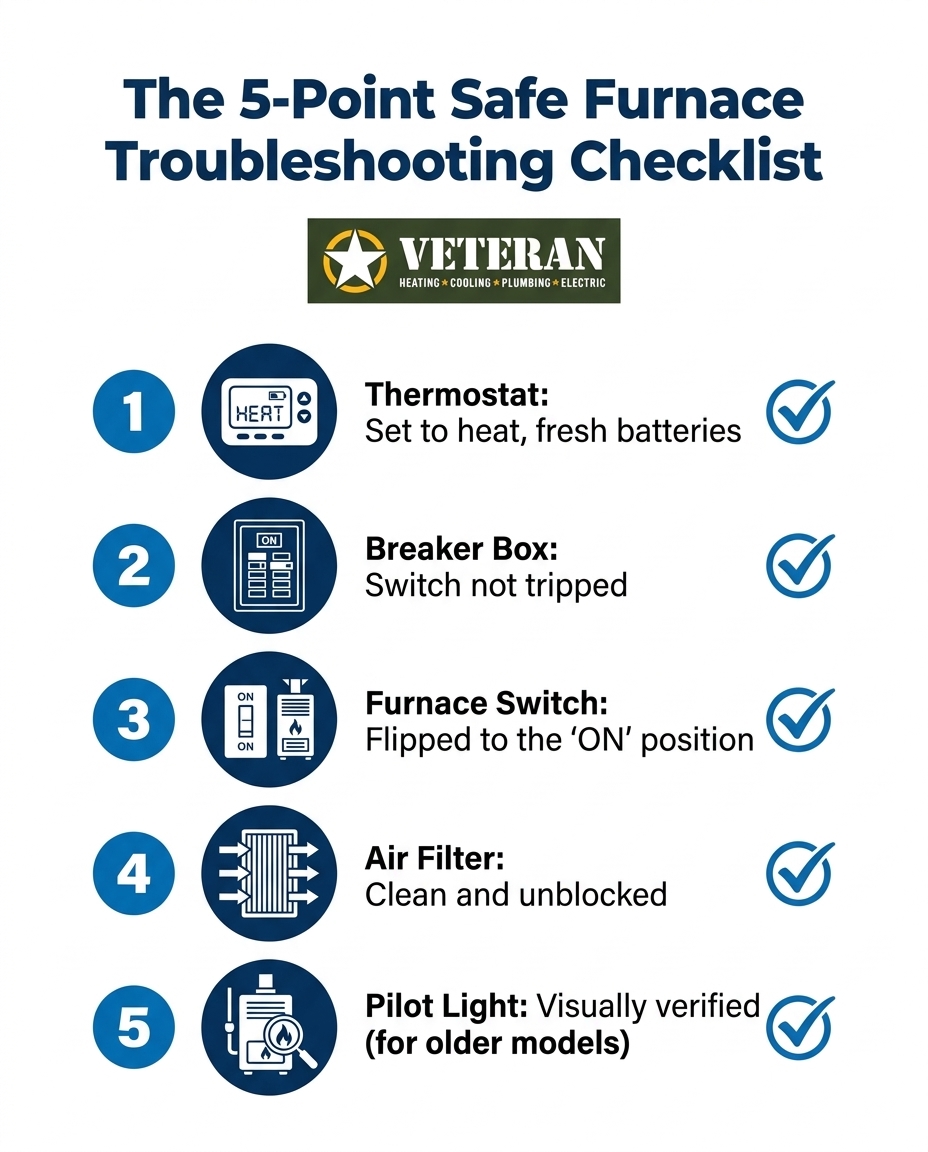
If you have checked the thermostat, reset the breaker, verified the power switch, replaced the filter, and visually inspected the pilot, and the system remains dead, professional intervention is officially required. By answering these dispatcher questions, you have successfully ruled out the easy fixes. You can now book a service call with complete confidence, knowing the visit is genuinely necessary.
The transition from our intake call to dispatching a knowledgeable technician is seamless. Because we have already gathered the triage data, our technicians arrive prepared for complex diagnostics rather than simple oversights. For example, one local homeowner reached out during a previous fall when their furnace was not working correctly after running through these basics. A technician named Jeff was dispatched, and because the simple fixes were already ruled out, he professionally and efficiently diagnosed and fixed the internal furnace problem, providing fast and dependable service. That is the exact experience we aim to deliver across the Denver metro area.
There is immense peace of mind that comes from knowing a repair visit is justified. You aren't paying a professional to flip a switch; you are paying for licensed expertise to safely diagnose control boards, blower motors, and gas valves.
Frequently Asked Questions About Early Fall Furnace Failures
What should I check before calling a furnace repairman?
Before calling for a repair, you should always check your thermostat settings, replace the thermostat batteries, and inspect your electrical panel for a tripped breaker. Additionally, verify that the furnace power switch is turned on and that your air filter is clean. These safe, external checks resolve a large percentage of calls during the late-September first cold snap.
Why is my furnace not turning on for the first time in fall?
A furnace often fails to turn on in the fall because the thermostat is still set to cooling mode or the batteries have died over the summer. Another common cause is a severely clogged air filter left over from heavy air conditioning use, which trips the internal safety switches. Finally, the local power switch may have been accidentally bumped off during summer storage or cleaning.
How do you reset a furnace breaker safely?
To safely reset a furnace breaker, locate the electrical panel and find the switch labeled for the heating system. Firmly push the switch entirely to the "Off" position until it clicks, wait a few seconds, and then push it firmly back to the "On" position. If the breaker immediately trips again, leave it off and call a professional, as this indicates a serious electrical short.
Can a dirty air filter completely stop a furnace from working?
Yes, a dirty air filter can completely shut down a heating system. When the filter is clogged, it severely restricts airflow, causing the heat exchanger to overheat rapidly. The furnace's high-limit switch detects this dangerous temperature spike and shuts off the burners as a safety precaution to prevent fire or mechanical damage.
Why does my furnace have a light switch next to it?
Building codes require furnaces to have a dedicated local disconnect switch for safety and maintenance purposes. It looks like a standard light switch and cuts electrical power directly to the unit so technicians can work safely. If this switch is accidentally flipped off, the furnace will not respond to the thermostat at all.
Partner with a Team That Puts Your Peace of Mind First
Facing a cold house doesn't have to be a stressful experience when you have a team that prioritizes transparency. Knowing the exact questions our dispatchers ask when you call with a dead furnace in late September empowers you to troubleshoot safely and avoid unnecessary service fees. If your system in the Denver metro area fails these basic checks, you can trust our veteran-led team to provide honest diagnostics and reliable repairs. Reach out today to schedule a thorough inspection and ensure your home stays warm all winter long.
ABOUT Veteran Heating, Cooling, Plumbing & Electric
Veteran Heating, Cooling, Plumbing & Electric was founded on the belief that service should be personal, honest, and community-focused. Our team is built around integrity, professionalism, and a true commitment to your home’s comfort and safety.
Led by a U.S. Army veteran with over 30 years of industry experience, we’re proud to remain locally owned and operated. Every technician, plumber, and electrician is EPA-certified, background checked, and driven to exceed expectations.
- 24/7 ServiceWe offer weekend & 24/7 emergency service. We’re here whenever you need us—day, night, or weekend, no exceptions.
- $0 Trip FeesNo dispatch or trip fees. You’ll never pay just for us to show up—service starts when the work does.
OUR SERVICES
AIR CONDITIONING
.jpg)
We offer specialty and seasonal services like indoor air quality upgrades, pre-winter furnace checks, and summer AC tune-ups to keep your home prepared year-round.
Our Primary Air Conditioning Services Include:
Don't see the service you need? Call our Team today!
PLUMBING
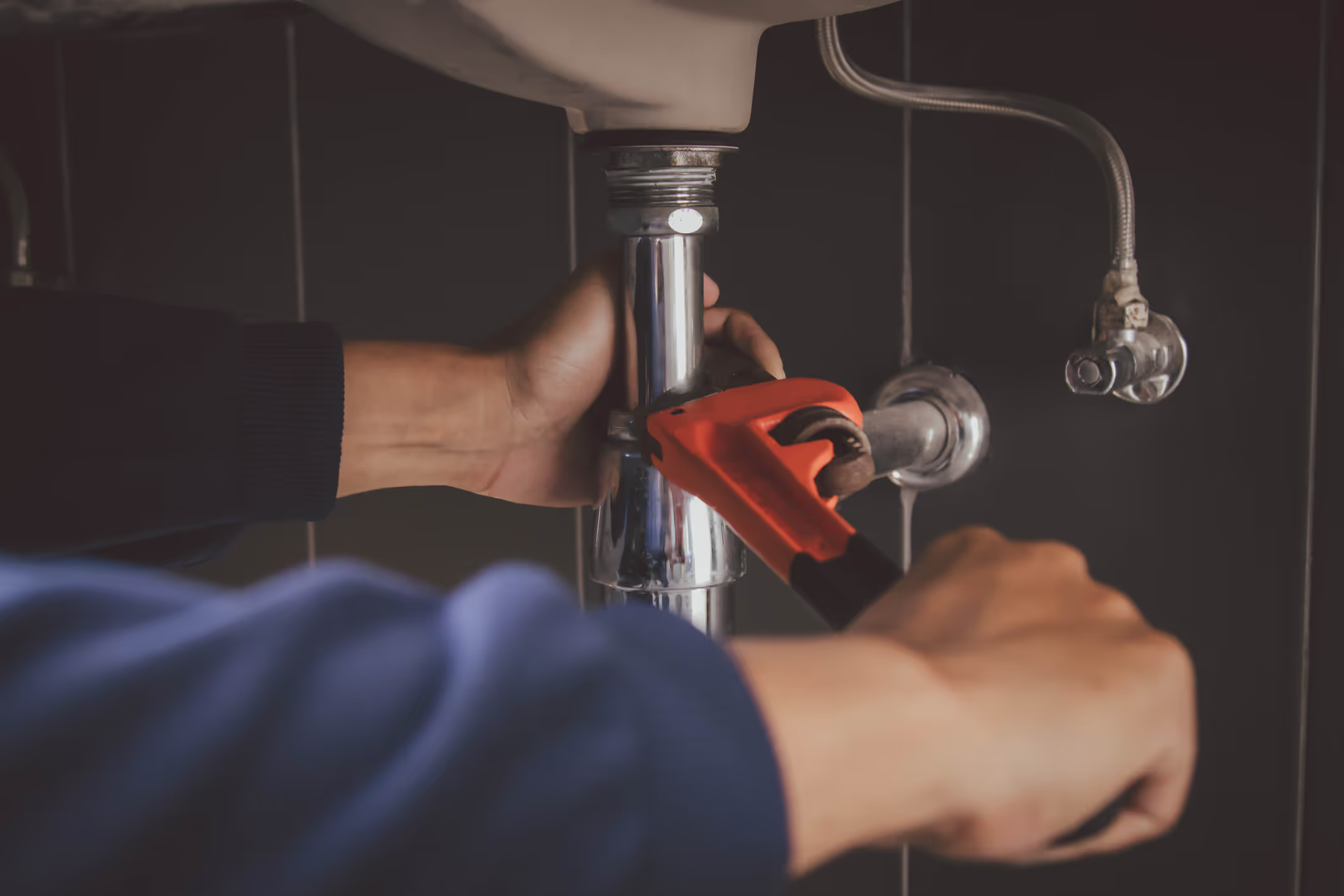
From leaks to full system installs, our plumbing services cover everything you need for a safe, reliable home water system, 24/7.
Our Primary Plumbing Include:
- Water Heater Replacement
- Water Heater Repair
- Trenchless Sewer Line
- Water Filtration
- Slab Leak
- Sewer Line Repair
Don't see the service you need? Call our Team today!
ELECTRICAL

Our electrical services ensure your home stays safe and powered, from routine fixes to complete system upgrades.
Our Primary Electrical Services Include:
- House Rewiring
- Electrician
- Electric Panel Upgrade
- Electric Panel Replacement
- EV Chargers
- Whole House Generator
Don't see the service you need? Call our Team today!
HEATING
.jpg)
We install, repair, and maintain heating & furnace systems with expert care to keep your Colorado home comfortable and energy-efficient year-round.
Our Primary Heating Services Include:
- Heating Installation
- Heating Replacement
- Heating Maintenance
- Heating Repair
- Heating Service
- Heating Tune-Up
Don't see the service you need? Call our Team today!