When Summer Heat Meets High Demand: The Retrofit Dilemma
As the August late-summer cooling season sets in and the back-to-school transition begins, our team frequently sees homeowners forced to face the reality of installing a tankless water heater in an older Denver home when the AC is running non-stop. Late summer in our region brings intense heat waves that push residential cooling systems to their absolute limits. While the appeal of endless hot water is undeniable, swapping out a traditional tank for a modern tankless unit isn't a simple, plug-and-play plumbing job. It is a comprehensive infrastructure project. Homeowners often want the upgrade immediately, but in our experience servicing Denver's historic neighborhoods, older residential infrastructure frequently hides significant hurdles behind the drywall.
The core problem centers on capacity. When you introduce a high-draw appliance into a home where the cooling system is already maximizing the electrical panel's output, you run the risk of overloading the system. This creates a critical decision point: you must evaluate whether your current electrical panel and gas lines can safely support the simultaneous load of an air conditioner and a tankless system without requiring a whole-home infrastructure upgrade first.
If you are exploring water heater replacement in Denver, understanding the multi-trade HVAC, plumbing, and electrical benefits of a unified assessment is the most important first step toward a safe and successful project.
Understanding the Electrical Baseline in Historic Properties
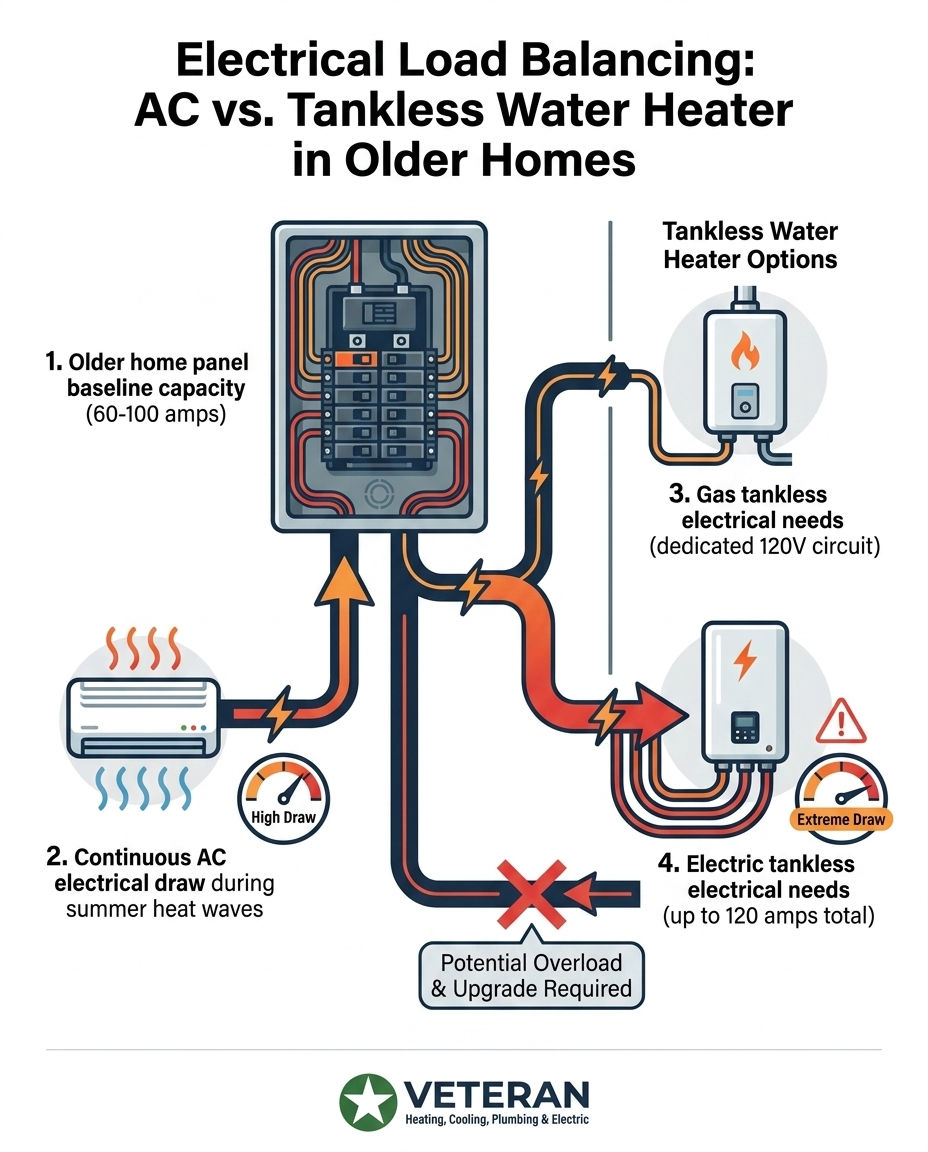
The problem: Many older Denver neighborhoods are defined by historic charm, but that charm often masks outdated electrical infrastructure. Homes built before the 1970s were simply not designed to handle the simultaneous power demands of modern, high-efficiency appliances.
The cause: The standard electrical baseline for a mid-century home was typically a 60-amp to 100-amp electrical panel. Decades ago, this was more than enough to run basic lighting, a refrigerator, and a standard furnace. Today, the landscape is entirely different. A modern household might run a central air conditioner, an electric oven, a microwave, multiple computers, and a tankless water heater all at the exact same time. When our electricians inspect these aging systems, we routinely find that outdated panels become dangerously stressed under sustained, high-amperage draws. Heat builds up at the breaker connections, and the risk of a sudden failure increases dramatically. In fact, our team notes that homeowners often discover hidden electrical problems in older homes only after they attempt to add a new major appliance.
The solution: Adding any new high-draw appliance requires a formal, professional electrical load calculation. This calculation takes inventory of every electrical demand in your home to determine if your current panel has the physical capacity to safely handle the addition. You cannot simply look at a panel, see an empty breaker slot, and assume there is enough overall amperage available.
The Impact of Continuous Air Conditioning on Panel Capacity
To truly understand the strain on your home's electrical system, you have to look at how air conditioners consume power during the August late-summer cooling season. Denver's specific climate extremes—featuring intense, sustained afternoon heat—make continuous AC operation a necessity rather than a luxury. When your air conditioner runs continuously, it monopolizes a massive portion of your available amperage.
Starting amps versus running amps: Air conditioners have two distinct power profiles. The Locked Rotor Amps (LRA) represent the massive surge of electricity required just to kick the compressor on. This surge only lasts a fraction of a second, but it is incredibly demanding. The Rated Load Amps (RLA) represent the continuous power the unit needs to keep running. During a heat wave, your AC might run for hours at its full RLA, effectively removing any "buffer" or overhead in a standard 100-amp panel.
We see this exact scenario play out every August: if you introduce a tankless water heater into this environment without upgrading the panel, the results are highly predictable. The moment the AC kicks on while someone is taking a shower, the combined load exceeds the main breaker's rating. This leads to nuisance tripping—where your main breaker constantly shuts off power to the entire house—or worse, severe overheating within the panel itself. Because evaluating these loads involves complex calculations and significant safety risks, this assessment must always be performed by a licensed professional, never as a weekend DIY project.
Tankless Water Heater Power Requirements: Gas vs. Electric
A common myth among homeowners in older Denver neighborhoods is that choosing a gas-powered tankless water heater means you don't have to worry about electricity. This is entirely false. Both gas and electric tankless units have specific electrical requirements that will impact your home's infrastructure.
• Electric Tankless — Electrical Requirements: Up to 120 amps (requires 3 to 4 double-pole breakers) — Infrastructure Impact: Almost always requires a full 200-amp or 320-amp panel upgrade in older homes.
• Gas Tankless — Electrical Requirements: Dedicated 120V standard electrical outlet — Infrastructure Impact: Requires a new, dedicated circuit to prevent interference with other appliances.
If you opt for a fully electric tankless unit, the electrical demand is staggering. These units heat water instantly using heavy-duty heating elements that can require up to 120 amps all by themselves. If your home only has a 100-amp panel, an electric tankless unit is mathematically impossible to run without a comprehensive electric panel replacement.
Gas-powered tankless units are much gentler on your electrical panel, but they are not exempt from electrical needs. A gas unit requires a dedicated 120V electrical outlet to power its electronic ignition, internal computer board, and built-in freeze protection systems. If this unit shares a circuit with another appliance, a tripped breaker means you lose your hot water entirely.
It is also worth noting that upgrading to high-efficiency systems often qualifies for generic energy rebates or tax credits. While programs vary by year and municipality, checking with your local utility provider can help offset the cost of necessary infrastructure upgrades.
Gas Line Sizing and High-Altitude Adjustments
If you choose a gas tankless water heater to avoid a massive electrical upgrade, you still have to navigate the realities of older plumbing infrastructure and regional climate factors. Older Denver neighborhoods present unique challenges when it comes to gas delivery.
Addressing Legacy Gas Infrastructure
Traditional tank water heaters sip gas slowly throughout the day. Tankless units, however, require a massive surge of gas to heat water instantly on demand.
1. Identifying undersized pipes: Most older homes were built with half-inch gas lines. A modern, high-BTU tankless unit almost universally requires a three-quarter-inch gas line to operate correctly. Attempting to run a tankless unit on an undersized line will result in error codes, system lockouts, and a lack of hot water.
2. Ensuring safe connections and leak prevention: Modifying older gas lines requires extreme caution. The joints in aging pipes can become compromised when disturbed. One local homeowner recently experienced the importance of this firsthand when our technicians identified and fixed two hidden gas leaks during a routine inspection—a critical safety intervention that had to be addressed before any new equipment could be installed.
The Science of High-Altitude Derating
Denver's "Mile High" elevation is a critical factor in gas appliance combustion and efficiency.
1. Why less oxygen means less heat output: At higher altitudes, the air is thinner and contains less oxygen per cubic foot. Because fire requires oxygen to burn, a gas burner in Denver cannot produce the same amount of heat as that exact same burner operating at sea level.
2. Selecting the right unit for elevation: This phenomenon requires a process called "high-altitude derating." Our plumbers and HVAC technicians must calculate the necessary BTU output adjustments and specifically configure the unit's internal dip switches or computer settings for high altitude. Furthermore, proper venting adjustments are strictly required to ensure that carbon monoxide is safely expelled from the home.
The Multi-Trade Orchestration Required for a Safe Upgrade
Upgrading a historic home's water heating system is rarely a single-trade job. The logistical nightmare of trying to act as your own general contractor—hiring a separate plumber to pipe the water, an electrician to upgrade the panel, and an HVAC technician to handle the gas venting—is overwhelming and frequently leads to costly delays.
Working with a unified team changes the entire dynamic. At Veteran Heating, Cooling, Plumbing & Electric, we bring a distinct multi-trade capability to these complex retrofits. By utilizing military precision to orchestrate the plumbing, gas modifications, and electrical panel load calculations simultaneously, the project moves seamlessly.
Our unified coordination ensures that the electrician's load calculation perfectly accounts for the air conditioner's summer draw, while the plumber ensures the gas line is sized correctly for the specific tankless unit being installed. This cross-discipline expertise guarantees that safety protocols and local building codes are strictly followed across all trades, ensuring you aren't left without hot water or cooling during the transition.
Evaluating Your Home's Infrastructure for a Tankless Retrofit
Before committing to a tankless upgrade, especially leading into the August late-summer cooling season, a thorough evaluation of your home's current capabilities is essential. Here is what our professional assessment will review:
• The age and capacity of the current electrical panel: Verifying if you have a 100-amp, 150-amp, or 200-amp service, and checking the physical condition of the bus bars.
• The age and continuous draw of the existing air conditioning system: Determining the RLA and LRA of your cooling equipment to accurately calculate available overhead.
• The current gas line size and routing: Measuring the diameter of the existing pipes and calculating the distance from the gas meter to the installation site.
• The exhaust venting pathways: Identifying how the high-efficiency PVC or concentric venting will safely exit the home.
An expert assessment is the only reliable way to ensure safe, compliant, and efficient operation of your new system.
Frequently Asked Questions About Tankless Upgrades in Older Homes
Can a 100 amp panel handle a tankless water heater?
The short answer is usually no if you are considering an electric tankless unit. Electric tankless water heaters require an immense amount of power, often needing up to 120 amps on their own. If your home has a 100-amp panel, installing an electric unit would require a complete service upgrade. However, a 100-amp panel can often handle a gas tankless water heater, provided a formal load calculation shows enough capacity for the unit's 120V ignition system alongside your other appliances.
Does a tankless water heater need a dedicated circuit?
Yes, almost all modern tankless water heaters require a dedicated electrical circuit. For gas units, this is typically a standard 120V circuit that powers the computer board, ignition, and freeze protection without interference from other devices. For electric units, multiple dedicated 240V circuits are required. Sharing a circuit risks tripped breakers, which will instantly shut down your hot water supply.
Do I need to upgrade my electrical panel for a tankless water heater?
Whether you need an upgrade depends entirely on your home's current capacity and the type of unit you select. Electric tankless units almost universally require a panel upgrade in older homes due to their massive amperage draw. Gas units are far less demanding electrically, but an upgrade might still be necessary if your current panel is completely full or outdated. A professional load calculation is required to know for sure.
How much electricity does a gas tankless water heater use?
A gas tankless water heater uses a very minimal amount of electricity. It typically draws less than 3 to 5 amps to operate the digital display, the electronic ignition spark, and the internal sensors. While the electrical footprint is small, this power is absolutely vital; during a power outage, a gas tankless unit will not produce hot water unless it is connected to a battery backup.
How does Denver's altitude affect gas tankless water heater performance?
Denver's high altitude means the air is thinner and contains less oxygen, which directly impacts the combustion process of gas appliances. Because there is less oxygen available for the burner, a unit will naturally produce fewer BTUs than it would at sea level. To compensate, our professionals must perform high-altitude derating, adjusting the unit's settings so it burns fuel safely and efficiently in the thinner air.
Can I run my AC and a tankless water heater at the same time in an older home?
You can run both simultaneously only if your home's infrastructure has been properly sized to handle the combined load. In older homes with outdated 100-amp panels, the continuous draw of an air conditioner combined with the sudden spike of a high-draw appliance can easily trip the main breaker. A professional assessment will determine if your current panel can handle both or if an infrastructure upgrade is necessary.
Next Steps for Upgrading Your Home's Water Heating System
Upgrading to endless hot water is an exciting prospect, but as we've explored, the reality of installing a tankless water heater in an older Denver home when the AC is running non-stop requires careful planning. A realistic breakdown of your home's electrical and gas requirements is the only way to ensure a safe, effective, and code-compliant upgrade. By treating the installation as a holistic infrastructure project rather than a simple appliance swap, you protect your home from overloaded panels and undersized gas lines. We highly encourage homeowners to seek a comprehensive home infrastructure evaluation to understand their true capacity. When you are ready to explore professional, multi-trade installation options, rely on our experts at Veteran Heating, Cooling, Plumbing & Electric to safely orchestrate every detail of the process.
ABOUT Veteran Heating, Cooling, Plumbing & Electric
Veteran Heating, Cooling, Plumbing & Electric was founded on the belief that service should be personal, honest, and community-focused. Our team is built around integrity, professionalism, and a true commitment to your home’s comfort and safety.
Led by a U.S. Army veteran with over 30 years of industry experience, we’re proud to remain locally owned and operated. Every technician, plumber, and electrician is EPA-certified, background checked, and driven to exceed expectations.
- 24/7 ServiceWe offer weekend & 24/7 emergency service. We’re here whenever you need us—day, night, or weekend, no exceptions.
- $0 Trip FeesNo dispatch or trip fees. You’ll never pay just for us to show up—service starts when the work does.
OUR SERVICES
AIR CONDITIONING
.jpg)
We offer specialty and seasonal services like indoor air quality upgrades, pre-winter furnace checks, and summer AC tune-ups to keep your home prepared year-round.
Our Primary Air Conditioning Services Include:
Don't see the service you need? Call our Team today!
PLUMBING
From leaks to full system installs, our plumbing services cover everything you need for a safe, reliable home water system, 24/7.
Our Primary Plumbing Include:
- Water Heater Replacement
- Water Heater Repair
- Trenchless Sewer Line
- Water Filtration
- Slab Leak
- Sewer Line Repair
Don't see the service you need? Call our Team today!
ELECTRICAL

Our electrical services ensure your home stays safe and powered, from routine fixes to complete system upgrades.
Our Primary Electrical Services Include:
- House Rewiring
- Electrician
- Electric Panel Upgrade
- Electric Panel Replacement
- EV Chargers
- Whole House Generator
Don't see the service you need? Call our Team today!
HEATING
.jpg)
We install, repair, and maintain heating & furnace systems with expert care to keep your Colorado home comfortable and energy-efficient year-round.
Our Primary Heating Services Include:
- Heating Installation
- Heating Replacement
- Heating Maintenance
- Heating Repair
- Heating Service
- Heating Tune-Up
Don't see the service you need? Call our Team today!