When the Late Summer Transition Overwhelms Aging Plumbing Systems
As the August back-to-school transition arrives, households undergo a massive behavioral shift. At Veteran Heating, Cooling, Plumbing & Electric, our team knows firsthand that understanding the hidden connection between back-to-school schedule changes and sudden water heater failures is the first step to preventing a cold shower. During the relaxed months of summer, morning routines are often staggered. One family member might shower at 6:00 a.m., another at 8:30 a.m., and a third in the evening. This relaxed pacing gives your home's plumbing systems plenty of time to recover, masking underlying wear and tear on aging equipment.
However, once the school year begins, that staggered routine vanishes overnight. Suddenly, the entire household needs to shower, run the bathroom sinks, and perhaps start a load of laundry within the exact same concentrated timeframe. This abrupt shift forces an aging water heater to operate at absolute maximum capacity without its usual recovery periods. For older tanks that have been coasting through the summer months, this sudden, relentless demand is often the breaking point.
Recognizing the early warning signs of mechanical stress before a total rupture occurs can save you from a chaotic morning emergency. When an aging tank faces this sudden demand spike, the right next step is evaluating whether your equipment is simply struggling to keep up or actively failing. By understanding how your family's daily schedule impacts the physical stress on your plumbing, you can make informed decisions about traditional and tankless water heater options to ensure your home is ready for the busy months ahead.
The Shock of the 60-Minute Peak Demand Window
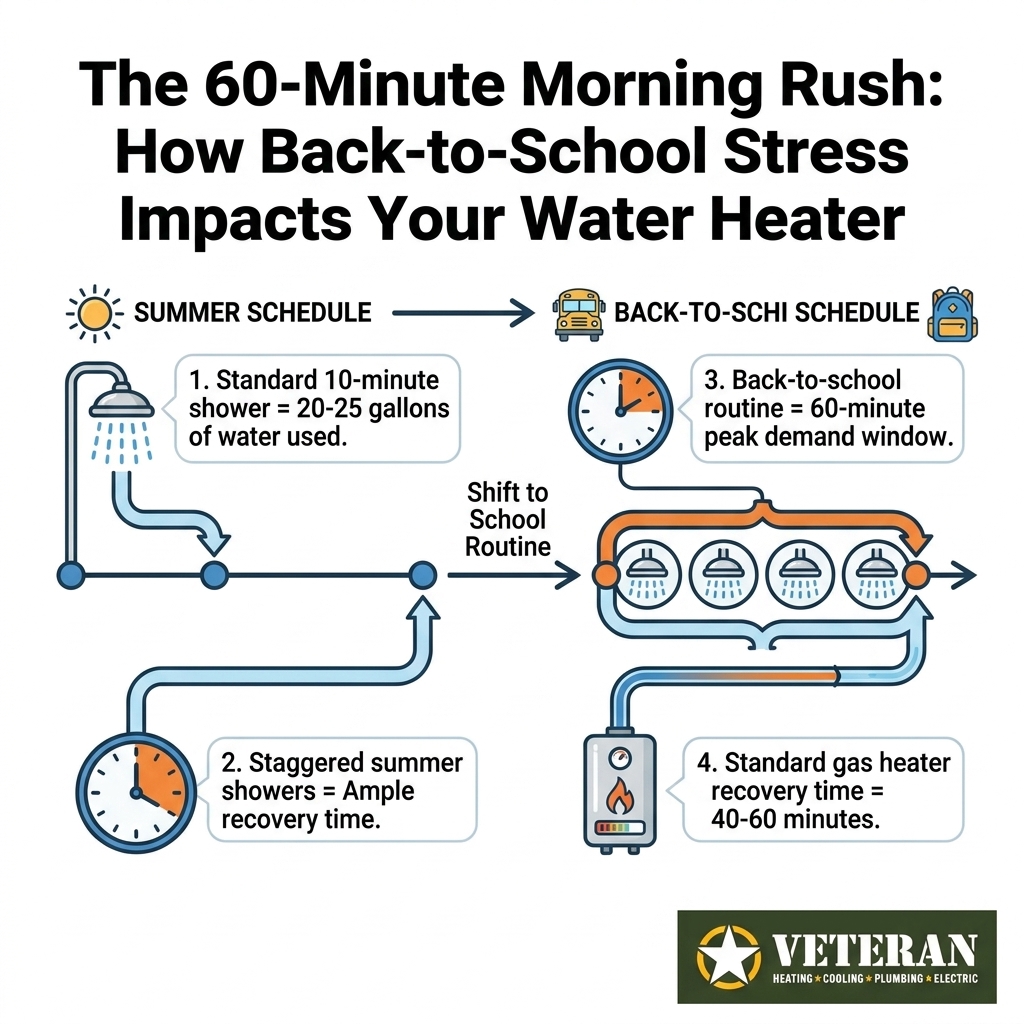
To understand why water heaters fail in late August, you have to look at the math behind household water consumption. The back-to-school routine compresses nearly all of a family's hot water demand into a single 60-minute peak demand window. This highly stressful, concentrated timeframe completely changes how your plumbing system operates compared to the rest of the year.
Consider the volume of water moving through your system during a typical morning rush. A standard showerhead uses approximately two to two-and-a-half gallons of water per minute. That means a standard 10-minute shower consumes 20 to 25 gallons of hot water. If your home has a standard 40- or 50-gallon tank, a single shower depletes half of its stored reserves. When two or three family members shower back-to-back, the tank is rapidly emptied of its heated water and filled entirely with cold groundwater.
The typical timeline of a morning rush looks like this:
• Minute 0 to 10: The first shower uses 25 gallons. The tank begins pulling in cold water to replace it, lowering the overall internal temperature.
• Minute 10 to 20: The second shower begins immediately. The tank is now dispensing a mixture of remaining hot water and newly introduced cold water. The burner fires up, but it cannot heat the incoming water fast enough.
• Minute 20 to 30: The third shower starts. The original 50 gallons of stored hot water are completely gone. The person showering is now relying entirely on the tank's ability to heat water in real-time, which a standard tank is not designed to do.
This sudden, massive draw forces the system to operate at maximum capacity without adequate recovery time. The burner or heating elements are pushed to their absolute limits. If you find your family constantly running out of hot water during this crucial hour, it may be time to evaluate water heater replacement in Denver to accommodate your household's true peak demand.
How Rapid Recovery Cycles Cause Hidden Tank Stress
When a water heater is drained of its hot water and filled with cold water, it enters a recovery cycle. During the staggered usage of summer, a tank might go through a few gentle recovery cycles a day. However, the 60-minute peak demand window forces the system into "rapid recovery cycles"—a state where the burner or heating elements must run continuously for an extended period just to catch up.
The physics of rapid recovery cycles place immense strain on the physical structure of the tank. Standard gas water heaters typically take 40 to 60 minutes to fully recover a depleted tank, while electric models can take significantly longer. When cold water rushes into a tank that is simultaneously being blasted by a high-heat gas burner at the bottom, thermal expansion and contraction occur. The metal tank and its protective glass lining expand as they heat up and contract as cold water hits them. Doing this relentlessly every single morning accelerates wear and tear on aging metal components, leading to micro-fissures in the glass lining and eventual rusting of the steel tank.
Understanding the mechanics of thermal stress is vital for homeowners who want to know how long a water heater lasts in Colorado. The constant flexing of the tank walls during these high-stress morning hours is one of the primary reasons our technicians see older systems suddenly spring a leak or suffer a catastrophic failure just weeks into the new school year.
The Insulating Effect of Sediment Buildup
The stress of rapid recovery cycles is severely compounded by sediment buildup. Over time, naturally occurring minerals in the water supply—primarily calcium and magnesium—settle at the bottom of the tank. As this sediment accumulates, it hardens into a thick, calcified layer.
This sediment acts as a highly effective thermal insulator sitting directly between the gas burner at the bottom of the tank and the water inside. During a rapid recovery cycle, the burner must fire longer and much hotter just to push heat through that rock-hard layer of sediment. This forces the bottom of the steel tank to reach dangerously high temperatures, risking severe overheating, metal fatigue, and premature failure. The tank is working twice as hard to heat the water half as effectively.
Why Late Summer Temperature Drops Accelerate the Problem
The mechanical stress of the back-to-school routine does not happen in a vacuum; environmental factors play a massive role in compounding the issue. In our years of servicing the Denver metro area, we consistently see how late August average morning low temperatures, which frequently dip into the 50s, coincide exactly with the start of the chaotic school schedule, creating a perfect storm for plumbing systems.
The temperature of the environment directly impacts the temperature of the groundwater entering your home. In mid-July, the groundwater traveling through underground pipes is relatively warm. If your water heater is set to 120 degrees, it might only need to raise the temperature of the incoming water by 40 or 50 degrees. This is known as the "temperature rise" or Delta T.
As the late summer temperature drops, the groundwater entering your tank becomes significantly colder. Now, that same water heater must raise the temperature by 60 or 70 degrees to reach the desired output. The tank must work much harder, and burn fuel much longer, to heat colder incoming water.
Furthermore, human behavior shifts alongside the weather. Cooler mornings naturally prompt family members to take hotter, longer showers to warm up before heading out the door. This increases the total volume of water demanded while simultaneously requiring the tank to heat colder water. The combination of increased load, colder input, and the compressed morning schedule pushes aging tanks past their breaking point.
Capacity Limits vs. Imminent Failure: Knowing the Difference
When the hot water runs out halfway through the third shower of the morning, it is easy to assume the water heater is broken. However, it is highly beneficial to differentiate between a temporary lack of hot water due to high demand and the actual warning signs that the equipment is breaking down.
Simply running out of hot water after three back-to-back showers is a capacity limit. A 50-gallon tank only holds 50 gallons; once it is depleted, you will get cold water regardless of how perfectly the machine is functioning. This is an issue of sizing, not necessarily a mechanical failure. On the other hand, if the system is exhibiting strange behaviors or taking hours to reheat, you may be looking at internal decay.
Here is what to look for when evaluating your system:
• Water runs cold after 30 minutes of continuous use. — Underlying Cause: The total volume of the tank has been depleted by consecutive showers. — Verdict: Normal Capacity Limit
• Popping, banging, or rumbling noises from the tank. — Underlying Cause: Water is trapped under a thick layer of sediment and is boiling into steam bubbles that collapse violently. — Verdict: Imminent Failure Warning
• Rusty or discolored water appearing from the hot tap. — Underlying Cause: The sacrificial anode rod has failed, and the internal steel tank is actively corroding. — Verdict: Imminent Failure Warning
• Recovery takes significantly longer than an hour. — Underlying Cause: Failing heating elements, a broken dip tube, or severe sediment buildup blocking heat transfer. — Verdict: Mechanical Failure
If you notice popping noises, rusty water, or drastically reduced recovery times, the system is actively degrading. Catching these signs early is the key to scheduling proactive maintenance rather than scrambling for emergency hot water heater repair when the tank finally rusts through and floods the utility room.
Applying Military Precision to Preventative Maintenance
The most effective way to handle the intense demand of the back-to-school season is to address the health of your plumbing system before the peak demand window exposes its weaknesses. As a veteran-owned business, our team at Veteran Heating, Cooling, Plumbing & Electric applies military precision to preventative maintenance, ensuring your family's morning routine isn't disrupted by sudden equipment failure.
Framing a water heater flush and inspection as a necessary readiness check shifts the focus from reactive panic to proactive control. Just as military equipment requires disciplined, routine maintenance to ensure it performs under pressure, your home's mechanical systems require the same level of accountability. When we perform a professional inspection, we go far beyond just looking at the tank; it involves a systematic evaluation of every critical component.
A rigorous, military-precision maintenance check includes:
1. Anode Rod Inspection: The sacrificial anode rod is designed to attract corrosive elements in the water, rusting away so the steel tank does not. Checking and replacing a depleted rod is the single most effective way to extend the lifespan of the unit.
2. Sediment Flushing: Draining the tank and flushing out the calcified minerals at the bottom removes the insulating barrier, allowing the burner to heat the water efficiently without overheating the metal.
3. Pressure Relief Valve (PRV) Testing: The PRV is a critical safety mechanism that releases excess pressure if the tank overheats. Testing this valve ensures the tank can safely handle the thermal expansion caused by rapid recovery cycles.
4. Burner and Element Diagnostics: Verifying that gas burners are firing cleanly or that electric heating elements are drawing the correct voltage ensures the system can recover as quickly as possible during the morning rush.
This disciplined approach delivers consistent results. For instance, when we help property owners maintain their rental units during the busy season, our focus is on prompt arrival, professional respect for the property—down to wearing shoe covers—and honest, straightforward work that successfully prepares the units for peak usage. Applying this level of thoroughness to hot water heater installation and maintenance ensures the equipment can handle sudden load spikes, providing reassurance that proactive checks prevent chaotic emergency scenarios.
Frequently Asked Questions About Sudden Hot Water Loss
Why is my hot water running out faster than usual?
Sudden increases in demand, sediment buildup reducing tank volume, or a failing heating element are the most common culprits. If your household schedule has recently compressed into a tighter morning window, you are likely draining the tank faster than it can recover. Additionally, a thick layer of sediment at the bottom of the tank physically displaces water, meaning a 50-gallon tank might only hold 40 gallons of actual water. Having the tank professionally flushed can restore its original holding capacity.
How long does a water heater take to recover?
Recovery typically takes 40 to 60 minutes for gas models and up to twice as long for electric models, depending heavily on the size of the tank and the incoming water temperature. If the groundwater is particularly cold, the tank must run longer to achieve the desired temperature rise. If your system consistently takes more than an hour to recover after a standard shower, it is a strong indicator of mechanical inefficiency or severe sediment buildup.
What causes a water heater to fail suddenly?
Continuous rapid recovery cycles, severe sediment buildup causing overheating, or internal corrosion breaching the tank lining are the primary drivers of sudden failure. When a tank is forced to heat cold water continuously without a break, the thermal expansion and contraction weaken the metal. Over time, this stress, combined with the extreme heat trapped by sediment, causes the glass lining to crack and the steel to rust through, resulting in a sudden leak.
Can a water heater burst without warning?
While rare, excessive pressure buildup from a failed relief valve or severe corrosion can cause a rupture; however, warning signs like leaks or noises usually precede it. The temperature and pressure relief (T&P) valve is designed to open and release water if the internal pressure reaches unsafe levels. If this valve is faulty and the thermostat fails in the "on" position, pressure can build to dangerous levels. Routine maintenance testing of the T&P valve prevents this specific hazard.
How do you know when a water heater is going bad?
Look for rusty water, popping noises, pooling moisture around the base, and inconsistent water temperatures. Popping or rumbling sounds indicate that water is boiling underneath a layer of sediment. Rusty water usually means the internal anode rod has failed and the tank itself is corroding. Any visible moisture or small puddles around the base of the unit should be treated as an immediate red flag that the structural integrity of the tank has been compromised.
Protect Your Morning Routine Before the Rush
Understanding the immense mechanical stress of the 60-minute morning window helps you differentiate between normal capacity limits and actual equipment failure. When the late summer transition forces your plumbing to work overtime, ignoring the warning signs only increases the risk of a total breakdown. A clear, logical approach to preventative maintenance ensures that your system remains resilient against sudden demand spikes. By scheduling a professional inspection and flush before the busiest days of the school year arrive, you can protect your morning routine, extend the lifespan of your equipment, and keep your household running smoothly.
ABOUT Veteran Heating, Cooling, Plumbing & Electric
Veteran Heating, Cooling, Plumbing & Electric was founded on the belief that service should be personal, honest, and community-focused. Our team is built around integrity, professionalism, and a true commitment to your home’s comfort and safety.
Led by a U.S. Army veteran with over 30 years of industry experience, we’re proud to remain locally owned and operated. Every technician, plumber, and electrician is EPA-certified, background checked, and driven to exceed expectations.
- 24/7 ServiceWe offer weekend & 24/7 emergency service. We’re here whenever you need us—day, night, or weekend, no exceptions.
- $0 Trip FeesNo dispatch or trip fees. You’ll never pay just for us to show up—service starts when the work does.
OUR SERVICES
AIR CONDITIONING
.jpg)
We offer specialty and seasonal services like indoor air quality upgrades, pre-winter furnace checks, and summer AC tune-ups to keep your home prepared year-round.
Our Primary Air Conditioning Services Include:
Don't see the service you need? Call our Team today!
PLUMBING
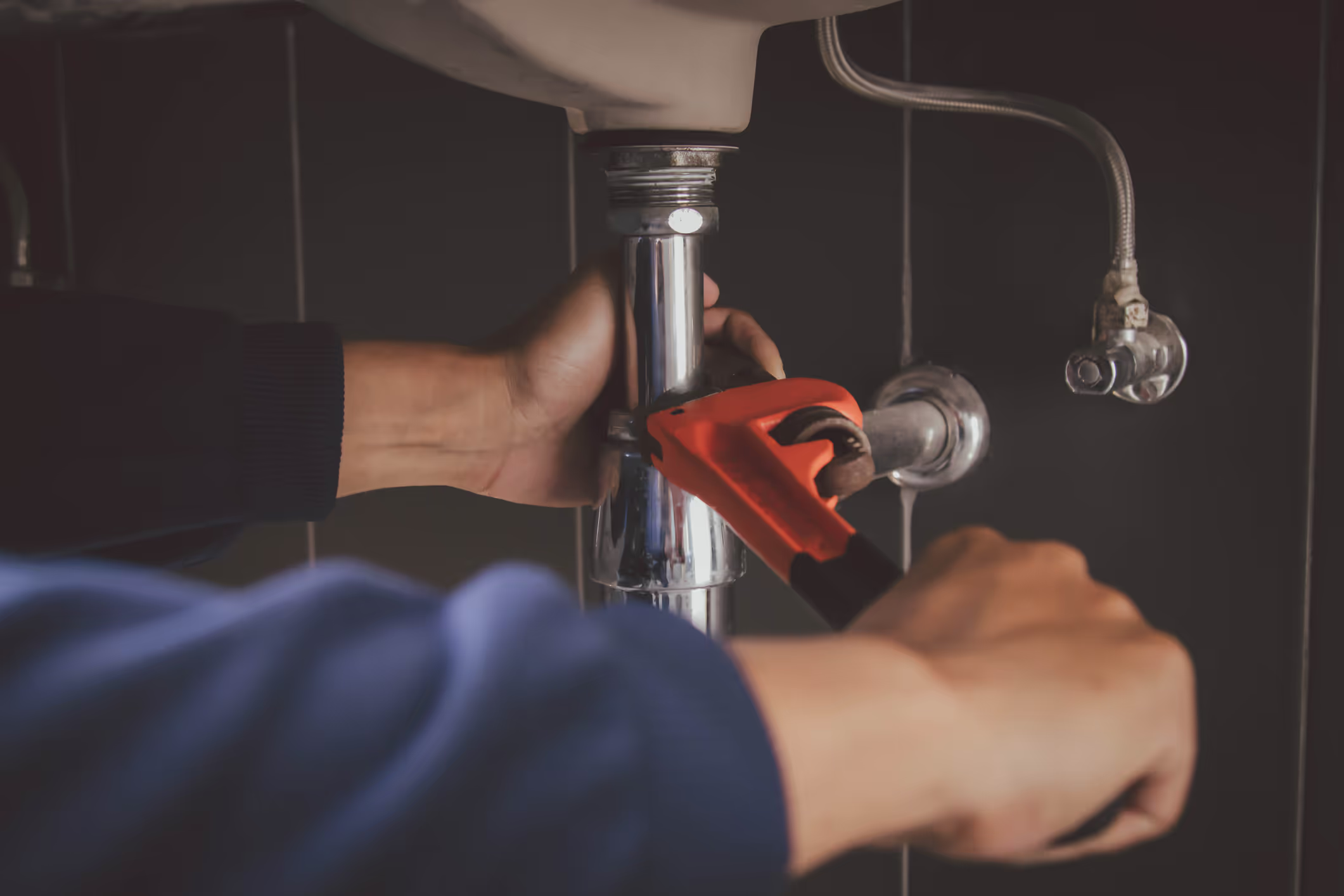
From leaks to full system installs, our plumbing services cover everything you need for a safe, reliable home water system, 24/7.
Our Primary Plumbing Include:
- Water Heater Replacement
- Water Heater Repair
- Trenchless Sewer Line
- Water Filtration
- Slab Leak
- Sewer Line Repair
Don't see the service you need? Call our Team today!
ELECTRICAL

Our electrical services ensure your home stays safe and powered, from routine fixes to complete system upgrades.
Our Primary Electrical Services Include:
- House Rewiring
- Electrician
- Electric Panel Upgrade
- Electric Panel Replacement
- EV Chargers
- Whole House Generator
Don't see the service you need? Call our Team today!
HEATING
.jpg)
We install, repair, and maintain heating & furnace systems with expert care to keep your Colorado home comfortable and energy-efficient year-round.
Our Primary Heating Services Include:
- Heating Installation
- Heating Replacement
- Heating Maintenance
- Heating Repair
- Heating Service
- Heating Tune-Up
Don't see the service you need? Call our Team today!