What Your Circuit Breaker Is Trying to Tell You
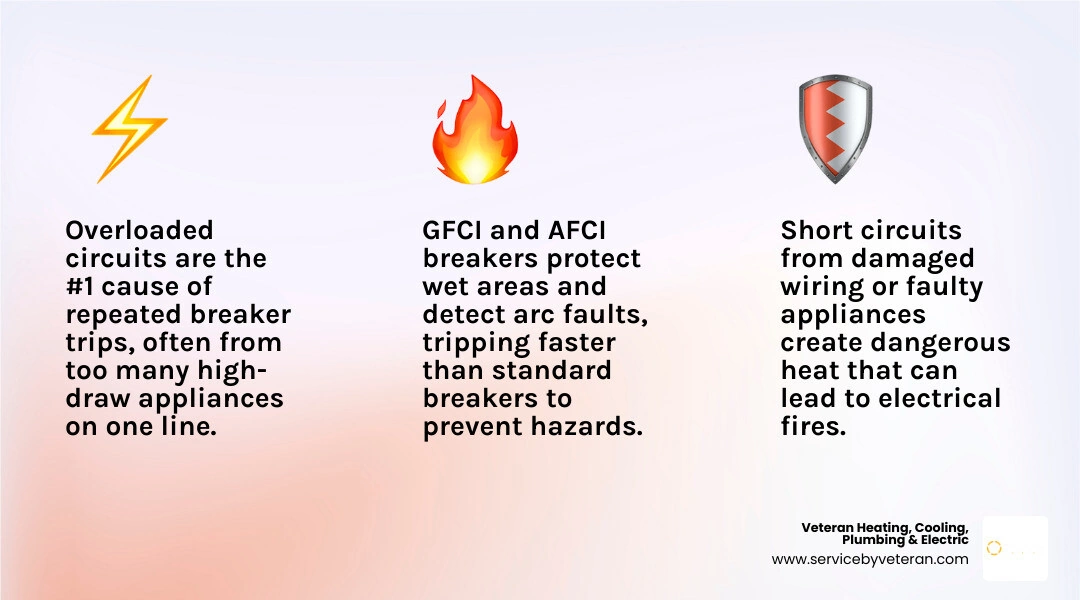
If you're dealing with a circuit breaker tripping frequently, what to check first comes down to a short list of common culprits. Here's a quick-reference breakdown before we dive deeper:
Most common reasons a breaker keeps tripping — and what to check:
1. Circuit overload — Too many high-draw appliances on one circuit (microwave, toaster, coffee maker, etc.)
2. Short circuit — Hot and neutral wires are touching, often due to damaged insulation or a faulty appliance
3. Ground fault — A hot wire is contacting a ground wire or grounded surface, common in kitchens and bathrooms
4. Faulty appliance — A single damaged device drawing excessive current at startup or during use
5. Aging or worn breaker — The breaker's internal components have degraded from years of use or repeated trips
6. Wiring issues — Loose connections, aluminum wiring, or older insulation types creating intermittent faults
7. GFCI or AFCI sensitivity — These specialized breakers trip on smaller faults than standard breakers and may need investigation
A circuit breaker is your home's first line of defense against electrical fires and appliance damage. When it trips once, that's it doing its job. When it keeps tripping — that's your home's electrical system telling you something is wrong and needs attention.
Electrical failures are one of the leading causes of residential fires, and many of those fires are preventable with early intervention. Repeatedly resetting a tripping breaker without finding the root cause doesn't solve the problem — it adds cumulative heat and mechanical wear to your wiring and the breaker itself, increasing risk over time.
Whether you've got a kitchen circuit that goes dark every time you run the microwave and toaster together, or a breaker that trips with nothing plugged in at all, the right first step is the same: stop guessing and start diagnosing.
I'm Mike Townsend, a U.S. Army veteran and the owner of Veteran Heating, Cooling, Plumbing & Electric serving the Denver Metro area — and understanding exactly why a circuit breaker keeps tripping frequently and what to check is something our licensed electricians handle every day, applying the same precision and discipline I learned in the military to keeping your home safe. In the sections below, I'll walk you through exactly how to troubleshoot the problem safely and when it's time to call in a professional.
Key circuit breaker tripping frequently what to check vocabulary:
• burning smell from outlets causes and solutions
Circuit Breaker Tripping Frequently: What to Check First
When your power suddenly cuts out in a specific room, your first instinct is probably to head straight to the electrical panel, find the switch that is resting halfway between "ON" and "OFF," and flip it back. However, if this has become a routine, you must change your approach. Repeatedly resetting a breaker forces high-current surges through your home’s wiring, heating up connections and significantly reducing the lifespan of the breaker itself.
Before touching the panel, you need a systematic game plan. Start by identifying the tripping pattern. Does the breaker trip immediately when you flip it back on, or does it take a few minutes? Does it only happen when you use a specific appliance, or does it seem completely random?
Mapping out which outlets, lights, and appliances are connected to that specific breaker is a crucial first step. Once you know what lies downstream of that switch, you can narrow down the root cause. For a comprehensive look at how your home's electrical components tie together, check out our Electrical Repair Service Complete Guide.
Circuit Breaker Tripping Frequently: What to Check on Your Appliances
High-draw appliances are the most common instigators of a tripped breaker. Devices that generate heat or rely on heavy motorized compressors draw a massive amount of electrical current.
Here is what you should check on your appliances:
• The High-Wattage Culprits: Hair dryers (which can draw up to 1,800 watts), space heaters (often drawing 1,500 watts continuously), microwaves, toasters, curling irons, and vacuum cleaners are prime suspects. If you run two of these on the same circuit simultaneously, you are virtually guaranteed a trip.
• Startup Surges: Refrigerators, portable air conditioners, and washing machines require a massive "inrush" of current to start their motors—often 3 to 4 times their running wattage. If a circuit is already near its limit, this startup surge will instantly push the breaker over the edge.
• The Appliance Isolation Test: Unplug every single device on the affected circuit. Reset the breaker. If it holds, plug the appliances back in one by one. If the breaker trips the moment a specific device turns on, you have found your culprit.
If your appliances are fine but you still cannot get steady power, you may need professional troubleshooting to inspect the dedicated lines. You can learn more about our specialized diagnostic services on our Electrical Services page.
Circuit Breaker Tripping Frequently: What to Check in Older Homes
If your home in Denver, Arvada, or Littleton was built several decades ago, its electrical system was designed for a completely different era. In the 1950s or 1970s, households did not run multiple computers, high-definition televisions, electric vehicle chargers, and high-powered kitchen appliances all at once.
When dealing with older properties, pay close attention to these structural factors:
• Outdated Wiring Materials: Homes built between the late 1960s and mid-1970s often feature aluminum wiring. Aluminum expands and contracts more than copper when heated, leading to loose connections at outlets and switches that cause intermittent arcing and tripping.
• Knob-and-Tube Insulation: Very old homes may still have active knob-and-tube wiring. The cloth insulation on these wires degrades over time, leaving bare copper exposed to dust, moisture, and structural framing, which triggers ground faults.
• Panel Age and Capacity: If your electrical panel is more than 30 to 40 years old, the breakers themselves may simply be worn out. Older panels like those manufactured by Federal Pacific Electric (FPE) or Zinsco are notorious safety hazards that may fail to trip entirely or trip constantly as they degrade.
To evaluate whether your vintage home is up to modern safety standards, review our Electrical Safety Checklist for Older Homes. If you suspect your wiring has simply reached the end of its safe lifespan, read through our guide on the primary Signs Your Home Needs Rewiring to understand your next steps.
Understanding the Three Main Causes of a Tripped Breaker
To troubleshoot like a pro, you must understand exactly how and why a breaker trips. Standard breakers utilize a dual-trip mechanism: a thermal element (a bimetal strip that bends as it heats up from a sustained overload) and a magnetic element (which reacts instantly to massive current surges from short circuits).
• Circuit Overload — What Happens: Too much current drawn by too many devices on a single path. — How Fast It Trips: Delayed (seconds to minutes as the bimetal strip heats up). — Common Signs: Warm outlets, dimming lights, breaker trips when a second appliance is turned on. — Safety Risk Level: Moderate (can lead to localized wire overheating if bypassed).
• Short Circuit — What Happens: A hot wire directly touches a neutral wire, bypassing the load. — How Fast It Trips: Instantaneous (fraction of a second via magnetic trip). — Common Signs: A loud "pop" or buzz, visible spark, scorch marks on outlets, immediate trip upon resetting. — Safety Risk Level: High (immediate fire and shock hazard, risk of arc flash).
• Ground Fault — What Happens: A hot wire touches a ground wire, metal box, or water, creating an unintended path to earth. — How Fast It Trips: Instantaneous to intermittent (highly sensitive). — Common Signs: Common in kitchens, bathrooms, and outdoors; often trips GFCI outlets first. — Safety Risk Level: High (extreme risk of electrical shock, especially in wet areas).
Overloaded Circuits vs. Short Circuits
The difference between an overload and a short circuit is the difference between a slow burn and an explosion.
An overloaded circuit occurs when the cumulative amperage of your devices exceeds the rated capacity of the breaker (typically 15 or 20 amps). For example, a standard 15-amp circuit can safely handle up to 1,440 continuous watts (following the 80% safety rule for continuous loads). If you plug in a 1,500-watt space heater and a 1,000-watt microwave on that same line, the bimetal strip inside the breaker will slowly bend as the current heats it up, eventually flipping the switch off after a few seconds or minutes.
A short circuit, on the other hand, is an immediate emergency. It occurs when a hot wire (usually black) directly contacts a neutral wire (usually white). Because there is no resistance (like an appliance motor or light bulb) to slow the electricity down, the current spikes to thousands of amps in a millisecond. The magnetic sensor inside the breaker detects this massive spike and trips instantly to prevent the wires from melting inside your walls.
If you suspect your home has damaged, shorted, or compromised wiring hidden behind the drywall, you may need professional remediation. For residents in the metro area, our team specializes in restoring safety through House Rewiring Denver CO.
Ground Faults and the Role of GFCI and AFCI Protection
A ground fault is a specific type of short circuit where the hot wire contacts the grounding wire (bare copper or green), a metal junction box, or a grounded plumbing pipe. Because water is an excellent conductor of electricity, ground faults are exceptionally common in wet environments like kitchens, bathrooms, basements, and outdoor patios.
To protect you from lethal shocks, the National Electrical Code (NEC) requires specialized safety devices:
• GFCI (Ground Fault Circuit Interrupter): These outlets or breakers constantly monitor the balance of current leaving the hot wire and returning on the neutral. If they detect a leakage of even 4 to 6 milliamps—indicating that electricity is escaping, potentially through your body to the ground—they shut off the power in as little as 1/40th of a second.
• AFCI (Arc Fault Circuit Interrupter): While GFCIs protect against shock, AFCIs protect against fire. They use advanced microprocessors to detect the distinct electrical "signature" of an arc fault—which occurs when electricity sparks across damaged or loose connections inside your walls.
Because AFCI and GFCI breakers are highly sensitive, they can sometimes experience "nuisance tripping" caused by older motors, cheap electronics, or moisture in outdoor outlet covers. However, you should never ignore these trips. If you reside in the eastern metro area and are dealing with persistent safety trips, our local experts can help trace the fault; learn more at House Rewiring Aurora CO.
How to Safely Troubleshoot a Tripping Breaker at Home
Before you begin testing, remember the golden rule of home electrical safety: never open your main electrical panel cover or touch raw wiring inside the panel. Flipped switches are perfectly safe to interact with, but the internal bus bars carry lethal voltage even if the main breaker is turned off.
If you want to handle the basic diagnostics yourself, follow this systematic isolation method. For a broader look at how we safely install and test residential systems, check out our Electrical Installation Service overview.
Step 1: Unplug and Reset
The absolute safest way to start troubleshooting is to completely eliminate the load on the circuit.
1. Locate the affected area: Identify every single outlet, light fixture, and appliance that has lost power.
2. Unplug everything: Physically pull the plugs of all appliances, chargers, lamps, and electronics out of the wall sockets on that circuit. Turn off all wall switches controlling lights on that line.
3. Go to your panel: Open the panel door and locate the tripped breaker. It will usually be resting in the middle position, showing a red indicator, or feeling loose.
4. Perform a clean reset: Push the breaker switch firmly to the "OFF" position until you hear a distinct click. Then, flip it back to the "ON" position. Stand slightly to the side of the panel while doing this as a standard safety precaution.
5. Observe the behavior:
— If the breaker trips instantly with nothing plugged in and all switches off, you have a direct short circuit in your home’s structural wiring or a dead breaker. Stop troubleshooting immediately and call an electrician.
— If the breaker holds and stays on, the problem lies with an overloaded circuit or a faulty appliance. Proceed to Step 2.
Step 2: Isolate the Faulty Device
Now that the breaker is holding with zero load, you can systematically identify the culprit.
1. Wait a few minutes: Let the breaker sit for 2 to 3 minutes to ensure no delayed thermal trips occur.
2. Test one by one: Walk back to the room and plug in your first appliance. Turn it on and wait a minute.
3. Repeat sequentially: If the first device doesn't trip the breaker, unplug it, and plug in the next device.
4. Identify the trigger: Keep testing each appliance individually. If plugging in your toaster instantly kills the power, you know the toaster has an internal short circuit and needs to be repaired or replaced.
5. Check for cumulative overload: If every appliance works perfectly when plugged in by itself, but the breaker trips when you plug all of them in together, you have confirmed a circuit overload. You must redistribute your high-draw appliances to different circuits or contact us to install a dedicated line.
When to Stop Troubleshooting and Call a Professional Electrician
Electrical troubleshooting has its limits, and knowing when to step back is a matter of personal safety and protecting your property. If your basic appliance isolation tests do not yield a clear answer, continuing to flip a tripping breaker can lead to catastrophic failure.
If you smell a distinct plastic odor, hear crackling, or see the power cut out immediately, do not wait. You can reach our emergency dispatch team immediately through our 24/7 Electrician page.
Warning Signs of Serious Electrical Hazards
Some symptoms point to deep-seated issues that are actively generating heat behind your walls. If you notice any of the following warning signs, leave the breaker off and call a licensed professional immediately:
• The Burning Smell: A fishy, sweet, or sharp plastic burning odor coming from an outlet, switch, or the panel itself indicates that wire insulation is melting. This is an active fire hazard. For a detailed breakdown of what this smell means and how to handle it, read our guide on Burning Smell from Outlets Causes and Solutions.
• Hot Outlets or Switches: If an outlet cover plate or light switch feels warm or hot to the touch, electricity is meeting extreme resistance, likely due to a loose, corroded, or poorly spliced wire.
• Buzzing or Crackling Noises: A faint sizzling, buzzing, or popping sound inside a wall cavity or electrical box is the sound of electricity arcing across a gap—a leading cause of house fires.
• The Instant Buzz-Trip: If you reset a breaker and it immediately trips back to the middle with a loud "bzzz-pop" sound, there is a direct metal-to-metal short circuit that must be physically traced and repaired.
If you suspect your home’s wiring infrastructure is failing, particularly in southern suburbs like Littleton, our local crews are equipped with thermal imaging and insulation resistance testers to pinpoint hidden faults. Learn more about our regional services at House Rewiring Littleton CO.
Is the Breaker Itself Faulty?
Like any mechanical device, circuit breakers wear out. Standard breakers are designed to last roughly 30 to 40 years, but frequent tripping, environmental humidity, and lightning surges can cut that lifespan short.
How can you tell if the breaker itself is the issue?
• Physical Slack: When you try to reset the breaker, the switch feels "mushy" or loose and refuses to snap firmly into the ON or OFF positions.
• Warm to the Touch: The plastic casing of the breaker inside the panel is noticeably warm even when minimal electrical load is running.
• Visual Damage: There are visible scorch marks, discoloration, or signs of melted plastic on the breaker body or the bus bar connection behind it.
• Fails the Swap Test: A licensed electrician can safely test a breaker by measuring its voltage output (which should read approximately 120V on a standard single-pole breaker) or temporarily swapping the load wire to an identical, known-good breaker. If the second breaker holds under the exact same load, the original breaker was faulty and must be replaced.
Do not attempt to replace a breaker yourself, as working inside a live panel carries extreme risk. If you are in the southwest metro area and need a safe, professional swap, visit our Electric Panel Replacement Littleton CO page to schedule a technician.
Long-Term Solutions and Panel Upgrades
If your electrical panel is constantly tripping despite your appliances being in perfect working order, minor repairs may no longer cut it. Modern homes in the Denver Metro area demand a robust, stable power supply to support modern lifestyles, including central air conditioning, multi-zone heating, hot tubs, and electric vehicle (EV) charging stations.
To explore your options for a complete system overhaul, check out our Electric Panel Replacement services, or learn more about upgrading your capacity on our Electric Panel Upgrade Denver CO page.
When to Upgrade Your Electrical Panel
Many older homes in Arvada, Lakewood, and Aurora still operate on outdated 60-amp or 100-amp electrical services. Today, a standard single-family home requires a minimum of a 200-amp panel to operate safely and efficiently.
An upgrade is highly recommended—and often legally required by building codes—in the following scenarios:
1. Adding Major Appliances: If you are installing a central air conditioning unit, a tankless water heater, or a hot tub, your existing panel likely lacks the physical space or the overall amperage capacity to support the load.
2. Installing an EV Charger: Level 2 electric vehicle chargers require a dedicated 240V circuit drawing 40 to 50 amps. Trying to squeeze this onto an old 100-amp panel will cause frequent main breaker trips.
3. Eliminating Subpanels or Double-Tapping: If your panel is full and previous handymen have "double-mapped" wires or crowded the system with unsafe subpanels, a clean, modern panel replacement is the only way to ensure long-term safety.
If you are ready to bring your home's electrical system into the modern era, our certified teams provide seamless, code-compliant upgrades across the metro area. If you are in the eastern suburbs, check out our options for Electric Panel Upgrade Aurora CO. If you reside on the west side, we have you covered with expert Electric Panel Upgrade Lakewood CO services.
Frequently Asked Questions About Tripping Breakers
Is it dangerous if a circuit breaker keeps tripping?
Yes, it is highly dangerous. While a single trip is a safety mechanism working exactly as designed, repeated tripping indicates an unresolved hazard. Every time a breaker trips, an electrical arc occurs inside your walls or within the panel. Over time, this repeated stress damages the breaker’s internal springs, weakens wire insulation, and generates cumulative heat that can easily spark a devastating electrical fire. Never treat a tripping breaker as a mere nuisance—it is a critical safety alert.
Why does my breaker trip only in the summer?
Summertime trips are exceptionally common in the Denver Metro area due to two main factors:
• Air Conditioning Demands: Central AC units draw massive amounts of current when their compressors kick on. If your AC is sharing a circuit or if your overall panel capacity is strained, this startup surge will trigger a trip.
• Ambient Temperature: Circuit breakers operate on thermal principles. When summer temperatures soar, the ambient air inside an unconditioned garage or outdoor electrical enclosure rises. This heat reduces the breaker’s thermal margin, causing it to trip at a lower current threshold than it would in cooler weather.
Can a bad appliance cause a breaker to trip instantly?
Yes, absolutely. If an appliance has an internal short circuit—such as a frayed power cord, a damaged heating element, or a seized motor—it will create an immediate path of zero resistance. The moment you plug that device in or switch it on, current spikes instantly, causing the breaker's magnetic safety mechanism to trip in a fraction of a second to prevent immediate damage and fire.
Keeping Your Home Safe and Powered
Dealing with a persistent electrical issue is frustrating, but you do not have to navigate it in the dark. At Veteran Heating, Cooling, Plumbing & Electric, we approach every job with the same core values of integrity, service, and meticulous attention to detail that defined our military service. Led by a U.S. Army veteran with over 30 years of hands-on industry experience, we are proud to keep homes safe and comfortable across Denver, Greenwood Village, Arvada, Aurora, Broomfield, Castle Rock, Centennial, Columbine, Golden, Highlands Ranch, Lakewood, and Littleton.
We believe in honest, transparent relationships with our neighbors, which is why we offer:
• No Dispatch or Trip Fees — You only pay for the work we do.
• Lifetime Warranty on Parts and Labor — We stand behind our craftsmanship, period.
• 10% Discount for veterans, active military, seniors, and first responders.
• 24/7 Weekend and Emergency Service availability for when you need us most.
• A Money-Back Satisfaction Guarantee to give you total peace of mind.
Whether you need a simple breaker diagnostic, a dedicated line for a new appliance, or a complete electrical panel upgrade, our background-checked, EPA-certified technicians are ready to serve.
If you're experiencing frequent power outages or a tripping breaker, don't wait for a minor issue to turn into a major hazard. Visit our Electrical Services page today to schedule a professional inspection, or give us a call to experience honest, veteran-led service firsthand.
ABOUT Veteran Heating, Cooling, Plumbing & Electric
Veteran Heating, Cooling, Plumbing & Electric was founded on the belief that service should be personal, honest, and community-focused. Our team is built around integrity, professionalism, and a true commitment to your home’s comfort and safety.
Led by a U.S. Army veteran with over 30 years of industry experience, we’re proud to remain locally owned and operated. Every technician, plumber, and electrician is EPA-certified, background checked, and driven to exceed expectations.
- 24/7 ServiceWe offer weekend & 24/7 emergency service. We’re here whenever you need us—day, night, or weekend, no exceptions.
- $0 Trip FeesNo dispatch or trip fees. You’ll never pay just for us to show up—service starts when the work does.
OUR SERVICES
AIR CONDITIONING
.jpg)
We offer specialty and seasonal services like indoor air quality upgrades, pre-winter furnace checks, and summer AC tune-ups to keep your home prepared year-round.
Our Primary Air Conditioning Services Include:
Don't see the service you need? Call our Team today!
PLUMBING
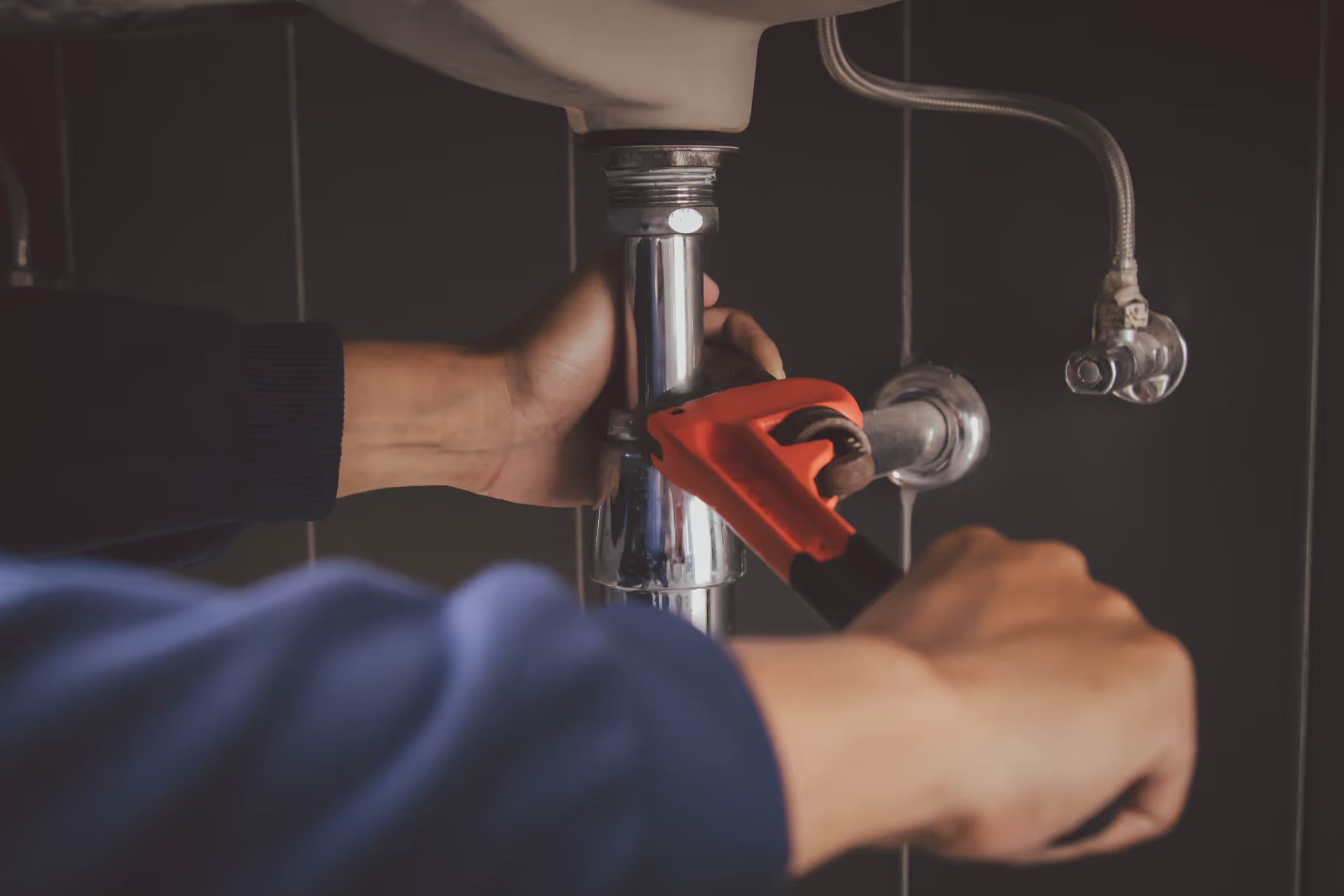
From leaks to full system installs, our plumbing services cover everything you need for a safe, reliable home water system, 24/7.
Our Primary Plumbing Include:
- Water Heater Replacement
- Water Heater Repair
- Trenchless Sewer Line
- Water Filtration
- Slab Leak
- Sewer Line Repair
Don't see the service you need? Call our Team today!
ELECTRICAL

Our electrical services ensure your home stays safe and powered, from routine fixes to complete system upgrades.
Our Primary Electrical Services Include:
- House Rewiring
- Electrician
- Electric Panel Upgrade
- Electric Panel Replacement
- EV Chargers
- Whole House Generator
Don't see the service you need? Call our Team today!
HEATING
.jpg)
We install, repair, and maintain heating & furnace systems with expert care to keep your Colorado home comfortable and energy-efficient year-round.
Our Primary Heating Services Include:
- Heating Installation
- Heating Replacement
- Heating Maintenance
- Heating Repair
- Heating Service
- Heating Tune-Up
Don't see the service you need? Call our Team today!