Bridging the Gap Between Seasonal Anxiety and Winter Readiness
Your furnace has been sitting idle for months, and as the morning air suddenly turns crisp, you might be wondering if your home is truly ready for the freezing temperatures ahead. At Veteran Heating, Cooling, Plumbing & Electric, when we look at the community impact of our fall outreach: what we learn from homeowners at September local events is that this seasonal anxiety is incredibly common. During the September pre-heating season, our team hears many Denver residents express deep uncertainty about their winterization steps and indoor air quality concerns. The rapid transition from summer heat to crisp fall air in Denver sets the stage for imminent freezing temperatures, leaving homeowners stressed about whether their systems will perform when needed most.
In our years of keeping Front Range homes comfortable, we've noticed a significant communication gap during standard, mechanical pre-heating season HVAC service visits. Technicians frequently run through a generic checklist, verify the equipment is functional, and move on to the next house. However, this purely mechanical approach fails to address the underlying questions and worries that homeowners actually have. Our public engagement coordinator recognized this disconnect and realized that the casual conversations our veteran-led team has with neighbors at community gatherings are a goldmine of genuine insight.
Turning Conversations into Actionable Training
Instead of guessing what you need, we use a unique approach: we translate informal community feedback directly into specific, actionable technical training for our HVAC and plumbing teams. By actively listening to your concerns before the busy season begins, we adapt our internal winter service preparation to match exactly what our community requires. This ensures that when a Veteran Heating, Cooling, Plumbing & Electric technician arrives at your door, they are equipped not just with tools, but with the specific knowledge and empathy needed to bridge the gap between seasonal anxiety and total winter readiness.
Why the September Pre-Heating Season is Critical for Front Range Homes
Living in the Front Range means dealing with unpredictable weather patterns, but in our experience serving Denver, we know the average first freeze typically occurs in early to mid-October. This incredibly short window between crisp September days and sudden, hard October freezes makes the September pre-heating season a vital period for proactive home preparation. We always advise our customers that if you wait until the first major snowstorm to check your heating and plumbing systems, you are much more likely to find yourself facing an emergency situation when local service schedules are already booked solid.
Denver's unique semi-arid climate adds an extra layer of complexity to winterizing your home. It is not just about the cold; a pattern we see often is the combination of sudden temperature drops and extremely dry indoor air putting immense strain on a home's infrastructure. When temperatures plummet overnight, heating systems must work overtime, and plumbing pipes exposed to unconditioned spaces become highly vulnerable to freezing and bursting.
The Risks of Delaying Winter Preparation
The reactive approach: Homeowners who delay maintenance often assume that because the furnace worked last March, it will work perfectly this November. Unfortunately, our technicians frequently find that mechanical components sitting dormant for months can develop unseen issues. Dust settles on burners, electrical connections loosen, and blower motors lose their lubrication.
The proactive advantage: Utilizing the early fall weeks to prepare allows you to address these minor issues before they escalate into complete system failures. To illustrate the urgency, consider the typical transition we see in our region:
• Early September — Typical Weather Conditions: Warm days, cool nights — Home System Risks: Mild strain; ideal time for system testing and tune-ups.
• Late September — Typical Weather Conditions: Crisp air, approaching frost — Home System Risks: Increased heating demand; vulnerable pipes begin to chill.
• Mid-October — Typical Weather Conditions: First hard freeze expected — Home System Risks: High risk of sudden furnace failure and frozen plumbing if unprepared.
By treating September as your primary window for action, you eliminate the stress of scrambling for help during the first major cold snap, ensuring your home remains a safe, comfortable refuge.
Gathering Field Intel at Denver Local Fall Festivals
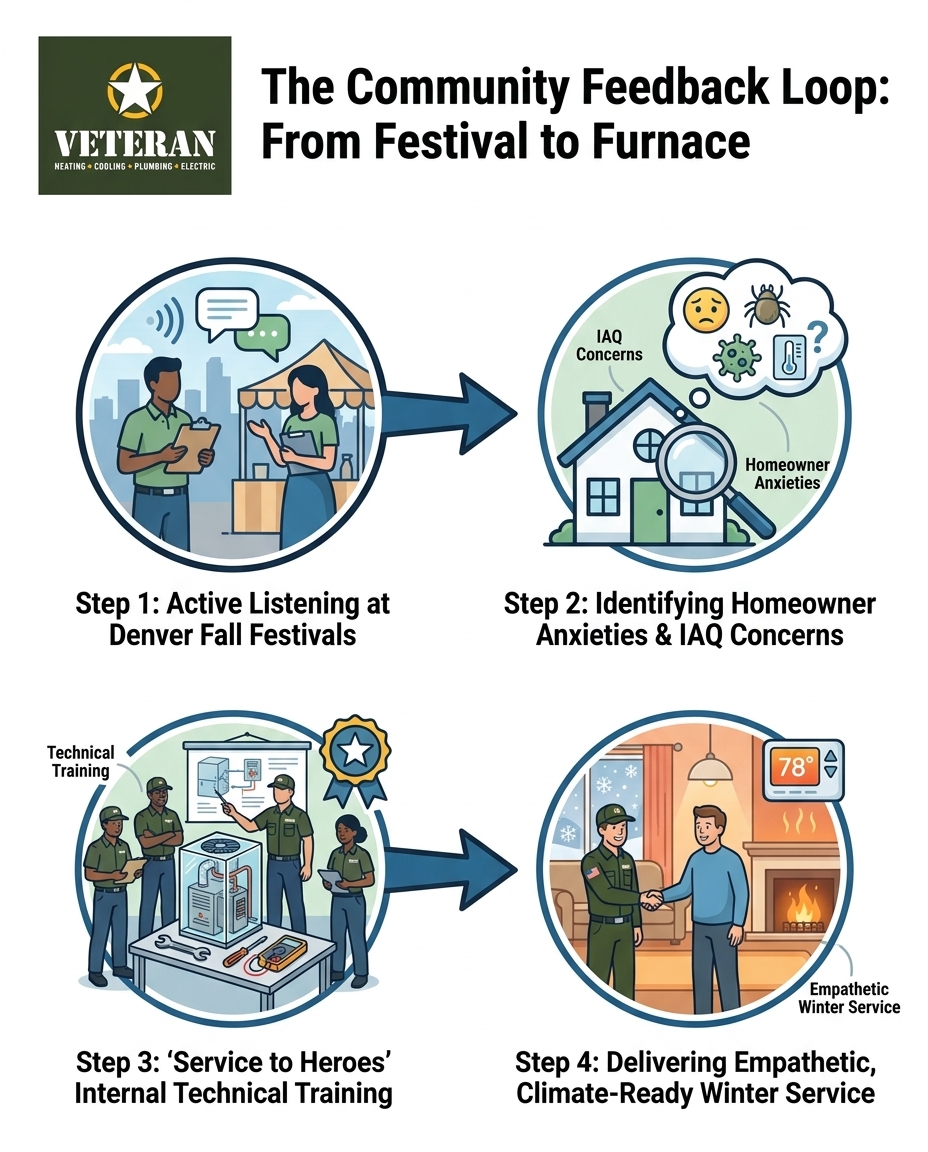
To truly understand what homeowners are worried about, our team steps outside the service van and into the community. We maintain an active presence at Denver local fall festivals, focusing entirely on listening rather than selling. In a relaxed, festive environment, the dynamic shifts. Without the pressure of a ticking clock or a broken appliance, homeowners feel comfortable opening up to us about their genuine concerns regarding their homes.
These casual conversations reveal true homeowner anxieties that rarely surface during a rushed service call. People ask our team the questions they might feel are too basic to ask a technician who is busy working in their basement. We hear about the drafty spare bedroom, the strange noise the furnace made at the end of last winter, and the fear of high winter utility bills. For Veteran Heating, Cooling, Plumbing & Electric, this community outreach is not merely a public relations exercise; it is a highly structured method for gathering real-time feedback on local needs.
Listening Over Selling
Our representatives take great pride in their professionalism and engagement when meeting neighbors face-to-face. For example, while we were out at a recent Denver Oktoberfest event, one local homeowner stopped by our booth. They weren't looking for a hard sales pitch; instead, our representative was able to have an engaging, friendly conversation, answering questions about winter preparation. The homeowner walked away impressed by our people and our representation, gaining confidence in our community-first approach.
What our team looks for during these events:
• Recurring themes: Are multiple neighbors asking about humidifier installations? That tells us dry air is a major concern this season.
• Misconceptions: If homeowners express confusion about how to set their thermostats for optimal efficiency, we know we need to improve our educational materials.
• Emotional pain points: We listen for words like "worried," "frustrated," or "confused" to understand the emotional weight behind seasonal maintenance.
By treating Denver local fall festivals as a direct research and development loop, we gather the exact field intel necessary to serve our community better.
Uncovering the Real Questions: Indoor Air Quality and System Mechanics
When we compile the feedback from these fall events, clear patterns emerge. One of the most significant trends we see across Denver neighborhoods is a sharp rise in indoor air quality (IAQ) concerns. As residents prepare to seal their homes tightly against the dropping temperatures, they inadvertently trap indoor pollutants. In the Front Range, sealing windows and doors to block out the cold means that dust, pet dander, and airborne particles constantly recirculate through the home's ductwork.
The Problem: Homeowners notice that as soon as the heat kicks on, their allergies flare up, the air feels uncomfortably dry, and they worry about the air their family is breathing in a tightly sealed house.
The Cause: During the summer, open windows provide natural ventilation. In the fall and winter, that ventilation disappears. Furthermore, standard 1-inch furnace filters are often inadequate for capturing microscopic pollutants, and the heating process itself naturally reduces the relative humidity in the home, exacerbating respiratory irritation.
The Solution: At Veteran Heating, Cooling, Plumbing & Electric, we know addressing these concerns requires more than just changing a filter. It requires a comprehensive approach to IAQ, including high-efficiency filtration, whole-home humidification, and proper duct maintenance. We also spend time explaining how different HVAC components interact during extreme weather shifts. Understanding the connection between your indoor and outdoor units helps clarify why a seemingly small issue outside can dramatically impact the comfort and air quality inside your home.
Addressing the Emotional Anxiety
Beyond the mechanics, our technicians are trained to address the underlying emotional anxiety homeowners feel about keeping their families safe and comfortable. A heating system is not just a piece of machinery; it is the heartbeat of a home during a Colorado winter. When homeowners understand the mechanics of their system—how the blower motor distributes air, how the heat exchanger safely warms that air, and how humidity levels are controlled—it demystifies the process. This understanding replaces seasonal stress with confidence, which is exactly why we prioritize education based on the questions we hear at Denver local fall festivals.
From Conversation to Curriculum: The 'Service to Heroes' Training Approach
Gathering feedback is only the first step; the true value lies in how we apply it. As a veteran-owned company, the team at Veteran Heating, Cooling, Plumbing & Electric views the insights gained during the September pre-heating season through a distinct operational lens. We treat homeowner feedback as vital "field intel" that directly drives our "unit readiness." Just as military units adapt their strategies based on real-time intelligence, we adapt our service delivery based on what our community tells us they need.
This military-inspired framework relies on active listening followed by structured "after-action" training updates. When our public engagement team returns from a weekend of community events, they brief our service managers on the most common questions and concerns they encountered. This data is immediately integrated into our pre-winter training curriculum for all HVAC and plumbing technicians.
The After-Action Review Process
Our training goes far beyond standard mechanical troubleshooting. If the field intel indicates that homeowners are highly concerned about water heater longevity during cold snaps, our training that week will focus heavily on water heater diagnostics and how to explain those diagnostics clearly to the customer.
This continuous training loop ensures our representatives possess a deep, practical knowledge of our products and services. At a recent Loveland home show, a visitor stopped to discuss their home's specific needs. Because of our rigorous internal training, our representative was incredibly knowledgeable about the precise products required and provided exceptional customer service, leading the visitor to confidently state they would refer friends and family to us.
How the 'Service to Heroes' ethos shapes our training:
• Discipline: We do not skip steps. Every technician is trained to perform thorough, consistent evaluations.
• Adaptability: We adjust our focus based on real-time community feedback, ensuring we are always addressing current, not past, concerns.
• Communication: Technicians practice explaining complex mechanical issues in clear, everyday language, ensuring you always understand your options.
This ethos ensures our team is always adapting to serve the community better, approaching every winter mission fully prepared to protect your home.
Equipping Our Technicians Beyond the Mechanical Checklist
In standard industry practice, a pre-winter tune-up is often driven entirely by a generic mechanical checklist. While checking voltage, inspecting heat exchangers, and testing safety switches are absolutely essential for safe operation, our team knows these tasks alone do not address the communication gaps homeowners experience. In our experience, a technician can perfectly calibrate a furnace, but if they cannot explain why the air in the home feels so dry, the homeowner is still left with unresolved seasonal anxiety.
Because of the intel gathered at Denver local fall festivals, our pre-winter training focuses heavily on empathy, clear explanations, and addressing specific anxieties. We train our team to recognize the subtle signs of homeowner stress and to proactively answer the questions we know are on your mind.
The Difference Transparency Makes
We believe there is immense value in transparency—in showing a community exactly how a company adapts its service delivery based on direct input. When a Veteran Heating, Cooling, Plumbing & Electric technician explains that they are checking a specific component because "a lot of folks at the fall festival mentioned having trouble with this last year," it changes the dynamic of the service visit. It proves that we are paying attention.
• Follows a static, generic checklist. — Our Community-Informed Approach: Checklist is updated based on recent community feedback.
• Focuses solely on mechanical function. — Our Community-Informed Approach: Focuses on mechanical function, indoor air quality, and home comfort.
• Uses technical jargon to explain issues. — Our Community-Informed Approach: Uses plain language to educate and empower the homeowner.
• Treats the visit as a simple transaction. — Our Community-Informed Approach: Treats the visit as an opportunity to build lasting trust.
This holistic training approach builds lasting trust before the technician even knocks on the door. You can have confidence knowing that the professional entering your home has been specifically trained to address the unique challenges of the upcoming Denver winter.
Delivering a Better Winter Service Experience
So, what actually happens when a community-informed technician from our team arrives for a pre-winter tune-up during the September pre-heating season? The experience is fundamentally different from a standard service call. From the moment they step through the door, the focus is on comprehensive home health and homeowner peace of mind.
The Community-Informed Service Visit:
1. The Initial Consultation: Before touching any equipment, our technician will ask specific questions based on recent community trends. They will ask about your indoor air quality, any drafty areas, and your experiences from the previous winter.
2. The Comprehensive Inspection: They perform the rigorous mechanical checks required for safety and efficiency, paying special attention to the vulnerabilities specific to Denver's semi-arid climate.
3. The Educational Walkthrough: Instead of just handing you a bill, the technician will walk you through their findings. They will explain how your system is functioning and provide actionable advice on maintaining optimal humidity and air quality.
4. The Proactive Plan: They will help you map out a strategy for the winter, ensuring you know exactly what to do if temperatures drop unexpectedly.
This process provides incredible reassurance. Homeowners tell us they feel a profound sense of relief knowing their specific regional and seasonal concerns are understood and validated. Our ultimate goal is not just to fix equipment; it is to ensure your home remains a safe, comfortable refuge all winter long. By actively engaging with our neighbors, we continuously elevate the standard of local home services.
Partnering with Our Community for a Warmer Winter
Our commitment to listening to the community is not a seasonal promotion; it is the foundation of how Veteran Heating, Cooling, Plumbing & Electric operates. The insights we gather at Denver local fall festivals directly shape the quality of service you receive in your home. By treating every conversation as valuable field intel, we ensure our technicians are fully prepared to meet the demands of the upcoming winter.
As the calendar moves deeper into the September pre-heating season, we strongly encourage you to take proactive steps in preparing your home. Do not wait for the first hard freeze to discover that your furnace is struggling or your indoor air quality is suffering. We invite you to experience the difference of a community-driven approach. Reach out to our team to schedule your seasonal maintenance, and let us show you how our active listening translates into a warmer, safer, and more comfortable home for your family this winter.
Frequently Asked Questions
Why is fall home maintenance important?
Fall home maintenance is critical because it prepares your home's vital systems for the severe strain of winter weather. In our experience, addressing minor wear and tear before freezing temperatures arrive prevents sudden breakdowns and costly emergency repairs. In regions with rapid weather transitions like ours, proactive fall maintenance ensures your heating and plumbing systems are reliable when you need them most.
What should I ask my HVAC technician before winter?
You should ask your technician about the overall health of your heat exchanger, the state of your indoor air quality, and if your current filtration is adequate for a tightly sealed home. We also advise asking for recommendations on optimal thermostat settings and how to manage indoor humidity during the dry winter months. A well-trained technician will gladly walk you through these details.
When should I schedule winter HVAC maintenance in Denver?
The best time to schedule winter HVAC maintenance in Denver is during the September pre-heating season. Because the first hard freeze typically occurs by mid-October, scheduling early ensures your system is tested and ready before the sudden temperature drops. Waiting until the snow flies often means longer wait times due to high emergency service demand.
What is included in a fall furnace tune-up?
A comprehensive fall furnace tune-up includes inspecting the heat exchanger for cracks, cleaning the burners, testing safety switches, checking electrical connections, and evaluating the blower motor. Beyond these mechanical checks, our thorough tune-ups also assess your system's airflow and filter condition to ensure it can operate safely and efficiently all winter.
How does indoor air quality change during the fall and winter?
Indoor air quality often declines in the fall and winter because homes are sealed tightly to keep the cold out, which traps airborne pollutants, dust, and pet dander inside. Additionally, the heating process naturally removes moisture from the air, leading to uncomfortably dry conditions that can irritate the respiratory system. We recommend proper filtration and whole-home humidification to combat these seasonal changes.
How does community feedback improve local HVAC services?
Community feedback allows local HVAC companies like ours to understand the specific, real-world anxieties homeowners are facing, rather than relying on generic industry assumptions. By listening to concerns at local events, we tailor our internal training to address exact regional issues, such as specific indoor air quality worries or confusion about system mechanics. This results in service visits that are more empathetic, educational, and effective.
ABOUT Veteran Heating, Cooling, Plumbing & Electric
Veteran Heating, Cooling, Plumbing & Electric was founded on the belief that service should be personal, honest, and community-focused. Our team is built around integrity, professionalism, and a true commitment to your home’s comfort and safety.
Led by a U.S. Army veteran with over 30 years of industry experience, we’re proud to remain locally owned and operated. Every technician, plumber, and electrician is EPA-certified, background checked, and driven to exceed expectations.
- 24/7 ServiceWe offer weekend & 24/7 emergency service. We’re here whenever you need us—day, night, or weekend, no exceptions.
- $0 Trip FeesNo dispatch or trip fees. You’ll never pay just for us to show up—service starts when the work does.
OUR SERVICES
AIR CONDITIONING
.jpg)
We offer specialty and seasonal services like indoor air quality upgrades, pre-winter furnace checks, and summer AC tune-ups to keep your home prepared year-round.
Our Primary Air Conditioning Services Include:
Don't see the service you need? Call our Team today!
PLUMBING
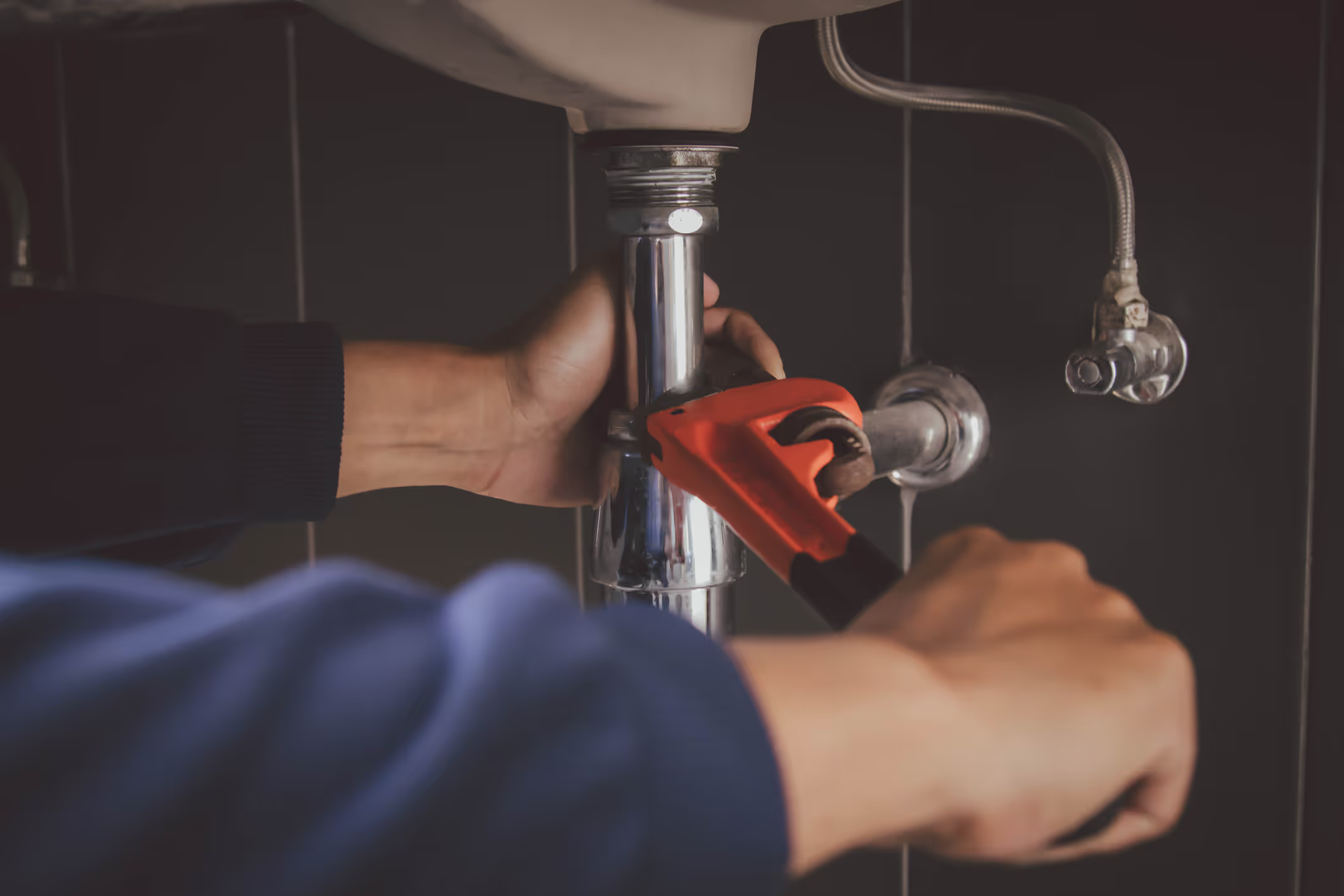
From leaks to full system installs, our plumbing services cover everything you need for a safe, reliable home water system, 24/7.
Our Primary Plumbing Include:
- Water Heater Replacement
- Water Heater Repair
- Trenchless Sewer Line
- Water Filtration
- Slab Leak
- Sewer Line Repair
Don't see the service you need? Call our Team today!
ELECTRICAL

Our electrical services ensure your home stays safe and powered, from routine fixes to complete system upgrades.
Our Primary Electrical Services Include:
- House Rewiring
- Electrician
- Electric Panel Upgrade
- Electric Panel Replacement
- EV Chargers
- Whole House Generator
Don't see the service you need? Call our Team today!
HEATING
.jpg)
We install, repair, and maintain heating & furnace systems with expert care to keep your Colorado home comfortable and energy-efficient year-round.
Our Primary Heating Services Include:
- Heating Installation
- Heating Replacement
- Heating Maintenance
- Heating Repair
- Heating Service
- Heating Tune-Up
Don't see the service you need? Call our Team today!