The Hidden Challenge of Thin Air Combustion for Denver Homeowners
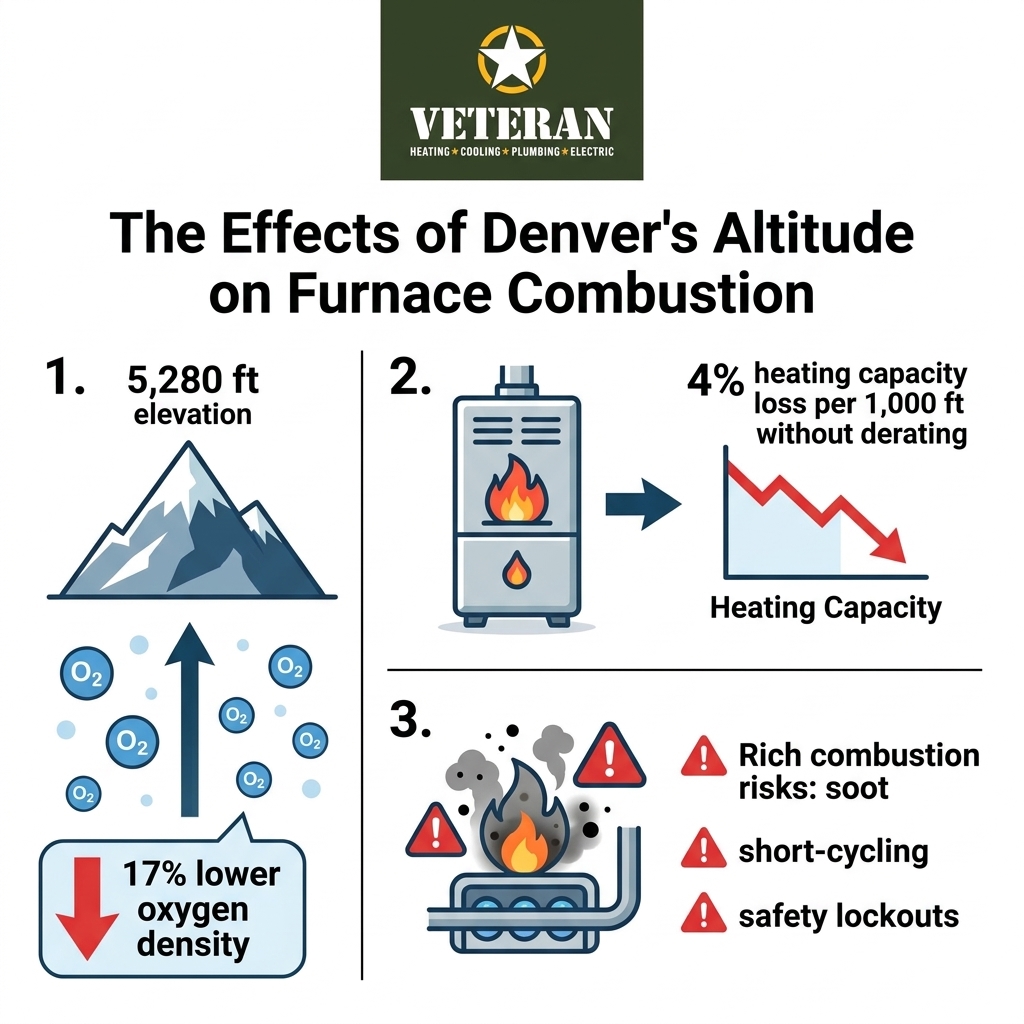
At an exact elevation of 5,280 feet, the oxygen density in Denver is roughly 17% lower than it is at sea level. If you are wondering how Denver's altitude affects the efficiency of newly installed high-efficiency furnaces, our team at Veteran Heating, Cooling, Plumbing & Electric can tell you that this single statistic holds the entire answer. Gas appliances rely on a very specific ratio of oxygen to natural gas to burn cleanly and safely. Over our years of serving the Denver area, a pattern we see often is brand-new heating systems arriving from factories closer to sea level, calibrated for dense, oxygen-rich air. Placed straight into a home in the Mile High City without mechanical adjustments, that same premium furnace will struggle to breathe.
Many homeowners invest heavily in top-tier heating equipment, expecting immediate comfort and lower utility bills. Instead, they often run into frustrating performance issues right out of the box. A high-efficiency furnace that hasn't been adjusted for Denver's specific atmospheric pressure will frequently experience safety lockouts, poor heat output, and excessive wear on its internal components. The underlying problem is a phenomenon known as thin air combustion.
Understanding why standard, unadjusted installations fail is the first step toward protecting your investment. Heating a home at 5,280+ feet altitude requires precise mechanical intervention. Without this mandatory adjustment, the internal sensors inside modern furnaces will detect unsafe operating conditions and shut the system down completely, leaving you without heat when you need it most. Fixing this requires a specific calibration process that goes far beyond a basic installation.
The Chemistry of Heating in the Mile High City
When our technicians inspect underperforming systems, we frequently see the effects of this chemistry firsthand. Natural gas requires oxygen to ignite and burn. Manufacturers design their gas valves and burners to mix these two elements perfectly based on standard atmospheric pressure. In Denver, the air simply contains fewer oxygen molecules per cubic foot. The furnace still pulls in the same volume of air, but the actual amount of oxygen delivered to the burner is drastically reduced.
The immediate result: The furnace attempts to burn its standard supply of natural gas with an inadequate supply of oxygen. This creates an unbalanced, inefficient, and potentially unsafe chemical reaction inside your equipment.
Why Sea-Level AFUE Ratings Don't Apply in the Mile High City
When you shop for a new heating system, the most prominent number on the yellow energy guide sticker is the AFUE rating. Annual Fuel Utilization Efficiency (AFUE) measures how efficiently a furnace converts gas into usable heat over a typical year. A 96% AFUE rating means that 96 cents of every dollar spent on gas goes directly into heating your home, while only 4 cents escapes as exhaust. However, as our team regularly explains to our Denver customers, these standardized tests are conducted in laboratories at or near sea level.
The physics of high elevation dictate a completely different reality. As a general rule of thermodynamics, unadjusted gas furnaces lose roughly 4% of their total heating capacity for every 1,000 feet above sea level. When we do the math for Denver's elevation, an uncalibrated furnace loses over 20% of its heating power the moment it is turned on. A furnace advertised at 96% efficiency will never deliver that level of performance in our thinner atmosphere without professional intervention.
This is exactly how altitude affects your overall HVAC system. You are essentially starving the unit of the air it needs to reach its rated output. To illustrate this impact, consider how altitude changes standard operational metrics:
• Sea Level (0 ft) — Oxygen Density (vs. Sea Level): 100% — Unadjusted Capacity Loss: 0% — System Status: Factory calibration operates perfectly.
• 2,000 ft — Oxygen Density (vs. Sea Level): 93% — Unadjusted Capacity Loss: ~8% — System Status: Minor efficiency drop; adjustments recommended.
• Denver (5,280 ft) — Oxygen Density (vs. Sea Level): 83% — Unadjusted Capacity Loss: ~21% — System Status: Severe performance loss; mandatory mechanical derating required.
The Impact on Sizing and Installation
Because of this inherent capacity loss, sizing a furnace for a Denver home requires careful calculation. In our experience sizing systems across the metro area, if a contractor simply looks at the square footage of your home and installs a unit based on sea-level BTU (British Thermal Unit) charts, the system will be drastically undersized for your actual heating needs. The equipment will run constantly, trying in vain to reach the temperature set on your thermostat, burning excess fuel while failing to keep the house warm.
The Dangers of Rich Combustion and Equipment Short-Cycling
When a furnace operates in Denver's thin air without proper adjustments, it enters a state known as "rich combustion." This means the fuel mixture is too rich in natural gas and too poor in oxygen. As a veteran-owned company performing countless pre-heating-season tune-ups every fall, we consider rich combustion not just an efficiency problem, but a serious mechanical hazard that actively damages the internal components of your new heating system.
The most immediate byproduct of rich combustion is soot. Because the natural gas cannot burn completely without sufficient oxygen, the leftover unburned carbon materializes as thick, black soot. This soot coats the inside of the heat exchanger—the critical metal component that transfers heat from the burner into the air circulating through your vents. Soot acts as a powerful insulator. As it builds up, the heat exchanger can no longer transfer heat efficiently, causing the metal itself to overheat dangerously.
The Short-Cycling Chain Reaction
Modern high-efficiency furnaces are equipped with sensitive safety mechanisms designed to prevent catastrophic failures. When soot buildup causes the heat exchanger to overheat, a component called the high limit switch detects the excessive temperature and immediately shuts down the burners to prevent a fire. Here is how our technicians typically see that cycle play out:
• Ignition: The thermostat calls for heat, and the furnace turns on.
• Overheating: Rich combustion causes rapid soot buildup, insulating the heat exchanger and trapping heat inside the unit.
• Safety trip: The limit switch detects the dangerous temperature spike and cuts the gas supply.
• Cool down: The blower fan continues running to cool the overheated metal.
• Restart: Once cooled, the furnace tries to start again, repeating the loop.
This rapid on-and-off behavior is called short-cycling. It puts immense strain on the blower motor, the igniter, and the gas valve, often leading to premature component failure. During a sudden cold snap last fall, one local homeowner realized their heating system was repeatedly locking out in exactly this manner. Jeff, one of our expert technicians, was dispatched to the home. He diagnosed a severe combustion issue causing the safety lockouts, recalibrated the system professionally, and fixed the furnace problem quickly so the family had dependable heat again.
Precision Calibration: The Mechanics of High-Altitude Derating
Preventing rich combustion and short-cycling requires a highly specific mechanical procedure known as "derating." Derating is the process of intentionally reducing the amount of natural gas that flows into the burners so that the fuel perfectly matches the lower oxygen levels found at Denver's altitude. This is a strict mathematical calibration, not a casual adjustment, and it is governed by rigorous safety standards.
The process involves physically resizing the gas orifices. An orifice is a small brass fitting with a precisely drilled hole that dictates exactly how much gas enters the combustion chamber. To derate a furnace for 5,280 feet, a qualified professional must remove the factory orifices and replace them with smaller ones, restricting the gas flow by the exact percentage required by local atmospheric pressure. Following this, the technician must use a digital manometer to adjust the gas valve's manifold pressure, ensuring the fuel delivery is perfectly smooth and consistent.
Code Compliance and Military Precision
High-altitude derating is not an optional upgrade; it is a mandatory safety requirement governed by the International Fuel Gas Code (IFGC) and guidelines set by the Department of Energy (DOE). Operating an un-derated furnace in Denver violates local building codes and will frequently void the manufacturer's warranty on a newly installed high-efficiency unit.
Because this involves modifying the primary fuel delivery system of a combustible appliance, it is strictly a job for licensed professionals. Never attempt to resize gas orifices or adjust manifold pressure yourself. Working with our veteran-owned company means you receive the same level of discipline, accountability, and strict adherence to protocol that military service demands. Our team treats code compliance and precision calibration as non-negotiable standards, ensuring your equipment operates safely and exactly as engineered.
Timing Your Furnace Replacement for the Fall Heating Season
If you are planning to upgrade your home's heating system, timing is everything. Our team highly recommends finalizing a furnace replacement and completing the high-altitude derating process during the September pre-heating season. Denver's early fall weather is notoriously unpredictable, and the first hard freeze can arrive with very little warning. Having your equipment fully calibrated before the temperature drops significantly ensures your home remains comfortable and safe.
Testing a newly derated high-efficiency system during the early fall allows our technicians to verify that it operates safely under real heating loads. A furnace behaves differently when it is actively working to raise the temperature of a cold house compared to a brief test run on a mild afternoon. By scheduling your installation and calibration early, you give the system time to prove its reliability before the heavy winter demand begins.
Verifying Safety and Performance
Gas appliance safety is never something to leave to chance. For example, during a routine inspection, our technician TJ discovered two separate gas leaks in a home's utility room. He explained everything clearly to the homeowner, repaired the leaks, and ensured the home was completely safe before leaving. That same level of rigorous safety checking applies to verifying proper gas flow and combustion in your new high-efficiency furnace.
When you schedule your installation, always verify with your contractor that high-altitude derating is explicitly included in the replacement process. Understanding how Denver's altitude affects the efficiency of newly installed high-efficiency furnaces protects your home, lowers your utility costs, and ensures your premium equipment lasts for years to come.
Frequently Asked Questions
Why do gas furnaces need derating in Denver?
Gas furnaces need derating in Denver because the air at 5,280 feet contains roughly 17% less oxygen than at sea level. Without derating, the furnace receives too much natural gas and not enough oxygen, leading to an unsafe and inefficient burn. Derating restricts the gas flow to match the available oxygen, ensuring clean combustion.
How does thin air affect furnace combustion?
Thin air affects furnace combustion by creating a "rich" fuel mixture that cannot burn completely. Because there are fewer oxygen molecules available to mix with the natural gas, the flame burns cooler and produces excess unburned carbon. This carbon turns into thick soot that coats internal components and restricts heat transfer.
What happens if a furnace is not derated for high altitude?
If a furnace is not derated for high altitude, it will quickly develop heavy soot buildup inside the heat exchanger. This soot traps heat, causing the system to overheat and trigger its internal safety sensors. The furnace will repeatedly shut down (short-cycle) and eventually lock out entirely to prevent a fire hazard.
Do high-efficiency furnaces lose their AFUE rating in Denver?
Yes, high-efficiency furnaces lose their standard AFUE rating in Denver if they are not professionally adjusted. Because AFUE ratings are tested at sea level, an uncalibrated furnace will lose about 4% of its heating capacity for every 1,000 feet of elevation. Proper derating helps restore the system's efficiency and performance to safe, optimal levels.
Can a homeowner adjust their furnace for altitude themselves?
No, a homeowner cannot adjust their furnace for altitude themselves. Derating requires opening the sealed gas valve, replacing precisely machined brass orifices, and recalibrating gas manifold pressure with a digital manometer. This is a highly technical procedure that must be performed by a licensed professional to meet safety codes and maintain the equipment warranty.
Dependable Heating for the Mile High City
Upgrading your home's heating system is a major investment, and you deserve equipment that performs exactly as promised. If you are concerned about how Denver's altitude affects the efficiency of newly installed high-efficiency furnaces, our team at Veteran Heating, Cooling, Plumbing & Electric is here to help. We ensure every unit is mathematically derated, strictly code-compliant, and rigorously tested for safe combustion. Reach out to schedule your professional installation and calibration before the cold weather sets in.
ABOUT Veteran Heating, Cooling, Plumbing & Electric
Veteran Heating, Cooling, Plumbing & Electric was founded on the belief that service should be personal, honest, and community-focused. Our team is built around integrity, professionalism, and a true commitment to your home’s comfort and safety.
Led by a U.S. Army veteran with over 30 years of industry experience, we’re proud to remain locally owned and operated. Every technician, plumber, and electrician is EPA-certified, background checked, and driven to exceed expectations.
- 24/7 ServiceWe offer weekend & 24/7 emergency service. We’re here whenever you need us—day, night, or weekend, no exceptions.
- $0 Trip FeesNo dispatch or trip fees. You’ll never pay just for us to show up—service starts when the work does.
OUR SERVICES
AIR CONDITIONING
.jpg)
We offer specialty and seasonal services like indoor air quality upgrades, pre-winter furnace checks, and summer AC tune-ups to keep your home prepared year-round.
Our Primary Air Conditioning Services Include:
Don't see the service you need? Call our Team today!
PLUMBING
From leaks to full system installs, our plumbing services cover everything you need for a safe, reliable home water system, 24/7.
Our Primary Plumbing Include:
- Water Heater Replacement
- Water Heater Repair
- Trenchless Sewer Line
- Water Filtration
- Slab Leak
- Sewer Line Repair
Don't see the service you need? Call our Team today!
ELECTRICAL

Our electrical services ensure your home stays safe and powered, from routine fixes to complete system upgrades.
Our Primary Electrical Services Include:
- House Rewiring
- Electrician
- Electric Panel Upgrade
- Electric Panel Replacement
- EV Chargers
- Whole House Generator
Don't see the service you need? Call our Team today!
HEATING
.jpg)
We install, repair, and maintain heating & furnace systems with expert care to keep your Colorado home comfortable and energy-efficient year-round.
Our Primary Heating Services Include:
- Heating Installation
- Heating Replacement
- Heating Maintenance
- Heating Repair
- Heating Service
- Heating Tune-Up
Don't see the service you need? Call our Team today!