The Sudden Threat of a Flooded Basement
Understanding the mechanical reasons why water heaters rupture without warning is the first step toward preventing a catastrophic basement flood. You go downstairs to grab something from storage, only to step into standing water. Your water heater—which seemed to be operating perfectly just hours ago—has split open, sending dozens of gallons of water across your floor. At Veteran Heating, Cooling, Plumbing & Electric, our team often sees homeowners experience this sudden rupture with zero obvious external warning signs, leaving them completely blindsided by the damage.
If you are worried about the integrity of your plumbing system, learning how to spot hidden plumbing problems before they escalate is your best defense against unexpected water damage.
The invisible threat: The breakdown of a water heating system is rarely an external event. Instead, it is an invisible, internal mechanical process driven by the strict physics of closed-loop plumbing systems. While the outside of the steel tank looks solid and dry, the inside may be undergoing severe structural degradation. Recognizing this unseen mechanical breakdown process is exactly why our technicians highly recommend scheduling a professional inspection during the September pre-heating season transition, long before the tank physically fails.
Understanding how internal pressure spikes from thermal expansion physically stress the tank is critical. A water heater is essentially a pressurized vessel. When the internal environment becomes unstable, the steel walls can only handle so much force before they give way. By exploring the actual physics at play inside your tank, you can take proactive steps to protect your home from sudden flooding.
The Physics of Closed-Loop Thermal Expansion
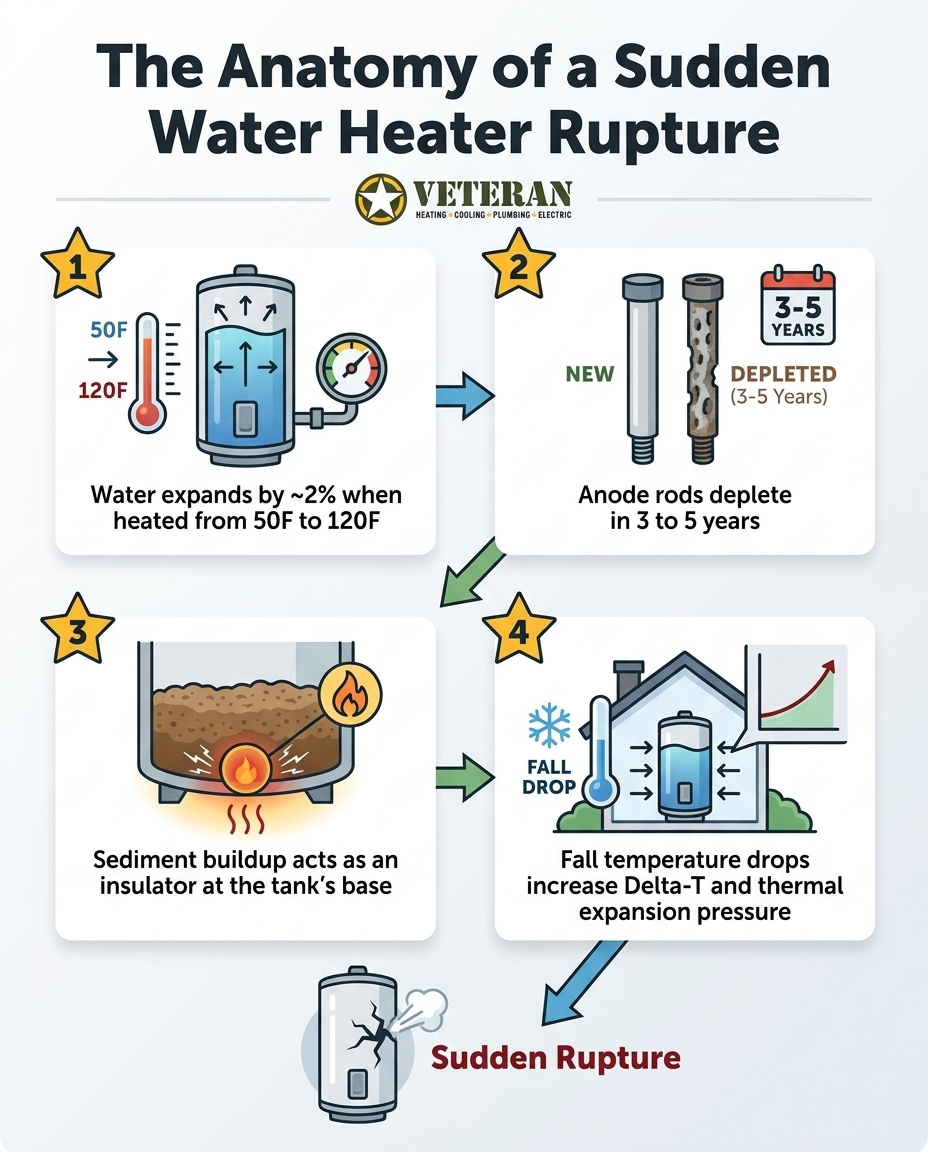
The problem: Water behaves in very predictable ways when exposed to heat. When your burner ignites to warm the water inside the tank, that water physically expands. In fact, water expands by approximately 2% when heated from 50°F to 120°F. In a standard 50-gallon tank, that equals about an extra gallon of water volume that suddenly needs to occupy the same amount of space.
The cause: Modern residential plumbing systems operate as closed loops. This means the expanded water volume has absolutely nowhere to go. Historically, expanding water could simply push backward into the municipal water supply line. Today, city codes require backflow preventers and check valves to protect the public water supply from contamination. While necessary for public health, these valves trap the expanded water inside your home's plumbing.
The solution: Our plumbers frequently remind homeowners that managing this trapped volume is critical for protecting your tank and avoiding the need for extensive pipe repair. This trapped volume creates significant internal pressure spikes from thermal expansion every single time the burner cycles on. Constant pressure fluctuations physically push and pull against the steel tank walls, acting as a primary catalyst for sudden ruptures.
How Closed-Loop Systems Trap Pressure
To fully grasp why tanks fail, you have to understand the mechanics of a closed-loop system. When water enters your home from the municipal line, it passes through a Pressure Reducing Valve (PRV) or a one-way check valve.
• One-way flow: Water can enter your home, but it cannot exit back into the city main.
• Trapped expansion: As the water heater warms up, the extra volume pushes against the closed valves.
• Path of least resistance: The trapped pressure forces its way against the weakest points in your plumbing system—usually the seams of the water heater tank.
Without a properly functioning thermal expansion tank to absorb this extra volume, the water heater bears the full brunt of the pressure. Over thousands of heating cycles, the steel expands and contracts, eventually leading to metal fatigue and structural failure.
Galvanic Corrosion and the Sacrificial Anode Rod
Water and steel are a destructive combination. Left unprotected, a steel water heater tank would rust through and fail in a matter of months. To prevent this, manufacturers rely on a brilliant piece of engineering called a sacrificial anode rod. These rods, typically made of magnesium or aluminum, are suspended inside the tank to protect the steel through a process called galvanic corrosion.
How galvanic corrosion works: In any environment where dissimilar metals are submerged in water, the more reactive metal will corrode first. The anode rod is designed to be highly reactive. It intentionally attracts the corrosive elements in the water supply, sacrificing itself so the steel tank walls remain completely intact.
However, this protection is temporary. Based on our extensive field experience, these rods typically deplete completely within 3 to 5 years of installation, which heavily dictates your overall water heater lifespan in Colorado. Once the rod is entirely consumed, the galvanic corrosion immediately and aggressively attacks the next available metal: the steel tank itself.
The timeline of internal degradation:
1. Years 1-3: The anode rod slowly dissolves, protecting the tank perfectly.
2. Years 4-5: The rod reaches the end of its lifespan, leaving only a bare wire core.
3. Years 5+: Corrosive elements begin attacking the steel tank walls directly.
This internal rusting process thins the metal entirely out of sight. You will not see rust on the outside of the tank, but the walls are steadily weakening. This leaves the compromised tank highly susceptible to the internal pressure spikes from thermal expansion we discussed earlier. A thinned, rusted tank wall simply cannot withstand the daily pressure fluctuations of a closed-loop system.
How Hard Water Accelerates Internal Tank Breakdown
The problem: Local water quality plays a massive role in how quickly a water heater breaks down mechanically. Our technicians constantly battle local water conditions, knowing that Denver's municipal water supply contains moderate to hard water levels—roughly 75 to 150 milligrams per liter (mg/L) of dissolved minerals like calcium and magnesium. This mineral density aggressively accelerates both anode rod consumption and internal calcification.
The cause: As water is heated, these dissolved minerals separate from the liquid and fall to the bottom of the tank as solid sediment. Over time, this sediment builds up into a thick, rock-like layer. This calcified layer acts as a thick insulating barrier between the gas burner (located at the bottom of the tank) and the water it is trying to heat.
The solution: Because the sediment blocks the heat transfer, the burner is forced to run significantly longer and hotter to reach the thermostat's set temperature. This forces the burner to literally overheat the metal at the bottom of the tank. If you are weighing tankless vs traditional water heaters, this sediment vulnerability is a major factor we discuss when explaining traditional tank failures.
The Structural Impact of Overheating
This constant overheating severely degrades the structural integrity of the tank's base. The extreme heat weakens the steel, while the trapped moisture under the sediment layer accelerates localized rusting. Eventually, the combination of weakened, overheated metal and intense internal pressure causes the bottom of the tank to literally "fall out," resulting in a massive, instantaneous flood.
The Impact of Seasonal Temperature Drops on Delta-T
The changing of the seasons directly impacts the mechanical stress placed on your plumbing system. As municipal incoming water temperatures drop in the fall, the temperature differential—known as Delta-T—between the incoming cold water and your target tank temperature increases dramatically.
As a local Denver company, we know firsthand that our area experiences sharp temperature swings in early fall, which dramatically lower the temperature of the water flowing through underground city pipes. If your target water temperature is 120°F, heating 60°F summer water requires a 60-degree Delta-T. But heating 40°F late-fall water requires an 80-degree Delta-T.
• Summer — Incoming Water Temp: 60°F — Target Tank Temp: 120°F — Resulting Delta-T: 60°F — Burner Cycle Length: Standard
• Early Fall — Incoming Water Temp: 50°F — Target Tank Temp: 120°F — Resulting Delta-T: 70°F — Burner Cycle Length: Extended
• Winter — Incoming Water Temp: 40°F — Target Tank Temp: 120°F — Resulting Delta-T: 80°F — Burner Cycle Length: Maximum
Heating much colder water requires significantly longer burner cycles. The longer the burner runs, the more the water expands, creating a larger, more rapid volume expansion inside the closed loop. This seasonal shift maximizes the internal pressure spikes from thermal expansion, often pushing an already weakened, rusted tank past its breaking point.
This is exactly why we consider the September pre-heating season transition the critical window to inspect tanks. Identifying a depleted anode rod or a failing expansion tank before these extreme temperature swings begin is the most effective way to prevent a mid-winter rupture.
The Chain Reaction: When Multiple Mechanical Failures Converge
In our experience, a sudden tank rupture is almost never caused by a single isolated issue. Instead, it is the devastating convergence of multiple mechanical failures happening simultaneously. When a depleted anode rod, severe sediment overheating, and unmanaged thermal expansion all collide, the tank is pushed to its absolute limit.
At this stage, the system relies entirely on its final safety mechanism: the Temperature and Pressure (T&P) relief valve. This valve is engineered to automatically open and release water if the internal pressure or temperature exceeds safe operational limits.
However, if the T&P valve fails, the expanding pressure has absolutely nowhere to escape. When this chain reaction occurs, the structural failure is immediate and catastrophic. A burst tank will continue to flood your basement with fresh municipal water until the main supply valve is manually shut off, often requiring immediate professional intervention for emergency hot water heater repair to mitigate severe property damage.
Why the T&P Valve Fails
The T&P valve sits unused for years, waiting for an emergency. Unfortunately, the same hard water minerals that coat the bottom of the tank also coat the internal mechanisms of this safety valve.
• Mineral buildup: Calcium and magnesium solidify around the valve spring, effectively seizing the mechanism in place.
• Invisible failure: Without professional testing, a seized T&P valve looks perfectly normal from the outside. You cannot tell it is broken just by looking at it.
• Safety warning: Due to extreme scalding risks and the danger of releasing highly pressurized boiling water, homeowners must never attempt to test or replace a T&P valve themselves. This requires specialized tools and licensing to handle safely.
Preventing Catastrophe Through Disciplined Inspections
Because these mechanical failures are entirely internal, visual checks by homeowners are simply insufficient to predict a rupture. You cannot see a depleted anode rod through a steel tank, nor can you visually measure internal pressure spikes from thermal expansion. Furthermore, attempting DIY replacements of anode rods, T&P valves, or expansion tanks carries significant safety and flooding risks that require professional licensing to navigate safely.
A thorough, professional inspection evaluates the unseen physics of the tank. Working with our veteran-owned team at Veteran Heating, Cooling, Plumbing & Electric means you benefit from the military discipline and rigorous, veteran-led inspection processes we bring to every call. Our disciplined technicians don't just look for leaks; we evaluate anode depletion, test thermal expansion control mechanisms, and assess sediment accumulation.
What our disciplined inspections cover:
• Anode rod evaluation: Checking the remaining lifespan of the sacrificial metal.
• Expansion tank testing: Ensuring the bladder is properly pressurized to absorb thermal expansion.
• Sediment flushing: Removing insulating minerals from the bottom of the tank.
• Safety valve verification: Safely testing the T&P valve to ensure it will open during a high-pressure event.
For example, one Denver homeowner recently scheduled a pre-heating season maintenance visit with us. Our punctual, knowledgeable team arrived on time and thoroughly explained the entire maintenance process. By providing honest advice and top-tier workmanship, our technicians evaluated the equipment thoroughly, demonstrating exactly why proactive service matters.
Catching these internal issues during the September pre-heating season transition ensures your plumbing system is safe, stable, and ready to handle the extreme stress of incoming winter water temperatures.
Frequently Asked Questions
Why do water heaters burst suddenly?
Water heaters burst suddenly due to a combination of internal galvanic corrosion and unchecked thermal expansion. When the sacrificial anode rod depletes, the steel tank begins to rust from the inside out, severely thinning the metal. Once the walls are weakened, the daily internal pressure spikes from heating water in a closed-loop system simply push the compromised steel past its breaking point.
What happens when a water heater anode rod fails?
When a water heater anode rod fails, the galvanic corrosion process immediately redirects its destructive energy to the steel tank walls. Because the rod is fully consumed, it can no longer attract corrosive elements in the water. This allows rust to rapidly eat away at the internal structure of the tank, leading to inevitable leaks or sudden ruptures.
How does thermal expansion affect a water heater?
Thermal expansion affects a water heater by significantly increasing the internal pressure of the tank every time the burner cycles on. Because modern plumbing systems use check valves that prevent water from flowing backward, this expanded volume is trapped. If an expansion tank is not present or functioning, this trapped pressure constantly stresses the steel seams of the water heater.
Can a water heater explode without warning?
A water heater can rupture catastrophically without obvious external warning signs if multiple internal safety mechanisms fail simultaneously. If the tank is severely weakened by internal rust and the Temperature and Pressure (T&P) relief valve is seized shut by hard water minerals, the trapped thermal expansion pressure has nowhere to go but through the side of the tank.
What causes the bottom of a water heater to fall out?
The bottom of a water heater falls out when thick sediment buildup insulates the water from the gas burner beneath it. This forces the burner to run longer and significantly hotter to reach the target temperature, physically overheating and weakening the steel base. Over time, the structural integrity degrades until the weight and pressure of the water push the bottom completely out.
How often should a professional inspect my water heater's internal components?
Our team recommends that a professional inspect your water heater's internal components annually, ideally during the September pre-heating season transition. This timing ensures that vital components like the anode rod, expansion tank, and T&P valve are fully operational before extreme winter temperature drops put maximum thermal stress on the system.
Protect Your Home Before the Cold Sets In
A sudden basement flood is an expensive, stressful emergency that is almost always preventable. By addressing internal pressure spikes from thermal expansion and anode rod depletion early, you can keep your home safe and dry. Schedule your comprehensive pre-heating season inspection with Veteran Heating, Cooling, Plumbing & Electric today to catch invisible mechanical breakdowns before they turn into a catastrophic rupture.
ABOUT Veteran Heating, Cooling, Plumbing & Electric
Veteran Heating, Cooling, Plumbing & Electric was founded on the belief that service should be personal, honest, and community-focused. Our team is built around integrity, professionalism, and a true commitment to your home’s comfort and safety.
Led by a U.S. Army veteran with over 30 years of industry experience, we’re proud to remain locally owned and operated. Every technician, plumber, and electrician is EPA-certified, background checked, and driven to exceed expectations.
- 24/7 ServiceWe offer weekend & 24/7 emergency service. We’re here whenever you need us—day, night, or weekend, no exceptions.
- $0 Trip FeesNo dispatch or trip fees. You’ll never pay just for us to show up—service starts when the work does.
OUR SERVICES
AIR CONDITIONING
.jpg)
We offer specialty and seasonal services like indoor air quality upgrades, pre-winter furnace checks, and summer AC tune-ups to keep your home prepared year-round.
Our Primary Air Conditioning Services Include:
Don't see the service you need? Call our Team today!
PLUMBING
From leaks to full system installs, our plumbing services cover everything you need for a safe, reliable home water system, 24/7.
Our Primary Plumbing Include:
- Water Heater Replacement
- Water Heater Repair
- Trenchless Sewer Line
- Water Filtration
- Slab Leak
- Sewer Line Repair
Don't see the service you need? Call our Team today!
ELECTRICAL

Our electrical services ensure your home stays safe and powered, from routine fixes to complete system upgrades.
Our Primary Electrical Services Include:
- House Rewiring
- Electrician
- Electric Panel Upgrade
- Electric Panel Replacement
- EV Chargers
- Whole House Generator
Don't see the service you need? Call our Team today!
HEATING
.jpg)
We install, repair, and maintain heating & furnace systems with expert care to keep your Colorado home comfortable and energy-efficient year-round.
Our Primary Heating Services Include:
- Heating Installation
- Heating Replacement
- Heating Maintenance
- Heating Repair
- Heating Service
- Heating Tune-Up
Don't see the service you need? Call our Team today!