Facing a Late-Summer AC Dilemma
Is your air conditioner suddenly struggling to keep up, or completely failing, just as the late-August heat hits its peak? You are certainly not alone. The late-August back-to-school transition is already a chaotic time for most households. When you add a broken cooling system to the mix, disrupted routines become incredibly stressful. Evaluating the cost of emergency AC repairs in August vs scheduling a replacement for September is one of the most common, yet difficult, decisions homeowners face at the end of the summer season.
When your system breaks down during peak heat, the immediate reaction is often to authorize whatever emergency fix is necessary just to survive the month. However, a step back reveals a crucial decision point: paying a premium for a temporary patch, or managing the heat temporarily to schedule a full, strategic replacement. If you are leaning toward an upgrade, exploring professional AC replacement services can provide the clarity you need to move forward.
Understanding End-of-Season AC Strain
Air conditioners do not simply break down at random; they typically fail when they are pushed to their absolute limits. By the time late August arrives, your cooling system has been running almost continuously for months. This continuous operation compounds wear and tear on aging components, making end-of-season failures incredibly common.
If your unit is over 10 years old, it has already experienced significant efficiency drops. The cumulative stress of summer heat exposes every minor weakness that was previously ignored. Understanding these failure points helps clarify whether your system is experiencing a minor hiccup or a catastrophic breakdown.
1. Electrical component fatigue: Capacitors and contactors endure immense electrical loads during continuous summer operation. By August, these parts are highly susceptible to burning out.
2. Refrigerant flow issues: Minor leaks that started in June can result in critically low refrigerant levels by late summer, causing the system to freeze up or the compressor to overheat.
3. Airflow restrictions: Months of accumulating dust, pollen, and pet dander in filters and evaporator coils restrict airflow, forcing the blower motor to work harder and eventually fail.
4. Compressor failure: The compressor is the heart of the system. Overheating due to dirty coils or low refrigerant over the entire summer often culminates in total compressor failure just before the season ends.
When navigating these issues, especially during the hectic late-August back-to-school transition, it helps to understand what you are up against. A professional assessment can pinpoint whether you are dealing with a simple fix or a major system failure, guiding you through the most common AC repairs and their underlying causes.
The Cumulative Toll of Summer Heat
Continuous cycling puts immense pressure on aging motors and compressors. When temperatures stay high for consecutive weeks, your air conditioner never truly gets a break to cool down. The oil inside the compressor breaks down faster, moving parts generate more friction, and the electrical components run hotter.
What might have been a minor, easily fixable issue in early June—like a slightly dirty coil or a weak capacitor—snowballs into a major, costly failure by late August. The system simply has no remaining resilience to handle the final heatwaves of the year.
The True Impact of Emergency August Repairs
When an air conditioner dies in the sweltering heat, the instinct is to fix it immediately. However, choosing a band-aid fix during peak heat comes with significant realities. Emergency, after-hours repairs inherently carry premium service rates. Technicians are working overtime, parts are in high demand, and the urgency of the situation drives up the overall investment required to get cold air flowing again.
Before making a hasty decision, it is vital to weigh the pros and cons of an immediate fix versus waiting. The choice between patching a refrigerant leak or replacing your AC requires a careful look at your system's long-term viability.
• Pros of an Emergency Repair:
— Immediate restoration of home comfort during a severe heatwave.
— Avoids the short-term inconvenience of using fans or portable units.
— Makes sense if the system is relatively young and the failed component is minor.
• Cons of an Emergency Repair:
— Premium service rates for after-hours or peak-season dispatch.
— High risk of the sunk cost fallacy—investing heavily in a dying unit that will still need replacement next year.
— Potential delays if specific parts for older units are out of stock.
When a Band-Aid Fix Makes Sense
Not every late-summer breakdown requires a complete system overhaul. If your air conditioner is less than eight years old, has been well-maintained, and the failure is isolated to an inexpensive component like a capacitor or a fan relay, a repair is the logical choice. The immediate comfort benefit during a severe heatwave outweighs the manageable cost of a minor fix. In these scenarios, repairing the unit restores it to full functionality without jeopardizing your long-term financial plans.
The Risks of Sinking Funds into an Older Unit
The danger arises when homeowners attempt to revive a system that is well past its prime. Industry professionals often use the "5,000 rule" as a conceptual framework for deciding when a repair is no longer a viable investment. You take the age of the equipment and multiply it by the estimated severity of the repair. If the resulting number exceeds 5,000, repairing the unit is generally a poor financial decision, and replacement is recommended.
Furthermore, older systems that rely on obsolete R-22 refrigerant face massive hurdles. Because R-22 has been phased out globally due to environmental regulations, acquiring it to recharge a leaking system is incredibly expensive. Sinking funds into an obsolete system is a temporary delay of the inevitable, draining resources that could have been invested in a modern, efficient upgrade.
The Denver Climate Factor: Why September Changes the Math
Regional climate plays a massive role in how you should handle an end-of-season breakdown. In the Denver metro area, the weather patterns offer a unique strategic advantage. While August can deliver punishing, intense heat, the local climate undergoes a rapid transformation as September arrives. The intense heat gives way to rapid cooling, and the average high temperatures drop significantly within just a few weeks.
This rapid shift means the home cooling load drops off dramatically. Unlike southern states where oppressive heat lingers through October, Denver homeowners have a highly viable "ride it out" option. If your aging air conditioner fails in the last week of August, you only need to manage the heat for a very short period.
Strategic management techniques for the short term:
• Optimizing ventilation: Opening windows during the cool Denver nights to flush the house with cold air, then closing them and drawing the blinds early in the morning to trap the coolness inside.
• Strategic fan placement: Using ceiling fans and high-velocity floor fans to create a wind-chill effect, making the indoor temperature feel significantly cooler than it actually is.
• Reducing indoor heat generation: Avoiding the use of ovens, large appliances, and incandescent lighting during the hottest parts of the day.
By utilizing these methods, you can comfortably bridge the gap between a late-August breakdown and a planned September installation. Understanding how your indoor and outdoor units are connected and how they handle cooling loads can help you realize that a short delay is not just manageable, but financially strategic. The shoulder season of September is an ideal window for home improvement projects, allowing you to upgrade without the pressure of a heatwave.
Strategic Advantages of a Planned September Replacement
Choosing to wait just a few weeks to schedule a full system replacement during the early fall offers immense long-term benefits. When you remove the panic of an emergency breakdown, you regain control over the purchasing process. Scheduling an installation during standard hours, rather than demanding an after-hours emergency dispatch, avoids premium rates entirely.
A planned replacement also gives you the breathing room to properly evaluate your home's specific needs. You have the time to consult with professionals, calculate the exact sizing requirements for your home, and explore various high-efficiency models. If you are considering a new AC installation in Bow Mar or the surrounding areas, planning ahead ensures you get the right system, installed correctly, without the rush.
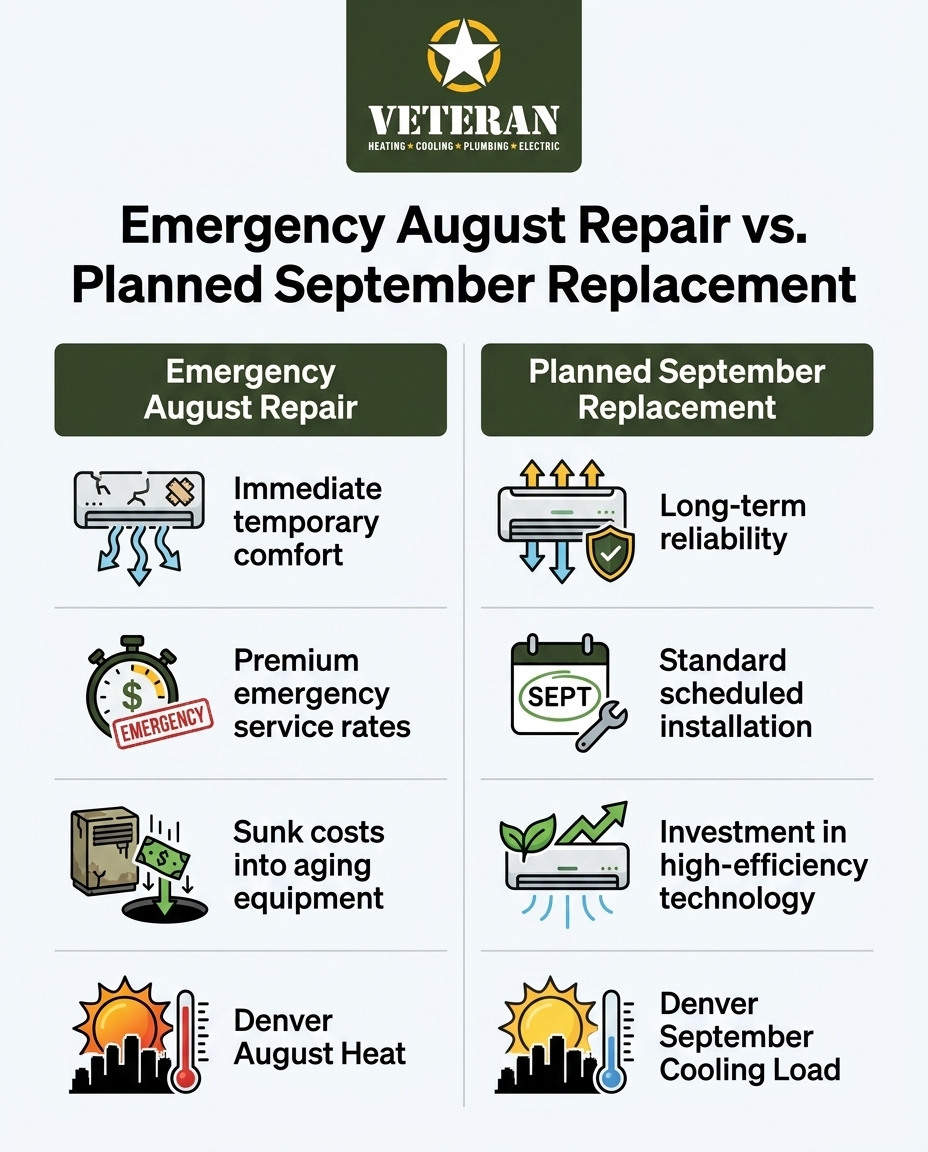
• Financial Impact — Emergency August Repair: High immediate cost for premium service and temporary fixes. — Planned September Replacement: Standard installation rates; investment goes toward a brand-new asset.
• System Reliability — Emergency August Repair: Low. The aging unit may still fail again next season. — Planned September Replacement: High. Brand new system backed by a comprehensive manufacturer warranty.
• Energy Efficiency — Emergency August Repair: Poor. Older units consume significantly more electricity to cool the home. — Planned September Replacement: Excellent. Modern systems use advanced technology to drastically lower utility burdens.
• Decision Pressure — Emergency August Repair: High stress, rushed decisions made simply to restore comfort quickly. — Planned September Replacement: Low stress, objective evaluation of equipment options and financing.
Upgrading for Efficiency and Comfort
The technological leap between a 15-year-old air conditioner and a modern system is staggering. Modern heat pumps and AC units offer vastly superior SEER2 (Seasonal Energy Efficiency Ratio) ratings. Features like variable-speed compressors allow the system to run continuously at lower speeds, providing superior dehumidification and a much more consistent indoor temperature compared to the harsh on-and-off cycling of older single-stage units.
Additionally, taking the time to plan your replacement allows you to explore generic federal tax credits and local utility rebates that may apply to qualifying high-efficiency installations. These incentives are designed to encourage homeowners to adopt better technology, but they require careful equipment selection—something that is difficult to manage during a panicked emergency replacement. Ultimately, entering the next cooling season with a reliable, warrantied system provides unmatched peace of mind.
Making the Right Call with Military-Grade Integrity
When you are facing a major HVAC decision, the character of the company you invite into your home matters just as much as their technical skill. The HVAC industry unfortunately has a reputation for using high-pressure emergency sales tactics during peak summer heatwaves. A technician arrives at a sweltering house, diagnoses a major failure, and immediately pushes for an on-the-spot replacement while the homeowner is most vulnerable.
Working with a veteran-owned company means you experience a different standard—one built on military-grade integrity. The goal is never to force a quick sale on an emergency breakdown. Instead, the focus is on providing a transparent, objective decision framework. We prioritize your long-term investment, even if that means advising you to wait a few weeks for a planned replacement rather than pushing a panicked sale today.
One local homeowner reached out this past summer needing urgent HVAC service when their system started struggling. Instead of rushing them into a corner, our team provided punctual, knowledgeable service, taking the time to explain the entire HVAC process and thoroughly answering every question. That customer received honest advice and top-tier workmanship, empowering them to make the best choice for their home without feeling pressured. A professional, integrity-driven assessment will always provide the clarity you need to confidently choose between repairing your current unit or planning for a replacement.
Frequently Asked Questions About Late-Summer AC Decisions
Is it worth repairing a 15-year-old AC at the end of summer?
In most cases, investing heavily in a 15-year-old air conditioner is not recommended. At 15 years old, a cooling system has typically exceeded its expected lifespan and is likely suffering from severely degraded efficiency. Sinking funds into a major repair at the end of summer is risky, as another vital component could easily fail next year. It is usually wiser to manage the remaining heat and invest those funds into a modern, energy-efficient replacement.
When is the best time of year to replace an AC in Colorado?
The shoulder seasons—specifically early fall (September and October) and early spring (March and April)—are generally the best times for an AC replacement in Colorado. During these months, the extreme weather subsides, reducing the immediate demand for emergency HVAC services. This allows for more flexible scheduling, standard installation rates, and the time needed to properly evaluate and select the best high-efficiency equipment for your home.
Should I fix my AC or just replace it if it breaks in August?
This depends entirely on the age of the unit and the severity of the breakdown. If the system is under ten years old and requires a minor, inexpensive repair, fixing it makes sense to restore immediate comfort. However, if the system is older, uses obsolete R-22 refrigerant, or has suffered a catastrophic compressor failure, replacing it is the more strategic long-term financial decision, rather than paying premium rates for a temporary patch.
Is it better to replace an AC in the fall?
Yes, replacing an air conditioner in the fall offers several distinct advantages. The urgency of summer heat is gone, allowing you to make a calm, calculated decision without the pressure of an uncomfortably hot home. Fall installations avoid emergency service premiums and ensure your home is fully equipped with a reliable, highly efficient cooling system well before the next summer season begins.
How do you know when it's time to replace your AC?
You should consider replacing your AC when it requires frequent repairs, struggles to maintain a consistent temperature, or causes your energy bills to spike unexpectedly. The "5,000 rule" is a helpful guideline: multiply the age of the unit by the estimated severity of the repair, and if the number exceeds 5,000, replacement is advised. Additionally, if your unit is over 10-15 years old and uses phased-out R-22 refrigerant, upgrading is highly recommended.
Can I survive without AC in Denver during September?
Yes, managing without an air conditioner in Denver during September is highly viable for most households. The local climate features a rapid temperature drop as early fall approaches, with cool nights and milder daytime highs. By strategically opening windows at night to capture cool air and using fans to maintain circulation during the day, you can comfortably bridge the gap until a planned replacement can be installed.
Secure Your Home's Comfort for the Long Haul
Making the choice between an emergency repair and a planned replacement does not have to be an overwhelming ordeal. By stepping back from the panic of a late-summer breakdown, you can evaluate your options logically based on your system's age, the severity of the failure, and the realities of the local climate. A strategic decision always outweighs a rushed one.
If your cooling system is failing and you need an honest, pressure-free evaluation, our team is here to help. We provide a clear, logical framework to assess your equipment, ensuring you have all the facts before moving forward. Reach out today to schedule a professional assessment and secure your home's comfort for the long haul.
ABOUT Veteran Heating, Cooling, Plumbing & Electric
Veteran Heating, Cooling, Plumbing & Electric was founded on the belief that service should be personal, honest, and community-focused. Our team is built around integrity, professionalism, and a true commitment to your home’s comfort and safety.
Led by a U.S. Army veteran with over 30 years of industry experience, we’re proud to remain locally owned and operated. Every technician, plumber, and electrician is EPA-certified, background checked, and driven to exceed expectations.
- 24/7 ServiceWe offer weekend & 24/7 emergency service. We’re here whenever you need us—day, night, or weekend, no exceptions.
- $0 Trip FeesNo dispatch or trip fees. You’ll never pay just for us to show up—service starts when the work does.
OUR SERVICES
AIR CONDITIONING
.jpg)
We offer specialty and seasonal services like indoor air quality upgrades, pre-winter furnace checks, and summer AC tune-ups to keep your home prepared year-round.
Our Primary Air Conditioning Services Include:
Don't see the service you need? Call our Team today!
PLUMBING
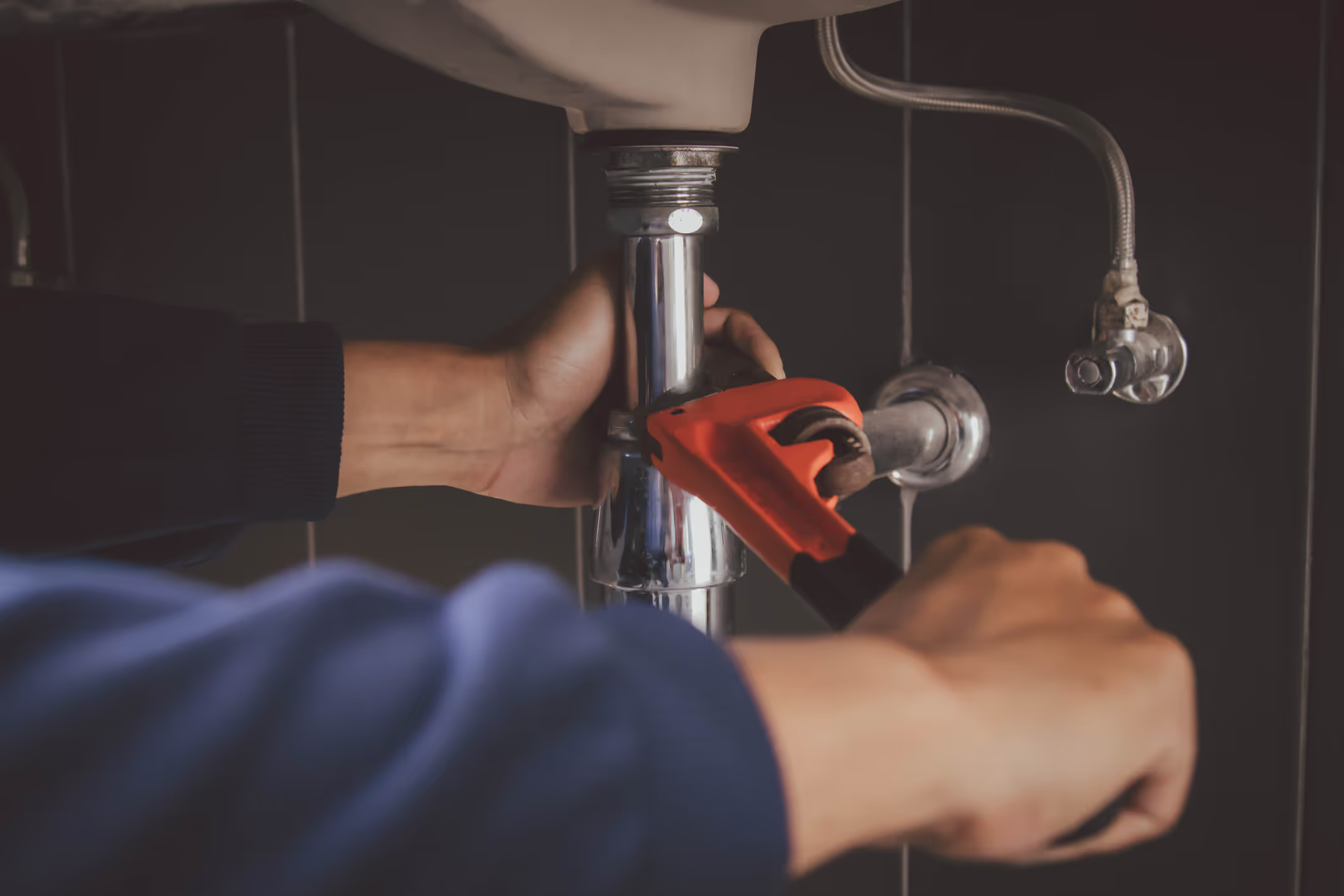
From leaks to full system installs, our plumbing services cover everything you need for a safe, reliable home water system, 24/7.
Our Primary Plumbing Include:
- Water Heater Replacement
- Water Heater Repair
- Trenchless Sewer Line
- Water Filtration
- Slab Leak
- Sewer Line Repair
Don't see the service you need? Call our Team today!
ELECTRICAL

Our electrical services ensure your home stays safe and powered, from routine fixes to complete system upgrades.
Our Primary Electrical Services Include:
- House Rewiring
- Electrician
- Electric Panel Upgrade
- Electric Panel Replacement
- EV Chargers
- Whole House Generator
Don't see the service you need? Call our Team today!
HEATING
.jpg)
We install, repair, and maintain heating & furnace systems with expert care to keep your Colorado home comfortable and energy-efficient year-round.
Our Primary Heating Services Include:
- Heating Installation
- Heating Replacement
- Heating Maintenance
- Heating Repair
- Heating Service
- Heating Tune-Up
Don't see the service you need? Call our Team today!