The Myth of the 'Perfect Blue Flame' in Furnace Safety
For decades, the heating industry relied on a dangerous myth: if your furnace burns with a steady blue flame, the system is safe and operating perfectly. If you are researching Visual Inspection vs Digital Combustion Analysis: Why We Abandoned the Old Way of Testing Denver Furnaces, you need to know that the human eye is completely unequipped to detect the invisible hazards hiding inside modern heating equipment.
In our years of serving Denver homeowners, we've noticed a clear pattern during the critical September pre-heating season: many families schedule standard maintenance checks expecting a simple visual once-over. Historically, a technician would remove the furnace door, watch the burners ignite, and look for a crisp blue color. If the flame appeared stable and did not dance or burn yellow, the system was given a passing grade. We now know this subjective human observation is dangerously inadequate. A flame can look absolutely flawless while the system simultaneously vents hazardous gases directly into your living space.
To truly understand your system's health, you need more than a quick look. Securing a comprehensive fall furnace tune-up means utilizing tools that measure what the human eye cannot see.
The core problem with the visual eyeball test is that it assumes all mechanical failures produce a visible symptom. This is simply not true. Your furnace contains a critical component called a heat exchanger, which acts as a metal barrier keeping deadly combustion exhaust separate from the clean air blowing through your vents. Over years of expanding and contracting, this metal barrier can develop microscopic, hairline cracks. These stress fractures are often so small they cannot be seen with a flashlight or an inspection mirror. Yet, when the blower motor turns on, it forces air through those tiny cracks, altering the draft and pushing exhaust gases into your home. A visual check completely misses this invisible threat until the crack becomes massive enough to physically disrupt the burner flame.
The hidden dangers of relying on a visual check:
• Subjective judgment: What looks like a "good" flame to one technician might look slightly off to another, leaving your family's safety up to a difference of opinion.
• Microscopic metal fatigue: Hairline fractures in the heat exchanger do not always alter the flame shape, making them invisible to the naked eye.
• Delayed detection: By the time a crack is large enough to make the flame turn yellow or dance, the system has likely been leaking exhaust into your home for months.
• Lack of data: Looking at a flame provides zero mathematical data about the actual chemical composition of the exhaust gases leaving the flue pipe.
Guessing is not an acceptable safety standard. A true diagnostic evaluation requires looking past the surface and analyzing the actual chemical process happening inside the combustion chamber.
Why We Stopped Trusting Our Eyes: The Invisible Threat of Carbon Monoxide
Carbon monoxide (CO) is a byproduct of burning natural gas or propane. It is completely colorless, odorless, and tasteless. Because it lacks any physical characteristics that human senses can detect, it is known as the silent killer. A furnace can appear to burn perfectly clean, sound entirely normal, and still emit dangerous levels of CO into your air supply.
This is precisely why we transitioned away from visual checks and adopted digital combustion analysis as a mandatory standard. We use advanced digital sensors that probe directly into the furnace exhaust flue to read the exact chemical makeup of the gases leaving the system. This method takes the guesswork out of the equation and replaces it with hard, verifiable data.
Consider a situation our veteran-led team encountered recently. One homeowner called us during their early fall preparations about a potential gas leak. A basic visual inspection might have missed the underlying combustion issues entirely. However, our technician TJ thoroughly investigated the property using advanced diagnostic tools and found two separate gas leaks. By relying on precise instruments rather than just a visual scan, the leaks were resolved quickly, making the home safe again before the winter chill set in. The same principle applies to testing your furnace for electrical issues or exhaust leaks—you need the right diagnostic equipment to find the truth.
How digital combustion analysis protects your home:
1. Direct exhaust sampling: A specialized probe is inserted directly into the exhaust flue to capture the gases before they leave the house.
2. Real-time chemical breakdown: The analyzer reads the exact percentages of oxygen, carbon dioxide, and carbon monoxide in the exhaust stream.
3. Draft pressure measurement: The tool verifies that the exhaust is being safely pulled up the chimney or out the PVC vent pipe, rather than spilling back into the utility room.
4. Temperature differential calculation: By measuring the temperature of the exhaust gases against the temperature of the air in the room, the analyzer calculates the exact efficiency of the burn.
The Environmental Protection Agency (EPA) and the Consumer Product Safety Commission (CPSC) maintain strict guidelines regarding indoor air quality and combustion appliances. Meeting these guidelines requires exact measurements. An eyeball test cannot tell you if your furnace is operating within safe federal parameters, but a calibrated digital sensor can.
Measuring What Matters: Parts Per Million
When discussing carbon monoxide safety, the measurement standard is parts per million (PPM). This metric tells us exactly how many molecules of carbon monoxide exist within one million molecules of air. Specific numerical thresholds are required to diagnose a failing heat exchanger accurately.
For example, a healthy, well-tuned furnace should produce very low levels of CO in its exhaust flue—typically under 100 PPM. If our digital analyzer reads 400 PPM or higher, it is an immediate red flag indicating incomplete combustion and a severe safety hazard. If those gases are escaping the heat exchanger and entering the ambient air of your home, even 9 PPM can cause long-term health issues, and levels above 35 PPM require immediate evacuation. Exact digital measurements identify these microscopic leaks and rising PPM levels long before they become catastrophic household emergencies.
How High-Altitude Physics Alters Furnace Combustion
In our extensive experience working on homes across the Front Range, we've seen firsthand how geography plays a massive role in how your heating system operates. Here in the Denver metro area, our elevation fundamentally changes the rules of combustion. At 5,280 feet above sea level, the air is significantly thinner, meaning there is roughly 17% less oxygen available per cubic foot of air compared to sea level.
Furnaces rely on a very specific air-to-fuel ratio to burn natural gas safely and efficiently. This is known as stoichiometric combustion. When a furnace is manufactured in a factory near sea level, it is calibrated for dense, oxygen-rich air. If you install that exact same unit in Denver without modifying it, the thinner air means the furnace will receive too much gas and not enough oxygen. This "rich" fuel mixture leads to incomplete combustion, excessive soot buildup, and a dramatic spike in carbon monoxide production.
An eyeball test cannot calculate complex high-altitude combustion physics. You might look at the flame and think it seems fine, but the lack of oxygen is quietly causing the system to overwork and produce dangerous exhaust. Factory settings on a furnace must be digitally recalibrated for local atmospheric conditions. By using a digital combustion analyzer, we can measure the exact oxygen levels in the exhaust and adjust the gas valve pressure to match the thinner air. This ensures the air-to-fuel ratio is perfectly balanced for our specific regional climate, maximizing the lifespan of the equipment and keeping your indoor air safe.
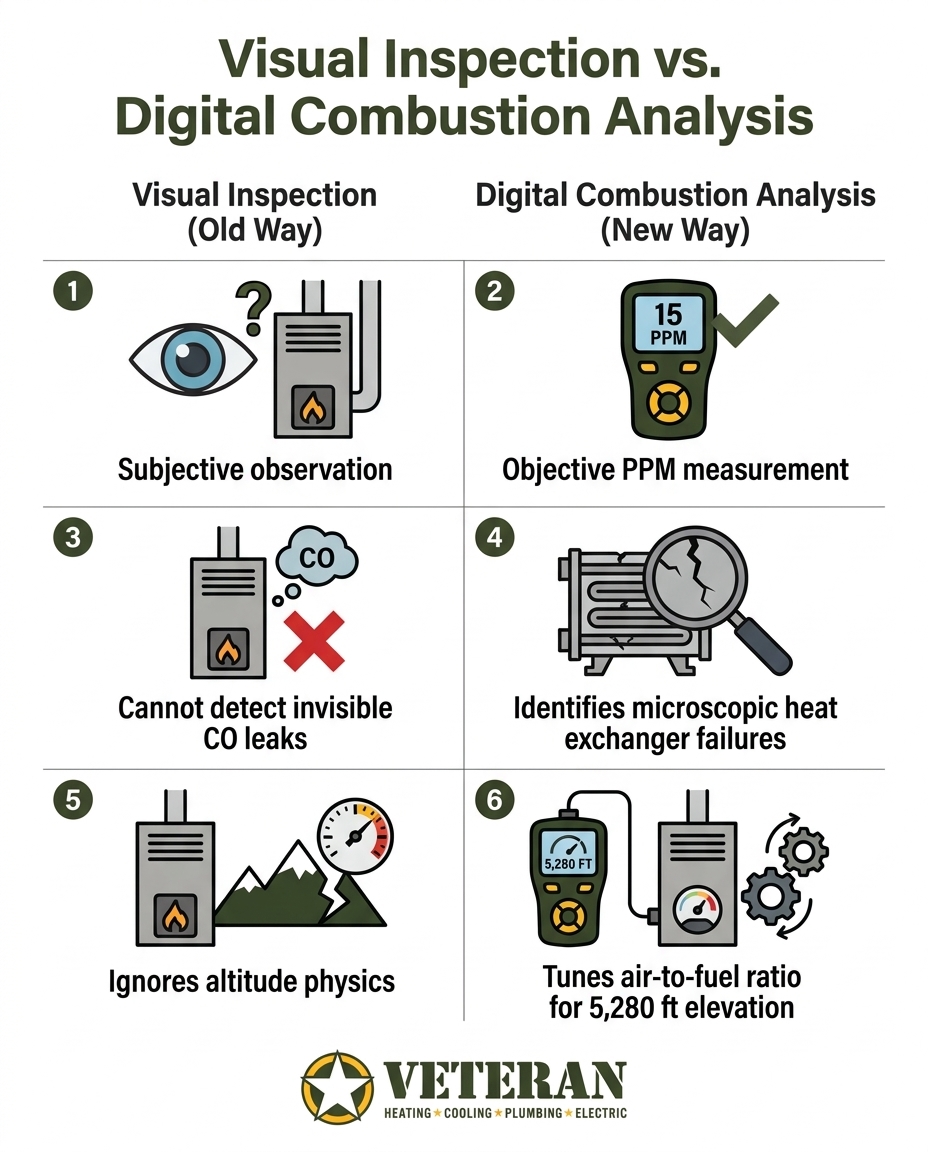
Head-to-Head: Visual Inspection vs. Digital Combustion Analysis
To clearly illustrate why the old methods are no longer acceptable, we need to compare the two approaches directly. The differences in accuracy, safety, and reliability are staggering.
• Method of Evaluation — Traditional Visual Inspection: Subjective human observation of the burner flame. — Digital Combustion Analysis: Objective, calibrated data from specialized electronic sensors.
• Carbon Monoxide Detection — Traditional Visual Inspection: Assumes safety based entirely on flame color and shape. — Digital Combustion Analysis: Measures exact exhaust gases in Parts Per Million (PPM).
• Heat Exchanger Integrity — Traditional Visual Inspection: Misses hairline cracks and microscopic metal stress fractures. — Digital Combustion Analysis: Detects minute fluctuations in CO levels indicating a hidden breach.
• Altitude Calibration — Traditional Visual Inspection: Cannot account for thinner air or oxygen density changes. — Digital Combustion Analysis: Tunes the air-to-fuel ratio perfectly for Denver's 5,280 ft elevation.
• Efficiency Tracking — Traditional Visual Inspection: Provides zero mathematical data on fuel consumption. — Digital Combustion Analysis: Calculates exact combustion efficiency to reduce wasted energy.
Upgrading to a Military-Grade Safety Standard
As a local team deeply committed to our community's safety, the decision to abandon the visual inspection completely was not made lightly. It required a fundamental shift in how we approach every single service call. Working with a veteran-owned company like Veteran Heating, Cooling, Plumbing & Electric means you are getting the same level of discipline and accountability that military service demands. In the military, standard operating procedures (SOPs) are written in blood; you do not guess, you verify. We brought that exact mindset to our diagnostic protocols.
Adopting digital combustion analyzers is now a non-negotiable standard operating procedure for our team. We do not view it as an optional premium service or an upsell; it is the baseline requirement for ensuring a home is secure. The training and discipline required to run comprehensive digital diagnostics on every call is extensive. Our technicians are trained to calibrate their instruments, read complex chemical data, and make microscopic adjustments to gas valves based on hard science.
Leaving community safety to guesswork is simply unacceptable. When we perform a Service to Heroes fall HVAC inspection, we use military-grade diagnostic discipline to ensure every family is protected from invisible threats. We test, we measure, and we verify.
Acting on the Data: When to Repair and When to Walk Away
The Problem: Our team typically sees homeowners facing intense stress when an older heating system starts acting up just before winter. Without concrete data, deciding whether to pour money into a repair or invest in a replacement feels like a massive gamble based on a technician's opinion.
The Cause: The root of this anxiety is a lack of objective information. If a technician just looks at a flame and says, "It looks bad, you need a new one," it is natural to feel skeptical. The visual method relies entirely on trust without providing any verifiable proof of failure.
The Solution: Digital data completely removes the emotion and guesswork from furnace replacement decisions. When a digital analyzer flags a critical failure in an older unit, we can show you the exact PPM readings. You see the numbers on the screen. If the heat exchanger is cracked and venting dangerous gases, the analyzer provides the mathematical proof.
A pattern we see often is the hesitation to trust a diagnosis without hard proof. Last fall, a customer reached out because their furnace was failing to keep the house warm and was running erratically. Instead of guessing at the problem, our technician Jeff used comprehensive diagnostics to pinpoint the exact failure. Because we relied on data, Jeff professionally and efficiently fixed the furnace problem, restoring dependable heat quickly. Conversely, if the data shows that the unit is beyond safe operation, you have the peace of mind knowing that abandoning a 15-year-old furnace is backed by hard science, not just an opinion.
Securing Your Home for the Winter Ahead
True safety requires looking far beyond the surface. A steady blue flame is no longer the gold standard for heating safety; it is merely a baseline expectation that hides deeper truths. As the temperatures drop and your system kicks into high gear for the heating season, you deserve the confidence that comes from objective, scientific testing.
We strongly recommend Denver homeowners demand digital testing for their heating systems. Do not settle for an eyeball test when the technology exists to guarantee your family's well-being. Schedule a comprehensive diagnostic check today, and experience the peace of mind that comes from knowing your furnace is safe, efficient, and ready to handle the winter ahead.
Frequently Asked Questions
Why is a visual furnace inspection not enough?
A visual inspection relies entirely on human observation and cannot detect invisible hazards. Microscopic cracks in the heat exchanger can leak dangerous exhaust gases into your home without ever altering the shape or color of the burner flame. Digital tools are required to measure these hidden chemical threats.
What does a digital combustion analyzer measure?
A digital combustion analyzer measures the exact chemical composition of the exhaust gases leaving your furnace. It calculates the percentages of oxygen, carbon dioxide, and carbon monoxide, while also tracking draft pressure and exhaust temperature to determine the system's overall safety and efficiency.
How do you test a furnace for carbon monoxide?
We test for carbon monoxide by inserting a calibrated digital probe directly into the furnace's exhaust flue while the system is running. This allows us to read the carbon monoxide levels in parts per million (PPM) before the gases vent out of the house, ensuring no toxic exhaust is spilling back into the living space.
Does Denver's altitude affect furnace combustion?
Yes, Denver's 5,280-foot elevation means the air is thinner and contains less oxygen than at sea level. Furnaces must be digitally recalibrated to adjust the air-to-fuel ratio for this altitude; otherwise, they will run "rich," wasting fuel and producing dangerous levels of carbon monoxide.
Can a furnace with a blue flame still leak carbon monoxide?
Absolutely. A furnace can burn with a perfectly steady blue flame while simultaneously leaking high levels of carbon monoxide through a hairline fracture in the heat exchanger. The flame color only indicates the fuel mixture at the burner, not the integrity of the metal barrier keeping the exhaust out of your home.
ABOUT Veteran Heating, Cooling, Plumbing & Electric
Veteran Heating, Cooling, Plumbing & Electric was founded on the belief that service should be personal, honest, and community-focused. Our team is built around integrity, professionalism, and a true commitment to your home’s comfort and safety.
Led by a U.S. Army veteran with over 30 years of industry experience, we’re proud to remain locally owned and operated. Every technician, plumber, and electrician is EPA-certified, background checked, and driven to exceed expectations.
- 24/7 ServiceWe offer weekend & 24/7 emergency service. We’re here whenever you need us—day, night, or weekend, no exceptions.
- $0 Trip FeesNo dispatch or trip fees. You’ll never pay just for us to show up—service starts when the work does.
OUR SERVICES
AIR CONDITIONING
.jpg)
We offer specialty and seasonal services like indoor air quality upgrades, pre-winter furnace checks, and summer AC tune-ups to keep your home prepared year-round.
Our Primary Air Conditioning Services Include:
Don't see the service you need? Call our Team today!
PLUMBING
From leaks to full system installs, our plumbing services cover everything you need for a safe, reliable home water system, 24/7.
Our Primary Plumbing Include:
- Water Heater Replacement
- Water Heater Repair
- Trenchless Sewer Line
- Water Filtration
- Slab Leak
- Sewer Line Repair
Don't see the service you need? Call our Team today!
ELECTRICAL

Our electrical services ensure your home stays safe and powered, from routine fixes to complete system upgrades.
Our Primary Electrical Services Include:
- House Rewiring
- Electrician
- Electric Panel Upgrade
- Electric Panel Replacement
- EV Chargers
- Whole House Generator
Don't see the service you need? Call our Team today!
HEATING
.jpg)
We install, repair, and maintain heating & furnace systems with expert care to keep your Colorado home comfortable and energy-efficient year-round.
Our Primary Heating Services Include:
- Heating Installation
- Heating Replacement
- Heating Maintenance
- Heating Repair
- Heating Service
- Heating Tune-Up
Don't see the service you need? Call our Team today!