Are You Struggling to Find Refrigerant for Your AC This August?
Is your air conditioner running constantly, but only blowing warm air into your living room? The reality of sourcing R-410A refrigerant for older AC units during August shortages in Denver is a frustrating situation many homeowners are facing right now. When your cooling system breaks down during the peak of late-summer heat, right as families are managing the back-to-school transition, you expect a quick fix. Instead, you might be hearing that the specific refrigerant your system needs is heavily delayed, strictly rationed, or simply unavailable at local supply houses.
This is a concrete problem our team at Veteran Heating, Cooling, Plumbing & Electric sees affecting the entire Denver metro area. Unexpected delays and severe supply constraints for R-410A are forcing homeowners to make a tough choice. You are now at a critical decision point: do you wait out the supply delays to recharge an aging unit at the end of the season, or do you upgrade to a new system that uses modern, readily available materials? In this guide, we will provide a clear, jargon-free explanation of why this supply chain bottleneck is happening and exactly what steps our experts recommend you take next.
For more comprehensive guidance on your next steps, read our full breakdown on deciding between AC repair and replacement.
The National R-410A Phase-Out Explained
To understand why our local technicians cannot simply drive to a warehouse and pick up a jug of refrigerant, you have to look at the massive regulatory shift happening across the heating and cooling industry. The shortage you are experiencing is not a localized fluke; it is the direct result of federal environmental regulations reshaping how refrigerants are manufactured and distributed.
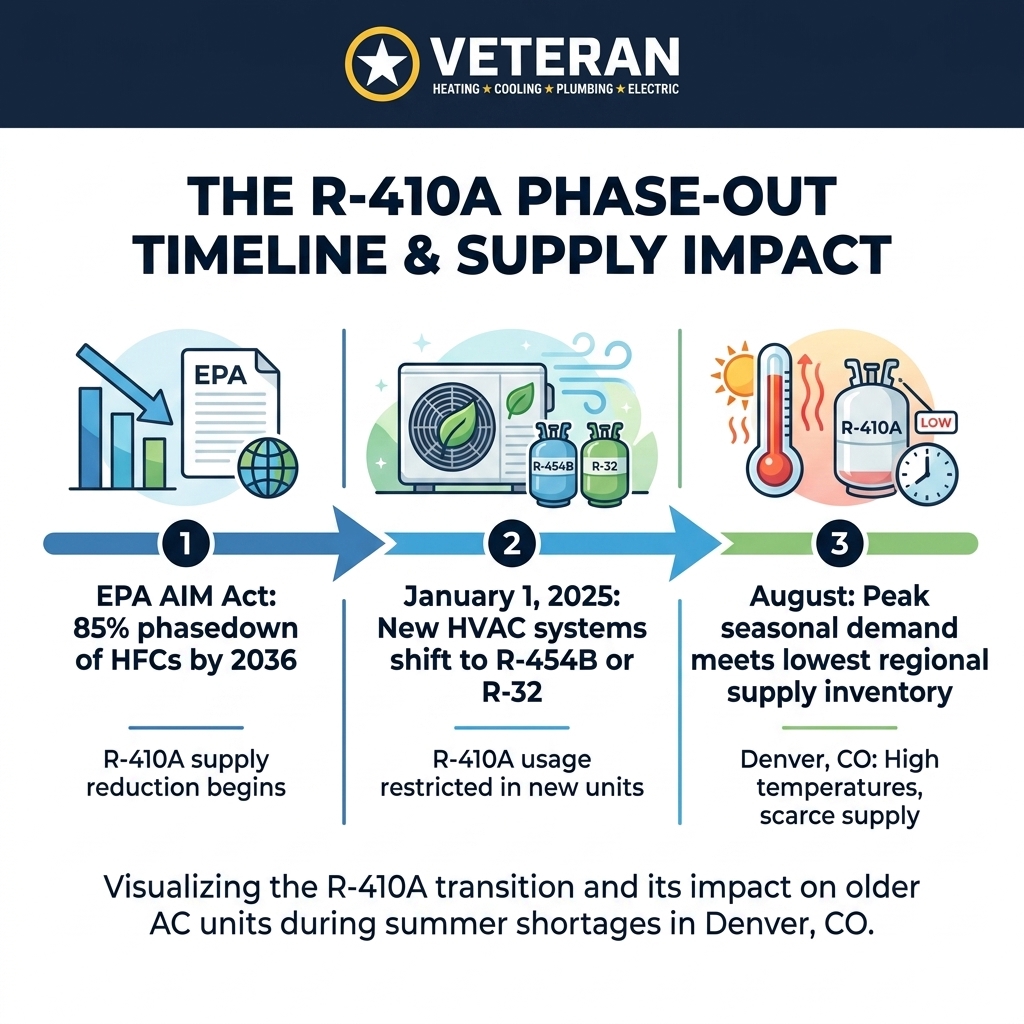
The Environmental Protection Agency (EPA) is executing a phasedown of hydrofluorocarbons (HFCs) under the American Innovation and Manufacturing (AIM) Act. Because R-410A is an HFC with a high Global Warming Potential (GWP), it falls directly under these new restrictions. Here is how the national transition is unfolding:
1. Strict Production Caps: The AIM Act mandates an 85% reduction in HFC production and consumption by 2036. To hit this target, the government has placed strict allocation caps on how much R-410A can be produced domestically or imported into the United States.
2. Manufacturing Shifts: Because new HVAC systems manufactured after January 1, 2025, must use lower-GWP refrigerants (such as R-454B or R-32), chemical manufacturers are aggressively shifting their production lines away from legacy refrigerants.
3. Supply Chain Constriction: With less R-410A entering the market overall, the available pool of refrigerant shrinks every quarter. It is important to note that owning or operating older AC systems reliant on R-410A is not illegal. However, the dwindling chemical supply naturally creates severe bottlenecks for our service crews trying to maintain those older units.
What the EPA Mandates Mean for Homeowners
For the average homeowner we serve, federal policy translates directly into local scarcity. When production limits are enforced at the top of the supply chain, the impact trickles down to the regional supply houses where our HVAC technicians buy their materials. Manufacturers are prioritizing the production of the new refrigerants required for 2025 equipment, leaving legacy supplies on the back burner. As a result, scarcity drives up the difficulty of sourcing materials, meaning that a simple leak repair on an older unit suddenly becomes a logistical nightmare requiring weeks of waiting for backordered supplies.
Why Denver Homes Face Severe Shortages in Late Summer
The national phase-out explains the overall drop in R-410A production, but it does not fully explain why the problem peaks so aggressively at the end of the summer. To understand that, we have to look at how regional supply chains interact with the unique climate of the Front Range.
The problem of regional allocations: HVAC supply houses do not have access to unlimited inventory. They receive set allocations of R-410A for the entire calendar year based on historical data and federal caps. By the time the August late-summer cooling season arrives, these local warehouses have already sold through the majority of their allotted inventory during the early summer heatwaves. The shelves are quite literally running dry just as you need them most.
The cause of high-altitude thermal load: In our years working on Front Range HVAC systems, we've learned that Denver's specific climate acts as a stress multiplier on aging equipment. The high-altitude UV intensity, combined with extreme late-summer heat, places maximum thermal load on your air conditioner. To keep your home comfortable, the system is forced to run continuously. This non-stop operation causes internal system pressures to spike dramatically. If your older unit has weakened joints, worn-out seals, or micro-fissures in the copper coils, this intense pressure will cause blowout leaks.
The resulting perfect storm: This creates an incredibly frustrating reality for homeowners. Your aging equipment is most likely to suffer a catastrophic refrigerant leak during the exact month when regional supplies hit their seasonal lowest. Your frustration is completely valid—you are caught in a perfect storm of high demand, maximum wear-and-tear, and entirely depleted inventory.
Navigating Supply Delays with Honest Assessments
When you are sweltering in your home, the last thing you want to hear is that the parts you need are unavailable. Unfortunately, the pressure of the situation can sometimes lead to poor communication from service providers. Understanding how to navigate these delays starts with finding a team that prioritizes transparency over a quick sale.
The reality of wait times: During peak season, waiting for an R-410A recharge can take days or even weeks depending on local inventory. Some contractors, eager to secure your business, might overpromise on refrigerant availability. They might claim they can get the chemical tomorrow, only to leave you waiting in a hot house while they scramble to find a supplier with stock. This leads to extended, uncomfortable downtime for your family.
The value of military discipline and transparency: Working with our veteran-owned company means you get the same level of discipline, accountability, and honesty that military service demands. You deserve an objective, non-salesy explanation of supply chain mechanics. If the refrigerant is not available, our disciplined technicians will tell you the truth upfront, allowing you to make an informed decision without feeling pressured into a corner.
Even outside of the chaotic summer season, rapid and reliable response is critical. One of our local Denver customers noted that when they needed an AC repair during an off-season period, our technician Jimi arrived the same day, proving highly efficient and knowledgeable while handling the repair professionally. That same commitment to efficiency applies during the August rush, but when the physical supply of refrigerant is exhausted locally, honest communication about your options becomes the most valuable service our technicians can provide. If you find yourself in this situation, you need clear guidance on handling emergency AC repairs.
Identifying If Your Current System Relies on R-410A
Before you make any major decisions about repairing or replacing your equipment, you need to verify exactly what type of refrigerant your system uses. Determining if your unit is impacted by these shortages is a straightforward process you can handle yourself, though any actual handling of the chemical must be done by an EPA-certified professional.
Here is a quick checklist our team recommends to help you identify your system's requirements and spot potential issues:
• Check the manufacturing label: Walk outside to your outdoor compressor unit. Look for a large sticker or metal plate on the side of the cabinet. This data plate will list the system's specifications.
• Look for the refrigerant type: Scan the label for the word "Refrigerant" or "Factory Charge." If it says "R-410A" (or sometimes the brand name "Puron"), your system is directly impacted by the current supply shortages.
• Check the manufacturing date: If your system was manufactured between 2010 and 2023, it almost certainly uses R-410A.
Understanding how your system operates can also help you understand why leaks occur. The cooling process relies on a closed loop traveling between your indoor and outdoor AC units. Over time, our repair crews frequently see that vibrations from the compressor, combined with formicary corrosion (microscopic rust caused by household chemicals interacting with copper), weaken the metal coils. When the system is under high pressure during an August heatwave, these weak spots rupture.
Signs you have a refrigerant leak:
• A faint hissing or bubbling sound coming from the indoor coil or outdoor unit.
• Ice building up on the copper refrigerant lines or the indoor evaporator coil.
• The system runs constantly but only blows warm or room-temperature air from the vents.
• Unusually high energy bills despite a lack of cooling power.
If you notice these symptoms, it is critical to understand that simply "topping off" a leaking system is a temporary and increasingly impractical measure. Because it is a closed loop, refrigerant does not evaporate or get used up like gas in a car. If it is low, there is a physical hole in the system. Recharging an older AC system reliant on R-410A without fixing the source of the leak means you will be right back in the same situation—facing severe shortages—in a matter of weeks.
Weighing Your Options: Wait for a Recharge or Upgrade Now?
If your system has suffered a significant leak and requires a massive recharge of R-410A, you are faced with a difficult choice. Do you wait for the local supply house to receive a new shipment, or do you cut your losses and upgrade to a modern system? Providing a practical decision framework can help you move toward a resolution.
While upfront costs for a new system certainly exist, avoiding repeated, supply-constrained recharges provides long-term stability. Furthermore, many modern, high-efficiency systems we install may qualify for generally applicable energy rebates, utility incentives, or federal tax credits. (Always verify current programs with your local utility provider or a tax professional, as program terms change frequently.)
Consider the following comparison to help you decide your best path forward during the August late-summer cooling season:
• Immediate Availability — Waiting for an R-410A Recharge: Subject to severe regional supply delays and allocation limits. — Upgrading to a Modern System: New systems and their corresponding lower-GWP refrigerants are prioritized by manufacturers and readily available.
• Long-Term Reliability — Waiting for an R-410A Recharge: Temporary fix. The original leak source often remains, risking future blowouts. — Upgrading to a Modern System: A brand-new closed-loop system eliminates existing leaks and comes with fresh warranty coverage.
• Future Maintenance — Waiting for an R-410A Recharge: R-410A will only become scarcer and harder to source as the 2036 phasedown progresses. — Upgrading to a Modern System: Uses modern refrigerants (like R-454B) that are fully supported by the current EPA supply chain.
• Energy Efficiency — Waiting for an R-410A Recharge: Aging systems lose efficiency rapidly, driving up monthly utility bills. — Upgrading to a Modern System: New units offer significantly higher SEER2 ratings, reducing the electrical load required to cool your home.
Many homeowners who choose to upgrade find that the process is smoother than expected, even during the busy season. For example, one local family needed a full installation of a new heat pump during the summer. Our technicians John, Jacob, and Tanner handled the project, going above and beyond to ensure the system was installed professionally, leaving the homeowners completely satisfied with their reliable new cooling source.
Ultimately, the choice depends on the age of your current equipment and the severity of the leak. If you are struggling to make the call, we highly recommend reviewing our guide on repairing a refrigerant leak or replacing your AC to evaluate the economics of your specific situation.
Frequently Asked Questions
Why is there a shortage of R-410A refrigerant right now?
The shortage is driven by federal regulations under the EPA's AIM Act, which mandates an 85% phasedown of HFC production. Because R-410A is an HFC, strict import and production caps are limiting how much enters the market. When you combine this reduced national supply with peak late-summer demand, local HVAC supply houses quickly run out of their allocated inventory.
Is R-410A being phased out completely?
It is not being banned overnight, but its production is being drastically reduced over a timeline ending in 2036. While it remains perfectly legal to own and operate a system that uses R-410A, the ongoing phasedown means that the chemical will become increasingly scarce and difficult for our technicians to source for repairs.
Can I still get R-410A for my older AC unit in Denver?
Yes, but you should expect significant delays, especially during the late-summer months. Because local supply houses receive set allocations for the year, inventory is often depleted by August. Our technicians can still procure it, but it may require waiting on backorders rather than same-day availability.
Is it worth recharging an old AC with R-410A during late summer?
If your system is relatively young and the leak is minor and easily repairable, a recharge might make sense. However, if your unit is over 10 years old and has a major coil leak, investing heavily in a scarce refrigerant is often a poor choice. The system is likely to leak again, putting you back at square one.
How does the R-410A phase-out affect my current air conditioner?
The phase-out does not force you to replace a functioning air conditioner. As long as your system operates normally and does not develop a leak, you will not notice any impact. The phase-out only affects you when your system breaks down and requires additional refrigerant to function.
What new refrigerants are replacing R-410A?
The HVAC industry is shifting toward lower-GWP (Global Warming Potential) refrigerants, primarily R-454B and R-32. Any new residential air conditioning equipment manufactured after January 1, 2025, is required by law to utilize these newer, more environmentally friendly chemical alternatives.
Making the Right Call for Your Home's Comfort
Navigating the reality of sourcing R-410A refrigerant for older AC units during August shortages in Denver does not have to be a guessing game. By understanding the national phase-out and how it impacts local supply chains, you can make an informed decision about your home's comfort. Whether you choose to wait for a repair or invest in a modern, highly efficient system, having a clear explanation of your options gives you back control. If you are tired of dealing with an unreliable system and want practical, honest guidance on your next steps, reach out to our team at Veteran Heating, Cooling, Plumbing & Electric to evaluate your equipment today.
ABOUT Veteran Heating, Cooling, Plumbing & Electric
Veteran Heating, Cooling, Plumbing & Electric was founded on the belief that service should be personal, honest, and community-focused. Our team is built around integrity, professionalism, and a true commitment to your home’s comfort and safety.
Led by a U.S. Army veteran with over 30 years of industry experience, we’re proud to remain locally owned and operated. Every technician, plumber, and electrician is EPA-certified, background checked, and driven to exceed expectations.
- 24/7 ServiceWe offer weekend & 24/7 emergency service. We’re here whenever you need us—day, night, or weekend, no exceptions.
- $0 Trip FeesNo dispatch or trip fees. You’ll never pay just for us to show up—service starts when the work does.
OUR SERVICES
AIR CONDITIONING
.jpg)
We offer specialty and seasonal services like indoor air quality upgrades, pre-winter furnace checks, and summer AC tune-ups to keep your home prepared year-round.
Our Primary Air Conditioning Services Include:
Don't see the service you need? Call our Team today!
PLUMBING
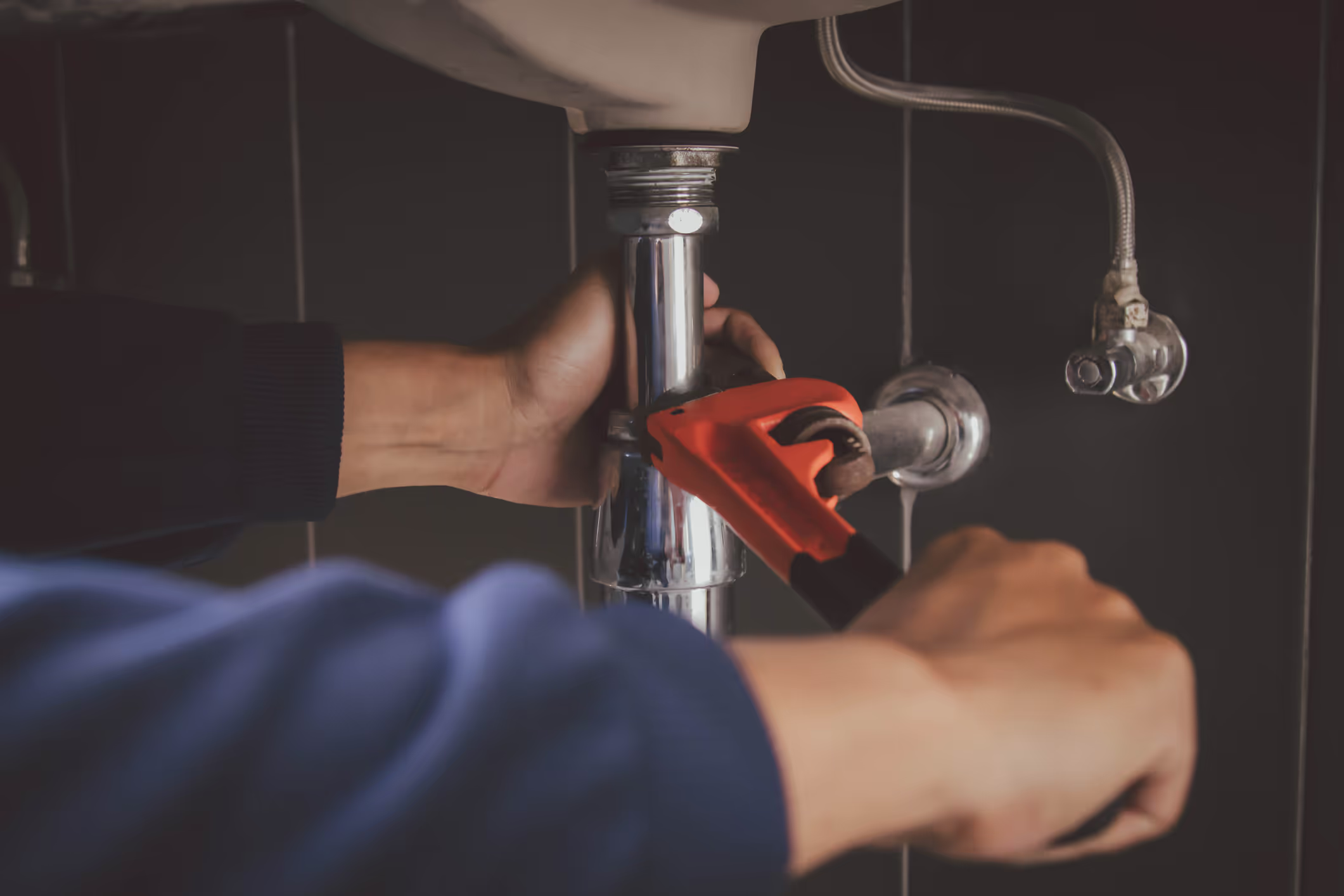
From leaks to full system installs, our plumbing services cover everything you need for a safe, reliable home water system, 24/7.
Our Primary Plumbing Include:
- Water Heater Replacement
- Water Heater Repair
- Trenchless Sewer Line
- Water Filtration
- Slab Leak
- Sewer Line Repair
Don't see the service you need? Call our Team today!
ELECTRICAL

Our electrical services ensure your home stays safe and powered, from routine fixes to complete system upgrades.
Our Primary Electrical Services Include:
- House Rewiring
- Electrician
- Electric Panel Upgrade
- Electric Panel Replacement
- EV Chargers
- Whole House Generator
Don't see the service you need? Call our Team today!
HEATING
.jpg)
We install, repair, and maintain heating & furnace systems with expert care to keep your Colorado home comfortable and energy-efficient year-round.
Our Primary Heating Services Include:
- Heating Installation
- Heating Replacement
- Heating Maintenance
- Heating Repair
- Heating Service
- Heating Tune-Up
Don't see the service you need? Call our Team today!