Did Your Smart Thermostat Upgrade Just Hit a Wiring Wall?
Are you staring at a handful of mismatched wires, wondering how to navigate the hidden electrical quirks of upgrading to a smart thermostat in a 1970s Aurora home? You are certainly not alone in this frustration. At Veteran Heating, Cooling, Plumbing & Electric, our team frequently fields calls from homeowners who purchased a sleek new Wi-Fi thermostat to save energy during the early fall pre-heating season, only to take their old unit off the wall and discover a missing C-wire. The instructions usually assume you have a modern five-wire setup, but your wall might only reveal two or four faded wires wrapped around a mechanical dial.
This missing wire represents a concrete problem: older homes simply lack the continuous 24-volt power line required to keep modern digital displays and Wi-Fi radios running. Without it, you are left at a frustrating decision point. Do you risk attempting a DIY electrical workaround you found online, or do you call a professional to pull new wire before the weather turns cold?
When you start noticing signs your home needs electrical repair, it is often tied directly to these legacy systems. In fact, hidden electrical problems in older homes frequently reveal themselves during what should be simple cosmetic or technology upgrades. Understanding why your house was wired this way is the first step toward getting your new thermostat powered up safely.
The Architectural Reality of 1970s Aurora Homes
To understand why your new smart thermostat is starved for power, we have to look back at the local housing stock. In our years of servicing the Denver metro area, we've seen firsthand how the massive 1970s housing boom shaped our local infrastructure. Builders were constructing homes rapidly to keep up with demand, and they followed the standard electrical practices of the era. At that time, residential HVAC controls were purely mechanical.
If you are working through an electrical safety checklist for older homes, you will quickly notice that 1970s electrical standards were vastly different from today's requirements. Here are a few historical facts about how these homes were wired:
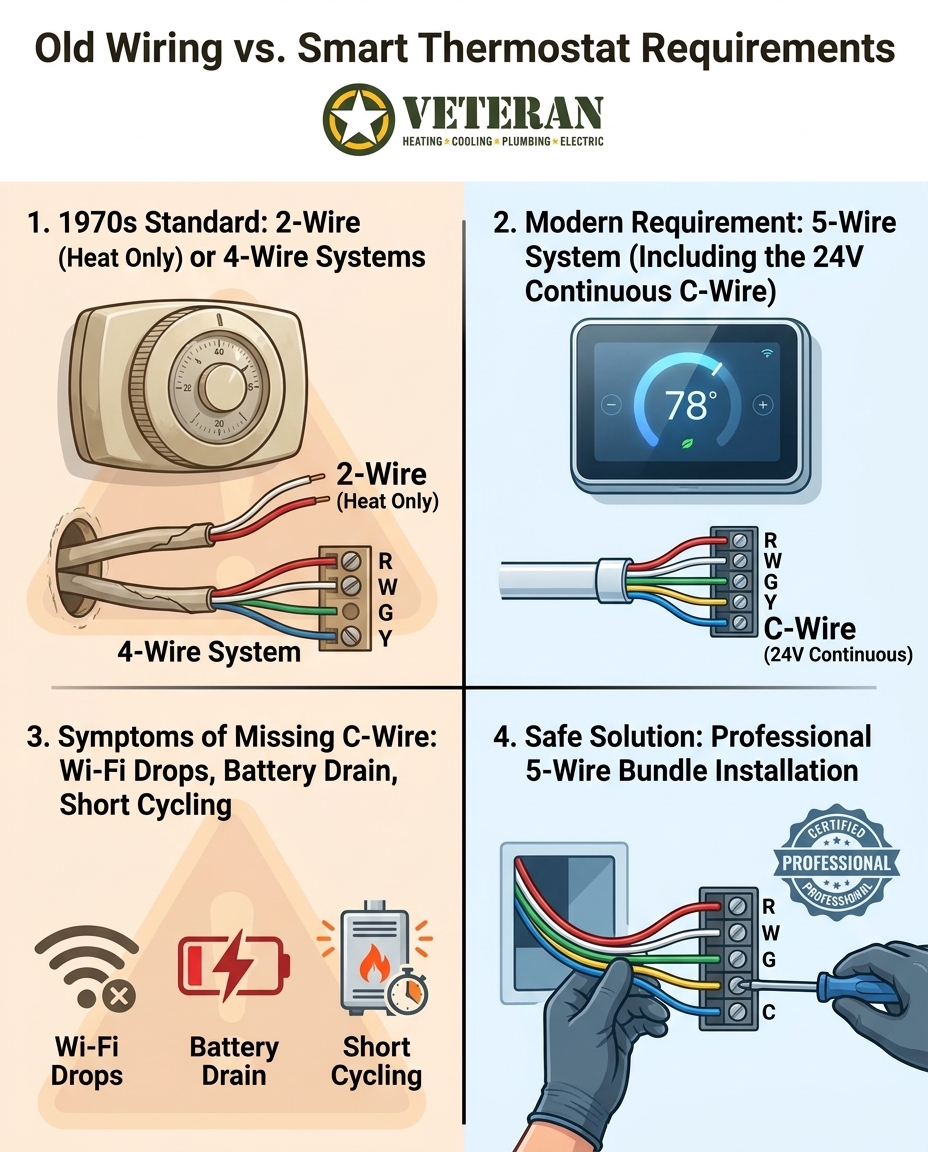
1. Heat-Only Systems Were Common: Many homes were built with furnaces but no central air conditioning. These systems only required a basic 2-wire setup (a power wire and a heating control wire).
2. Mechanical Mercury Switches: Older bi-metal or mercury-switch thermostats did not need electricity to run a display. They simply acted as a physical bridge to close a circuit when the room temperature dropped.
3. The 4-Wire Standard for AC: If the home was built with central air, builders typically ran a 4-wire bundle. This added a cooling wire and a fan control wire, but still omitted a dedicated power return line.
These legacy systems were never designed to power a miniature computer on your wall. This missing wire is a widespread architectural quirk across the region, not a unique defect in your specific house.
Comparing Legacy vs. Modern Thermostat Wiring
To put this into perspective, let's look at the difference between what builders installed in the 1970s and what your new smart thermostat actually expects to find behind the drywall.
• Power Delivery — 1970s Standard Setup: Intermittent (only when running) — Modern Smart Thermostat Requirement: Continuous 24VAC power
• Wire Count — 1970s Standard Setup: 2 to 4 wires — Modern Smart Thermostat Requirement: 5 or more wires
• Common (C) Wire — 1970s Standard Setup: Rarely included — Modern Smart Thermostat Requirement: Strictly required for Wi-Fi
• System Control — 1970s Standard Setup: Mechanical switch — Modern Smart Thermostat Requirement: Digital circuit board
Recognizing that your home is simply a product of its time can alleviate the frustration of a stalled installation. A pattern we see often is that the wiring in your wall did exactly what it was designed to do for fifty years—it just needs a professional update to handle the next fifty.
What Exactly is a C-Wire (and Why Does Your Smart Thermostat Demand It)?
The "Common" wire, universally known as the C-wire, is the dedicated return path that completes a 24-volt alternating current (VAC) electrical circuit between your heating equipment and your thermostat. To understand its role, you have to look at how power flows through your HVAC system.
Your furnace or air handler has a control board with a built-in transformer. This transformer takes the standard 120-volt household current and steps it down to a safer 24 volts to run the thermostat. The "R" wire carries this 24-volt power up to the thermostat. When the house gets cold, the thermostat connects the "R" wire to the "W" (heating) wire, sending power back down to the furnace to ignite the burners.
However, that power only flows when the system is actively heating or cooling. A mechanical dial does not care what happens when the system is off. A modern smart thermostat, on the other hand, is a completely different machine. It has a full-color touchscreen display, motion sensors, and a Wi-Fi radio that constantly communicates with your router and smartphone. It cannot wait for the heat to kick on to get a burst of power.
The 24V Continuous Power Requirement
Without a C-wire to complete the circuit, your new Wi-Fi thermostat is essentially starved for electricity. The HVAC control board sends power, but there is no dedicated path for it to return continuously.
Some smart thermostats attempt to get around this by "power stealing"—drawing tiny sips of electricity through the heating or cooling wires even when the system is off. In an older Aurora home, this often leads to a host of performance issues. If you try to force a smart thermostat to run on internal batteries or power-stealing without a true C-wire, our technicians typically see several distinct symptoms:
• Frequent Wi-Fi disconnects: The thermostat shuts down its wireless radio to conserve its rapidly draining internal battery.
• Blank screens: The touchscreen goes completely dark and refuses to wake up when you walk by.
• Short-cycling: The furnace turns on and off rapidly because the power-stealing mechanism is confusing the main control board.
• Complete system shutdowns: The thermostat battery dies entirely, leaving you with no heating or cooling until you physically remove the unit and charge it with a USB cable.
Ignoring the manufacturer's C-wire requirement usually results in a thermostat that fails right when you need it most.
The Hidden Dangers of Popular DIY Thermostat Workarounds
When homeowners discover the missing wire, their first instinct is often to search the internet for a quick fix. You will find dozens of videos promoting "easy" DIY workarounds, ranging from plug-in adapters to rearranging the wires inside your furnace. While these hacks might seem appealing, they carry significant risks, especially given the architectural age of 1970s homes.
The problem with add-on C-wire adapter kits:
Many smart thermostats come with a small "power extender kit" or C-wire adapter in the box. These devices require you to open up your furnace panel, splice into the high-voltage control board, and mount a secondary module. These add-on kits are often flimsy and highly prone to failure. Aurora's extreme temperature swings require a robust, failure-proof HVAC system. A DIY adapter failing during a freezing night leaves the home entirely vulnerable, as the thermostat will instantly die and shut down the furnace.
The cause of lost circulation (The G-Wire Hack):
Another popular internet trick is the "G-wire hack." This involves taking the green wire (which controls your indoor blower fan) and repurposing it to act as the C-wire. The immediate result is that you lose independent fan control. You can no longer run the fan to circulate air through the house unless the heat or AC is actively running. In a multi-level home, losing the ability to balance indoor air temperatures by circulating the fan is a major downgrade in comfort.
The solution is avoiding control board damage:
The most severe danger of DIY thermostat wiring is accidentally shorting out the HVAC control board. If you cross the wrong wires or fail to properly ground a connection while attempting a workaround, you can instantly blow the fuses on the furnace board—or fry the board entirely.
In a recent pre-heating season case involving local electrical repairs, our team responded to a homeowner experiencing the direct fallout of a failed DIY adapter kit. Our technicians provided thorough service with strict attention to detail, carefully mapping out the electrical fault. By the end of the visit, the customer fully understood how the faulty workaround had compromised the system and why pulling proper wire was the only permanent fix. If you are unsure about your system's status, it is always best to check your thermostat before calling for repair, but leave the internal wiring modifications to our experts.
Doing It Right: Pulling a True 5-Wire Bundle with Precision
The only safe, long-term solution to a missing C-wire—and the one we always recommend to our Aurora customers—is pulling a brand new, true 5-wire bundle from the furnace control board directly to the thermostat location on your wall. This eliminates the need for adapters, prevents power-stealing issues, and ensures your smart home technology operates exactly as the manufacturer intended.
Conceptually, this process involves carefully fishing a new, properly gauged thermostat wire up through the wall cavities from the basement or utility closet. It requires safely navigating around existing plumbing, ductwork, and 1970s electrical runs without causing damage to the drywall. Once the new bundle is routed, it must be correctly stripped, seated, and secured to the 24V terminals on the furnace control board.
Why Dedicated Wiring Outlasts Quick Fixes
Having a dedicated, properly gauged electrical line means your thermostat receives clean, uninterrupted power. There are no secondary modules to fail, and you retain full control over your blower fan.
Working with our Veteran-owned team means applying military precision and discipline to this exact process. We believe in doing the job right the first time, safely diagnosing outdated electrical systems, and refusing to cut corners with flimsy band-aid fixes. Upgrading the wiring in an older home is licensed professional work that bridges both the electrical and HVAC systems, demanding a high level of accountability.
This commitment to doing things right extends to all types of residences. In one scenario involving local rental properties, our team was called in to correct outdated wiring that was causing heating failures. The property owner noted our affordable, honest service and appreciated the strict attention to detail—down to our technicians wearing shoe covers while working inside the home to protect the flooring.
Timing Your Upgrade Before the Fall Transition
If you are planning to upgrade your thermostat, timing is everything. The rapid shift from scorching late summer days to freezing October nights in Colorado necessitates a fully reliable HVAC system. The average first freeze in the region typically hits by mid-October, making September the critical window for finalizing thermostat and electrical upgrades.
During the early fall pre-heating season, your system is often tasked with cooling the house during a warm afternoon and then heating it overnight. A properly powered smart thermostat optimizes this transition, automatically switching between modes to keep your home comfortable without wasting energy. If your thermostat is relying on a dying battery or a faulty DIY adapter, it will likely fail right in the middle of this seasonal shift.
The connection to overall system readiness:
A new thermostat is only as good as the equipment it controls. Upgrading your wiring before the cold sets in ensures that your heat pump or furnace is communicating flawlessly with the wall unit. If you are curious about how heat pumps work in a four-season climate, you will find that they rely heavily on precise, continuous data from the thermostat to manage defrost cycles and auxiliary heating. Securing a strong, continuous 24V power supply guarantees that your system is ready to handle whatever the fall weather brings.
Frequently Asked Questions About Smart Thermostats in Older Homes
Why does my 1970s house not have a C wire?
Your 1970s house lacks a C-wire because old mechanical thermostats did not need continuous power for Wi-Fi or digital displays. The original builders only installed the two or four wires necessary to signal the furnace or air conditioner to turn on and off. There was simply no technological need for a dedicated power return line fifty years ago.
Is it safe to use a C-wire adapter for a smart thermostat?
While C-wire adapters can work temporarily, they are generally prone to failure and can cause power fluctuations to the HVAC control board. These add-on modules add an unnecessary point of failure to your heating system. For long-term safety and reliability, pulling a proper 5-wire bundle is always the superior choice.
Can I use the fan wire for my smart thermostat?
Repurposing the fan wire (the G-wire) to act as a C-wire means sacrificing your independent fan control. You will no longer be able to circulate air through your home unless the heating or cooling is actively running. This significantly reduces indoor air circulation, which can lead to stagnant air and uneven temperatures across different floors of your home.
What happens if you don't connect the C wire?
If you do not connect a C-wire, your smart thermostat will suffer from rapid battery drain, frequent Wi-Fi disconnections, and short-cycling of your HVAC equipment. Eventually, the thermostat will shut itself down completely to protect its internal circuitry, leaving you without any temperature control until the unit is recharged.
How do I know if my house has a hidden C wire?
You can check for a hidden C-wire by removing your thermostat's wall plate and gently pulling the wire bundle forward to look inside the wall cavity. Often, previous owners or technicians may have pulled a newer 5-wire bundle but left the extra wires wrapped around the jacket because the old thermostat didn't need them. If you see an unused blue or black wire tucked away, you might already have what you need.
Secure Your Comfort: Schedule Your Thermostat Wiring Upgrade Today
A professional wiring upgrade is the absolute safest path to getting your new smart thermostat working flawlessly before winter arrives. By pulling a true 5-wire bundle, you guarantee clean, continuous power to your device without sacrificing fan control or risking damage to your furnace control board. Skip the frustrating DIY hacks and rely on the expert, disciplined service from Veteran Heating, Cooling, Plumbing & Electric to prepare your home for the early fall pre-heating season. Schedule an inspection or electrical upgrade with our team today to ensure your HVAC system is fully equipped for the seasonal shift.
ABOUT Veteran Heating, Cooling, Plumbing & Electric
Veteran Heating, Cooling, Plumbing & Electric was founded on the belief that service should be personal, honest, and community-focused. Our team is built around integrity, professionalism, and a true commitment to your home’s comfort and safety.
Led by a U.S. Army veteran with over 30 years of industry experience, we’re proud to remain locally owned and operated. Every technician, plumber, and electrician is EPA-certified, background checked, and driven to exceed expectations.
- 24/7 ServiceWe offer weekend & 24/7 emergency service. We’re here whenever you need us—day, night, or weekend, no exceptions.
- $0 Trip FeesNo dispatch or trip fees. You’ll never pay just for us to show up—service starts when the work does.
OUR SERVICES
AIR CONDITIONING
.jpg)
We offer specialty and seasonal services like indoor air quality upgrades, pre-winter furnace checks, and summer AC tune-ups to keep your home prepared year-round.
Our Primary Air Conditioning Services Include:
Don't see the service you need? Call our Team today!
PLUMBING
From leaks to full system installs, our plumbing services cover everything you need for a safe, reliable home water system, 24/7.
Our Primary Plumbing Include:
- Water Heater Replacement
- Water Heater Repair
- Trenchless Sewer Line
- Water Filtration
- Slab Leak
- Sewer Line Repair
Don't see the service you need? Call our Team today!
ELECTRICAL

Our electrical services ensure your home stays safe and powered, from routine fixes to complete system upgrades.
Our Primary Electrical Services Include:
- House Rewiring
- Electrician
- Electric Panel Upgrade
- Electric Panel Replacement
- EV Chargers
- Whole House Generator
Don't see the service you need? Call our Team today!
HEATING
.jpg)
We install, repair, and maintain heating & furnace systems with expert care to keep your Colorado home comfortable and energy-efficient year-round.
Our Primary Heating Services Include:
- Heating Installation
- Heating Replacement
- Heating Maintenance
- Heating Repair
- Heating Service
- Heating Tune-Up
Don't see the service you need? Call our Team today!