The Hidden Impact of the First Fall Cold Snap on Indoor Air Quality
You turn your thermostat up for the first time in months, expecting cozy warmth, but instead, you are greeted by a harsh, burning odor—which brings us to the truth about duct cleaning: why we recommend it during the September transition from AC to heat. That sudden, alarming smell is not a mystery; it is a mechanical inevitability caused by the sudden shift from the cooling season to the heating season. This transition period places immense stress on your home's indoor air quality, acting as a critical bottleneck for airborne debris.
During the peak of summer, your cooling system works tirelessly to keep you comfortable. However, as the seasons change and the first cold snap arrives, the rapid switch from air conditioning to heating exposes a hidden problem inside your ductwork. Homeowners frequently turn on their heat to take the chill out of the air, only to immediately smell burning dust circulating through every room. This is the exact moment when you face a clear decision point: you can either address this duct buildup proactively during the brief seasonal window, or you can suffer through compromised, dusty air quality all winter long.
Scheduling a thorough cleaning during the September AC-to-heat transition is a highly strategic move. It intercepts the debris that accumulated over the summer before your furnace has a chance to bake it and blow it into your living spaces. By taking a proactive approach to routine HVAC system service, you ensure that your system starts the heating season with a clean slate, protecting both your respiratory health and your equipment.
The Physics of Summer Cooling: How Condensation Traps Airborne Debris
The problem: Many homeowners assume that dust simply blows through their vents and settles on furniture. In reality, the cooling process actively traps and holds onto airborne debris inside your ductwork, creating a stubborn, restrictive layer of grime that standard filters cannot entirely eliminate.
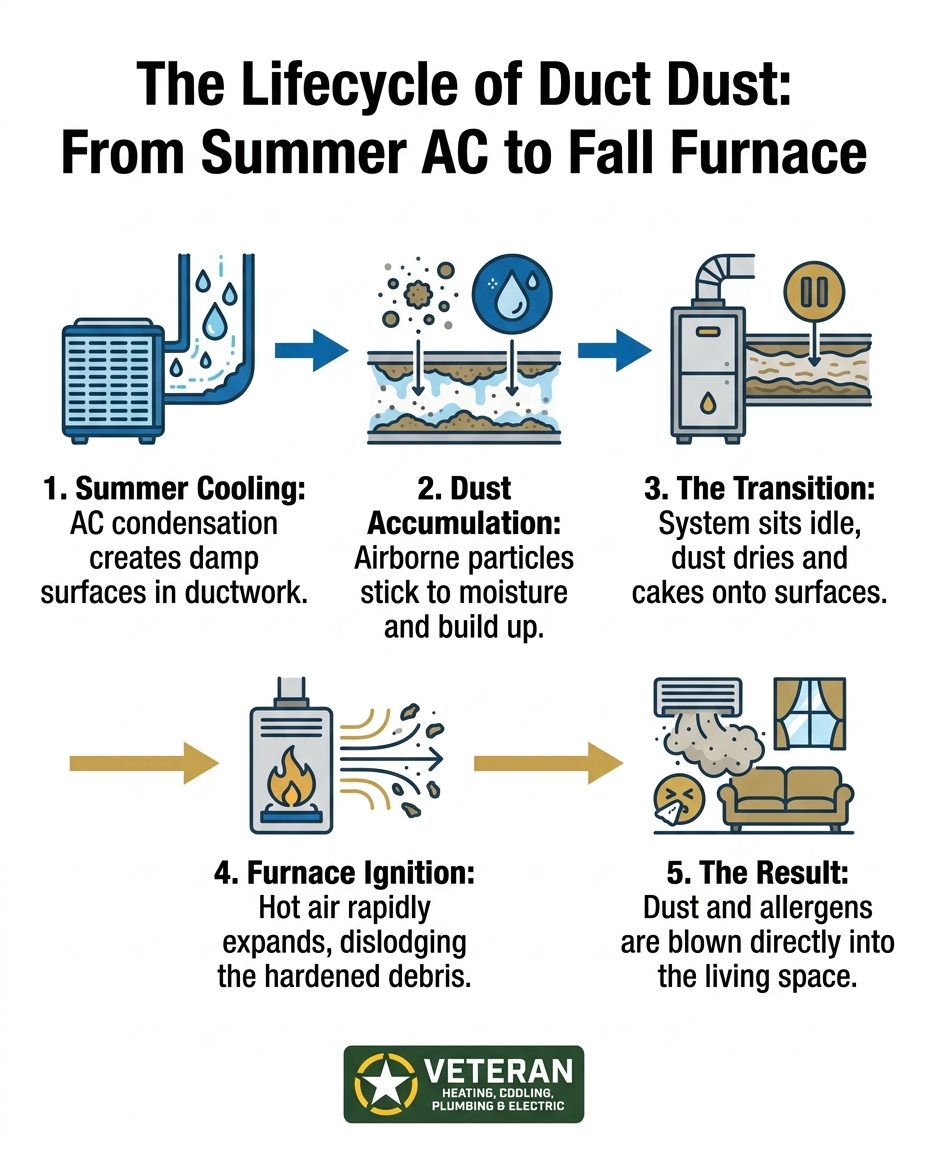
The cause: Air conditioners do more than just lower the temperature; they naturally produce condensation as they extract humidity from your indoor air. This moisture creates a consistently damp environment inside the ductwork, particularly around the indoor evaporator coil. As ambient airborne particles, pet dander, lint, and household dust get pulled into the return vents, they bypass minor gaps in the filter and collide with these damp surfaces. Instead of blowing through, the dust sticks to the moisture. Over months of heavy summer usage, this creates a caked-on layer of damp debris. When the cooling season ends and the system cycles off, this sludge dries out and hardens into a solid crust inside the metal and flex ducts.
The solution: Breaking up this hardened layer requires more than a basic filter change. It requires a dedicated fall furnace tune-up and professional duct cleaning to physically dislodge the caked-on dust before the heating cycle begins.
The Moisture and Dust Cycle
To truly understand why this buildup occurs, you have to look at the airflow dynamics during the cooling season. Here is how the cycle unfolds inside your walls:
• Airflow dynamics: High-velocity air constantly circulates through the system, carrying microscopic particulate matter that easily evades standard, low-MERV fiberglass filters.
• The limitation of standard filters: Even high-quality residential filters cannot catch 100% of microscopic particulate matter. The finest particles slip through and adhere to the wet surfaces inside the air handler.
• The hardening process: As temperatures fluctuate in the early fall and the air conditioner runs less frequently, the damp, dusty sludge loses its moisture. It transitions into dried, caked-on dust that clings stubbornly to the walls of the ductwork.
Local Climate Factors: Semi-Arid Summers and Rapid Temperature Shifts
The environmental dust load: The local climate plays a massive role in how quickly your ductwork becomes compromised. In the Denver metro area, the semi-arid environment naturally produces significantly higher levels of ambient outdoor dust during the dry summer months. This fine, powdery dirt easily infiltrates homes through open windows, doors, and microscopic drafts. Once inside, the HVAC system pulls this heavy dust load directly into the return vents.
The impact of diurnal shifts: What makes this region particularly challenging for indoor air quality are the extreme diurnal temperature swings. During the early fall, it is entirely common for the air conditioner to run during a warm, 80-degree afternoon, only for the furnace to kick on during a freezing, 30-degree night. These rapid, extreme temperature shifts prevent the ductwork from naturally drying out and clearing out gradually.
The compounding effect: Because the indoor and outdoor AC units are working overtime during the day, the indoor coil remains wet. When the furnace fires up just hours later, it blasts intense heat over that freshly dried, heavily dusted surface. This environmental dust load, compounded by the rapid thermal cycling of the local climate, accelerates the buildup inside your HVAC infrastructure far faster than in more temperate, humid regions.
The 'Dust Bomb' Detonation: When the Heating Cycle Finally Engages
The problem: The first time the thermostat calls for heat in the fall, homeowners are often startled by a sudden, intense odor and a visible reduction in air quality. This event is what industry professionals refer to as the "dust bomb" detonation.
The cause: The physics of the first heating cycle are intense. When the furnace ignites, the heat exchanger rapidly warms up, and the blower motor forces high-temperature air into the cold, dust-lined ducts. This sudden blast of hot, rapidly expanding air forcefully dries out, fractures, and dislodges the caked-on summer dust. Because the debris has been baked loose, it violently blows directly into your living space through the supply registers. This mechanical process is the exact source of the infamous furnace dust burn-off smell that alarms so many families during the first cold snap.
The solution: The immediate impact on indoor air quality is severe, often creating an invisible allergen cloud that can irritate respiratory systems, trigger asthma, and leave a layer of fine soot on furniture. The only way to prevent this detonation is to extract the fuel—the accumulated dust—before the ignition sequence ever happens.
Timing the Intervention: Why the Pre-Heating Window is Critical
Many homeowners associate deep cleaning with the spring season. However, when it comes to your HVAC system, defaulting to a generic "spring cleaning" mentality ignores the mechanical realities of how your equipment operates. Early fall intervention is a scientifically sound strategy that yields significantly better results for your home's air quality. Here is why the timing matters so much:
1. Intercepting the debris: The ultimate goal is to remove the dust before the furnace runs consistently. If you wait until mid-winter, the debris has already been baked onto the heat exchanger and blown into your breathing air.
2. Combating sealed-home syndrome: According to EPA data, indoor air can be two to five times more polluted than outdoor air. This pollution peaks in the winter when homes are tightly sealed to conserve heat. Cleaning the ducts in September removes the contaminants before you lock your windows for the season.
3. Maximizing the tactical window: The September AC-to-heat transition provides a brief, perfect window. The heavy cooling season is over, meaning the moisture has stopped accumulating, but the heavy heating season has not yet begun.
To illustrate why fall is the superior choice for this specific service, consider the mechanical differences between the two seasons:
• System Status — Spring Duct Cleaning: Furnace is shutting down; AC is starting up. — Early Fall Duct Cleaning: AC is shutting down; Furnace is starting up.
• Debris Condition — Spring Duct Cleaning: Mostly dry, loose winter dust. — Early Fall Duct Cleaning: Caked-on, hardened summer sludge.
• Odor Prevention — Spring Duct Cleaning: Minimal impact on AC smells. — Early Fall Duct Cleaning: Prevents the severe "burning dust" furnace odor.
• Air Quality Impact — Spring Duct Cleaning: Good, but homes are often open anyway. — Early Fall Duct Cleaning: Critical, as homes are about to be sealed tight.
Executing Tactical Winter Preparation with Military Precision
A higher standard of service: There is a vast difference between a thorough, tactical duct cleaning and a surface-level, rapid-sweep upsell. When preparing a home for the harsh winter months, we apply a "Service to Heroes" standard. This means treating duct cleaning not as a basic chore, but as a rigorous, tactical winter preparation executed with military precision and discipline.
The methodology: A proper cleaning requires specialized equipment and a methodical approach. The process begins with inspecting the entire network, from the furthest registers back to the main trunk line. Technicians use negative pressure vacuums and specialized agitation tools to safely dislodge the deeply embedded, caked-on debris without damaging the delicate flex ducting. Every branch of the system must be systematically isolated and extracted.
Respecting the home: This level of discipline ensures that the entire system is genuinely prepared for the heavy winter load. It also guarantees that the home is respected during the process—no mess left behind, no corners cut. A professional fall HVAC inspection paired with this meticulous cleaning ensures that the air quality is measurably improved and the system is mechanically sound.
Protecting System Longevity and Efficiency Through Proactive Maintenance
Reducing mechanical strain: Clean ductwork does more than just freshen the air; it directly impacts the overall health and efficiency of your HVAC system. When ducts are lined with restrictive layers of dust, the furnace blower motor has to work significantly harder to push air through the home. Removing these airflow restrictions reduces the mechanical strain on the motor, lowering its amperage draw and extending its operational lifespan.
Optimizing energy use: Furthermore, clean ductwork allows the system to reach the thermostat set point much faster. When air flows freely, the heat transfers efficiently into your rooms, meaning the furnace runs for shorter cycles. This optimized energy use translates directly into lower utility costs and less wear and tear on the internal components.
Preventing mid-winter breakdowns: Preventing dust from baking onto internal components—especially the sensitive heat exchanger and the blower wheel—drastically reduces the likelihood of catastrophic mid-winter breakdowns. One local homeowner reached out to us last fall when their furnace required a quick fix right as the temperatures dropped. Our technician, Jeff, professionally and efficiently resolved the problem, restoring reliable heat quickly. Often, these sudden fall breakdowns trace directly back to restricted airflow and debris buildup that caused the system to overheat and trip its safety switches. Proactive maintenance offers a dual benefit: pristine indoor air quality and a highly dependable, efficient heating system.
Secure Your Home's Air Quality Before the Winter Freeze
The window to prevent the first-furnace-run dust blast is remarkably short. Once the freezing temperatures settle in and the furnace runs daily, the opportunity to extract that caked-on summer debris without it circulating through your home is lost. Taking a logical, mechanical approach to your home's maintenance is the most effective way to yield a healthy, comfortable indoor environment. By addressing the physics of condensation and dust buildup now, you protect your equipment and your family's respiratory health. Reach out to a professional, disciplined team today to evaluate your system's readiness and secure your air quality before the heavy heating season begins.
Frequently Asked Questions
Why does my furnace smell like burning dust when I turn it on?
That smell occurs because dust settles on the heat exchanger and inside the ductwork while the furnace sits idle all summer. When the heating cycle engages for the first time, the heat exchanger gets incredibly hot, literally baking the settled dust. The blower motor then forces that burnt debris and odor out through your vents. Having your system cleaned before the first freeze eliminates the fuel for this unpleasant smell.
When is the best time of year to get ducts cleaned?
The early fall transition is the optimal time for this service. During the summer, air conditioning condensation causes dust to stick to the inside of the ducts. Cleaning them in September or October removes this hardened debris before the furnace can blow it into your sealed home for the winter. This proactive timing intercepts the dirt exactly when it is most vulnerable.
Is duct cleaning a waste of money?
It is absolutely not a waste when performed correctly and at the right time. Surface-level sweeps offer little value, but a thorough, negative-pressure extraction removes pounds of restrictive debris that strains your blower motor. By improving airflow and removing contaminants, you protect your system's efficiency and drastically improve the air you breathe daily.
Does cleaning air ducts really make a difference for indoor air quality?
Yes, it makes a profound difference, especially in homes that are sealed tightly for the winter. Ductwork acts as the respiratory system of your house; if the "lungs" are lined with pet dander, pollen, and hardened dust, that is exactly what circulates into your rooms. Removing this source material directly reduces airborne allergens and household dust accumulation.
How does summer AC condensation affect my ductwork?
Your air conditioner removes humidity from the air, creating a wet environment around the indoor coil and the adjacent ductwork. Airborne dust and particles stick to this moisture like wet sand. When the AC stops running as frequently in the fall, this damp sludge dries out into a hard crust that restricts airflow and degrades air quality.
Can dirty ducts cause furnace problems during the fall transition?
Dirty ducts severely restrict the volume of air that can pass through the system. When airflow is blocked, the furnace cannot push the heat away from the heat exchanger fast enough, causing the system to overheat. This overheating triggers safety switches that shut the furnace down, leading to frustrating breakdowns right when you need heat the most.
ABOUT Veteran Heating, Cooling, Plumbing & Electric
Veteran Heating, Cooling, Plumbing & Electric was founded on the belief that service should be personal, honest, and community-focused. Our team is built around integrity, professionalism, and a true commitment to your home’s comfort and safety.
Led by a U.S. Army veteran with over 30 years of industry experience, we’re proud to remain locally owned and operated. Every technician, plumber, and electrician is EPA-certified, background checked, and driven to exceed expectations.
- 24/7 ServiceWe offer weekend & 24/7 emergency service. We’re here whenever you need us—day, night, or weekend, no exceptions.
- $0 Trip FeesNo dispatch or trip fees. You’ll never pay just for us to show up—service starts when the work does.
OUR SERVICES
AIR CONDITIONING
.jpg)
We offer specialty and seasonal services like indoor air quality upgrades, pre-winter furnace checks, and summer AC tune-ups to keep your home prepared year-round.
Our Primary Air Conditioning Services Include:
Don't see the service you need? Call our Team today!
PLUMBING
From leaks to full system installs, our plumbing services cover everything you need for a safe, reliable home water system, 24/7.
Our Primary Plumbing Include:
- Water Heater Replacement
- Water Heater Repair
- Trenchless Sewer Line
- Water Filtration
- Slab Leak
- Sewer Line Repair
Don't see the service you need? Call our Team today!
ELECTRICAL

Our electrical services ensure your home stays safe and powered, from routine fixes to complete system upgrades.
Our Primary Electrical Services Include:
- House Rewiring
- Electrician
- Electric Panel Upgrade
- Electric Panel Replacement
- EV Chargers
- Whole House Generator
Don't see the service you need? Call our Team today!
HEATING
.jpg)
We install, repair, and maintain heating & furnace systems with expert care to keep your Colorado home comfortable and energy-efficient year-round.
Our Primary Heating Services Include:
- Heating Installation
- Heating Replacement
- Heating Maintenance
- Heating Repair
- Heating Service
- Heating Tune-Up
Don't see the service you need? Call our Team today!