Why Timely Mini Split Repair Matters for Your Home's Comfort
Mini split repair addresses common issues like refrigerant leaks, frozen coils, drainage problems, and electrical faults that prevent your system from heating or cooling properly. Here's what you need to know:
When to Seek Professional Mini Split Repair:
• No cooling or heating - System runs but doesn't reach set temperature
• Water leaking from indoor unit - Clogged drain line or frozen coil
• Strange noises - Grinding, hissing, buzzing, or clanking sounds
• Frozen coils - Ice buildup on indoor or outdoor unit
• Frequent cycling - System turns on and off repeatedly
• Higher energy bills - System working harder due to inefficiency
• Unresponsive controls - Remote or thermostat not responding
• Bad odors - Moldy, mildewy, or burning smells
Common Repairs Include:
• Fixing refrigerant leaks ($300-$1,000)
• Cleaning or replacing clogged filters
• Repairing electrical components
• Clearing blocked drain lines
• Replacing faulty compressors or control boards
Ductless mini split systems deliver zoned heating and cooling without major ductwork, making them popular for their efficiency and quiet operation. But like any HVAC system, they need attention when performance drops.
Why act quickly? Small issues like dirty filters or minor leaks can escalate into expensive compressor damage if ignored. Strange smells, unusual sounds, or reduced airflow are your system's way of asking for help.
As Mike Townsend, I bring eight years of military experience managing precision cooling systems for heat-seeking missile technology—discipline that translates directly to diagnosing and repairing mini split systems with absolute accuracy. At Veteran Heating, Cooling, Plumbing & Electric, we approach every mini split repair with the same attention to detail and commitment to excellence.
Basic mini split repair terms:
• ductless air conditioning installation
• mini split installation cost
Signs Your Mini Split Needs Attention
Your mini split system is designed to work quietly in the background, keeping your home comfortable year-round without much fuss. When it's running smoothly, you barely notice it's there—just consistent temperatures and clean, conditioned air. But when something goes wrong, your system will usually let you know pretty clearly that it needs help.
The key is catching these warning signs early. What starts as a minor hiccup can quickly turn into an expensive repair if you ignore it. Think of it like your car making a strange noise—you wouldn't wait until the engine seizes to get it checked out, right? The same logic applies to your mini split.
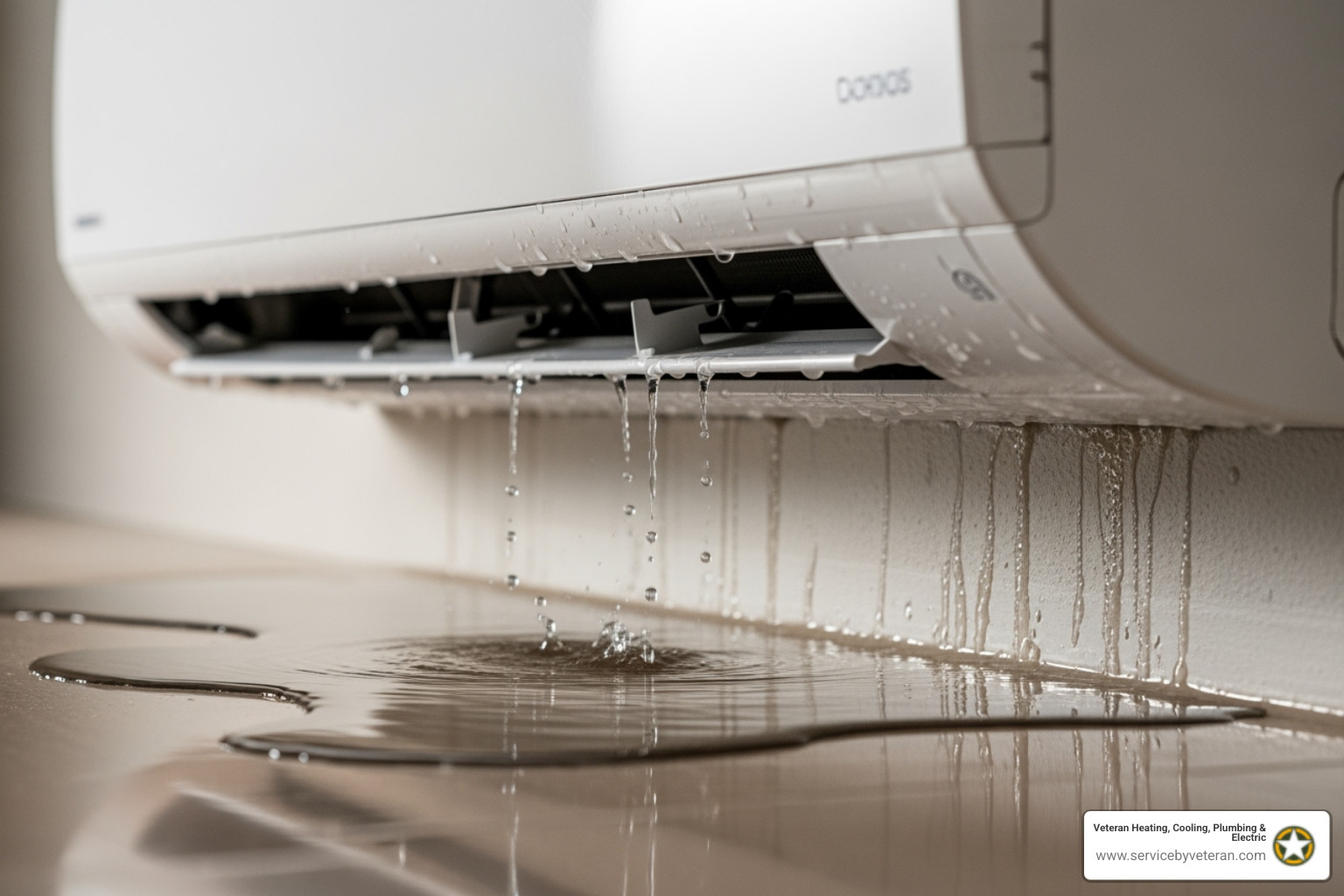
Watch for these common warning signs that your system needs attention: You might notice inconsistent temperatures where one room feels like the Arctic while another is tropical. Strange noises—grinding, hissing, buzzing, or clanking—are your system's way of saying something's not right. Leaking water from your indoor unit is another red flag you shouldn't ignore.
Your energy bill can also tell you a story. If you see a sudden spike without changing how you use your system, it's working harder than it should. Frequent cycling (turning on and off repeatedly) means your mini split is struggling. Unresponsive controls where your remote or thermostat stops working properly signal electrical issues. And trust your nose—bad odors from your unit are never a good sign.
Lack of Cooling or Heating
When your mini split stops doing its primary job—keeping you comfortable—it's time for mini split repair. This is the most obvious sign something's wrong, but it can show up in different ways.
Maybe your system runs constantly but never quite reaches the temperature you set. You hear it working away, but your home stays stuffy in summer or chilly in winter. Or perhaps you notice weak airflow coming from the unit, barely enough to feel when you stand near it. Sometimes you get no airflow at all, even though the unit appears to be running.
The worst scenario? Your system won't turn on at all, leaving you completely without heating or cooling when you need it most.
These performance issues usually point to specific problems. A dirty air filter is often the culprit—it restricts airflow and makes your system work overtime for minimal results. Low refrigerant from a leak will prevent your mini split from transferring heat effectively. Electrical problems or a malfunctioning sensor can stop the unit from operating entirely.
Whatever the cause, a mini split that can't heat or cool your home needs professional attention. This isn't something that fixes itself—it only gets worse.
Visible Issues and Strange Smells
Sometimes your mini split shows you exactly what's wrong. Ice buildup on your indoor evaporator coil or even on your outdoor unit is a clear sign of trouble. You might see frost forming on the copper lines or ice coating the coils themselves. This usually happens when airflow is restricted (hello, dirty filter) or when refrigerant levels drop too low.
When that ice melts—and it will—you'll likely end up with water leakage from your indoor unit. Water dripping down your wall or pooling on the floor isn't just annoying; it's a sign that your drain line is clogged or your drain pan is damaged. The condensation your system produces needs somewhere to go, and if it can't drain properly, it's going to find its own way out.
Then there are the smells. A properly functioning mini split shouldn't smell like anything at all. A moldy or vinegar smell tells you moisture is building up inside the unit where it shouldn't be. This often means fungal growth in the drain pan or on the coils—not something you want to breathe in. These odors can also point to a clogged condensate line that needs clearing.
A burning smell demands immediate attention. This could mean faulty wiring, an overheating motor, or other electrical issues that pose safety risks. Don't wait on this one—turn off your system and call for help right away.
These visible problems and strange odors aren't just unpleasant. They're your mini split's way of asking for help before things get worse. Catching them early means simpler, less expensive repairs and a system that keeps working reliably for years to come.
Common Problems and What Causes Them
When your mini split isn't working right, it helps to understand what's actually happening inside that sleek unit on your wall. Think of your mini split as a heat shuttle service—it doesn't create cold air, it moves heat from one place to another. The outdoor unit and indoor unit work together, connected by refrigerant lines that carry a special fluid back and forth. In summer, it pulls heat from inside your home and dumps it outside. In winter, it does the reverse. Pretty clever, right?
But here's the thing: this neat dance depends on several components working in perfect harmony. When one part stumbles, the whole system suffers, and that's when you need mini split repair.

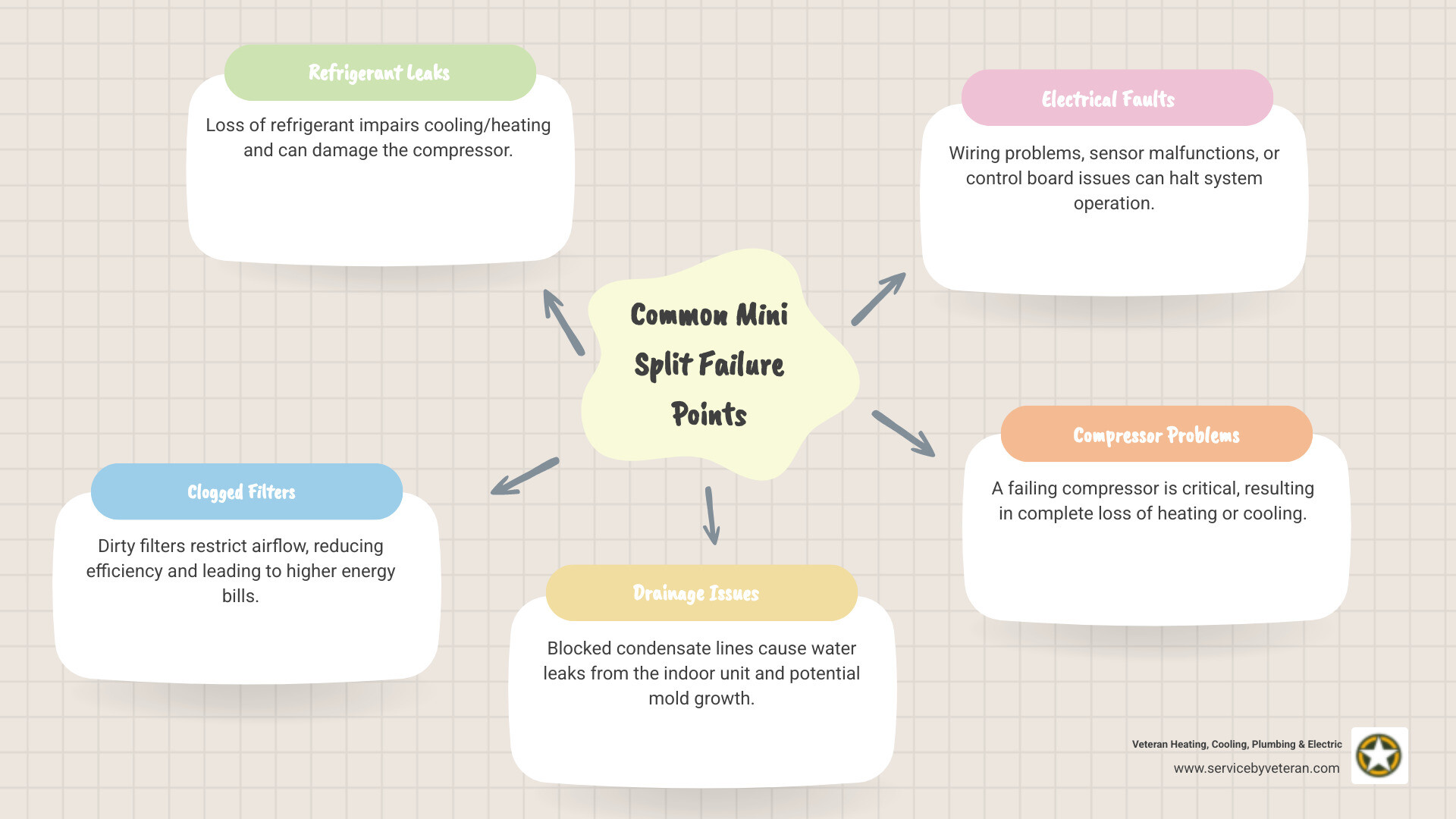
The usual suspects behind mini split problems aren't mysterious. Refrigerant leaks top the list—without enough refrigerant, your system simply can't move heat effectively. Clogged filters might sound minor, but they're like trying to breathe through a pillow; your system works overtime and still can't deliver. Electrical problems can shut everything down in an instant, from a tripped breaker to faulty wiring. The compressor, which is basically the heart pumping refrigerant through the system, can fail after years of faithful service. Sensor malfunctions confuse the system about what temperature it should be maintaining. And drainage issues are behind most of those frustrating water leaks you might see.
Here's what ties many of these problems together: neglect. Skipping regular maintenance is like never changing the oil in your car—eventually, something's going to give. Small issues become big ones, and a system that could have lasted fifteen years might struggle to make it to ten.
Common Issues Requiring Mini Split Repair
Let's get specific about what actually goes wrong and why it matters. Dirty air filters are the number one preventable problem we see. When filters get caked with dust and debris, airflow drops dramatically. Your system compensates by running longer and working harder, which drives up your energy bills. Worse, restricted airflow can cause the evaporator coil to freeze solid. When that ice melts, you get water everywhere. According to the U.S. Department of Energy, cleaning filters can lower energy use by 5-15%—that's real money back in your pocket.
Low refrigerant is another serious issue, almost always caused by a leak somewhere in the system. You'll notice your mini split running constantly but never quite reaching the temperature you set. The indoor coil might develop ice buildup, and you could hear hissing or bubbling sounds. Refrigerant doesn't just "run out" like gas in a car—if it's low, there's a leak that needs fixing before we can recharge the system.
Clogged drain lines cause those alarming water leaks from your indoor unit. As your mini split cools your home, it pulls moisture from the air. This condensation collects in a drain pan and should exit quietly through a drain line. But algae, mold, and debris love to grow in these damp, dark lines. When the line blocks, water backs up and overflows, potentially damaging your walls, floors, and ceilings.
The control board acts as your system's brain, managing every operation from temperature control to defrost cycles. When it fails, symptoms can be baffling—the unit might not respond to your remote, cycle on and off randomly, or refuse to start at all. Control board issues often require professional diagnosis because they can mimic other problems.
Compressor issues represent one of the more serious failures. This component circulates refrigerant through the entire system, and when it fails, you lose all heating and cooling capacity. Compressors can fail due to electrical problems, refrigerant issues, or simply wearing out after years of service. Because compressor replacement represents a significant repair, we'll always help you weigh the cost against the age and condition of your system.
Sensor malfunctions might seem minor, but they can make your home uncomfortable. Temperature sensors tell the system when to run and when to stop. A faulty sensor might cause your mini split to short-cycle (turning on and off rapidly) or run continuously without ever satisfying the thermostat.
Finally, a blocked outdoor unit can cripple your system's performance, especially in heating mode. That outdoor unit needs clear airflow to exchange heat with the outside air. When leaves, snow, cottonwood fluff, or other debris blocks the unit, it can't do its job efficiently. We see this frequently in Denver's changing seasons.
Understanding Single-Zone vs. Multi-Zone System Failures
Not all mini split systems are created equal, and understanding whether you have a single-zone or multi-zone setup helps us diagnose problems faster—and helps you understand what's happening in your home.
With a single-zone system, you've got one outdoor unit connected to one indoor unit. It's straightforward: if something goes wrong, the problem lies with one of those two units or the refrigerant lines connecting them. Diagnosis is relatively simple because there are fewer variables. If your bedroom mini split isn't working, we know exactly where to look.
Multi-zone systems are more complex and more interesting. One powerful outdoor unit serves multiple indoor units, each controlling a different room or zone in your home. This setup gives you incredible flexibility—your teenager can keep their room arctic while you enjoy cozy warmth in the living room. But this complexity means mini split repair requires more detective work.
When only one indoor unit acts up while the others work fine, we're usually looking at an issue specific to that zone. It could be that unit's control board, a sensor problem, or a blockage in its individual refrigerant line. But when all your indoor units fail simultaneously, that's a different story—the shared outdoor unit is probably the culprit. A compressor failure, major refrigerant leak, or electrical fault in the outdoor unit affects every zone at once.
Zone control problems can be frustrating. Each indoor unit has its own thermostat or remote, giving you independent temperature control for each space. If one zone won't heat or cool properly while others perform perfectly, we know to focus on that specific indoor unit rather than the outdoor equipment. It's like having one light switch that doesn't work while the rest of your home's lights are fine—the problem is local, not system-wide.
The shared outdoor unit is the linchpin of a multi-zone system. Because all indoor units depend on it for refrigerant circulation and compression, any major problem there ripples through your entire home. This makes the outdoor unit our first checkpoint when diagnosing widespread issues in multi-zone systems.
Our team brings this diagnostic expertise to every call, whether you're in Centennial, Highlands Ranch, or Parker. We understand these systems inside and out, which means we can pinpoint problems quickly and get your comfort restored without unnecessary guesswork or wasted time.
DIY Troubleshooting vs. Professional Mini Split Repair
When your mini split starts acting up, your first instinct might be to grab your toolbox and tackle the problem yourself. And honestly? Sometimes that's exactly the right move. A few simple checks can often restore your system to perfect working order, saving you time and money. But here's the thing: mini split repair isn't always a DIY-friendly project. Some issues require specialized training, tools, and certifications that only professional technicians possess.
Think of it this way: you wouldn't perform surgery on yourself just because you have a first-aid kit, right? The same principle applies to complex HVAC repairs. Attempting repairs beyond your expertise can be dangerous, potentially void your warranty, and—ironically—turn a small problem into an expensive disaster. That said, there's plenty you can safely check before calling in the pros.
We understand that HVAC emergencies don't follow a 9-to-5 schedule. That's why our 24 Hour HVAC Repair service is always ready when you need us most, whether you're in Denver, Lakewood, or anywhere in our service area.
Simple Fixes You Can Try First
Before reaching for your phone, try these straightforward troubleshooting steps. They're safe, simple, and surprisingly effective at resolving common mini split hiccups.
Start with the power supply. Make sure your unit is actually plugged in—it happens more than you'd think! Then head to your electrical panel and check if the circuit breaker has tripped. A flipped breaker is one of the easiest fixes you'll ever make.
Try resetting the system. Just like your smartphone occasionally needs a reboot, your mini split can benefit from a fresh start. Turn off the unit, either by unplugging it or switching off its dedicated circuit breaker. Wait a full ten minutes—this gives the system time to fully reset—then restore power and turn it back on. This simple step can clear minor electronic glitches that cause erratic behavior.
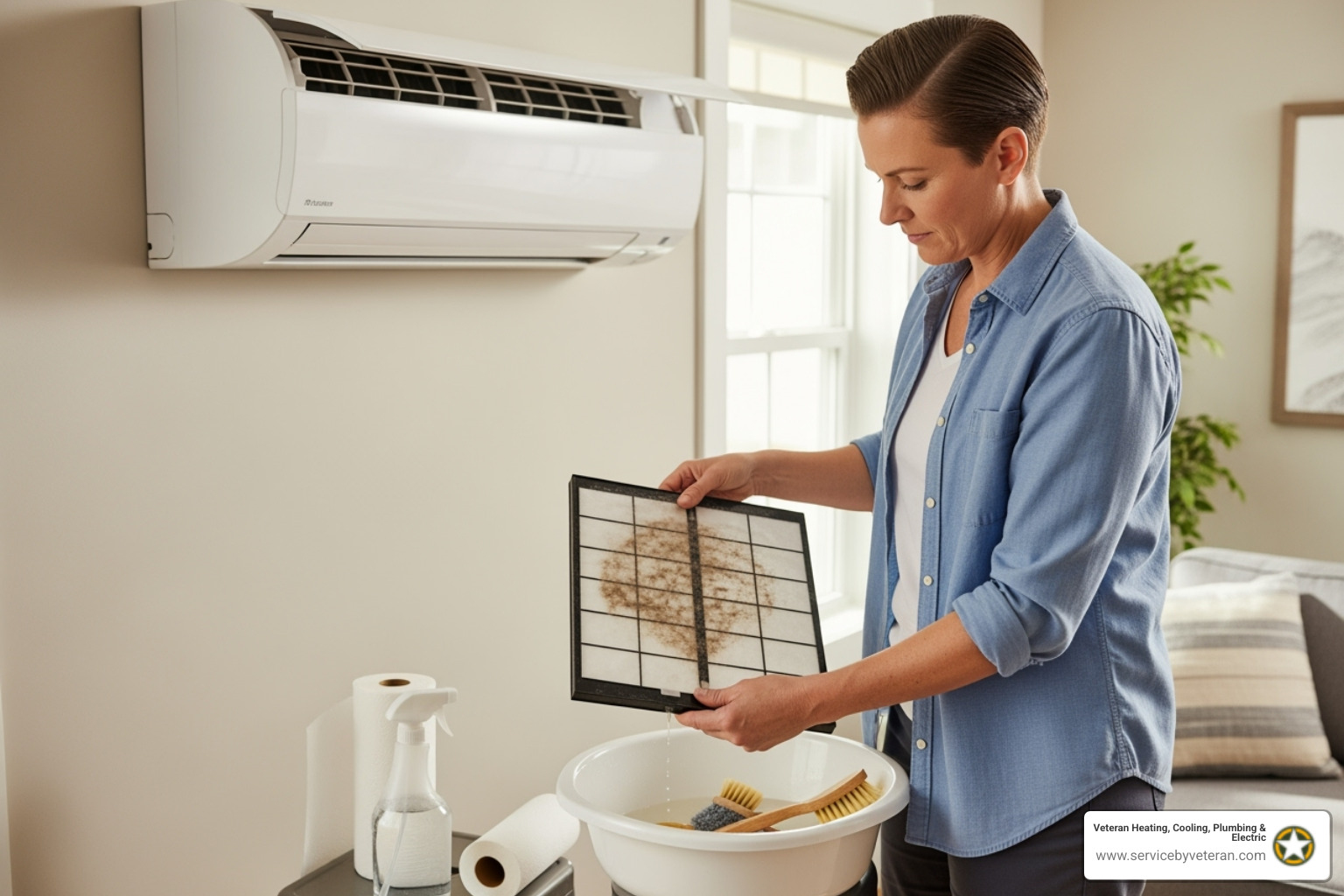
Clean those air filters. This might be the single most important maintenance task you can perform. Dirty filters are behind countless mini split repair calls, yet they're incredibly easy to address. Pop open your indoor unit, slide out the filters, and hold them up to a light. If you can't see light passing through, they're overdue for cleaning. Rinse them gently with lukewarm water and a bit of mild soap, let them dry completely, and reinstall. According to the U.S. Department of Energy, this simple task can lower your system's energy consumption by 5% to 15%.
Check the outdoor unit. Step outside and take a look at your condenser. Is it buried under leaves, grass clippings, or snow? Clear away any debris and make sure there's at least two feet of open space around the entire unit. Your system needs breathing room to function efficiently.
Replace the remote batteries. Yes, it's almost embarrassingly simple, but dead batteries cause a surprising number of service calls. Pop in fresh batteries and make sure nothing is blocking the signal between your remote and the indoor unit's receiver.
Double-check your settings. Sometimes the problem isn't a problem at all—just an accidental setting change. Verify that your thermostat is set to the correct mode (heating or cooling) and that the temperature setting makes sense for what you're trying to achieve.
When to Call a Professional Technician
While DIY troubleshooting has its place, certain situations absolutely require professional expertise. Knowing when to stop and call for help isn't admitting defeat—it's making a smart decision that protects your safety, your system, and your wallet.
Refrigerant leaks demand immediate professional attention. If you notice reduced cooling power, ice forming on refrigerant lines, or hear a hissing sound from your system, you likely have a leak. Refrigerant isn't just expensive—it's a hazardous substance that requires special handling. The U.S. Department of Energy advises that refrigerant leaks should always be fixed by a certified technician. Attempting to handle refrigerant yourself is dangerous, illegal in many jurisdictions, and can cause serious environmental harm. This is exactly the type of work our certified technicians handle safely and effectively.
Electrical problems are nothing to mess with. You can check a tripped breaker, but anything beyond that—faulty wiring, blown internal fuses, sparking components, or that terrifying burning smell—requires professional intervention immediately. HVAC electrical systems are complex and powerful. Working on them without proper training can result in serious injury or even death. It's simply not worth the risk.
Compressor issues spell big trouble. The compressor is essentially your system's heart, and when it fails, you're looking at complete loss of heating or cooling. If you've ruled out simpler problems like dirty filters or tripped breakers, but your system still won't heat or cool, the compressor might be failing. These repairs are complex, expensive, and absolutely require a qualified technician's expertise.
Persistent strange noises or odors won't fix themselves. An occasional settling noise is normal, but ongoing grinding, clanking, or buzzing sounds indicate mechanical problems. Similarly, if you're experiencing unusual odors that don't go away after cleaning your filters, something more serious is happening inside your system. These symptoms require professional diagnosis with specialized tools.
Ongoing water leakage needs expert attention. You've cleaned the filters, you've checked for obvious drain line blockages, but water keeps pooling around your indoor unit. This suggests a more complex issue—perhaps a cracked drain pan, a severe internal clog, or even a frozen coil that's now thawing. Our technicians have the specialized tools and experience to identify and fix these problems properly.
Error codes are your system's cry for help. Modern mini splits display diagnostic codes when something goes wrong. While your owner's manual might offer basic explanations, these codes often point to internal malfunctions that require professional diagnostic equipment to properly address. Don't ignore them hoping they'll go away.
Attempting repairs beyond your skill level can void your warranty, create safety hazards, and transform a manageable repair into a system replacement. When you're facing any of these serious issues, reach out for professional AC Repair Near Me. Our team proudly serves Castle Rock, Erie, Fort Collins, and communities throughout the Front Range, bringing military-grade precision and hometown service to every mini split repair we perform.
The Professional Repair Process: What to Expect
When you call Veteran Heating, Cooling, Plumbing & Electric for mini split repair, you're not just getting a quick fix; you're getting a comprehensive, disciplined approach to restoring your home's comfort. We understand that inviting someone into your home for repairs requires trust, and we aim to earn that trust with every visit.
Our process begins with a scheduled technician visit at your convenience. Our certified HVAC technicians, drawing on years of experience, will arrive equipped with the necessary tools and diagnostic equipment to thoroughly assess your mini split system. We start with a detailed system diagnosis, carefully inspecting both your indoor and outdoor units, checking electrical connections, refrigerant levels, air filters, drain lines, and all critical components. We'll use specialized tools like digital manifold gauges and infrared thermometers to pinpoint the exact cause of the malfunction.
We believe in transparent pricing and clear communication. Before any work begins, our technician will provide you with a clear explanation of the problem, the recommended mini split repair solutions, and an upfront estimate of the costs involved. There are no hidden fees with us. We use only quality parts for all repairs, ensuring the longevity and reliability of your system. And because we stand by our work, all our services come with robust service guarantees, including a lifetime warranty on parts and labor and a money-back guarantee. Your satisfaction isn't just a goal; it's our promise.
Estimating the Cost of Mini Split Repair
Understanding the potential costs involved in mini split repair can help you make informed decisions. While every repair is unique, some common issues have a typical cost range.
As mentioned in our introduction, fixing a refrigerant leak, which often includes leak detection, refrigerant recharge, labor, and any necessary parts, typically costs between $300 to $1,000. This variability depends on the severity of the leak, the amount of refrigerant needed, and the specific parts required.
Beyond leaks, the cost for routine mini split heating and cooling system maintenance, which is crucial for preventing major repairs, can range between $125 - $400. This usually covers cleaning, inspections, and minor adjustments.
Diagnostic fees are also common. Many companies charge a service call fee to cover the technician's time and travel to assess the problem. This fee is often waived or applied towards the total cost of the repair if you proceed with the recommended service. The overall cost of a mini split repair will be a combination of parts and labor, with more complex issues like compressor replacement naturally incurring higher costs due to the specialized components and extensive labor involved.
Is It Better to Repair or Replace Your Mini Split?
This is a question many homeowners grapple with when facing a significant mini split repair. The decision to repair or replace often depends on several factors, and there isn't a one-size-fits-all answer.
| Criteria | Repair [IMAGE] for the mini split repair (from the intro) will need to be added.This was a long one, so I'll need to pace myself and ensure I cover all points.I also need to ensure all the internal and external links are included.I'll need to keep an eye on the word count carefully.
Let's do this.
ABOUT Veteran Heating, Cooling, Plumbing & Electric
Veteran Heating, Cooling, Plumbing & Electric was founded on the belief that service should be personal, honest, and community-focused. Our team is built around integrity, professionalism, and a true commitment to your home’s comfort and safety.
Led by a U.S. Army veteran with over 30 years of industry experience, we’re proud to remain locally owned and operated. Every technician, plumber, and electrician is EPA-certified, background checked, and driven to exceed expectations.
- 24/7 ServiceWe offer weekend & 24/7 emergency service. We’re here whenever you need us—day, night, or weekend, no exceptions.
- $0 Trip FeesNo dispatch or trip fees. You’ll never pay just for us to show up—service starts when the work does.
OUR SERVICES
AIR CONDITIONING
.jpg)
We offer specialty and seasonal services like indoor air quality upgrades, pre-winter furnace checks, and summer AC tune-ups to keep your home prepared year-round.
Our Primary Air Conditioning Services Include:
Don't see the service you need? Call our Team today!
PLUMBING
From leaks to full system installs, our plumbing services cover everything you need for a safe, reliable home water system, 24/7.
Our Primary Plumbing Include:
- Water Heater Replacement
- Water Heater Repair
- Trenchless Sewer Line
- Water Filtration
- Slab Leak
- Sewer Line Repair
Don't see the service you need? Call our Team today!
ELECTRICAL

Our electrical services ensure your home stays safe and powered, from routine fixes to complete system upgrades.
Our Primary Electrical Services Include:
- House Rewiring
- Electrician
- Electric Panel Upgrade
- Electric Panel Replacement
- EV Chargers
- Whole House Generator
Don't see the service you need? Call our Team today!
HEATING
.jpg)
We install, repair, and maintain heating & furnace systems with expert care to keep your Colorado home comfortable and energy-efficient year-round.
Our Primary Heating Services Include:
- Heating Installation
- Heating Replacement
- Heating Maintenance
- Heating Repair
- Heating Service
- Heating Tune-Up
Don't see the service you need? Call our Team today!